How Victor Hugo Used Sex to Fight Injustice
June 3, 2026
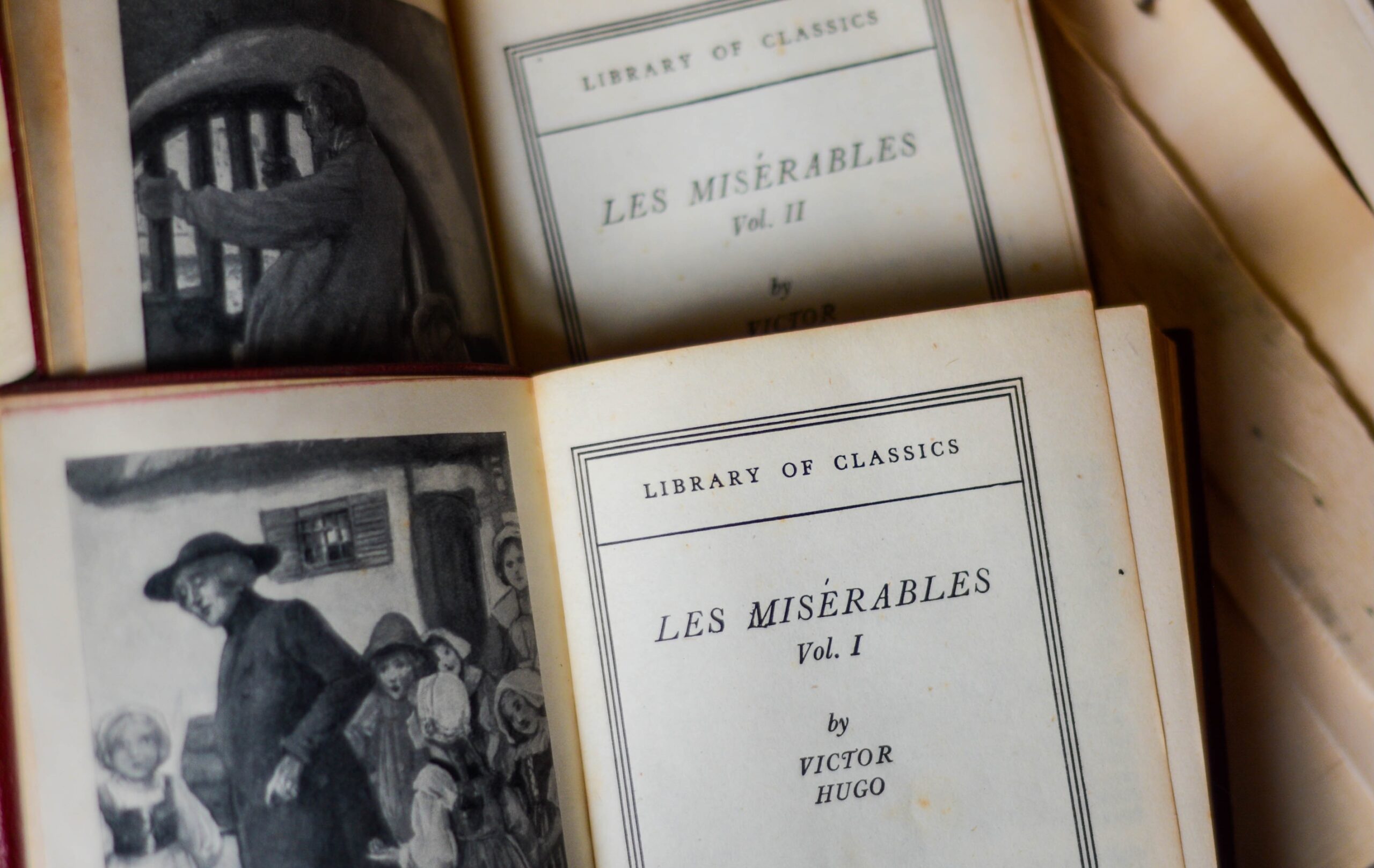
Every time I read the news, I hear a faint, French-accented cry: To the barricades!
Then I wonder what counsel Victor Hugo would give us.
The burning accusations in Les Misérables, his most famous and wildly popular work,drew so much attention that the National Assembly of France was forced to put them on its agenda. Meanwhile, Hugo was helping loosen and enliven the future of French literature. Flaubert resisted, saying the novel held “neither truth nor greatness.” Baudelaire called it “repulsive and inept.” Hugo said there were 740 attacks on the book in the Catholic press—not that he was counting.
Nonetheless, he had been heard.
You would think a man so exuberant and so scattered—he was also a beloved poet and playwright, and he sketched and painted more than four thousand works—would dissipate his own impact. But Hugo could animate and choreograph words, and above all, he knew how to dramatize contrast. In his art, he used ink, coffee, and soot to darken moody backgrounds. In his literature, he exposed the extremes of wealth and poverty we are fast coming to recognize. He was also willing to contrast good and evil, as those on the right do readily (though I seldom agree with their definitions). Uncomfortable with organized religion’s exclusions, the left shuns such categorical pronouncements—only to wind up sounding wishy-washy.
Ah, but Hugo. Liberal in politics and imagination, he was bold, sure of himself, freely emotional. He wrote, painted, felt, and acted upon his passions—some of them altruistic and idealistic, others purely carnal.
He claimed, for example, that on their wedding night, he and Adele Fouchard had sex nine times. He was also fascinated by his own conception, guessing at its date—24 June 1801?—and using 24601 as his character Jean Valjean’s prisoner number. His parents both had affairs. He had many, two of them notable. First was Juliette Drouet, who copied out and proofread his manuscripts, and who stayed with him for fifty years—often fuming with jealousy over his other encounters. “She is my widow,” he announced to his children, demanding their respect for her, though he had not married Juliette after his wife died. Overlapping was a seven-year affair with travel writer and Arctic explorer Léonie d’Aunet Biard, whose husband finally brought a police officer to the Paris hotel and caught them in flagrante. Hugo, a member of the Chamber of Peers, avoided consequence; Léonie spent two months in prison and six in a convent.
I was happy to learn that Adele had her own affair, with a literary critic and poet who was one of Hugo’s close friends. Already loose with his own vows, Hugo sensed the flirtation and was enraged by it. By the time Adele’s affair ended, he had taken up with Juliette. Et alia.
Hugo’s writing was far more prim than his life, yet he felt sure that sex invigorated his talent. “Imagination,” he once remarked, “is intelligence with an erection.”
Pleasure did not, however, blind Hugo to injustice. He fought for the abolition of both slavery and the death penalty. Appalled by Napoleon III’s coup, he went into exile in the Channel Islands. From there, he smuggled anti-Napoleon treatises through French territory, hiding them in sardine tins, bales of hay, and even busts of the emperor himself.
All in all, Hugo lived a full and robust life, though in his seventies, he was tested severely. In 1871, he had to grieve the death of one of his sons; in 1872, he had to watch his daughter Adele be placed in an insane asylum (later inspiring The Story of Adele H.); in 1873, his other son died. In 1878, Hugo suffered a mild stroke and wrote very little thereafter.
Still, he was resilient—and beloved. In 1881, to celebrate his eightieth birthday, France presented him with one of the Sevres vases traditionally given to kings. The parade stretched from his home on the Avenue d’Eylau down the Champs-Elysées all the way to the center of Paris. More than 600,000 people poured into the streets, and children’s school punishments were canceled for the occasion. It is said that the guides wore cornflowers, a nod to Fantine’s lullaby to her daughter in Les Misérables. The Avenue d’Eylau was renamed Avenue Victor-Hugo, and letters were soon addressed “To Monsieur Victor Hugo, in his avenue, Paris.”
Victor Hugo died on May 22, 1885. He was eighty-three. Havelock Ellis wrote that “he slept like a child; he rose at six and was able to begin work at once, and it was no fatigue to him to write standing. He ‘ate like an ogre,’ enormously, miscellaneously, and rapidly, yet he never suffered from indigestion; his teeth could crush peach stones. His beard, said the barber, was three times tougher than anyone else’s and destroyed all the razors. His eyesight was so keen that he could recognize friends from the top of Notre Dame.”
The night of his death, he whispered an alexandrine, “En moi c’est le combat du jour et de la nuit.” He felt day and night doing battle within him.
Hugo had asked for a pauper’s funeral. Instead, he was awarded a state funeral, the largest in French history. (Grumpy Nietzsche called it a “veritable orgy of bad taste.”) More than two million people joined the funeral procession from the Arc de Triomphe to the Pantheon, where his pauper’s coffin shares a crypt with the more plushly encased skeletons of Alexandre Dumas and Emile Zola. Brothels closed for a day of mourning—Hugo had been, after all, an excellent customer from his youth until weeks before his death. He had shown the sex workers courteous respect, and his humane portrayal of Fantine endeared him to them. Literary critic Edmond de Goncourt recorded a bit of gossip from one of the gendarmes, who said the women had draped their intimate parts in black crepe in Hugo’s honor. Apocryphal, perhaps. But what a marvelous yardstick for an immeasurable passion.
Hugo is venerated as a saint in the Vietnamese religion of Caodaism. A crater on Mercury was named for him. If we are to fight his sort of fight for justice, we cannot be mumbly, timid, stingy, or cold. We will need, if not all that illicit sex, at least the passion he threw into it.