Board Games and Human Nature
Why we still play them in our digital age.
July 4, 2026
You have discovered PiecesSTL, a board-game café in an old brewery that turned into a jail during Prohibition. Behind bars, you sweep aside your sweating beer steins and lay out eight rows of meeples: British and French officers eager to decimate each other. You are playing Stratego—your husband’s nostalgic pick, because he played it back when Jimmy Carter was president. Games are piled on your table, and while you wait for him to re-read the rules, you rummage wistfully through the watercolor beauty of Wingspan. But Stratego winds up taking all evening, because in spite of yourself, you sink into its world. Where shall you send your spy? Who can protect your French flag?
Board games fell asleep in our 1970s rathskellers while technology distracted and divided us. Now they are cool again: a way to touch, if not grass, then cardboard and painted wood, and the damp outstretched hand of the friend you just beat to smithereens. Nobody checks their phone during a good board game. Nobody even remembers they have a phone. You are living in a French castle in the Renaissance, or bidding on modern art in London, or fighting aliens….
At the moment, I am pondering an attack on the British. After three decades of marriage, we know not to rush each other. I hide a grin, seeing Andrew’s captures (my people!) lined up in a neat military row. Mine are mingling like this is a good cocktail party, a few tipsy, one knocked flat. I lose, of course, but then comes that tiny thrill as we set up the board again, fresh and ready, a guarantee that anything can happen.
Next time, we will play Wingspan, Elizabeth Hardgrave’s quiet masterpiece. Sick of colonialist clashes, she took her love of birdwatching and data from Cornell’s ornithologists and designed a game with beautiful watercolor images of, say, the Yellow-Bellied Sapsucker, or the Regent Honeyeater, or the Indigo Bunting. You must attract them to your wildlife preserve with the right food and habitat. The New Yorker called the game “slyly cooperative”: some birds actually collect food for everyone, and working together as conservationists, you are all making sure everyone thrives in the right habitat. Published by St. Louis’s Stonemaier Games, Wingspan is one of the highest-selling Eurostyle board games of the past decade. Another couple is eyeing our box.
Nobody even remembers they have a phone. You are living in a French castle in the Renaissance, or bidding on modern art in London, or fighting aliens….
On the weekends, our server tells us, the crowd is college-age or in their twenties; some people choose this place for a first date, knowing the style of play will be revelatory. During the week, people often stop by after work for a quick dinner, drink, and card game. Sunday brunch draws families. Regulars come once a month and play all day or all night. One couple set a record, showing up at 10 a.m. opening on a Saturday and playing, presumably with bathroom breaks, until 1 a.m. close on Sunday.
What are these games doing for us, other than reviving pure imagination? They are an outlet for murderous impulses, made safe because the victims are plastic meeples. They are wish fulfillment, an hour or two spent living a far cooler life. Dutch historian Johan Huizinga pronounced them a civilizing force, teaching restraint, strategy, patience, sociability, and sportsmanship.
But they also absorb, madden, and addict us.
What is clearest is that board games are not a pointless, childish irrelevant waste of time. They are profoundly serious. Without any of the usual incentives—pay, fame, glory—we leave our everyday lives and enter a shared symbolic world. Slowly, we begin to fathom its ways, learn its quirks, and master its challenges. Or laugh trying. Beneath the fun, we are learning what we are capable of, what fate can do to us, what skill can retrieve—and how the real world works. We can take safe risks, experiment, learn from each outcome. Anticipation splashes us with dopamine, rewarding the play. Points and captures and wins continue the reward. Now add the joy of immersion, that clean, intense focus its own reward.
Playing has to be pointless. Give it utility, and you destroy the fun. But lean close and I will whisper the secret rationale: games teach us human nature. Our own, and everybody else’s. We learn to manage stress, regulate emotions, navigate social hierarchies.
Now, forget you know that, so you can play.
“Muggles are buying tickets to Hogwarts”
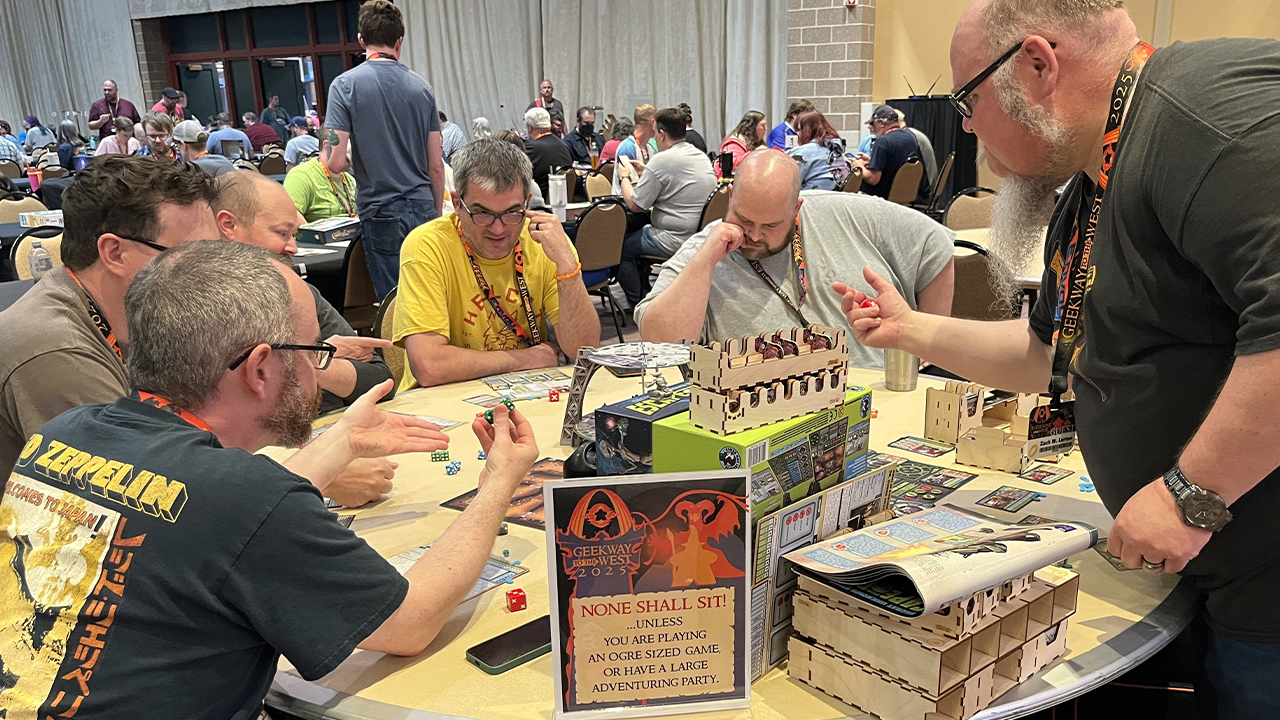
You show up at Geekway St. Louis—not the big annual con, just a small winter placeholder, yet hundreds of people are pouring in. These are the folks who haunt board-game cafés, follow gaming influencers, watch games played on YouTube, collect compulsively…. They arrived at sunup and waited an hour to get in; now they will play till they turn into pumpkins. The object is to meet as many like-minded players and play as many games as you can before the con ends.
I feel my spirit lighten. I have never played enough games. Only children have no built-in partners. There was Go Fish with my mom, which even then I knew was lame, then The Dating Game with my friends, tugging on that plastic doorknob with thrilled dread. In books, people played Charades, but my eager suggestion always fell flat. In adulthood, I loved Scruples, but guessing their ethics seemed to make our friends nervous. Not until Cards Against Humanity did I truly have fun.
My appointed guide at Geekway, Mark Finefield, had a little brother to play with. Except: “I’d try to read the rules to him, and I’d get half a page in and he’d say, ‘Let’s play!’ So we would, and something would come up and he’d say, ‘You didn’t tell me!’” Finefield sighs. “I have a T-shirt that says, ‘I read the rules, so you don’t have to.’”
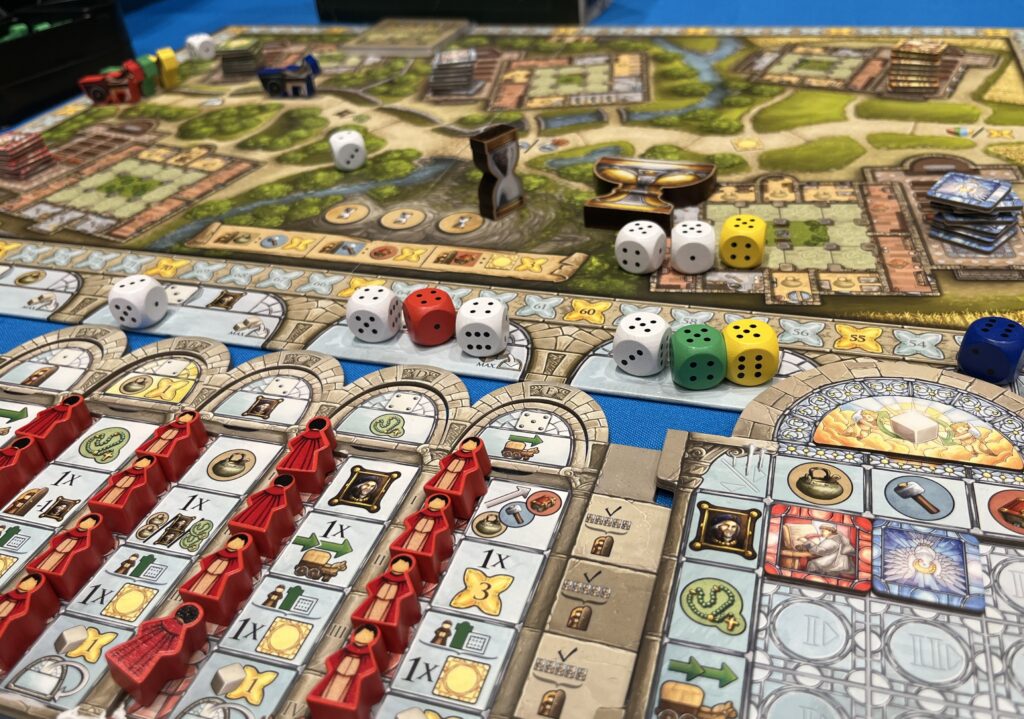
He shows me around a vast room of circles: groups seated at round tables and hunched forward, already deeply immersed. Then he leads me to a room lined with games. Dork that I am, I linger over Monasterium, in which you send your novices to various cathedrals to help complete their stained-glass windows. Then Petrochor, which tells me I am a cloud, competing with other clouds to manipulate the weather and green the world. Finefield points out the expansion games, in which you keep buying new packs, but I like my fun contained and reliable.
Playing has to be pointless. Give it utility, and you destroy the fun. But lean close and I will whisper the secret rationale: games teach us human nature. Our own, and everybody else’s. We learn to manage stress, regulate emotions, navigate social hierarchies.
Fantasy games tumble from crammed shelves. Escape from current realities? In part, he says, but there is also “some aspect of being able to control your own destiny. Becoming so powerful that no one can tell you what to do. Society has shifted: everybody thinks they are the center of the story. And in the fantasy world, they are.” Luckily, you can be your own hero and still be sociable. Will Wheaton (Wesley Crusher in Star Trek: The Next Generation; himself on The Big Bang Theory) hosted a web series called TableTop for years. “We live in a time where our entire world is so divided, it’s almost balkanized,” he told The Guardian. “When I hear games are selling out all over the place, that thrills me…. It’s like Muggles are buying tickets to Hogwarts.”
The renaissance started in 1993, when Magic: the Gathering spread itself across the nation’s tabletops. A few years later, the new Eurogames flew across the ocean. These games did not hinge on random dice rolls or high-conflict bloodlust; instead, they were thoughtful, requiring cooperative strategy and deft resource management. Elegant rules, beautifully designed boards, and for the meeples (moving pieces), plump little wooden figures in lieu of plastic pawns. Best of all, these games did not last for hours, and nobody had to sit on the sidelines, eliminated in the first round.
The contrast stung, and U.S. games were quickly branded “Ameritrash.” Then U.S. designers caught up to the new philosophy, higher standards, and ethical nuances. Like comic books and animation, board games became more artful, more expensive, more interesting to adults. For millennia, games had been folk culture, passed down for generations, the play communal. Now they are a craft, sometimes even an art, designed and authored, often with a deliberately niche appeal.
Guides abound: How to Find the Right Game for You. Do you like to build, engineer, create, guess, detect, strategize? What eras and places intrigue you? How territorial are you? Do you mind having your fate left up to chance and insist on relying on skill? Do you push your luck or guard your treasure? Are you the suspicious type, finding it easy to speculate about which comrade is secretly the werewolf or the Nazi sympathizer? Would you rather collaborate, defeating evil together? How silly do you want to be?
There is a game about cheesemaking. There are Mafia games and Moroccan tile games and farming games. Does any realm of life not lend itself? Urban development, politics, finance, fantasy, scientific inquiry, detection, war, art, religion…they can all be set up on a board.
Remember when board games were simple? Mickey Mouse Clubhouse. The Happy Little Train Game. Mr. Doodle’s Dog, before dogs were doodles. Today’s players have far more choices, and they can make more meaningful decisions, all within sophisticated and meticulously rendered worlds. Rulebooks are often thick—more than two hundred pages for Campaign for North Africa, which can take a thousand hours (literally) to complete. In High Frontier 4 All, you must manage complex rocket design, manufacturing, and interplanetary logistics. On Mars lets you build the red planet’s first colony, constructing intricate supply chains and making constant technology upgrades.
Beneath the mechanics, though, you are still making life’s usual decisions: buy, keep, take, save, wait, pounce, plan, risk, ignore, discard, exchange.
The passage
You live in a one-room house of sunbaked mud. In the distance, a half-built pyramid rises higher every month. This is the golden age of the Old Kingdom, and life is calm. Every day, you know how you must live, what you must do, whom you must obey. After dinner—bread and thick beer, fish cooked in onions and garlic—you sit on the cooling ground of the courtyard and toss four sticks of chance. The game is Senet, and for you, it is just a diversion. But by the time of the New Kingdom, it will be a sacred ritual, symbolizing your soul’s risky journey (“senet” means passing) through the underworld.
Tonight, you are racing against your brother, who has fewer pieces left on the game’s coiled path of numbered squares. Ha! He is forced to land in the water and must go backward many squares. Lucky you—because this is about luck, added to steady perseverance—your nearest piece sits safe on the House of Three Truths. All you need do is toss the sticks again and move it off the board into the Field of Reeds. Which is paradise.
Senet is at least five thousand years old. Many pharaohs, including Tutankhamun, were buried with Senet boards. One of his was an ebony-and-ivory travelling set, appropriate for his journey.
Our own board is pale wood, with black hieroglyphics. Tonight I am playing aggressively, indifferent to the Egyptian virtues of truth, justice, and purity. My husband is kinder; he plays the long game. But just when I am lulled, he begins capturing my pieces. Post-victory, he remarks that the game is “very Egyptian. There are limited rules, which makes it an easy game, as straightforward and uncomplicated as life in the Nile Valley. If you played by the rules, both physical and religious, you moved ahead. There was always bad luck, of course. But life was not Byzantine; people had no need to connive.”
He gives me a stern, over-the-spectacles look as he says this. My moves were perhaps a bit…fierce?
Nothing reveals you like a board game.
Coups and incest in Candy Land
Ten years old, you spend most of your time in an iron lung, staring at ceiling tiles that never change. There’s a sick lady in the polio ward, too: Eleanor Abbott. She’s a teacher, and she made up a keen game called Candy Land because she knew how bored you guys were. You go through a Peppermint Stick Forest and a sticky Molasses Swamp, and there’s a crooked old peanut brittle house, and a Lolli Pop Woods….it’s a blast. Ain’t hard at all—she says she wants it to be easy, so we can at least pretend we’re going someplace fun.
Later purchased by Milton Bradley, Miss Abbott’s Candy Land became the company’s best-selling game, elbowing even Uncle Wiggily aside. Over the years, though, the cast of candy characters had a few meltdowns. “Why was Plumpy removed from Candy Lane?” a Reddit user demands.
“Most likely, replacing scapegoat Plumpy with a matriarchal character [Mama Gingertree] was the result of recent developments in child psychology,” another user replies dryly. The replacement of Mr. Mint, back in 2010, was far more traumatic: he was supplanted by the Duke of Swirl, whom one commenter pronounced “a pompous fuck.”
Mr. Mint was hurriedly rehired. Milton Bradley no doubt remembered its debacle with Queen Frostine, who, “‘adrift on an Ice Cream Float in an Ice Cream Sea,’ was perhaps too reminiscent of a polar bear atop a melting ice cap in a warming world,” writes Elaine Mao. The queen was changed into a princess skating across Snow Flake Lake, “slimmed down and sexed up,” as another commenter puts it. “It’s unclear, though, why Frostine, previously Kandy’s wife, is now his daughter,” Mao adds.
The party of children, meanwhile, grew from two to four, to include kids of Asian and Black ancestry. Then all four kids vanished—a wishful end to identity politics?—and anthropomorphized sweets took their place. Players were now part of Candy Land, not just journeying through it.
There is a game about cheesemaking. There are Mafia games and Moroccan tile games and farming games. Does any realm of life not lend itself? Urban development, politics, finance, fantasy, scientific inquiry, detection, war, art, religion…they can all be set up on a board.
In 2013, King Kandy amassed a military of jellybean soldiers to safeguard his empire. It was, writes Mao, “the first and only time the game acknowledged the violent underpinnings of power.” Eight years later, Kandy is “in an interracial relationship with Frostine, who is Black and also no longer his daughter,” Mao reports. “Their daughter, Princess Lolly, is Asian.” Mr. Mint has been elected mayor, and his wheelchair doubles as a toboggan. The villain, Lord Licorice, has been disappeared. Frumpy Gramma Nutt has been supplanted by a soignée duchess. Scheduled for remediation, the molasses swamp was cleaned up and turned to chocolate. After entering politics, Mr. Mint became a clown.
Nothing reveals a culture like the evolution of its board games.
The Game of Life
It is 1780, and you are sipping absinthe in a Paris café, playing Le Nouveau Jeu de la Vie Humaine. With wry, mordant wit, you move through the stages of a man’s life. Voltaire waits for you in the last square, murmuring, “What a sad game of chance is the game of life.”
Ten years later, you have moved to London. A friend pulls out The New Game of Human Life, just published by an Act of Parliament. You shove aside your pint and squint at the board. It still moves from childhood to decrepitude (at sixty-one!) and dotage. But now it is a moral race, cheery for virtue. Land on The Negligent Boy, and you must sit out two rounds while The Assiduous Youth proceeds; The Complaisant Man remains twenty-six years old while the others play on. If you are drunk at sixty-three, you are sent back to childhood. If you are patient at sixty-eight, you shall be a Merry Fellow at eighty.
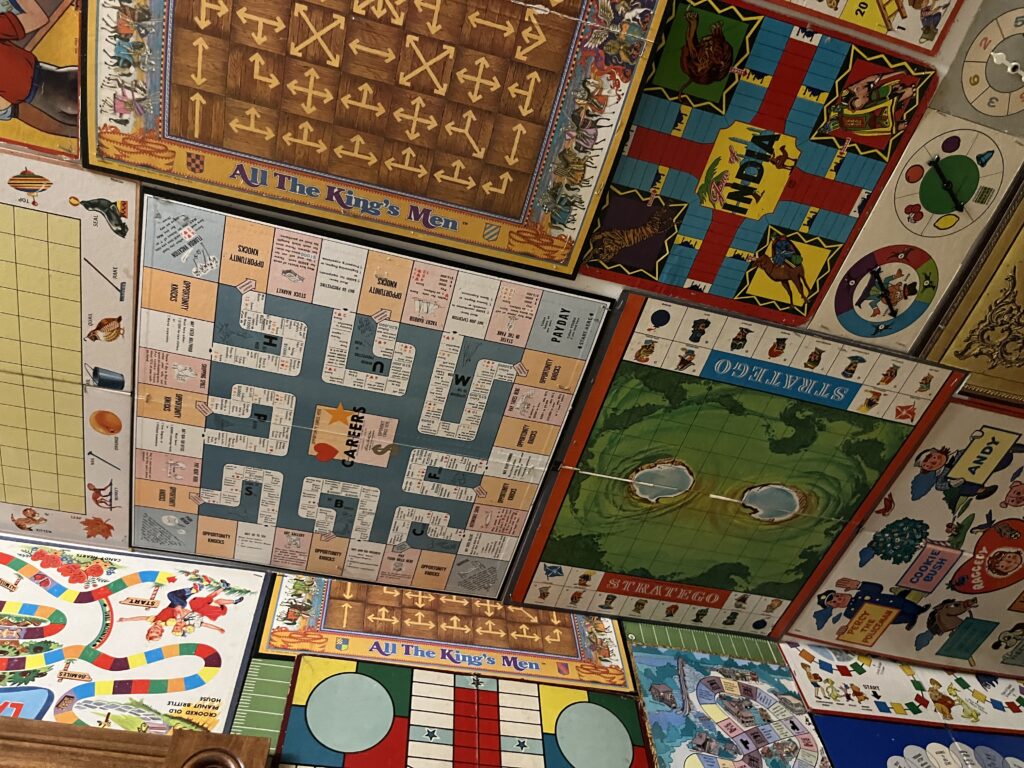
In 1860, a twenty-three-year-old lithographer called Milton Bradley recast the board as The Checkered Game of Life (this was America, after all). Virtue and vice mattered for the next century, but in 1960, the game became LIFE—where luck and cash, not character, made the difference. Little plastic station wagons carried plastic mommies and daddies with pink and blue plastic babies. A bank offered them cash, promissory notes, and stock certificates—which was necessary, because now you won by having the most money. People were playing the American dream.
By 2007, we had begun second-guessing that dream’s viability. Hasbro issued an alternative: The Game of Life: Twists and Turns. Money still mattered, but you had plastic, not cash, and you also earned points for experiences. Those points replaced the spinner, setting luck aside. You had multiple paths, tons of choices, a plethora of options—and no goal. Just “a thousand ways to live your life. You choose!”
In 2021, the original Game of Life loosened up, too. You can choose from lots of peg colors, not just a pink-and-blue pair. Paths branch. Marriage and family are optional, not assumed. Each life choice has its own trade-offs.
People play Life less often nowadays. Choices have exhausted us.
Monopoly was meant to shame what it became
In The Landlord’s Game, patented by Elizabeth Magie in 1903, the competition demonstrated the dire consequences of land-grabbing.
The game was later adapted, without credit to Magie, as Monopoly. Land-grabbing became the goal.
In 1972, John McPhee wrote his classic Monopoly essay, “The Search for Marvin Gardens,” for The New Yorker. He and a friend are longtime Monopoly rivals, and he switches back and forth between their game and a real-life hunt for one of the properties, Marvin Gardens. What he finds are Magie’s dire consequences: “The dogs are moving (some are limping) through ruins, rubble, fire damage, open garbage. Doorways are gone. Lath is visible in the crumbling walls of the buildings. The street sparkles with shattered glass.”
We can mythologize the American dream on cardboard, but it can be hard to locate in real life.
And the quest changes us.
Monopoly plays out the problems of capitalism, just as a slew of board games play out colonialism. Explore, settle, exploit—you find the same pattern in the beloved Puerto Rico game, in Mombasa (renamed Skymines), in Crowded Frontier, in Macao, in Maracaibo, in Vasco de Gama, in Goa, in Archipelago.
When psychology prof Paul Piff conducted his now-famous Monopoly experiment at the University of California-Berkeley, he rigged the game so half the players started out rich: double the starting cash, two dice instead of one, and they could travel the board in the Rolls Royce, not the dreaded shoe. In no time, they “started to move around the board louder, literally smacking the board with their piece,” Piff told NPR. They flashed more “signs of dominance and displays of power and celebration.” And by the end of the game, they were explaining their success as the result of their strategy and negotiating skill, not that lucky start.
Think for a minute about the reasons we all whine about Monopoly. Too much of your fate is up to a lucky or unlucky roll of the dice. Fall behind, and you have very few strategic options and very little chance of catching up. Once you are bankrupt, you are out of the game, watching the others have fun. Sound familiar? Monopoly plays out the problems of capitalism, just as a slew of board games play out colonialism. Explore, settle, exploit—you find the same pattern in the beloved Puerto Rico game, in Mombasa (renamed Skymines), in Crowded Frontier, in Macao, in Maracaibo, in Vasco de Gama, in Goa, in Archipelago. Always, the assumption is that to transform some wondrous new (to you) territory, you must destroy: slash the jungle, uproot what you consider weeds, kick out or subdue the natives, plunder the resources and sell them back home.
In Puerto Rico, the game lets you pretend the island is empty when the explorers arrive. In real life, you would have enslaved the residents and branded their foreheads with hot irons.
People still love these games. Critics enthuse about Puerto Rico’s clever mechanisms and depths of strategy. But the tide is turning. Maracaibo now has an expansion called The Uprising, in which you are an indigenous resident in colonial bondage, and you and your friends must work together to free your island from foreign rule.
Nothing reveals our history like our board games.
Lord of the games
Across the Atlantic, German game designer Reiner Knizia is one of the most prolific and lauded, with close to nine hundred games to his credit. He started designing his own at age eight, but veered away to study statistics, earn a Ph.D. in mathematics, and take a high post in a large international bank. At forty, he tells me, he abruptly decided that “life should be fun. Games are fun. And people should have fun with games.”
They are, he continues, “a mirror of our lives, our times. The constant being online, you get a certain unrest. I see people who, five minutes quiet, get nervous. I think people still like to play a lot. But the games need to serve them. What? Sixteen pages of rules? Of course there are the gamers, the insiders. But for the general public, making a simple game—but not a simplistic game—is not easy.”
His advice to a board game designer? “Look inside yourself. Play a lot of games, but find your own handwriting.
“I like cooperative games because they give you an even deeper play experience,” he says. “You don’t have to play against each other; it’s not, ‘I have to take something away from you to win.’ We can all win together. And you can bring in a more inexperienced player—they usually get smashed against the wall, but suddenly you want to help them, because they’re a member of the team.”
Knizia’s Lord of the Rings game was one of the first mainstream cooperative games, and it won Germany’s prestigious Spiel des Jahres special award for literature in a game. “A few members of the jury had said, unofficially, ‘Cooperative doesn’t work. You play it once and you’re done.’” He allows himself a small smile. “I think they changed their minds.”
The games that do not work, in his opinion, are “games that glorify violence and hostility. There’s even been a game of running a plane into the Twin Towers!” He shudders. “There’s enough violence out there already. I want to bring people together.
“When we sit around the table, everyone has the same standing, the same rights,” he continues. “It doesn’t matter what religion, what color, what age you bring to the table. It is all forgotten. Games open the door to other people.” A sly grin. “You get to know them very, very quickly.”
“A good game is one whole unit,” Reiner Knizia continues. “Everything has to fit. The rules and terminology must be consistent and clear, not overloaded by superficial administrative rules. The players can interact, bringing their own personalities, not being tyrannized by the rules. There is not too much downtime.” He waits a beat, then adds, “But it’s not as though you can go through a checklist and now you have a good game.”
What makes a good game? “In a cooperative game, you are addressing a common challenge,” he begins. “A good cooperative game avoids having one master player dominate. There are mechanisms that can prevent that.” A competitive game should give you imaginative, varied, story-based goals. “I want to find myself in the role. If I’m a pharaoh in Egypt, I want to build pyramids, not say, ‘Okay, if I make these three moves, I can increase my score.’
“A good game is one whole unit,” he continues. “Everything has to fit. The rules and terminology must be consistent and clear, not overloaded by superficial administrative rules. The players can interact, bringing their own personalities, not being tyrannized by the rules. There is not too much downtime.” He waits a beat, then adds, “But it’s not as though you can go through a checklist and now you have a good game.”
Knizia would know; his have won a slew of awards. At least once, though, the lord of the games foundered. “Funny enough, it was a marriage game,” he confides. “I am very happily married! But it was set in the times when you married your daughters and sons to gain power, and there were dowries, and political gains. It had to feel like, Do I want to give my daughter to this suitor? People played the mechanics, the system, but the feel did not gel. I tried two more times, but no, the marriage game does not work. One has to accept it. For me, it’s very important what emotions I create when people play the game.”

War games
Your husband and his pals are downstairs playing an interminable game of Axis & Allies. You and the dog are waiting for the right moment to sneak down and steal some of the snacks—salt, fat, sugar, lined up on the counter. You hear long silences, rumbles of discussion, sharp bursts of laughter, silence again, a triumphant shout, more silence. You seize the moment, fill a plate, head back upstairs. Five hours later, around 3 a.m., you are awakened by your husband’s voice cutting through the chatter to tell his friends firmly, “Go. Home.”
Late the next morning, Andrew tells me how “Steve wanted to attack every single turn. That’s his idea of playing. So I’d leave bait, and he’d attack, and that would set up a counterattack that was to my advantage.”
“How do the other guys play?”
“Scott”—a lawyer—“is cautiously aggressive. Frank is thoughtful and reliable; you can count on him for anything you need, even if it hurts his own interests. Charles plays by the numbers, constantly calculating troop size or the odds of certain dice rolls. But he wants the team to win, so he’ll make sacrifices too.”
“How would they describe your play?” I ask, curious.
“Probably ‘cautious and defensive,’” he says ruefully. “Lady Luck had her jack boot on my neck when it came to rolling, or I’d have taken more chances. Instead, I had to rely on overwhelming force.”
Two decades ago, Axis & Allies was the best-selling physical war game, handing two-to-five players global control of the armed and economic forces in World War II. Today’s bestseller is Warhammer 40,000, set in a dystopian universe where, “in the grim darkness of the far future, there is only war.” As in Axis & Allies, you are maneuvering an army—but yours includes monsters and fights robotic skeletons, and the Chaos Gods corrupt everything they touch.
War games began as preparation for war. The Prussian Army used a system of maps and color-coded units, to practice battlefield decisions before the fog of war descended. The RAND Corporation conducted Cold War Games, showing that if you used only quantitative variables, you would escalate to a nuclear launch rather quickly. In 1983, the Pentagon developed Proud Prophet—and by day seven of play, the map of Europe was covered with nuclear fallout. Today’s military are using AI to play out war scenarios, and Chat GPT-4 rationalized a nuclear strike with its usual blithe cheerleading: “A lot of countries have nuclear weapons. We have it! Let’s use it!”
What happens in the next crisis, when leaders turn to AI to game out their options?
Survival of the kindest
You stand in the village square with your buddies, staring stricken at the General Mobilization order taped to the door of the town hall. You will become le poilu, a nickname for stubbled, unwashed, manly French infantrymen. All you will care about is getting out alive. Not glory, not kills, just helping each other survive the Hard Knocks—times you are clumsy, scared, demoralized, prideful, hardheaded, panicked, or wounded—and Phobias, irrational fears of the gas masks, the shelling, the dark of night, even the rain. Card by card, you build the group’s morale, make heartfelt speeches, lend support. You are brothers.
Tignous, the French political cartoonist who drew the scribbly, approachable caricatures for The Grizzled, was murdered in the Charlie Hebdo shooting in 2015, shortly before the game’s release. Proof that we have yet to learn the point.
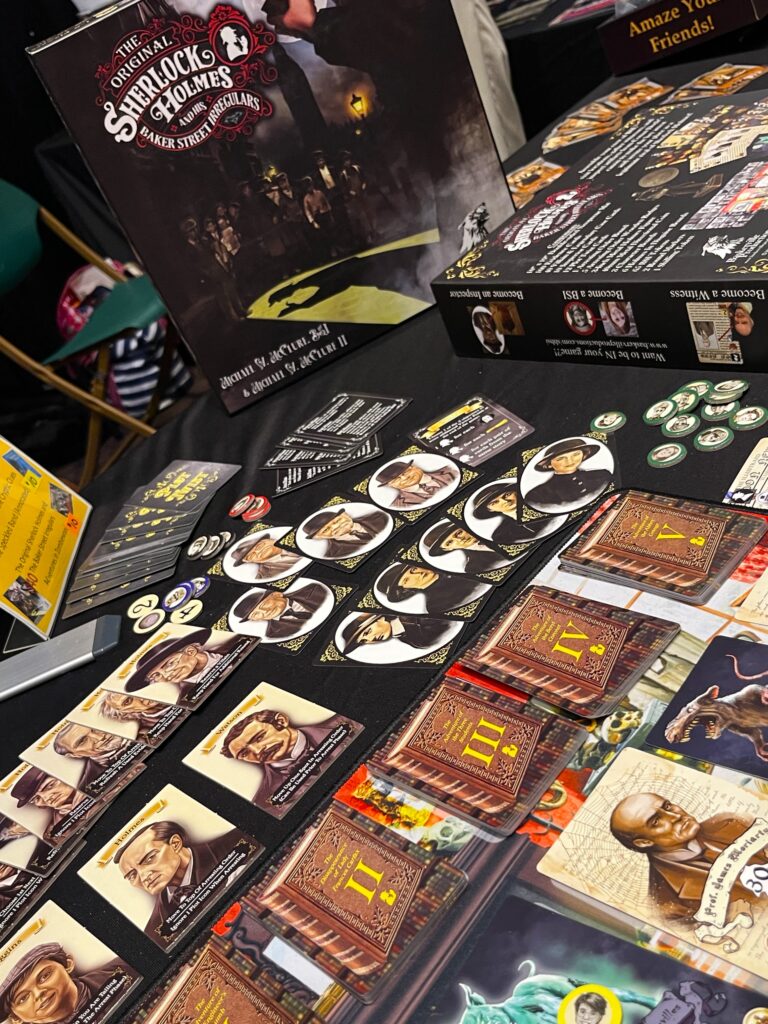
Still, at least we have cooperative games now. It only took us five millennia to devise one. Sherlock Holmes Consulting Detective, published in 1982, was the first contemporary effort to stick. After Pandemic came out in 2008, the genre exploded. That old American notion that nothing will be exciting unless people are pitted against each other…has dissolved. Turns out there is plenty of adrenaline in fighting contagion, creating a civilization, or working together to defuse a bomb. Attack, theft, conquest, beating, domination, and decimation are no longer the only sources of fun.
Even modern competitive games are entering that spirit. In Coffee Traders, you are trying to improve the working conditions on family-run plantations. This Guilty Land is about the U.S. struggle to end slavery. The Vote is about women’s suffrage. In Molly House, you can imagine yourself in the molly houses of Georgian London, gay but discreet, eager for companionship and the release of a wild party, and wily in evading the prim self-righteous bobbies. Imagination sneaks past barriers.
A board game both encourages and defangs self-interest, building it in as a norm so we know it is never personal.
“Playing games” is a coy practice in romance, a malicious one in the corporate world. Yet real games involve none of that deceit; to be fair, and a good sport, one must adhere to the rules, bending them only when your gracious opponent agrees. The game is a language all its own, and playing is a conversation. Every move you make carries meaning—and sends your opponent or teammate a message. Are you stalling? Going for broke? Unfolding a strategy planned far ahead?
I become a different person in certain games, relentless and coldly selfish. Amazingly, this is okay. Expected, even. A board game both encourages and defangs self-interest, building it in as a norm so we know it is never personal. My husband still laughs about the time his college roommate had him executed. “You asked for too much in the negotiation,” the roommate explained.
“Well, that’s true,” Andrew agreed, and they played on. In a game, we can tease each other about betrayals, but because we expect them, they are not betrayals at all. Victories can be crowed over, but losses are fleeting, more likely to make us want to play again than to depress us.
“If there’s a safe place to be sneaky or duplicitous, games are that place,” remarks Jamey Stegmaier, founder of St. Louis-based Stonemaier games. “And they provide a low-stakes way to explore worlds, perspectives, problems, and characters that are vastly different than my own.”
They also lean hard on rules: studying them, being thwarted by them, using them to outwit another player. At Geekway, I saw a couple in the snack bar: him reading from a rulebook, her with her hands in her lap, her shoulders slumped. He was enjoying explaining the world. She just wanted to enter it. I sympathized; in real life, I often chafe at rules. So many are bureaucratic nonsense, layered on over the years, their original purpose lost long ago. Others seem a deliberate attempt to confound us. To board-game rules, though, I am learning to submit. These constraints are freely chosen by all players, because they scaffold a miniature world. Break the rules, and you shatter that world.
Treating life like a game might not be such a bad idea.