Put a Time Machine in Your Closet
July 5, 2026
When Miyako Bellizi designed costumes for Marty Supreme, she spent “a lot of time thinking about Timothée Chalamet’s underwear.” One-piece union suit, typical in the early 1950s, or the newfangled boxers? She wanted to be period correct.
Hers was a professional choice. For the rest of us, wearing vintage clothing is either diabolically cool or fusty and sad. The outcome depends on attractiveness—what does not?—but also on attitude. Are the clothes worn or just slicked on top of the body, pure costume? And if someone has truly embraced and inhabited an earlier mode, is the motive aesthetic pleasure or escape?
Both, I suspect. Today’s clothes are bland and boring, people say, mass-produced of synthetics and often ill-fitting. “Things can feel so scruffy with just T-shirts and jeans around,” one young woman remarks. But an even stronger motive is comfort and practicality. Women speak of lace-up corsets as infinitely more comfortable than elastic shapewear; of back support and proper fit; of greater ease in breastfeeding. Yes, there are often lots of layers, but the natural fibers breathe, and there aren’t plastics involved, and the layers trap body-temperature air, so your temperature stays even, cooler in summer, warmer in winter.
“I am so much more comfortable now than I ever was with modern clothes,” writes Tom Coda.
“People in the past weren’t stupid,” one woman observes. “If they made clothing a certain way, there usually was a reason.” And because they could not count on technology to regulate indoor temperature, their clothes had to perform. We borrow the verb today—but only for synthetics that wick sweat.
Environmental responsibility is also considered. “For years now my wardrobe has been natural fibres only,” writes a woman in the UK, “and as far as reasonable, no waste designs. That led to a love of shifts…. My lifestyle is fairly self sufficient in an attempt to have the least environmental impact I can, so the neighbours already know I’m weird.”
Another wearer says “the most important thing is that people wear clothes that are more sustainable and that they use them. Vintage clothes are made to last and it’s made me learn to sew because I have to take care of these clothes—they have survived 80 years and they can’t die in my care.”
Often, people start with vintage clothes close to home, maybe from the 1980s, then notch back a few decades, then maybe a century or two, as they grow more adept and more sure. “It makes me feel like myself,” one young woman says.
To my surprise, men participate just as eagerly. “I wear Edwardian menswear daily,” one notes online. “More specifically, Edwardian lower/middle class workwear style. Fish tail trousers, braces, period accurate shirt, chore jacket, cap/boater hat, and detachable collar on occasion. Haven’t left the house in anything else in years.”
Another draws inspiration from the 1930s: “trousers with braces, made from a natural material such as cotton or linen, a collarless shirt, a bakerboy cap and leather shoes.” He started when he hurt his back on the job—he is a carpenter—and high-waisted trousers with braces took the pressure off. Thirties style seemed an obvious choice, and it led him into the culture of that time. “I started playing jazz saxophone and got into the dancing of the period,” he says. “I’m not trying to be anything I’m not, I just feel good dressing like this, and it gives other people a sense of who I am.”
Another guy says, “I never leave the house without a hat and I tend to walk around with a cane, too. A lot of what I wear at the moment is Regency style…. The Regency period was the last hurrah of men’s fun with fashion, when people could be loud with colour and exuberant.” He has experimented with his wardrobe since age fourteen: “Modern fashion has never appealed to me. I wanted to look back to a time when things were of a higher quality and wear clothes that would make me stand out.”
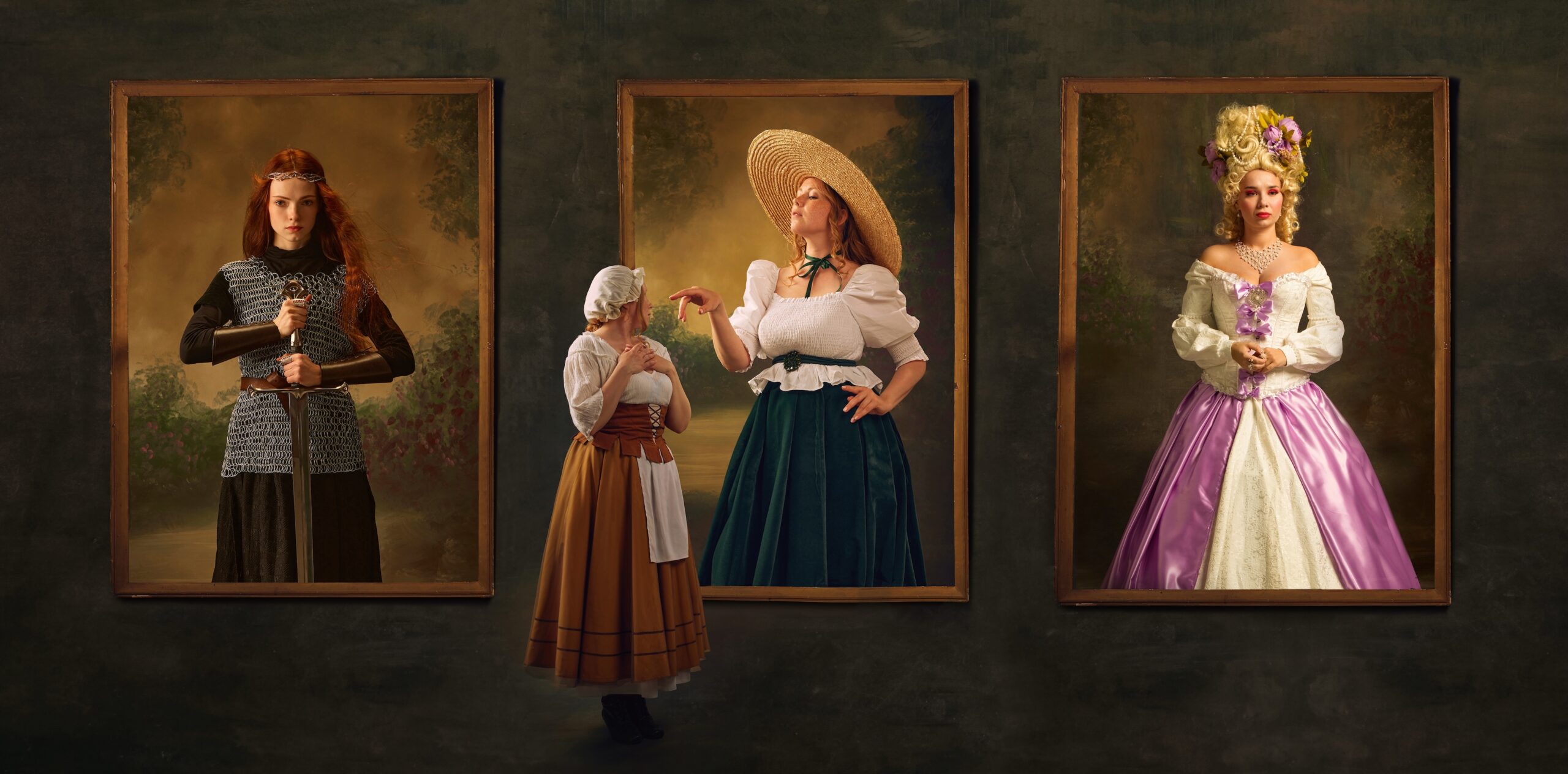
Attention is the most inevitable motive: you cannot dress in Regency or any other period without raising a few eyebrows. A video shows a young woman in full-skirted midcentury dresses, hats and gloves to match, turning heads as she passes. Another video shows someone lacing herself into a corset, then slipping on a ruffled white blouse and long skirt. On the street, little kids ask if she is a princess.
The rest of us are not always sure how to react; we fling compliments, we ask if there is some historic event going on, or we draw the wrong conclusions. A reenactor who wound up making seventeenth-century garb his everyday wear because it was so damned comfortable says, grinning, “People might shout on the street that I look like Robin Hood, but they need to learn their history; Robin Hood was dead by 1200.” A young woman wears late-medieval clothing, yet people keep asking if she is Amish. “My fifteenth-century kirtles A: are brightly colored B: are figure hugging and C: show a small amount of cleavage,” she points out—yet somehow they read as Amish?
What fun this seems. What would I pick? With these hips, I am hardly the flapper type. Fifties Dior, back when I had a tiny waist. Belle Epoque now, maybe? I already wear capes—they are so much easier than shrug-into, button-up coats. And I love hats and gloves, and my husband in one of those muslin poet shirts and breeches….
Criticize historical clothing as a costume, that is fair. But all garb is a costume of sorts. What I want to know is what it means that we have gotten less practical, less sustainable, and less comfortable? Consider pantyhose, that abhorrent departure from exquisitely sexy, cool, and luxurious silk stockings. We like to blame male designers for bras and shoes, but the entire industry has looked a tad masochistic since mid-century. Making athleisure the solution is a sorry attempt to distract us. It will not stand the test of time.