Winning and Losing at the Great Game of Intimacy
Anton Chekhov played at love most of his life. No one is sure if he won or if he even wanted to.
July 4, 2026
A favorite professor of my undergraduate years taught the short stories of Anton Chekhov as models of supreme, writerly virtues: brevity, compression, (seeming) simplicity, a cold realism, yet deep compassion for the felt experience of human suffering. He also extolled Chekhov’s personal life—brief, cool, practical, compassionate—giving the impression that the style was the man.
The Soviet Union was falling apart then, but this Chekhov was a writer the Soviets could claim as a pre-Revolution hero of the people: a wise, kind doctor who served in public health crises; traveled at great personal risk to a penal colony to write an early work of social science; helped build schools, libraries, sanatoriums, and local infrastructure; cared for his family as devoted son and brother; was a non-believer before atheism became state policy; and had brought fame to the motherland as a giant of literature and theater around the world. The fact that he died in 1904 at the age of 44, of the “Romantic affliction” and “poet-killing disease,” also meant he could never portray life under Lenin and Stalin.
If the Soviets retroactively claimed this Chekhov for their project, it seems comical that the same Chekhov was being claimed for the West in classrooms at the end of history, where his influence showed in anglophone writers such as Katherine Mansfield, Ernest Hemingway, Ray Carver, Joan Didion, Alice Munro, and Ethan Canin. American writing programs, which often taught Chekhov’s Apollonian aesthetics (despite students more often loving writers and poets who were Dionysian hot messes), agreed not to disagree with the Russians that Chekhov, though flirtatious, handsome, and famous, had been ascetic, perhaps even chaste, in his devotion to medicine (“my wife,” he said) and literature (“my mistress”).
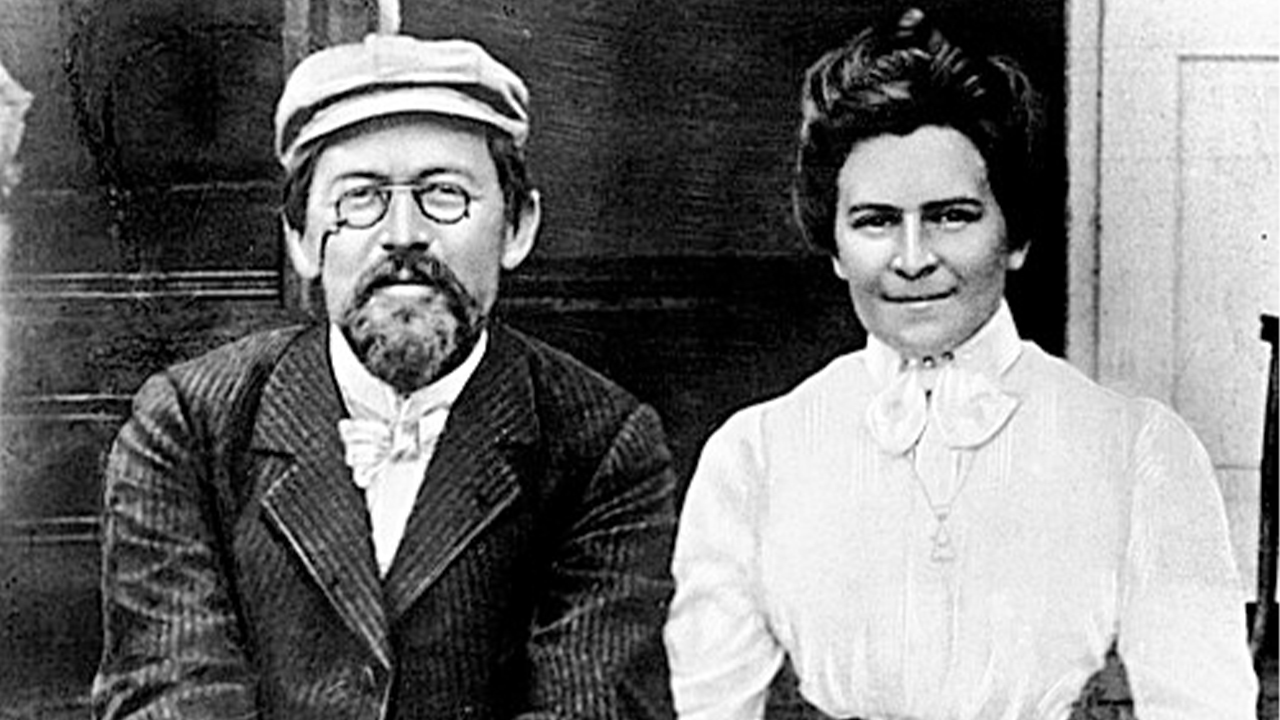
If this Chekhov had the scent of saintliness, it was partly because he cultivated it, as with “The Temptation of St. Anthony,” the jokingly self-titled photo of him visiting young women friends (here, often reproduced) that deflated worldliness with irony. He married only three years before his death; his relationship with actress Olga Knipper had been mostly epistolary and would continue to be. Their published correspondence is playful but positively demure compared to, say, the “wild filth and obscenity” that admirer James Joyce wrote to his own wife.
If I felt happy, as a student, learning that Chekhov had found love late in life, I could be moved to tears by his life’s ending.
Olga, who apparently adored Chekhov and whom he helped make famous with his plays, was younger and already had her own career, in Moscow, which he insisted on. His doctors had prescribed him the exile of warmer climes (Yalta, on the Crimean peninsula, and Nice, France) for his “health”—the tuberculosis killing him by inches, which he would not acknowledge—so he and Olga were often apart. In the letters they pledge their love, fuss over the shallowest parts of each other’s distant lives, gossip about the theater, and nag each other to write more often. They use nicknames (Dear Writer, Dear Actress is the title of the collection of their love letters edited by Jean Benedetti) and terms of endearment—“my wonderful horseykins,” and “my little sperm whale,” he teases Olga—with mildly sexual, romantic, or diminutive connotations.
Many point to Chekhov’s probably most-anthologized short story, “Lady with the Dog,” as autobiographical, at least in terms of Chekhov’s maturation into actual love. Published in 1899, the year after he met Olga at rehearsals for his Seagull at the Moscow Art Theatre, the story portrays the affair of one Gurov, an aging Muscovite, and a younger, more provincial woman, Anna, who meet in the resort town of Yalta. Gurov, who has had numerous affairs, realizes after long reflection that “only now when his head was gray he had fallen in love, really, truly—for the first time in his life” (trans. Vladimir Nabokov). In the story this means not just his affection for and new tenderness toward Anna, but also that he appears to see her as a real person and feels compassion and genuine concern for her. Readers are invited to believe this may be true, and that Anna believes she loves him.
In his Lectures on Russian Literature, Nabokov called it “one of the greatest stories ever written,” in part for how it uses hedging words and conditional verb tenses, such as “it seemed as though…a new and glorious life would begin” [my emphasis] for the couple. As Nabokov says, “The story does not really end, for as long as people are alive, there is no possible and definite conclusion to their troubles or hopes or dreams.”
If I felt happy, as a student, learning that Chekhov had found love late in life, I could be moved to tears by his life’s ending. He and Olga had traveled to Badenweiler, Germany, and she was there as comfort and witness when he began actively dying. She called a doctor to their room at his request. Chekhov sat up in bed and said, “Ich sterbe” (I’m dying, in German), as if in courtesy to his German colleague, and that doctor ordered champagne, a tradition then when one doctor attended another’s death. Chekhov famously, according to Olga, studied his full glass, smiled at her and said, “It’s been such a long time since I’ve had champagne.” He drank it to the lees, lay down quietly, and in the time it took Olga to run to his side, he was gone. Counting from his first major pulmonary hemorrhage, in 1897, he missed the cure for TB by only 45 years.
Russia and eventually the world grieved with his widow, and his reputation only grew. “His plays are produced more frequently than those of any other playwright, except for William Shakespeare,” says scholar Rhonda Blair. “It is possible to argue that Chekhov gave us modern tragicomedy.”
Olga lived another 55 years and never remarried. She was said to sit in a theater box in old age at performances of Chekhov’s plays and call out lines before the actresses playing “her” roles could say them. She and Chekhov are together forever, a different sort of Tristan and Isolde, in Novodevichy Cemetery in Moscow, where I traveled to visit their graves in 2014.
What to call this Chekhov, whom I first encountered in 1988? The Master, perhaps—of vision, decency, modesty, and industry, and, one might hope, in the old game of love.
• • •
Would it matter if the story of the life of The Master had been shaped by lies of omission? By flattening a writer’s life, do we block the source of what made the work possible? Worse, if Chekhov’s obsession as an artist was to see fully and clearly, isn’t it a secular sin not to see his (and his partners’) full humanity?
As Michael C. Finke, a longtime family friend, says in Seeing Chekhov: Life and Art, one of several excellent books of his scholarship on the writer:
“For years the image of Chekhov as a sexual ascetic prevailed among biographers, particularly in the West, where interest in the question was higher in the first place, and where very few scholars had access to the archival materials that might have shown otherwise. Among Russian Chekhov scholars of the pre-glasnost’ years, I believe, it was not only considerations of censorship that inhibited discussion of such matters, but also a charitable discretion and the lack of a theoretical interpretive framework—such as that offered by psychoanalytic theory —that would make the deployment of this material a valid act of scholarship rather than anachronistic and unprofessional gossip. All this has changed quite dramatically, in no small part owing to Donald Rayfield’s 1997 biography of Chekhov [that] utilized unpublished memoirs of and letters to Chekhov to replace the sexual ascetic of critical tradition with a red-blooded, and at times Don Juanish, man of the flesh.” (142-3)
This Chekhov, “whose vanity and self-love were remarked by so many who knew him and loved him,” as Mike writes, had enough experience in the carnal world to satisfy any Dionysian MFA student, from sleeping (as a teen) with another man’s wife in his hometown, to the intimate relationship (much of it epistolary) with his friend’s sister, Lidiia Mizinova, before Chekhov’s marriage to Olga Knipper. Between those two women were 25 years of other women, at various levels of entanglement: actresses, painters, writers including a “lesbian” with a partner, a “black-eyed Hindi girl [i]n a coconut grove, on a moonlit night” (as Chekhov said) in the “heaven” of Ceylon, a Jewish woman with whom he had an almost-engagement broken off over conversion, the woman who would become his brother Aleksander’s wife, et al. Chekhov, it is clear now, also loved a good brothel, and a bad one too, from Western Europe to the Sea of Japan.
This Chekhov surprised the non-scholarly, somewhat puritanical West, despite his bemused, direct gaze into the camera, his gentleman’s cane, and his immaculately groomed beard. I myself did not realize until recently that Chekhov was six feet tall, the first of today’s stereotyped criteria of women’s desire playing on social media. For some reason I thought he was diminutive. He had a deep voice, too, I remember writer Ivan Bunin saying. I would not have expected that either, given his breathing problems.
Now, knowing the extent to which he was human and experienced, do we think he found the kind of love with Olga we might have hoped for them? That depends on our definition of love, of course.
It has long been known that Chekhov could be distant and cruel with partners and friends when it came to sexual or romantic matters. His 1892 story “The Grasshopper,” eg, had “thinly disguised portraits” of his friend the painter Isaac Levitan, Levitan’s married lover, and her husband, which Chekhov may have written in part out of irritation and jealousy involving another woman in their group. Levitan was said to be ready to duel Chekhov over the scandal the story caused, and they were estranged two-and-a-half years.
How anyone thought Chekhov’s work could have come from a saint or an innocent began to seem puzzling to me by the time I went to grad school. Now, knowing the extent to which he was human and experienced, do we think he found the kind of love with Olga we might have hoped for them? That depends on our definition of love, of course.
Most of their time together was apart, and not as we think of now in “distance relationships.” Obviously, there was no instantaneous communication between Moscow and Yalta in the form of phone calls, video calls, texting, or social media posts. Telegraphy still took time and was prohibitively expensive. No flights could reunite them for an unplanned weekend; other modes of transport took days. (The cities are 1,000 miles apart.) Newspapers they both might have read were delayed and censored. In Benedetti’s edited collection of their love letters, it is an exceptional, perhaps annual, event when one has received a photograph of the other. Letters, written on average every few days, were delivered slowly, if not delayed further or lost altogether. The other’s life was 99 percent mystery. Misunderstandings, confusion, and upset, if sometimes performative, occurred weekly: I did not receive a letter from you; what does it mean? Are you well? Do you still love me?
Our culture has become vaguely (but severely) Aristotelian in its ideas about love: Quality is determined solely by actions, not by intentions, promises, longing, desire, projections, or endorphic highs. But for much of the Chekhov-Knipper relationship, the only agency they had, in direct action for the other, was to choose to write regularly. The letters show mutual dependence; each partner states that their life is lacking without the other; but conversations are fractured and not very deep or revealing. Olga seems insecure and needy, pleading with him to tell her something more significant, fishing for praise, or complaining; Chekhov is often distantly sweet and teases, gently chides, or reassures. He tells her what to do for her own good, their good, the theater’s good. He says he is fine, to stop fussing. There are elements of a father-daughter dynamic, exactly as in Gurov and Anna’s early relationship in “Lady with the Dog,” which feel like more of Chekhov’s emotional distancing at a time when communication would be key. This was not what those of us who wished them well might have hoped for.
There is more, but hidden. Donald Rayfield’s 1997 review of Benedetti’s abridgement of the love letters says in part: “Jean Benedetti’s crime of omission is that he did not go to the archive, or send anybody else, to look at the cuts [by everyone from Olga to the Soviets] and restore those that seriously alter the picture of a love affair and a marriage between a great writer and a powerful actress. …Benedetti carries on Olga’s work of misrepresentation.”
Part of this is the “event” at the intersection of love, marriage, sex, and personality that helps determine which Chekhov we might choose to see. In 1996, a letter scribbled by Olga to Chekhov on March 31, 1902, was published for the first time “without cuts,” as scholar Hugh McLean explains in the Summer 2003 issue of The Bulletin of the North American Chekhov Society. The letter, written while Olga was in St. Petersburg performing, and Chekhov was in Yalta, explains that Olga has lost a pregnancy neither supposedly knew about. McLean believes it was as Olga (the only real historical source) says: a miscarriage that needed subsequent dilation and curettage, and led to infection (which Chekhov would diagnose as peritonitis).
Nursed only in part (but for weeks) by Chekhov and his sister Masha, Olga fully recovered but apparently never conceived again. But, McLean says, “Chekhov’s most recent English biographer, Donald Rayfield,—the first foreign scholar to do extensive research in newly accessible Russian archives—has…arrived at an entirely different diagnosis.”
It angers McLean that Rayfield claims the event was instead an ectopic pregnancy that had to be aborted with abdominal surgery to save Olga’s life. More to the point, Rayfield’s calculation of the age of the fetus (an ectopic pregnancy eight to 12 weeks old, not a miscarriage at six weeks, as Olga claimed) meant Chekhov was not the father, because he and Olga had been hundreds of miles apart eight to 12 weeks earlier.
There are elements of a father-daughter dynamic, exactly as in Gurov and Anna’s early relationship in “Lady with the Dog,” which feel like more of Chekhov’s emotional distancing at a time when communication would be key. This was not what those of us who wished them well might have hoped for.
Rayfield responds, in the same issue, that McLean’s criticisms are invalid, in part because peritonitis would have been unlikely, he says, without invasive surgery, and because Chekhov’s “extraordinarily uncaring behavior” in leaving for the Urals, alone, while Olga was still recovering three months after the event was evidence of “a husband with a grievance.” His thesis is that the father was Vladimir Nemirovich-Danchenko, co-founder with Stanislavski of the Moscow Art Theatre, Olga’s director and administrator, former teacher, lover (including during her marriage to Chekhov), and the person who introduced Chekhov to her.
(Rayfield says in the review of Benedetti, “It is beyond doubt that a benevolent conspiracy arose between Nemirovich-Danchenko and Stanislavsky to marry Knipper off to Chekhov and so secure his plays as the exclusive property of the Moscow Arts Theatre. Without this link, Three Sisters might not have become their property. As for The Cherry Orchard, it would not have been written had Knipper, Nemirovich-Danchenko and Stanislavsky not harassed a very tired, dying man. For that much we have to be grateful.”)
Rayfield doubles down, in the Bulletin tiff with McLean, by throwing in “considerations I did not put in my [published] biography, as either too tentative or ‘unpleasant’”: that Chekhov may have been infertile due to a childhood hernia and undescended testicle. Then:
“Olga Knipper before, during and long after her marriage to Chekhov had a reputation of being a highly-sexed woman for whom the absence of close male companionship was hard to endure. This can be inferred not just from Bunin’s memoirs and other hints (from Mikhail Pavlovich Chekhov’s letters to their sister, from Knipper’s mother’s refusal to have Nemirovich-Danchenko in the house until she was married to Chekhov), but also from the memoirs and rich folklore of the Moscow Art Theatre, including a couplet by Mark Prudkin which begins ‘The Belgian critic Van Couver…’ and is not suitable for quotation in your journal.” [There needs to be a feminist biography of Knipper.]
Rayfield gives more reasons for his conclusions and ends, “I never intended when I tackled Chekhov’s life to besmirch the honour of a woman who is not alive to defend herself.” But “Olga Knipper was all her long life a very strong-willed, and not always straightforward, character (not for nothing did people accidentally call her Olga Leopardovna [her name was Olga Leonardovna Knipper]) and need not be treated as a simpering innocent or the critic’s favourite maiden aunt.”
The issue of Olga’s portrayal in this academic dustup is also my interest in truth in Chekhov’s portrayal. He hated self-pity, eg. Did he think he was a victim? In the Benedetti review, Rayfield says:
“Olga was…the first woman Chekhov encountered who seemed to satisfy two mutually exclusive requirements: decency and sensuality. She was spontaneous and sexual; she was deliberate and rational. She had all the qualities the puritan in Chekhov respected: she was a tidy, hard-working, financially independent woman, perfectly bilingual in German and Russian, with excellent English and French. Yet she had all the uninhibited vivacity that made him love the company of actresses. […] Olga Knipper…was the only woman for whom Chekhov pined when she was not there.”
Rayfield adds that, except with Olga, Chekhov “had great difficulty being aroused by women he liked or liking women who aroused him.”
Yet if Chekhov was looking for peace and communion in his final years, he may have chosen poorly. Ivan Bunin, mentioned above, told several stories about Chekhov’s pain during incidents such as the following, which Bunin told to friend and critic Aleksandr Bakhrakh:
“One time around evening—it was during one of his last visits to Moscow—I dropped by to see Chekhov. Sad and sitting home alone, he was truly happy to see me. We talked for a long time. It was getting late, and I tried to leave several times, but Anton Pavlovich would not let me go.
“‘Stay a little longer,’ he said, ‘and share the silence with me.’
“I sensed that he did not like to be alone. And so I stayed. Around three in the morn-ing, the doorbell rang, and in flew Olga Leonardovna, all perfumed, merry, and twittering.
“‘Dusin’ka,’ she said. ‘So you are not alone. How very nice.’
“She put out something to eat and with an appetite, began tearing into a cold chicken.
“Chekhov looked at her almost with hatred.”
This is recounted in Bunin’s About Chekhov: The Unfinished Symphony, translated by Thomas Gaiton Marullo, who adds, “Olga Knipper could be…insensitive with Chekhov. Her letters to the writer were often filled with comments regarding dalliances—real or imagined —not only with Nemirovich-Danchenko but also with Stanislavsky, Vishnevsky, and other men of the Russian stage. […] Chekhov answered her taunts in a characteristic [avoidant, passive-aggressive] way: with a joke. ‘Obviously Vishnevsky is counting on you to become a widow,’ Chekhov wrote to his wife. ‘But tell him that to spite him I am going to leave a will forbidding you to marry again.’”
Still, who is to say Chekhov was looking for peace? Maybe he would rather fuck around and find out, as our culture says. Hugh McLean, who defends the marriage strenuously can also say directly: “Chekhovian love [in the work] seems to be mostly the kind that makes trouble and suffering for the people who engage in it and by the same token offers dramatic opportunities to the playwright—in short, unhappy love, love mostly unrequited. Chekhov also probably considered such unhappy love truer, more characteristic of real human life.”
William B. Ober, in his book Boswell’s Clap and Other Essays, says, “[A] theme common to many of Chekhov’s stories [is] that men and women who attempt to develop an intimate relation, whether consummated or not, wind up lonely, frustrated, unhappy, alienated, and defeated. This tells us more about Chekhov than he might wish us to know….”
Is it love? I used to ask classes when we finished reading “Lady with the Dog.” Part of what is deeply, artfully comic in the story is its ultimate mystery, the characters’ shifting impressions of the same scenes seen again.
Chekhov’s stories have been described as epistemological, about the nature of knowing. When his characters pine, they often pine to see or to know. Yet they also have a streak of (what I think of as) Russian pessimism, so they believe they should drop the question, or are told to forget it.
Hugh McLean quotes from the story in an issue of Toronto Slavic Quarterly: “Anna Sergeevna and he [Gurov] loved each other like very close, related people, like husband and wife, like tender friends” (my italics). Yet such close and lasting love between a husband and wife is nowhere represented in Chekhov. Nevertheless, the phrase shows that he still evidently cherished it as an ideal.”
Chekhov’s stories have been described as epistemological, about the nature of knowing. When his characters pine, they often pine to see or to know. Yet they also have a streak of (what I think of as) Russian pessimism, so they believe they should drop the question, or are told to forget it.
Similarly, McLean says Chekhov’s own conclusion seems to be that, “Reciprocated love is so precious and so rare that even if it is destined to be short-lived and ephemeral, still the experience itself is so valuable that we should let nothing stand in its way. All the phrases about marriage vows and adultery, about friendship and responsibility to children are just that, conventional phrases. Real life is somewhere else. This is Chekhov the romantic. About love one should not think too much, as intellectuals are prone to do.”
The next-to-last letter Chekhov wrote Olga says, “You ask me: what is life? That is like asking: what is a carrot? A carrot is a carrot, and that’s all there is to it. […] Be well, don’t pine, don’t be sad, soon you will see your husband.” Soon she did, for their trip to Badenweiler, where he died less than three months later, not romantically at all, as some like to portray, but with his wife.
The Master, from his Notebook (trans. Koteliansky and Woolf), its entries undated, as if out of time:
“Essentially all this is crude and meaningless, and romantic love appears as meaningless as an avalanche which involuntarily rolls down a mountain and overwhelms people. But when one listens to music, all this is: that some people lie in their graves and sleep, and that one woman is alive—gray-haired, she is sitting in a box in the theatre, quiet and majestic, and the avalanche seems no longer meaningless, since in nature everything has a meaning. And everything is forgiven, and it would be strange not to forgive.”