That Spoonful of Sugar….
July 15, 2026
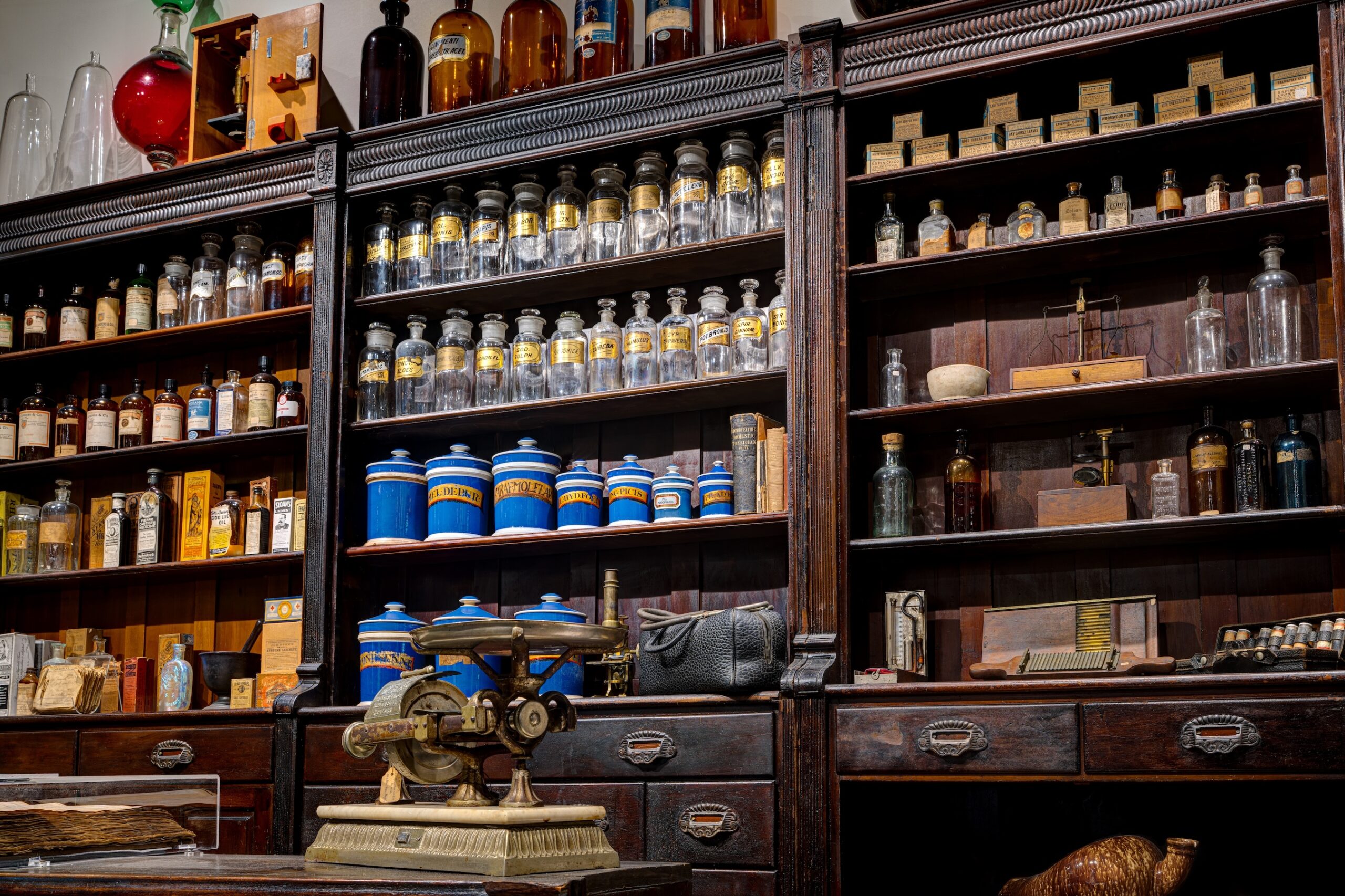
“Hidden in Manhattan’s Greenwich Village, a small establishment prepares and dispenses their own range of cure-alls and remedies just as they have everyday since 1838,” begins a piece in Atlas Obscura. Already, I am hooked. There is something magical about tiny pharmacies, the alchemists of the modern era. I picture a row of colored apothecary bottles in the window, glowing in the sunlight. Promises of care.
Indeed, the name of the place is C.O. Bigelow Apothecary, and it is the nation’s oldest drugstore, opened two hundred years ago with shelves crammed full of tonics, salves, balms, perfumes, elixirs, herbal remedies, and medicines. “Legend has it that Thomas Edison soothed his burnt fingers with a Bigelow’s balm whilst testing an early prototype of his light bulb,” the article notes. S.L. Clemens of 21, Fifth Avenue regularly charged to his account.
“Today, in an era where chain stores are driving smaller independent ones regularly out of business, Bigelow’s is still going strong,” the article concludes. “Dr. Hunter’s first creation, the skin replenishing Rose Wonder Cold Cream is for sale just as it was in 1838. Mark Twain might not be walking the aisles looking for barber cologne elixirs, and the eye drops for scratched corneas are no longer laced with cocaine, but a visit to Bigelow’s remains a refreshing step back in time.”
Well, our small-town pharmacy did not have Twain or Eleanor Roosevelt or any other luminaries in its books. But when my husband and I first moved to Waterloo, Illinois, we were stunned by its kindness. Wightman Pharmacy was family owned, in business for 128 years and now on its fifth generation. You often saw the white-haired dad there working alongside his son Steve. The first time I went, I handed over my prescription and asked when I should return to pick it up. I was used to wandering the aisles at Walgreen’s for an eternity, waiting for my name to be announced over the intercom.
Steve looked bemused by my question. “I’ll have it for you in five minutes, if you can wait.”
Four minutes later, he handed me the little white bag.
“Wightman’s closed on Sunday,” a neighbor told us, “but he’ll meet you there if you’re sick and you need some cough syrup.” We were used to standing in line with people hacking and wheezing all around us, spewing germs the way one did, B.C. By the time COVID hit, though, we had moved to Waterloo. One day I walked into Wightman’s wearing sunglasses, a hat, and a mask, and Steve said, “Hi Jeannette! What can I do for you?”
He knew us, no matter what. Knew our ailments and worries, knew the answers to our nervous questions, and knew, somehow, how to soothe us, just with steady presence and dispassionate interest.
Nobody was self-conscious at Wightman. The assistant would sing out the name of your prescription without the hush of HIPPA. Other customers never batted an eye. We were all human, all flawed and trying to heal. Under Steve’s kind vigilance, there was no judgment.
Except when it came to insurance greed and stupid bureaucracy. On those topics, he was frank with his displeasure—which only made us trust him more.
We ended up moving both our mothers to Waterloo, and one day my mother-in-law got sick, and I was trying to juggle work to pick up her prescription, and Steve said, “Oh, don’t worry. We’ll just drop it off.” No charge. Routine service for anyone who could not comfortably get out of the house.
Years passed. There were always a few customers in the pharmacy—though never a long wait—so we had no idea business had become hard. But one day, Steve told us, sadly, that he was selling. And not even to another small family-owned pharmacy, because those days are just about over.
The store stands empty, waiting for its next incarnation. We go to the CVS inside Schnucks now, and they leave endless messages on our voicemail prompting us to refill prescriptions that have not yet run out. There is an app, but I cannot figure out how to make it cover both of us, and I only need one prescription, renewed sporadically—so when I call, the machine does not know who I am. At first, I consoled myself that the hours were longer, it would at least be more convenient, but CVS closes at lunch—which is understandable but somehow always the time I am grocery shopping.
Ah, how the old carp. I do not mean to wax nostalgic at every turn, never wanted to be that sort of person. But so much that we have lost was clearly better. More human, and here is the surprise: in many ways, more efficient. For the customer, that is. Certainly not more efficient for the pharmaceutical industry or the mail-order companies, who rely on quantity and urge us to ever greater consumption (but only of the drugs cheap to make). Today’s tonics and elixirs lack color and imagination; more than that, they lack the attentiveness and kindred sympathy of someone mixing them up or counting them out just for us.
The new biochemistry works wonders, and at least some of its profits go into research and development of even more wonders. AI, it turns out, gives a sharper diagnosis than many docs. It also explains more patiently. But the other dimensions of healing, those in which we were seen as individuals and treated with felt, not generated, compassion? They are fast closing up shop.