America 250
A reflection on the meaning of Independence Day 2026.
By Wayne Fields
July 4, 2026
The debate over how best to celebrate the 250th anniversary of the American Declaration of Independence has presented more of a spectacle than the actual event is likely to provide. In 2016, remembering the success of the year-long celebration in 1976, and feeling the need for a fresh shot of patriotism, Congress provided for the Semi-Sesquincentennial celebration, unaware that when 2026 arrived the sitting president would be a man of little aesthetic taste and less historical knowledge, busily attempting to remodel the nation’s capital in the image of an Atlantic City casino and reinvent the American past in the model of the World Wrestling Federation.
The United States at 250 years of age faces hard decisions; will it be musically represented by Lee Greenwood or Smashing Pumpkins? Will its festival sport be UFC combat on the White House lawn or baseball at the park? At the moment the White House enjoys the home team advantage even though its team is proving hard to assemble. Perhaps the oddest coincidence on this occasion when we celebrate our escape from a monarchy and the signing of a document mostly composed of indictments against a king is the appearance across America of signs reading “No Kings!,” not the old George, but the man we elected president. Never since that first Fourth of July have we been so divided between wannabe monarchists and republicans. Perhaps what we assumed would be progress has turned out to be a circle.
Two hundred fifty years and two days before our upcoming birthday, John Adams wrote to his wife Abigail with details as to how he thought our nation’s founding should be observed: “It ought to be commemorated as the Day of Deliverance by solemn Acts of Devotion to God almighty. It ought to be solemnized with Pomp and Parade, with Shews [sic], Games, Sports, Guns, Bells, Bonfires and Illuminations from one end of this Continent to the other from this time forward forever more.” But the day of which he spoke was not the fourth. He wrote Abigail on and about the second of July, the day the Second Continental Congress actually approved the resolution for independence. On the fourth they ratified the final text, the official declaration of a decision already made. It was the legislative act Adams thought deserving of the extravagant celebration, but instead Americans decided to emphasize the words in which it was ultimately expressed.
Of the peculiar concoction of reverence and noise that Adams deemed appropriate, little remains of the first (though our present president has assembled his cadre of television evangelists to pray, but apparently more to him than to the more conventional divinity) while enthusiasm remains strong for the second. But it was not always so. At least twice in nineteenth-century history more than inclination forced a profound gravitas onto the date. On the fiftieth American Fourth of July the sense of divine deliverance that John Adams saw at work in American Independence, the sacred he recognized alongside the celebratory, was reinforced for his countrymen by the near simultaneous deaths of himself, often referred to as the chief defender of the Declaration, and of Thomas Jefferson, its principal author, a coincidence widely viewed with awe and seen as evidence of divine attention if not purpose. Then in 1863 Americans saw the hand of God much more purposefully in the Union victory at Gettysburg, a battle that raged throughout the 87th Fourth. The following November President Lincoln confirmed the connection when he reinterpreted and sanctified both the original declaration and the war that he insisted was that document’s necessary outcome.
In 1876, only eleven years removed from a bloody civil war, one might have thought there would be more of a pall over the nation’s hundredth birthday, but the country was looking in a different direction, forward to a future built on energy and enterprise, ideas that were literally embodied in the Corliss engine that powered the grand Philadelphia Centennial Exposition. The war was not forgotten but for the most part we seemed to have gotten beyond it and were looking to a happier, less conflicted future. That future lay to the west where just seven years earlier a golden spike had been driven to celebrate completion of the transcontinental railroad, a sort of zipper binding north to south (no matter how ineffectually), and a harbinger of the wealth we expected it to transport. The insignificant people who in 1776 began their presumptuous experiment in nation building—had become in one hundred years a global power. Fifty nations sent exhibits to the 236-acre exhibition grounds, both as a context for and an acknowledgement of the still upstart country’s growing economic importance. But the majority of the exhibits in the 180 Exposition buildings represented the fruits of American labor and offered proof of how good we are at inventing and making stuff.
On the fiftieth American Fourth of July the sense of divine deliverance that John Adams saw at work in American Independence, the sacred he recognized alongside the celebratory, was reinforced for his countrymen by the near simultaneous deaths of himself, often referred to as the chief defender of the Declaration, and of Thomas Jefferson, its principal author, a coincidence widely viewed with awe and seen as evidence of divine attention if not purpose.
The past lingered in 1876, however, even if overshadowed by the exuberant present. A twenty-one and a half foot Antietam soldier loomed in Memorial Hall, and in Washington D.C.’s Lincoln Park, a grand sculpture representing the freeing of the slaves was unveiled. And of course, many veterans were among the ten million visitors during the Exposition’s six-month life, having joined in the country’s revised narrative of the soldiers of the American Revolutionary Army as models of heroic citizenship and service, a standard to be applied to all who came after.
While no presidents died, news of one significant death did reach the celebration on the centennial Fourth, a reminder that the past was not entirely past and conflict was far from over. Word arrived that day of General George Custer’s demise at Little Big Horn, casting a pall over the opening ceremonies.
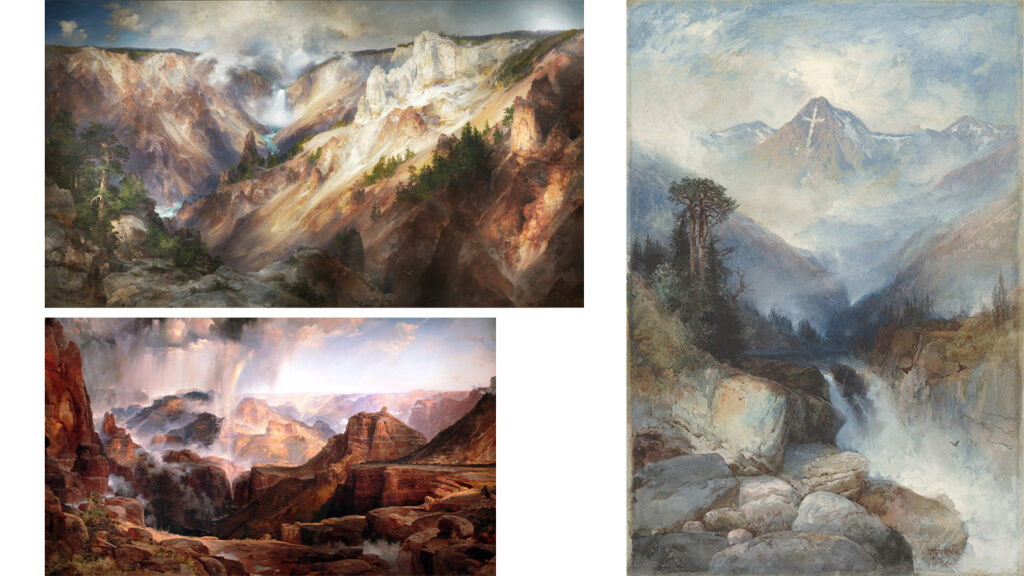
This surely might have provided fodder for those looking for “signs” and, for the more contemplative, a subject for deeper consideration. Similarly, though even more subtle in its implications, Thomas Moran’s enormous painting, The Mountain of the Holy Cross (1875) was not only exhibited in the grand Memorial Hall but was also awarded a gold medal. The artist had hoped that picture would be exhibited with two of his earlier monumental canvases, both owned by the U.S. government. His request was denied, and The Grand Canyon of the Yellowstone (1872) and The Chasm of the Colorado (1874) remained in Washington. Had they been hung together, the extraordinary triptych would have included two American scenes divided by almost unfathomable abysses, apt images of the country in the 1860s and, as we have learned and relearned, of America at all times. The third, the newer canvas, exemplified a resolution in a unified and soaring landscape bound together by a mountain bearing a massive cross of snow on its slopes, a theological statement perhaps akin to Lincoln’s Gettysburg.
One hundred years after that Fourth, we did it all again, albeit without the single “world’s fair style” exposition. Reassured now by 200 years of history and reinforced by an unequaled military and economic strength, we made not just a day or six months but a year of it, with a spate of historical reenactments, concerts, and sporting events across the country. Patriotic nostalgia delivered on a “Freedom Train” could help us get past the trauma of Vietnam and Watergate (although ironically on July the second, Adams’s choice for our national celebration, the provisional government of South Vietnam dissolved and reunited with the North.)
The year was replete with televised spectacles at locations like Disneyland, as well as historical events more local in nature, including a reenactment of Washington in full uniform re-crossing the Delaware. Also that year, the “Father of Our Country” was promoted to the grade of “General of the Armies of the United States,” although without back pay. There were, as always, disappointments. The hoped-for Olympic Games went elsewhere and plans for a much-anticipated Independence Day landing of the Mars lander had to be delayed. But impressive enough was the assemblage of tall-masted ships in New York harbor, reviewed by President Ford from a U.S. missile cruiser, and—just to demonstrate what a difference two centuries can make—joined by the HMY Britannia with Queen Elizabeth and Prince Phillip aboard.
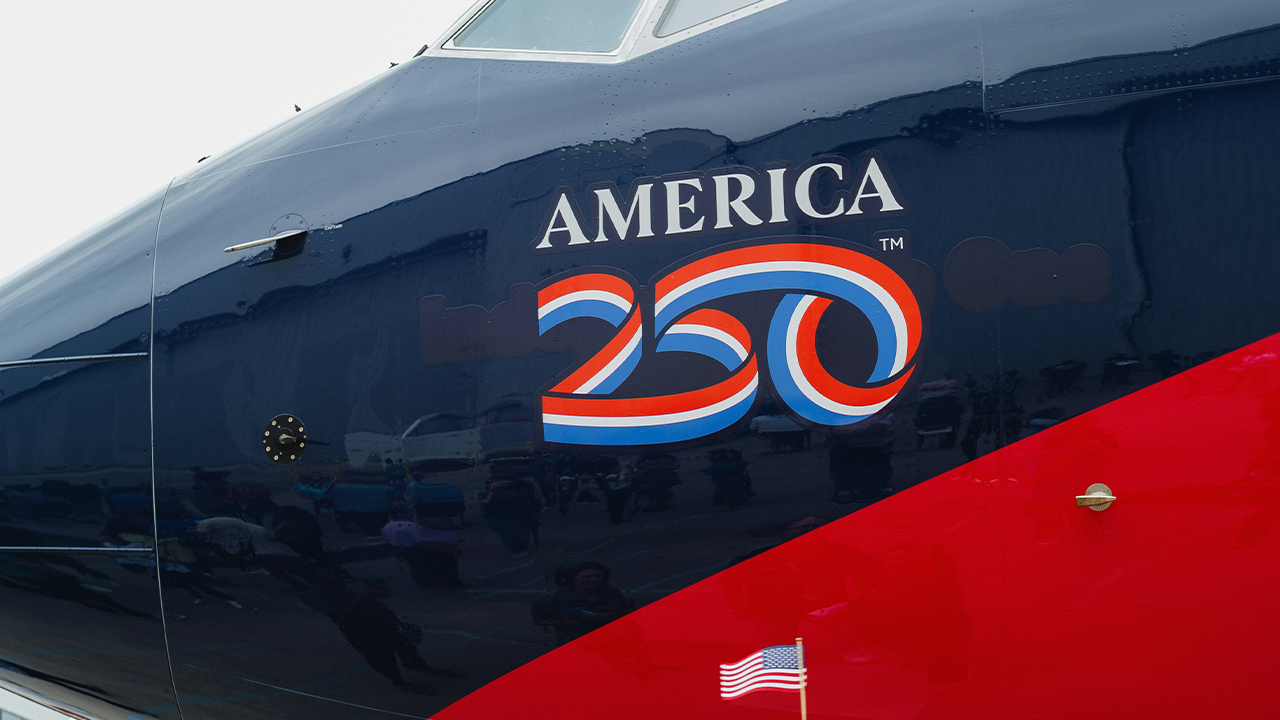
So pleased with how the bicentennial had gone, and looking ahead to 2026, Congress passed the United States Semiquincentennial Act in 2016. Besides providing for festivities, it also directed the issue of stamps, the minting of new coins, even the construction of new ships whose subjects and names would honor historically significant events and persons that had been overlooked in the past. The actual birthday plans were to be made and overseen by a national commission called America250.
Then came President Trump, who was reluctant, as his public appearances have demonstrated, to be “woke,” so to keep our quarters safe from female patriots and heroes of color, and even more from such troublesome events as abolition, the Civil Rights Movement, the Women’s Movement, he appointed his own “Freedom 250” commission. In this un-awakening stamps whose images offended White males of a certain type were cancelled before being printed and women were kept away from America’s money. History was also “cancelled” as national parks and museums, and schools were ordered to whitewash over all unpleasantness. His version of the national past carted around on “Freedom Trucks.”
All this suggests a basic confusion about what we are observing when we observe the Fourth of July. In Laura Ingalls Wilder’s Little Town on the Prairie (1941), set sometime in the 1880s, Laura goes to town with her father and sister Carrie as the village provides what it can by way of a Fourth of July celebration. The girls enjoy the fun and the food, but the highlight of the occasion is a reading of The Declaration of Independence. “Laura and Carrie,” the narrator informs us, “knew the declaration by heart, of course, but it gave them a solemn glorious feeling to hear the words.”
In 1863, shortly after the guns had fallen silent at Gettysburg, a group of soldiers serenaded President Lincoln at the White House, then called upon him to make some remarks. He responded, saying,
Fellow-citizens: I am very glad indeed to see you to-night…, “and “I do most sincerely thank Almighty God for the occasion on which you have called. How long ago is it?—eighty odd years—since on the Fourth of July for the first time in the history of the world a nation by its representatives, assembled and declared as a self-evident truth that all men are created equal. That was the birthday of the United States of America.
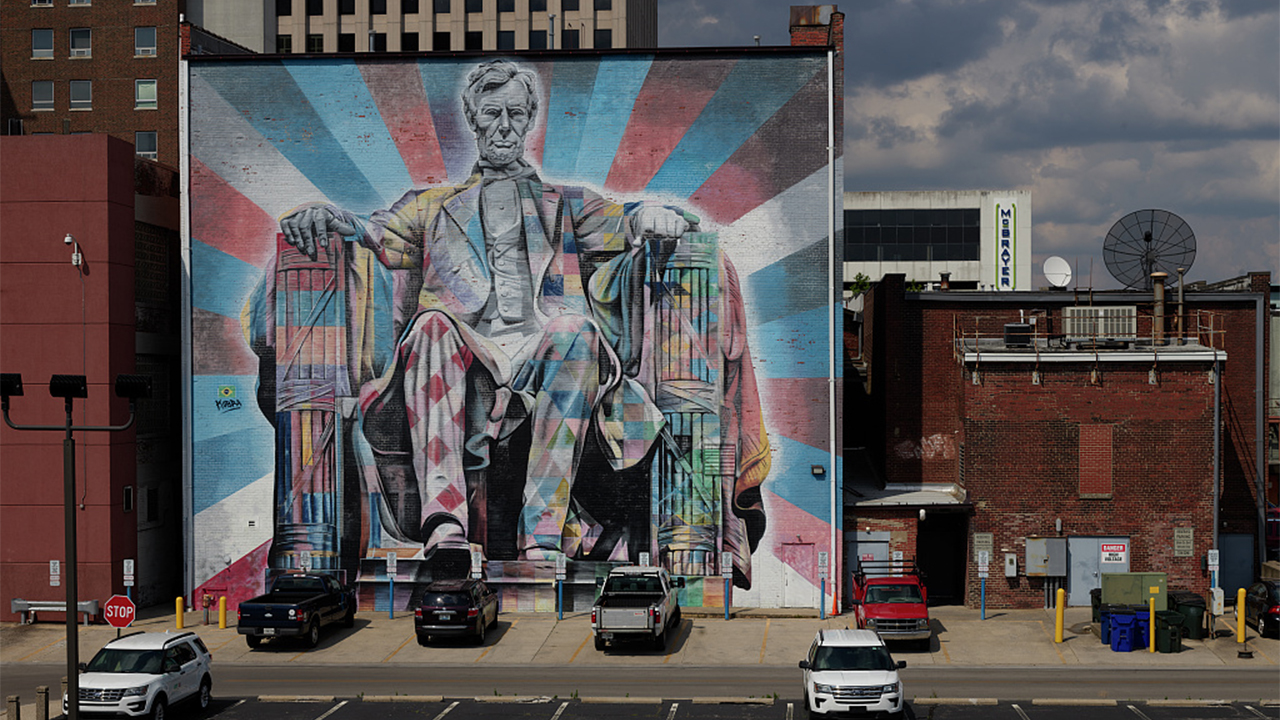
For Lincoln the Fourth of July is sanctified by a principle, one he praises Jefferson for enshrining in the Declaration of Independence. On his way to Washington and his first inauguration, he declared in Philadelphia,
All praise to Jefferson—to the man who in the concrete pressure of a struggle for national independence by a single people, had the coolness, forecast, and capacity to introduce into a merely revolutionary document, an abstract truth, applicable to all men and all times, and so to embalm it there, that today, and in all coming days, it shall be a rebuke and a stumbling-block to the very harbingers of re-appearing tyranny and oppression.
It is not the separation of one group of people from another, a particular and “merely revolutionary act,” not national “independence” that for Lincoln distinguishes the date in American history. The formal Declaration of Independence issues far more than a call for particular change; it presumes to change everything. There is truly only one radical assertion in the words the Second Continental Congress declared on that original July Fourth, only one line that eternally matters: “All men are created equal.” In his November speech at Gettysburg, Lincoln notes nothing else from the document Jefferson composed and that the Continental Congress ratified, but what he sanctifies far beyond anything its original author dared was the principle of equality. The logical implications of the Declaration are that no government, not just the British crown, can claim legitimacy if it denies equality, a large and complex claim that must always be affirmed even when we do not fully understand its implications or satisfy all its demands.
We do not and cannot have a fixed definition of “equal,” since the term must recognize not just blatant differences and circumstance, but also distinctions so subtle we may not yet be aware of them. Our humanity and our concept of humanity must continually grow and correspondingly so must our understanding of equality.
In celebrating the Fourth of July in any year, we rightfully celebrate first and foremost the Declaration of Independence. And since 1863 that document must be understood (as interpreted in the Gettysburg Address) through the principle of equality. Nothing it says has meaning without that foundation. So it is with the United States. Our legitimacy as a people depends on a commitment to that principle. This aspiration justified fireworks as well as prayers.
We do not and cannot have a fixed definition of “equal,” since the term must recognize not just blatant differences and circumstance, but also distinctions so subtle we may not yet be aware of them. Our humanity and our concept of humanity must continually grow and correspondingly so must our understanding of equality.
The Centennial leadership’s denial of Susan B. Anthony’s request to deliver a Declaration of Rights for Women and Frederick Douglass’s 1852 address, “What to the Slave Is the Fourth of July?” remind us how long and reluctant is the road of equality. But it is not just the humanity of those denied access to that highway that is at stake, but our own.
After 250 years of proclamations and speeches, it all boils down to one word. Equality is a principle that cannot be qualified. Without equality “independence” and even “freedom,” are meaningless.