Baseball, Battlefields, and the Beginnings of Cold War America
A new book recounts baseball’s ups and downs during the last frontline war in Asia.
By Gerald Early
September 15, 2026
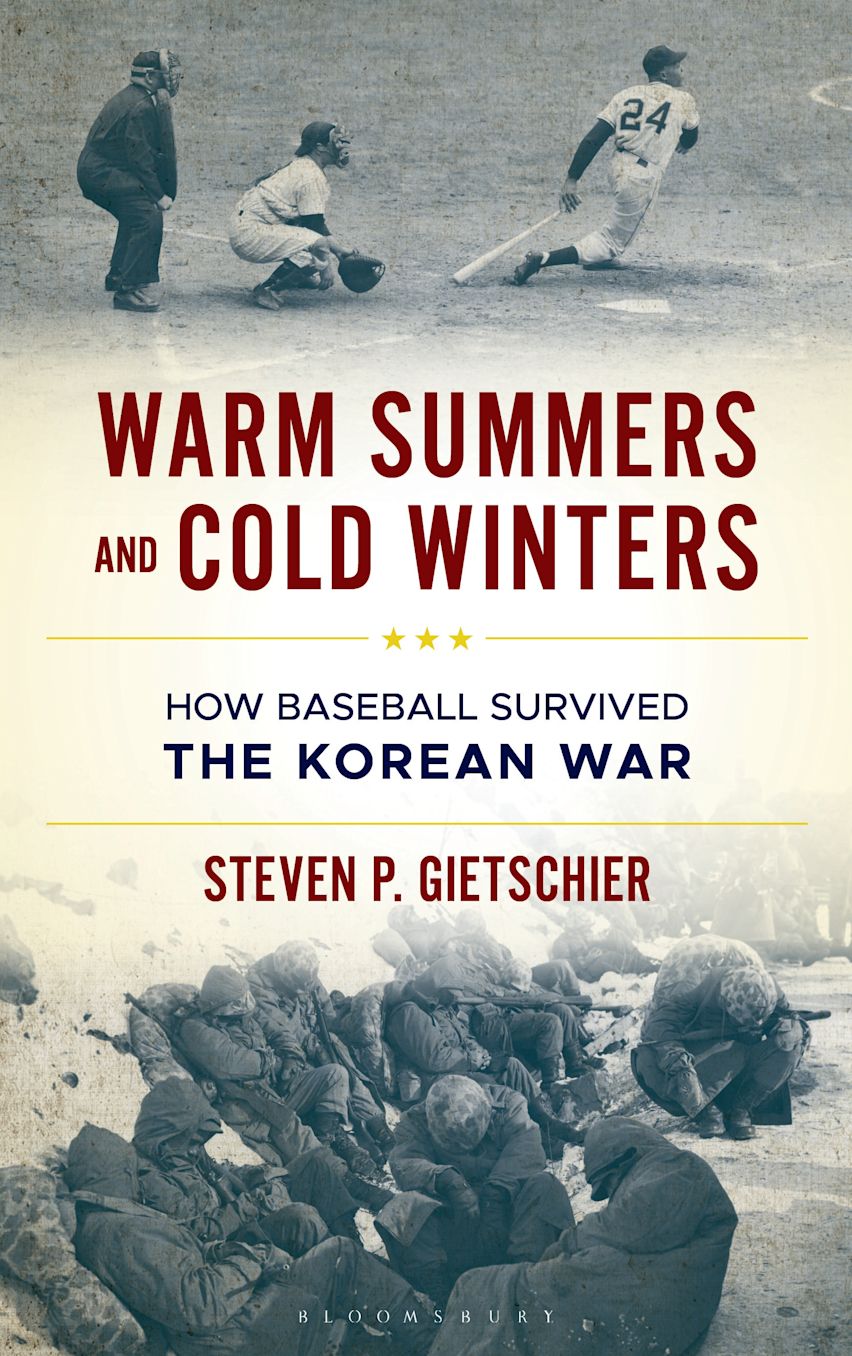
Warm Summers and Cold Winters: How Baseball Survived the Korean War
1. “Winning isn’t everything. . .”
“In war, there is no substitute for victory,” General Douglas MacArthur famously said before a joint session of Congress on April 19, 1951. He had been fired on April 11, 1951, by President Truman as Supreme Commander for the Allied Powers and head of the United Nations Command in the Korean War over their vehement disagreement about how to conduct that conflict, the dynamics of which had changed since the early autumn of 1950 with the entry of China on the side of the North Koreans against United Nations (mostly United States) forces on the side of the South Koreans. MacArthur wanted an aggressive war against the Chinese, even the possible use of nuclear weapons; Truman, understanding that he could no longer hope to unify Korea through military means, simply wanted a way out, not a bigger war. MacArthur could not accept the idea of a limited war, and Truman could not accept MacArthur’s criticism and dismissed him. MacArthur’s address to Congress was part of his retirement/licking his wounds/saving face/presidential hopeful exploratory national tour. MacArthur was at the height of his popularity when he addressed Congress. Truman was so unpopular that MacArthur might have become president by acclamation on April 19, if that were possible. But crowds diminished, and enthusiasm waned as MacArthur’s self-justifying, Truman-bashing tour continued. He was not chosen as the Republican presidential nominee in 1952. Another World War II general, Dwight Eisenhower, was. MacArthur discovered that there is no substitute for victory in politics, either.
In baseball, as in all sports, the axiom about victory may be just as rigid. Major league baseball of the early 1950s (1950–1953), the Korean War era, consisted of two eight-team leagues, National and American. There were no divisions. There were no rounds of playoff games. If your team finished the 154-game regular season with the best record in your league, your team won your league’s pennant and went to the World Series. What your team accomplished during the season was everything, not a prelude to what we now call “the post-season.” Simpler procedure for supposedly simpler times. There is no substitute for victory here either. In Warm Summers and Cold Winters, Steven P. Gietschier tells the story of Charley and Bill DeWitt, owners of the perennial American League losers, the St. Louis Browns, who, in 1950, decided to hire a psychologist and hypnotist named Dr. David Tracy to help some of the players get over their “inferiority complex.” (27) Losing causes trauma, an overused word today, that needs a cure. Tracy was gone by the end of May, when the Browns were 8-25. If winning is a state of mind, the hapless Browns needed the staff of a mental hospital, not just a single doctor.
The objective in baseball always is to win the World Series. Win or fail. Win or live in the unsatisfying expectancy of unfulfilled hope. Win or be forgotten. Perhaps MacArthur was right: The absence of victory is why the Korean conflict is this country’s forgotten war.
2. “It’s the only thing.”
In Warm Summers and Cold Winters, Gietschier uses the dated term “Organized Baseball” to describe the sports business structure that includes both major and minor baseball. It is totally appropriate, as that was the term that was used during the early 1950s, the time period the book covers. It was how White baseball distinguished itself from Negro League Baseball. Black baseball was not organized. This is not untrue. The story of Black baseball is about the aspiration to be organized as White baseball was. But the claim of being “organized” made White baseball superior. But that is another story for another time.
One of the narrative threads of Gietschier’s book on baseball during the Korean War is the tenuous nature of this “organized” business model. Minor league owners were unhappy about how the major leagues were using the new mass medium of television, which was highly dependent on sports to fill its broadcasting hours. (Boxing was the number one televised sport in the, but baseball was equally important as the national pastime.) Major league owners were careless about whether their televised games were shown in minor league team markets, something which minor league owners said adversely affected attendance at their games: “. . . the minor leagues as a whole became alarmed when major league games were shown in minor league cities.” (17) Part of the problem here is branding: dividing professional baseball into “major” and “minor” immediately signaled to fans that one branch of the game was inferior to another. How do you sell an inferior product? Gietschier notes that the minor leagues expanded at a robust pace immediately after WWII but experienced considerable contraction in the 1950s.
The objective in baseball always is to win the World Series. Win or fail. Win or live in the unsatisfying expectancy of unfulfilled hope. Win or be forgotten. Perhaps MacArthur was right: The absence of victory is why the Korean conflict is this country’s forgotten war.
Major league teams also squabbled with one another about broadcasts bleeding into another team’s region. Turf wars were about revenue, and major league baseball was still unsure if television increased attendance and interest in the game or diminished it. As Washington Senators owner Clark Griffith put it, echoing MacArthur, “There is no substitute for fans in the park,” when he chose to cut the number of Senators televised home games from seventy-seven to twenty-one. (76) The fact that teams made their own individual television deals made the situation more chaotic than it needed to be. Here was an instance where Organized Baseball was not so organized.
There was also concern about the entire farm system structure, where minor league teams were directly tied to major league clubs as supply lines for players. Many minor league owners did not feel this system helped the minor leagues—it emphasized their subsidiary status—and some major league owners felt it was inefficient. The bidding wars for amateur players, “bonus babies,” as they were called, were another inefficiency that Organized Baseball tried to solve during the Korean War years. “Club owners found self-restraint nearly impossible,” writes Gietschier, a complaint nearly identical to today’s cry by major league owners for a salary cap because they cannot restrain themselves in bidding for free agents. Many of these bonus babies turned out to be busts.
Gietschier offers a useful account of the Korean War, neither an entirely military nor diplomatic history but comprehensive. He concentrates, naturally, on how the war created personnel problems for Organized Baseball, though not as severe as World War II. The minors felt it more intensely than the majors, but as there was no full-blown mobilization, the leagues coped. He provides vignettes of ballplayers who served during the Korean War, with particularly detailed accounts of Bobby Brown, a medical doctor who played second base for the New York Yankees; superstar Boston outfielder and Hall of Famer Ted Williams, a pilot; and Jerry Coleman, another Yankee, who was also a pilot.
Some of the concerns of baseball owners and writers in the early 1950s echo those of today: the number of home runs in the 1950s, which made some think the ball was juiced (43-44); legal challenges to the reserve clause which bound a player to his team for life (91); the game’s slow pace (97); the challenge to interest youngsters in the game (131); the use of cameras to “check on some umpires’ decisions” (159).
One of the narrative threads of Gietschier’s book on baseball during the Korean War is the tenuous nature of this “organized” business model.
Gietschier gives a good account of baseball integration but a bit more about the Negro Leagues in the Korean War era, though they were on life support, would have been appreciated, as they did do something revolutionary by having a woman play with the male players.
On the whole, Warm Summers and Cold Winters does not necessarily offer a lot of new information, as there are other books dealing either with individual teams or players of this era that are rich accounts of aspects of this period. But Gietschier’s book does offer a fresh, tightly focused, and intelligent perspective of the era itself, which is commendable.
The New York Yankees won every World Series between 1950 and 1953. Where you lived determined whether you were elated or depressed about that achievement, whether it was good or bad for baseball, whether juggernaut teams (think the Los Angeles Dodgers today) are good or bad for our enjoyment of the sport. The one lesson we know for sure is that dreadnoughts are built for winning and they exist because there is no substitute for victory.