A Spiritual Palimpsest’s Stacked Stories
A church nearly hidden from view.
October 16, 2026
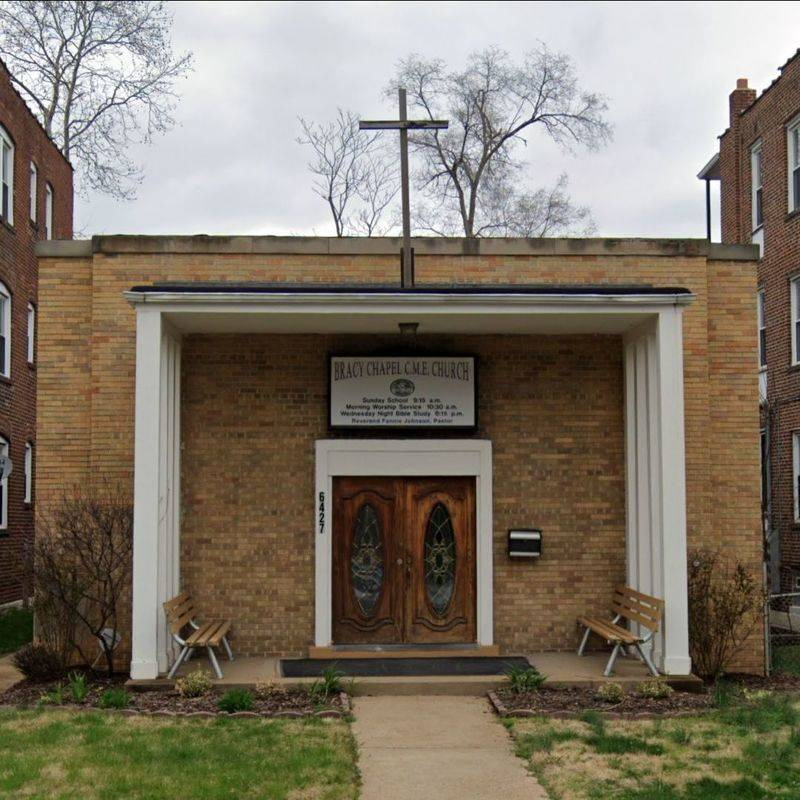
Several months ago, it had occurred to me that it was perhaps significant that I live next to a church. A friend of mine, who was crashing with me and my partner for a couple of nights before resuming his road trip, took in a view from the sunroom window, and remarked, with merely a curious tone, “Huh, there’s a big cross on that building.” I thought that was an odd way of saying that there was a church right beside my home, so I responded, without knowing exactly what to say, “Yeah…I mean, that’s a church,” to which he replied, “Oh, I had no idea.”
I wonder how many others who have stayed with me, or at least have walked on my block, had no idea either. For me, seeing this church is knowing that I am one building away from home—counting more cars than usual parked outside is to be reminded that it is indeed Sunday morning. When I first moved into this apartment, I remember my mother saying, “Oh, I hope you get to hear some good music from your neighbors.” According to my settled view, it has been an obvious fact of life that I hang out most of my days with a religious building in close proximity.
“What’s it like living next to a church,” another friend of mine asked me several weeks after my cross-country-trekking buddy resumed his trip to California. I did not have much to volunteer, besides the fact that I was once generously offered a delicious fried fish sandwich during one of the church’s community fish fries. “And did you notice that there’s a Hebrew inscription on the side?” I had not noticed that, no, I was embarrassed to concede. “I guess it was a synagogue in the past.” I guess it was. Resolute to learn more about a church that for so long had merely marked the propinquity of my home, I decided to attend service that coming Sunday.
A spiritual urgent care center
Small or large—inconspicuous or unmissable—I prefer places that accept walk-ins. Restaurants that do not require reservations. Barbershops not in need of a prior appointment. In a deep sense, although we perilously forsake socialistic and democratic principles in this country, and we feel this most distinctly in the catastrophe that is medical coverage, I guess I also love the model of the emergency room and the urgent care center.
A church is purposed for walk-ins as well. When I walked in for the first time, service had already commenced, and I felt the strange comfort of being their unacknowledged guest. They did not t pause their doings to ask me who I was or what I was about. For this I was thankful. No eyes were on me unless there was a related gesture to get me on the same page as the other worshippers. Not until the service was over—until there were no more songs to be sung, no more biblical parables to be untangled, or establishments of faith to be spoken—was I finally approached. And even then, I was startled by the casual and tender welcome. “I’ll be right with you,” is all the Reverend said to me, as if she had been expecting me the whole time.
On the flyer for Bracy Chapel CME Church, a predominantly African-American church nestled in a residential area north of the Delmar Loop in University City, Missouri, there is a stethoscope listening in on the happenings of the heart:
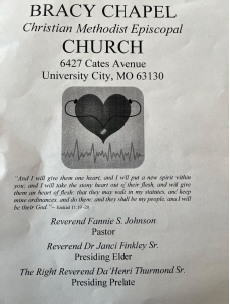
What I had known was that I was living next to a church for the past five years of my life. What I had not known was that, for all these years, I was in the midst of a “Spiritual Urgent Care Center,” the appellative Reverend Fannie S. Johnson opts for to remind her congregation of the purpose of their gathering at Bracy every Sunday.
“Spiritual Urgent Care Center”—that caught my attention during the first service I attended at Bracy, really the first Christian service I had ever attended, having grown up in a chiefly Judaic-secular environment in the heart of New York City.
I did not have much to volunteer, besides the fact that I was once generously offered a delicious fried fish sandwich during one of the church’s community fish fries. “And did you notice that there’s a Hebrew inscription on the side?” I had not noticed that, no, I was embarrassed to concede.
“I think so much is focused on healthcare now,” Reverend Johnson explained to me during a sit-down in the church one Tuesday morning. We were seated on the left, a few rows back from the front. Reverend Johnson was a vigorous presence who sported a stylish bowl cut and possessed an exacting yet encouraging countenance. She immediately handed me some papers that offered a history of the CME Church, a chronology of Bracy itself, and her own biography.
“You turn on the TV, there’s Obamacare, there’s Medicare, so much is talked about [regarding] medicine. People focus on the body. My job is to focus on the soul, you know? That’s kinda how the idea came. Do you have a medical home? Do you have a spiritual home, something that will take care of the permanent part of you?”
Our impermanent bodies are not to be taken lightly, however. “And I think that’s critical,” the Reverend would go on to elaborate. “I think that we have a responsibility to take care of these bodies. I have to maintain this body. Only if I take care of this body, can I do the other things.”
“The other things.” I like this too. It protects the profundity and ambiguity of spiritual attention.
A brief history of Bracy and the CME Church
On December 16, 1870, forty-one former slaves gathered together in Jackson, Tennessee. With the support of white members of the Methodist Episcopal Church, South (MEC, S), these forty-one men founded the Colored Methodist Episcopal Church of America. According to historian Raymond R. Sommerville, the CME Church was “. . . the first independent African-American denomination founded in the postwar South . . .” and had been the “. . . product of both southern white Methodist paternalism and African Americans’ quest for freedom.”
The denomination used this name until 1954, the year of Brown v. Board of Education, after which members opted for the Christian Methodist Episcopal Church (CME Church) instead. Sommerville suggests that, although not in direct response to the Supreme Court’s decision to integrate the public school system, the name change should be seen “. . . as a reflection of the denomination’s ever-evolving commitment to racial inclusivity and ecumenical commitment.”
The building that now occupies 6427 Cates Avenue was built for religious purposes, but it had not always been for Christian worship. Originally a synagogue, from at least 1955-1979, this small, unassuming edifice had been home to the Beth Yehuda Congregation.
One of the notable features of the denomination is its logo, variously known as the “connectional emblem” and the “connectional marker.” Consisting of four symbols—the World Globe, the Skyline, the Weathervane, and the Cross—the logo, designed by Will E. Chambers and officially adopted by the General Conference in 1974, represents “. . . the place of the Christian Methodist Episcopal Church in the rapidly changing urbanized society and its relation to God’s people,” according to the official website of the church.
The emblem can be seen clearly on the signage that fronts Bracy’s entrance:
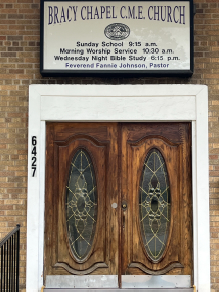
A part of the Third Episcopal District of the CME Church, Bracy itself was founded in 1986. Originally located at the Southside Senior Center 3017 Park Avenue, Bracy held its first worship on Sunday, July 5, 1987, under the pastoral leadership of Reverend Agnes Wallace. The church was briefly inactive after Reverend Wallace lost her husband and fell ill herself, but by March 1992, Bracy was rekindled with Margaret Dangerfield as pastor, who served from 1992 to 2004. From 1992 to 1995, Bracy was located in the Third Episcopal Regional Center, 5925 West Florissant Avenue. In September of 1995, it moved to its current location at 6427 Cates Avenue, which had previously been home to the Shining Star Missionary Baptist Church.
Reverend Johnson took over pastoral duties in August of 2004.
“And the irony,” the Reverend would interpret for me, “is this congregation has only had women pastors.”
Beth Yehuda Congregation
The building that now occupies 6427 Cates Avenue was built for religious purposes, but it had not always been for Christian worship. Originally a synagogue, from at least 1955-1979, this small, unassuming edifice had been home to the Beth Yehuda Congregation. As my friend had noticed, on the side of the church, one sees the original Hebrew lettering, with the date of 1949 inscribed:
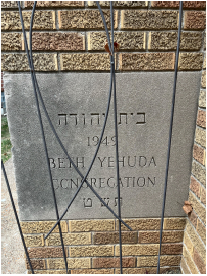
Based on archives at the Missouri Historical Society Library and Research Center, the synagogue had actually been located at 6431 Cates Avenue until at least 1953. To my knowledge, 6427 Cates had been an empty lot before Beth Yehuda moved in.
Today, no building is to be found at 6431 Cates. Instead, erected is a You Are Here sign, in this case advertising the University City Loop as “One of America’s Great Neighborhoods”:
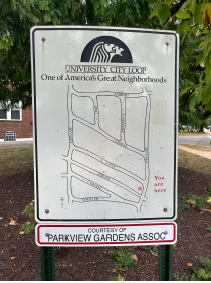
I am reminded of the transient meaning of You Are Here, a spatial here destabilized in a temporal here that knows nothing but change. You Are Here. What Was There?
A legacy of worship, i.e., a river (des Peres) ran through us
There, it turns out, and extending down the entire Cates Avenue, had once been the River des Peres, St. Louis’s central drainage channel that now runs from North Warson Road in Olivette, Missouri down to the Mississippi River in South St. Louis.
Rivers, like history, connect. I asked Reverend Johnson if she ever feels the reverberations of the legacy of worship that is this building on Cates Avenue in 2026. Judaic. Baptist. Methodist.
“We all had the same God. You can hardly not feel that because our foundations are the same.”
I remain on the outside looking in when it comes to this particular religious legacy—none of the three iterations of the Abrahamic God are my God. I am, in the end, steadfast in my unbelief. But I will not soon forget this little church in University City, Missouri, nor will I fail to remember a generous woman named Fannie Johnson who opened up to me about its history and her own. And if only for the revelation of shared values, it was certainly worth walking in. I yet may be back again just to check in. Who knows?