When Right Makes Might
A new book about right-wing political thinkers and their goals.
October 16, 2026
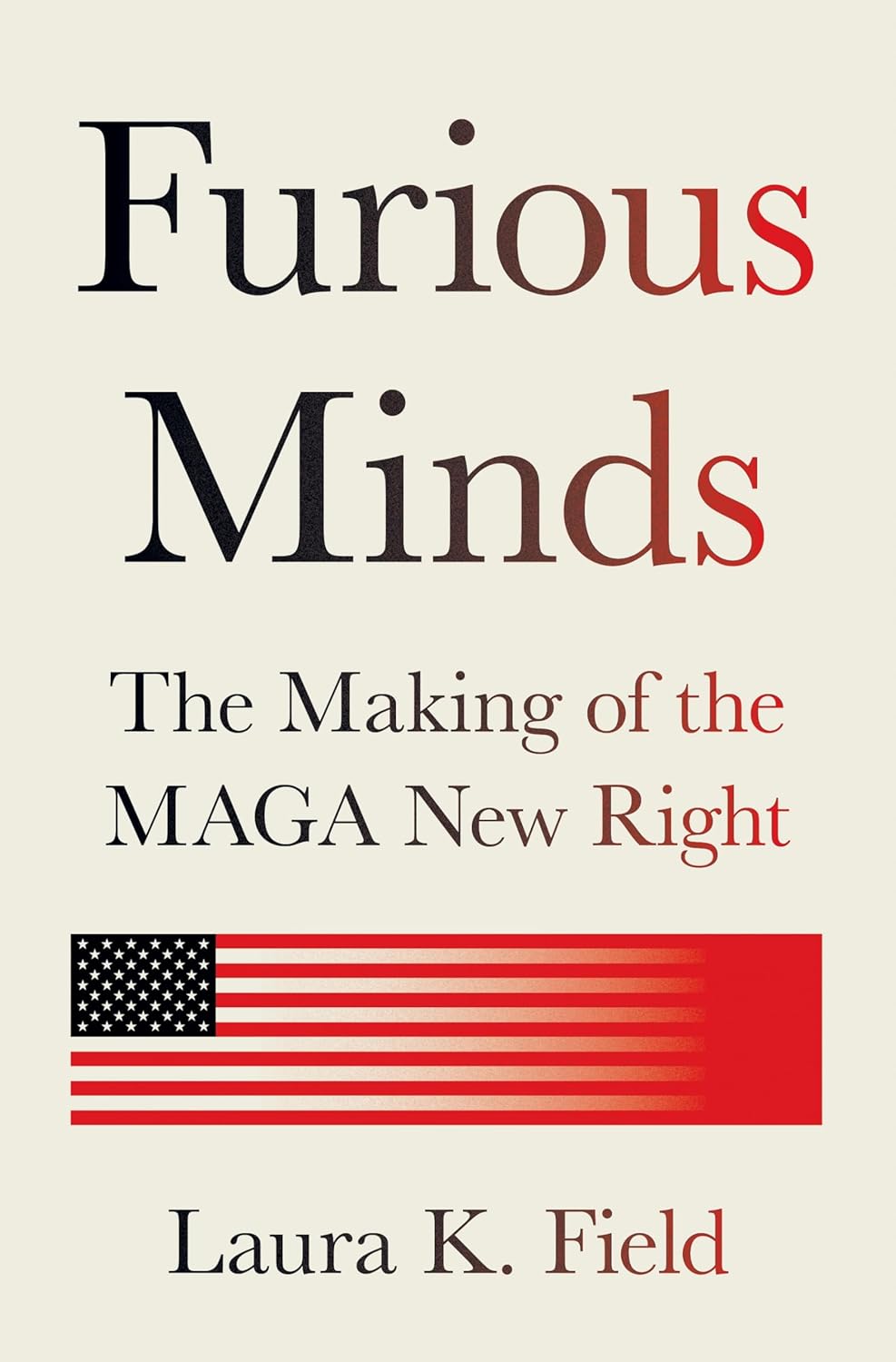
Furious Minds: The Making of the MAGA New Right
President Donald Trump has few core convictions and is anything but a student of ideas.
However, the political movement he leads is a coalition of individuals who adhere to a broad range of conservative philosophies. If you want to understand the details of these ideologies and how their adherents have translated ideas into policy, you would do well to read independent scholar Laura Field’s book Furious Minds: The Making of the MAGA New Right.
Her book is engaging and occasionally fun, though given that she is tackling arcane topics, she sometimes gets in the weeds. You do not need to have studied political theory to get a great deal out of this book, but if you have, reading it will be easier.
Liberals often sneer at the worldview of conservatives, and some even say that the phrase conservative intellectual is an oxymoron. Field’s book disproves that. Although she is a critic of the right’s worldview, she treats it with respect. That does not, however, stop her from using occasional snark and humor to make her points.
She describes the relationship between Trump and academic conservative intellectuals such as Harvard Law Professor Adrian Vermeule as follows. Vermeule is “the perfect high ivory-tower analog to Trump, the common thread being a bravura that intimidates and bamboozles.” She argues that Trump’s weapon is charisma while Vermeule’s is raw intellect. (224) Trump is also a skilled marketer, which many other GOP-leader wannabes were not.
Liberals often sneer at the worldview of conservatives, and some even say that the phrase conservative intellectual is an oxymoron. Field’s book disproves that. Although she is a critic of the right’s worldview, she treats it with respect. That does not, however, stop her from using occasional snark and humor to make her points.
Vermeule is one of the key figures in the Catholic postliberalism faction of contemporary conservatism. He argues that there is a “classical tradition” of law that rests on Saint Thomas Aquinas’s maxim that the law is “an ordinance of reason for the common good, promulgated by a public authority who has charge of the community.”
He is also an integralist, which Field describes as someone who “merely seeks to amplify the power of the faithful within the parameters of the institutional and cultural status quo: to staff the federal bureaucracy, to put integralists in positions of high executive authority, and to install them throughout the judiciary.” (230-231)
She rightly argues that Catholic integralists are for the “reintegration of church and state” and are theocratic because they want to “subsume political rule under that of a specific religion.” (230)
She argues that Vermeule and leaders of other factions of the current crop of conservative philosophies have a pessimistic set of ideas “organized around a traditionalist (usually White, Christian and patriarchal) social vision and homogenizing nationalism meant to counter and replace pluralistic liberalism.” (4)
Nobody will confuse this worldview with that of the last conservative hero, Ronald Reagan, whose 1984 reelection campaign television ads spoke of it being “Morning Again in America,” and was sometimes an incurable optimist.1
While Reagan and his ideological soulmates of earlier eras might well find the Trumpist worldview distasteful, the world has changed dramatically since Reagan’s presidency. And it is risky to try to guess how a politician from a previous era would assess contemporary conditions. That is one reason why the so-called “Never Trumpers” have had difficulty gaining traction in today’s GOP.
One could say that those who are not able to keep up with the times risk becoming the political equivalent of Norma Desmond. She was the leading character in Billy Wilder’s Oscar-winning 1950 film Sunset Boulevard, and a silent film star who could not accept the evolution into talking pictures.2
While that movie was released at the tail end of Hollywood’s golden era, few people would argue that we are currently living in the best of times politically.
Field, who has a doctorate in government with an emphasis on political theory, knows how to translate complicated topics into the vernacular. She approaches her subject like an anthropologist trying to learn about foreign cultures. Pardon the pun, but you might say her attendance at conservative gatherings constitutes field research.
The most important faction is national conservatism, which puts great emphasis on preserving national identity and uniform cultural views. Immigrants are only welcome if they come here legally (and then only in limited numbers) and if they assimilate in a manner prescribed by conservatives.
Field correctly contends that “‘National Conservatism’ serves as the big tent and umbrella for the movement. It is organized and formal in a way that the rest of the New Right is not, with regular conferences in the United States and abroad.” She describes its mood as “fervent and unyielding.” (7)
In addition, she notes that the New Right’s “capacious underbelly” is the Hard Right, people such as influencer and white supremacist Nick Fuentes. (7) A word about the phrase “white supremacist.” It is too often used by liberals to describe anyone who disagrees with their views on civil rights or racial relations. But Fuentes and some of his ideological soulmates definitely fit that description.
The origins of these strands of conservatism can be traced to political philosophers such as Harry Jaffa and Leo Strauss. Jaffa taught or influenced many contemporary conservative thinkers, and he in turn was a student and protégé of Strauss.
Field describes Jaffa, whose students founded the Claremont Institute, a leading right-leaning think tank, as having a “hard-line moralism.’’ (45) He was strongly anti-homosexual, and this caused him to clash with another intellectual hero of many conservatives, Allan Bloom, whose book The Closing of the American Mind,3 (1987) is the second best known critique of liberalism on college campuses after William F. Buckley’s God and Man at Yale.4 (1951)
Jaffa was a contributor to unsuccessful 1964 GOP Presidential nominee Barry Goldwater’s acceptance speech and is credited by some with the famous line “I would remind you that extremism in defense of liberty is no vice. And let me remind you also that moderation in pursuit of justice is no virtue.” 5
While Goldwater lost, conservatism would eventually triumph, and Reagan would enter the White House seventeen years later. Though Reagan was firmly on the right side of the political divide at that point (though he started out as a New Deal liberal), he was a pragmatist and sometimes frustrated those on the far right who wanted a less compromising form of conservatism.
Field reminds us that among the advocates for a hardline approach were journalist Samuel Francis and Nixon and Reagan speechwriter turned columnist and presidential candidate Patrick J. Buchanan. They were often described as paleoconservatives. While some of their ideas were considered too extreme by moderate conservatives like President George H.W. Bush (such as immigration restrictions and high tariffs) they gained traction among parts of the Republican and conservative base.
Those looking for a deeper dive into that era should read John Ganz’s When the Clock Broke: Con Men, Conspiracists and How America Cracked Up in the Early 1990s.6 (2024)
In a sense, we have come full circle. If you go back to the late nineteenth and early twentieth centuries when the GOP controlled both Congress and the presidency, immigration restrictions and high tariffs were key components of the party’s agenda. A significant difference, however, was in racial relations, where the Republicans were sometimes somewhat more progressive than the Democrats. Republican Theodore Roosevelt had dinner with Booker T. Washington at the White House in October 1901, an extraordinary thing at the time.
Field wants her soulmates on the left to have similar success as their conservative counterparts but thinks they have greater obstacles. She argues that “liberal purposes (and liberal happiness) will always be plural and messy: more Mardi Gras or renaissance fair than country club or debutante ball.”
In addition to promoting their own views, conservatives want to see most traces of liberalism gone. Harvard University political theorist Harvey C. Mansfield contends that “liberalism knows essentially nothing of the land of virtue.” That feeling of moral superiority has been a key part of modern conservative thought, though liberals are often equally contemptuous of their adversaries.
Field wants her soulmates on the left to have similar success as their conservative counterparts but thinks they have greater obstacles. She argues that “liberal purposes (and liberal happiness) will always be plural and messy: more Mardi Gras or renaissance fair than country club or debutante ball.” (319)
Her call to action includes better civic education and a “hardened but steadfast toleration for worldviews that we find incomprehensible, deeply offensive, or dangerous.” (320)
An effective way to start down that path is reading Furious Minds: The Making of the MAGA New Right. It is at times dense and other times quite lively, but worth the effort. Even if you find yourself pulling out philosophy texts to dig deeper or kick yourself for not having paid more attention in college.
1 https://www.youtube.com/watch?v=8J2hs6tuuCA
2 https://www.youtube.com/watch?v=TMUJpec6Bdc
3 https://www.simonandschuster.com/books/Closing-of-the-American-Mind/Andrew-Ferguson/9781451683202
4 https://www.regnery.com/9781684512362/god-and-man-at-yale/
5 https://www.youtube.com/shorts/JZUDsVnaTPM
6 https://us.macmillan.com/books/9780374605445/whentheclockbroke/