“Even a Nobody is More Powerful Than You Think”
June 19, 2026
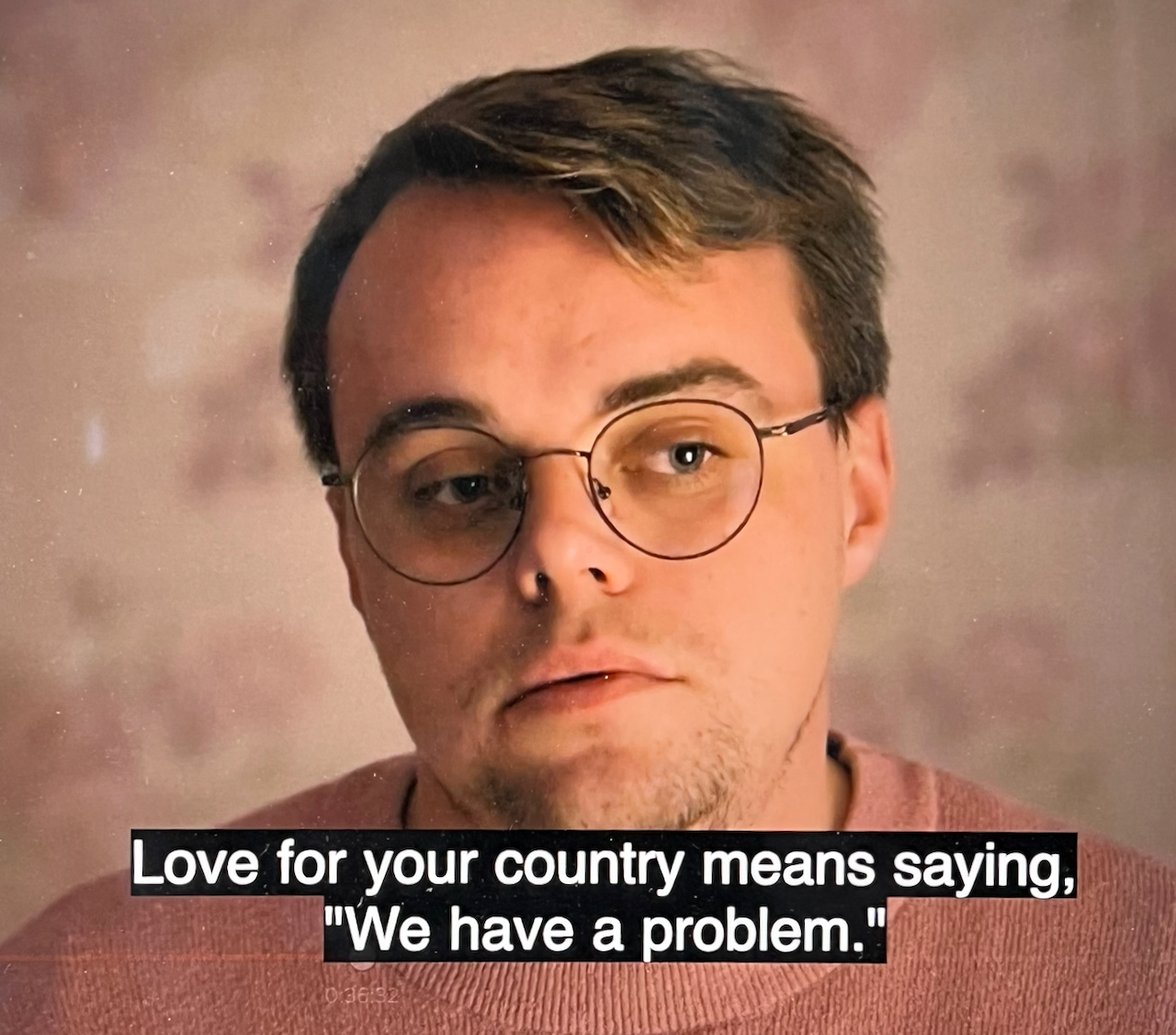
The documentary Mr. Nobody Against Putin (2025) is about a Russian events coordinator and videographer who documents the militarized indoctrination at the primary school where he works, after Russia invaded Ukraine in February 2022. The film has won major prizes, including the Academy Award for Best Documentary Feature Film in March. Predictably, the Russian government hates it and has taken steps to punish those involved.
The opening shots of the film are purposely misleading, showing a young Matt Damon-like figure doing something furtive with a shovel in the night, as a voice like a spy’s handler tells him how to cross a border. In reality, Pavel “Pasha” Talankin, the film’s main character and nominal co-director, is digging up a sapling for a traditional graduation ceremony at his school, and the audio is from a call at a different time.
The fake tradecraft reflects an irony. As co-director David Borenstein, an American who works from Copenhagen, says, the first footage that he saw from Pasha Talankin was more “like something out of School of Rock…[Talankin’s] motley group of kids hanging out in his classroom, doing jokes and making rap videos….” Talankin had attended the same school, and his round, grumpy mother is the school librarian. Borenstein thought he seemed more like “this goofy hometown teacher filled with humor and filled with love for his students” than an “international whistleblower.”
The town, Karabash, a thousand miles east of Moscow, is a catastrophically polluted, copper smelting town of 10,000, and socially not the sort of place a lone dissident might be expected to emerge. But Talankin had already been set apart to some extent. He is gay (something used against him in Russian condemnation of the film) and says he was lonely as a kid at the school and at home. When he was nine, his father drowned in a lake. In the documentary, he lives alone, apparently, in a two-bedroom apartment. (“Here I have 427 books,” he says.) At school, he says, he creates his own family of artsy and alienated kids in his welcoming office. One of them wears a Rick and Morty t-shirt. The faces of Hermione Granger and Severus Snape are pinned to the bulletin board, and when Talankin tells us to look at what he has hung above them, the camera pans up to a Russian democracy protest flag. The Russian government, predictably, considers the flag terroristic. Viewers have reason to worry for Talankin.
When Putin invades Ukraine, a federal policy is instituted for patriotic education in Russian schools, mandating special lessons, songs, morning drills, and flag ceremonies. Talankin is told to film and upload all the events “as proof that the school is complying with government orders.” He films a teacher reading to bored kids: “State policy in Ukraine is decided by radicals, nationalists, and”—she pauses—“neo-Nazis. Everything that unites us have been brought under attack.” A second teacher cannot pronounce “demilitarization” or “denazification” from her script, and she and Talankin discuss whether she needs to take it from the top. The kids look around, confused. Talankin tells another class their teacher is being forced to read what she is about to read to them. Later, mercenaries from the Wagner Group speak at a school assembly and pass landmines around. Later still there are marching drills, shooting practice, and a grenade-throwing contest. Talankin’s video captures how in less than two years the school is no longer the same institution.
“Commanders don’t win wars,” Putin is shown saying on the air. “Teachers win wars.”
Though the documentary serves as an example of one man using what he has at hand to fight propaganda and oppression, it also chooses, in subsequent editing, to represent warmongering only through this one school in the Ural Mountains. It does not portray bigger things, such as Ukrainian death and devastation, Russian soldiers killed by the hundreds of thousands, or Putin’s autocratic machinations. The worst bad guy in the film is the willing propagandist Pavel Abdulmanov, a ghoulish history teacher who loves his job as “representative of the ruling party.”
“I think that the history of Russia is one of the most important social sciences,” Abdulmanov says. Asked which historical figures he most admires, he names Lavrentiy Beria, chief of Stalin’s secret police and “father of the gulag system”; Viktor Abakumov, “Stalin’s spy hunter,” who murdered many non-spies falsely accused; and “definitely Pavel Sudoplatov,” “Stalin’s assassin.”
Asked how his students will remember him, Abdulmanov replies, “As a fun person, I hope.” To students, he says, “If you live in our country and don’t love it, then you’re a parasite. Leave.”
Predictably, when the town’s “favorite teacher of students” ceremony comes around, an award intended for someone kind, understanding, and “who creates a space for students where they feel comfortable,” it is handed to Pavel Shaihovich Abdulmanov. The prize is a deluxe apartment in the town center.
Meanwhile, Pasha Talankin openly questions things at work and acts out—playing the U.S. national anthem sung by Lady Gaga, instead of the Russian one, and pulling down a Russian flag, e.g., until he becomes a pariah. His mother chides him and says he has enemies. People glare at his camera. Police sit in the parking lot of his apartment. After Putin passes a new law against treason and convicts a journalist with it, Talankin, as part of his duties, must record Pavel Abdulmanov saying Russia’s enemies are using locals in communities to spread propaganda and confusion.
Talankin vows, “Whatever repercussions come of this, so be it.”
The consequences have included his (necessary) self-exile from Russia. Le Monde reports, “Concerned about the Russian state’s reaction, the BBC, the main producer of the project, advised Talankin to keep his social circle to a minimum and to be careful with everything he eats, ‘so as not to risk being poisoned.’” Predictably, a court in Russia banned the film, ruling it “propagates extremism and terrorism”; Russia has named Talankin a “foreign agent.”
An independent media outlet in Russia sent a reporter to Karabash on the eve of the film’s Oscar win to see what residents had to say about it. More than 10 teachers at the school ignored messages from the news team, and one said she would not speak to them but did not say why. A former student said that “teachers who appear in the film ‘do not raise this topic with students, even former ones.’”
Pavel Talankin told the publication, “As far as I know, the FSB [the successor to the KGB] came around, they gathered up all of the directors of educational organizations and told them to tell everyone not to be in contact with [me], don’t write to [me] at all, this person never existed, this film never existed, do not make any comment on it.”
“Even a nobody is more powerful than you think,” David Borenstein said on the Oscar stage.