The Friends of Vintage Flight Visit St. Louis
June 9, 2026
The Spirit of St. Louis Air Show and STEM Expo took place last weekend, sponsored in large part by Boeing, whose Defense, Space & Security division is headquartered in St. Louis.
Out by the Missouri River, an F-22 Raptor did its magic tricks, barely lifting off the runway before going vertical in a puff of vapor, then stopping midair for a bit, pretending to fall tail-first toward the ground, and shooting away with glowing afterburners and a roar felt in the chest.
There were performances by the US Navy Blue Angels and the Canadian Forces Snowbirds (to be grounded this year until the early 2030s, when they will exchange aging jets for turboprop aircraft). A WWII P-38 and P-51 Mustang flew over in formation, and a couple of Grumman warbirds—Bearcats? Hellcats?; it is hard for an amateur to know—made low, growling passes. Skip Stewart did flight-defying aerobatics in a modified Pitts biplane. On the ground there were the “That’s All, Brother” C-47 that led the invasion on D-Day; its cousin, a shining American Airlines DC-3; the Commemorative Air Force’s B-25 bomber; an odd CV-22 Special Operations Forces Osprey; and many other static displays among food stands, a climbing wall, vendor booths, and recruiting tents for the armed services.
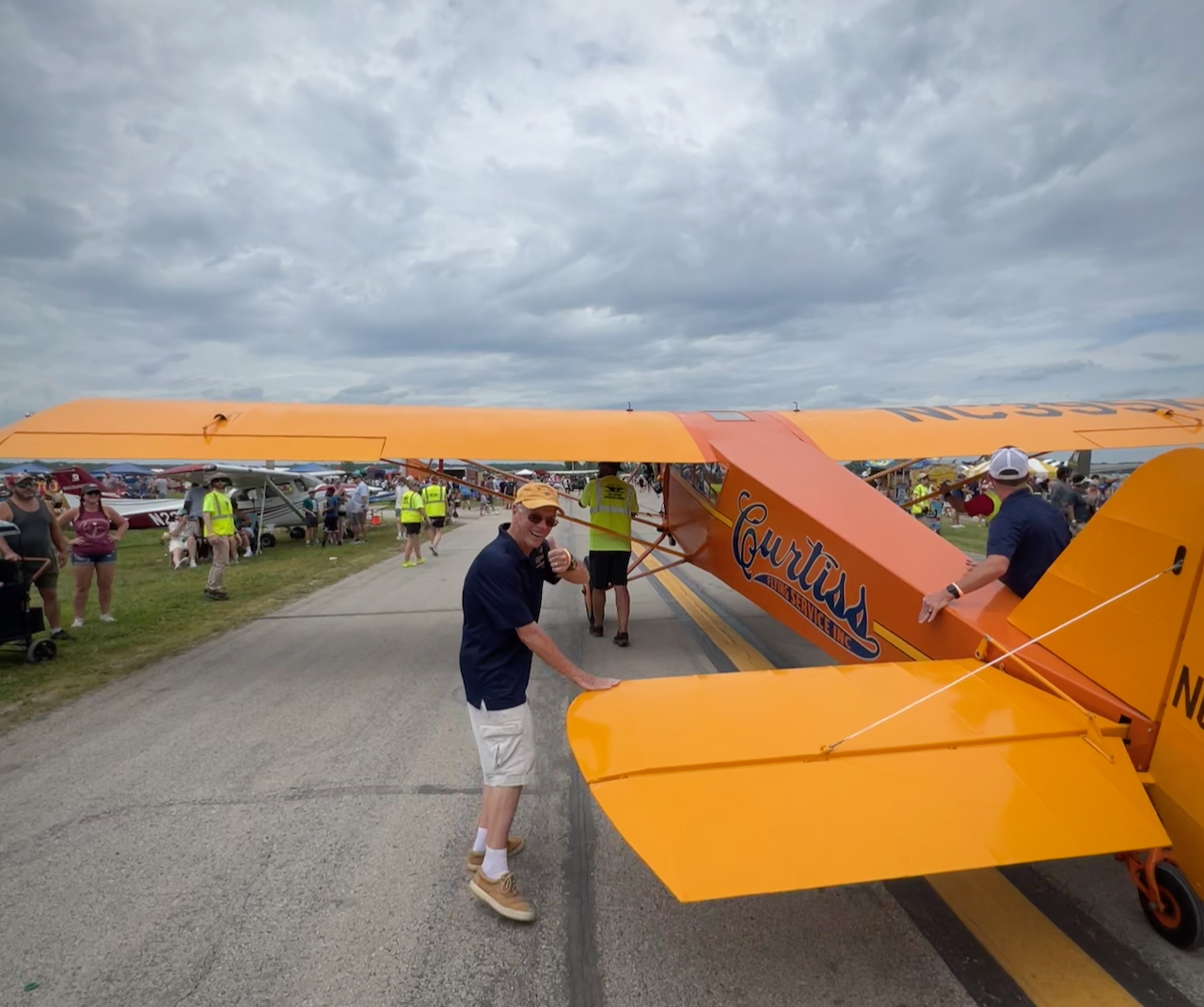
The main attraction for me was the latest historic restoration by the Friends of Vintage Flight. At the information table set up at the entrance to the massive airfield I told the staffer I had come specifically to see a friend who was there with a historic plane. She did not have a map but asked what the plane was, and when I said a 1929 Curtiss Robin, she remembered its distinctive orange color and pointed me in the right direction.
Dorian Walker, his wife, Elaine, and a co-pilot, Justin Tidwell, were answering visitors’ questions next to the plane, named “Spirit of Kentucky” after its home base in Bowling Green. The Robin, a beautiful, high-wing monoplane, last year won Grand Champion in the Transport Category at the Experimental Aircraft Association AirVenture in Oshkosh, Wisconsin, the biggest air show in the world. (A “walkaround” video of the plane can be watched here.)
Dorian and the team at Friends of Vintage Flight have restored several aircraft and believe strongly in the educational and emotional power of seeing old planes actually fly, not just sit in a museum. That was how we met, in 2022: I went looking, on a whim, for a WWI-era Jenny biplane to fly in, and Dorian gave me my chance for a once-in-a-lifetime experience. Less than a year later, returning from a different air show in St. Louis, the Jenny had a problem and was damaged badly when Dorian had to make an emergency landing without power.
Because of the time, resources, and skills needed to restore an aircraft to flying condition, Friends of Vintage Flight must make strategic decisions when they choose a project, based on the group’s capabilities, the condition of available aircraft, and their historical significance. The Curtiss Robin has a fascinating history as one of the most commercially successful aircraft of the period between the world wars, and began production the year after Lindbergh made the first solo trans-Atlantic flight in 1927. In July 1929, a Robin was used to establish a record endurance flight, over St. Louis, of 17½ days, refueling in the air. In 1938, “Wrong Way” Corrigan, denied permission to cross the Atlantic, flew a Robin anyway from Brooklyn, New York, to County Dublin, Ireland, claiming he had accidentally gone the wrong way back home to California.
This particular Robin flew on the West Coast, for a hunting camp in the Sierras, in the Civil Air Patrol in WWII, and for parachutists as a jump aircraft. In 1961 it was stolen while sitting on a truck and ended up in a bean field. A California craftsman bought it in 1971 and worked for 50 years to restore it but never finished. The Friends bought it in 2021 and flew it for the first time in 2024.
Dorian, one of my favorite people, gave me the kind of big handshake that starts out to the side.
“Now, you asked me, ‘How does it fly?’” he said with a grin. “Beautifully, when it flies.”
They had started in Bowling Green at 5:30 am on Friday, so they could meet a “photo ship” (a flying photography platform) in St. Louis, to get some in-flight shots of the Robin at 9:00 am. The big radial engine had been overhauled, so it had very few hours on it, but “about 30 minutes [from Bowling Green], and I’m hearing tick, tick, tick, tick,” Dorian told me. In flight, he asked Justin, who is also a mechanic, “You hear that?”
Justin said no, then, “Wait a minute, I do hear it.”
Dorian told me the landscape below was “not bad territory, but there’s a lot of woods and some hills…and you just are always on the lookout, as you know from your former stories, for where you might have to make an emergency landing.”
To be safe they turned back, and an acquaintance who owned a Boeing-Stearman biplane with the same engine was able to tell them to check the number two and number four cylinders, where they found some “non-critically overloaded plugs.” They changed out all the front spark plugs, got underway again, stopped once for fuel, and made it to the Spirit of St. Louis Airport in Chesterfield, Missouri, about one minute before it closed for air show practice.
There was a crosswind with gusts to 23 knots, “And, you know, these airplanes don’t like that,” Dorian said—the plane has enormous wheels that act like sails, among other reasons—but, “Justin brought it in like there was no wind at all. So it ended up being…an adventurous, unusual, ‘Were we gonna make it? Are we gonna make it?’…vintage aviation experience….”
Now it was Sunday, and the show was nearly over. The weather was predicted to be bad on Monday, so Dorian and the ground crew were eager to push the plane to an apron, in hopes that as soon as the Blue Angels finished their maneuvers and were down, the show’s air boss would let them take off for Kentucky. He invited me to come down there to fly in the Robin, and to come see a historic yacht he and Elaine had salvaged and restored, now berthed in the Chesapeake.
Dorian introduced me to Justin as a writer who had written about him and the Jenny.
“It’s hard to read about yourself,” he said, laughing, “but I’m told it’s fascinating.”