Yeah, No
September 30, 2026
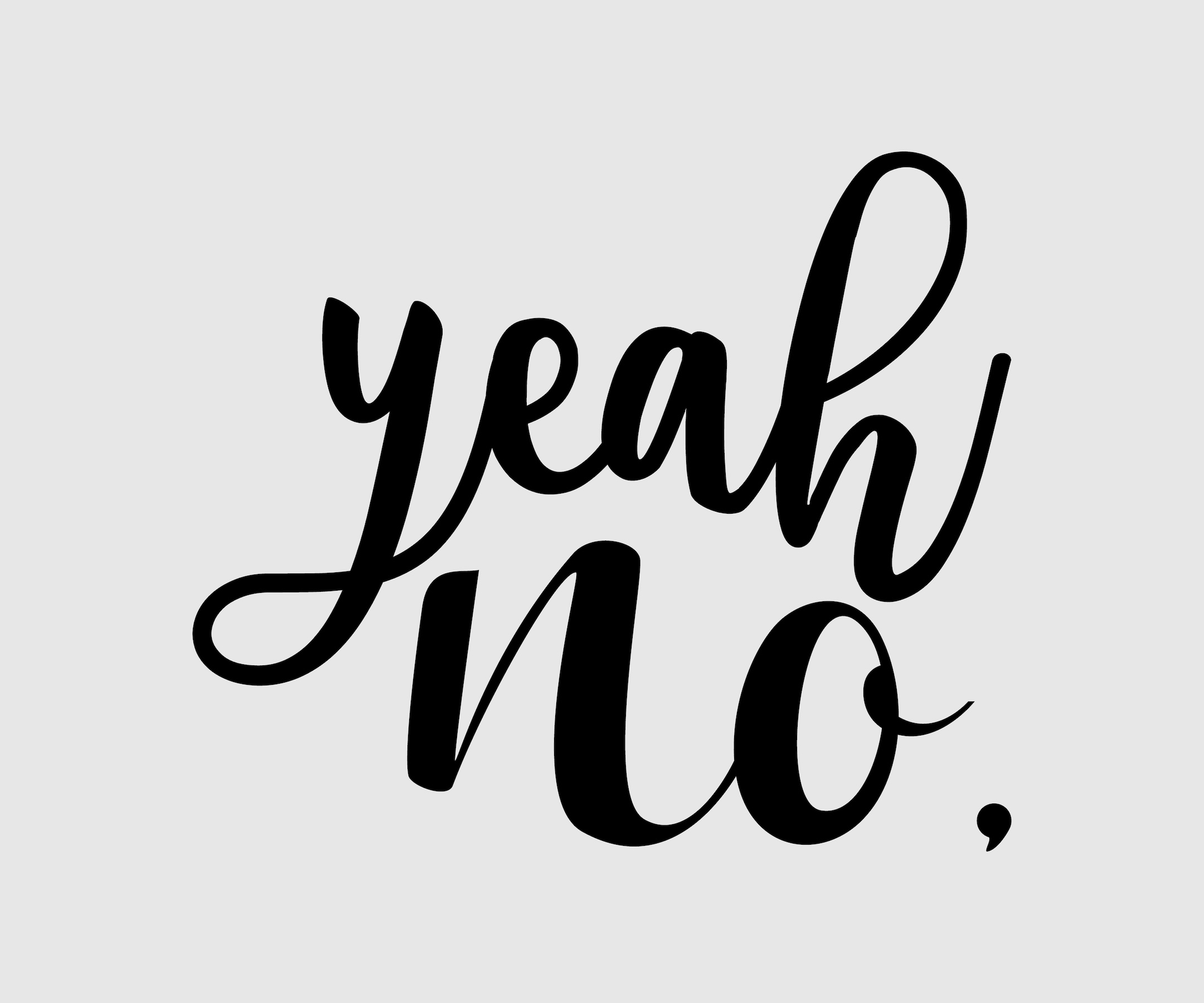
“Yeah, no.” There I go again. I do know my own mind, so why do I always sound so bloody indecisive? Yeah-no makes no sense. Yet I have caught myself saying it again and again for, what, twenty years now? Where did this verbal tic come from? Mortified, I dig into the etymology and find I am far from alone. The usage is actually rather common, and though it confounds logic, it has as many functions as a gadget in an infomercial. They are not conscious, mind you. At least not for me. I just find the phrase burbling from my lips. But leave it to the linguists to tease all this apart.
First, the phrase is not ambiguous, after all. One is answering two separate questions: “Yeah, I hear you. No, I don’t want to do that.” The “yeah” opener acknowledges the first speaker and softens the rejection. Or maybe the rejection is not complete. You can begin “Yeah, no,” to flag some complexity: the first speaker is right but not entirely right.
Add another positive—“Yeah, no, absolutely”—and the “no” in the middle has simply bought you time. It inserts a little pause that acknowledges the possibility of disagreement before agreeing. “Yeah, no, I know” does this too, showing that you understand that not everyone agrees. And my favorite, “Yeah…no,” has some edge, the “yeah” sarcastic enough to make your “no” emphatic.
All of this could have been done with words that actually meant these things, but the sentences would have been a lot longer. Besides, “Yeah, no” is managing the social interaction, not just the literal meaning. If somebody offers advice and you respond with a flat “No,” that sounds a bit ungrateful, even surly. “Yeah, no, you’re probably right” will soften the inevitable discard. Like one of those horrid compliment sandwiches they teach you to give when offering feedback or doing a performance review.
The sister phrase, “No, yeah,” is one I never use. Which tells you way too much about my need for harmony and aversion to conflict.
Both constructions sound fairly new to my ear, casual in a way that would have appalled people in previous centuries. My elders (the few still breathing) might have said, “Well, yes and no” or “Yes, but.” They would never have dreamed of loosening up and compressing their formal logic into a friendly shorthand.
Sure enough, a landmark study in 2002—“Yeah-No He’s a Good Kid: A Discourse Analysis of Yeah-No in Australian English”—described the phrase as a “relatively new marker” used for agreement, disagreement, softened disagreement, hesitation, and conversational cohesion. Australian English uses the phrase even more than we do, letting the intonation in “yeah nah” or “nah yeah” carry any of a number of meanings.
When actor and comedian Melissa McCarthy was filming in Australia, she was interviewed on ABC about her love for the Australian accent and the “yeah, nah, yeah.” “It’s so comforting, instead of just a flat no,” she remarked. (Granted, she was also delighted by seeing a spider the size of her head.)
In Australia, the phrase has melded into a single unit; for us, it is still two separate responses, one meant to either cushion the other or emphasize the disagreement. Other languages have yes-no constructions too: ja, nein in German; oui, non in French; da, nyet in Russian. Japanese is subtler, using a no in front of an affirmative statement to reject the assumption behind the question while at the same time affirm what is being proposed. Which makes me a little dizzy. The point is, this quirky little phrase has become a recurring human conversational strategy. It lets us operate on two levels at once, acknowledging the first speaker before responding to what was said. It is therefore useful for hedging, aligning, modestly downplaying a compliment (it shows up a lot in sports journalism), or saving face. Lexicographer Jonathan Lighter once quoted a former New York City police detective as saying on CNN: “Yeah, no, you’re right!” Lighter translates: “There it seems to mean, ‘Yes indeed, and no, I wouldn’t think of contradicting you.’”
Interesting, how the “yeah” can either erase any negativity from the word “no” or ramp it up. Now that I have learned about all these uses, though, I have to admit that I never perfected the sarcastic option. Nope, I use it to soften or stall. Which, come full circle, is a bit indecisive of me. “A bit.” Softening again. No wonder my YouTube videos keep getting interrupted by crisp, professional women who have trained themselves to speak with authority and never, ever use all these fabric-softener words that smell prettier than they should.
I like indirect speech. I can be assertive about that. We are all at odds often enough. Why should we not soften the blows? Like the parents who hug their kids even as they are scolding them, the habit means to reassure.
A “no” should never be a rejection of the person you’re talking to, only of whatever they are asking or suggesting. “Yeah, no” reminds us that conversation is about far more than logic. It will annoy purists and trouble those of us who already worry that we are not assertive enough. But assertiveness has been taught in a way that glides, indifferent, over other people’s feelings, concerned only with the value of its own point.
That kind of logic works in a courtroom. But a conversation, I hav decided, needs a little illogical gentleness.