Exorcisms Are on the Rise
November 15, 2026
The nation’s vice president believes that UFOs are piloted by demons. The president says left-wing radicals “have the devil’s ideology.” And if you watched The Tucker Carlson Show between December 2023 and the end of July, you heard 644 mentions of demons and the supernatural. An easy way to lure viewers? Yes, but more than that. In an interview for adocumentary on Christianity, Carlson confided, “I got attacked while I was asleep with my wife and four dogs. I was mauled, physically mauled. By a demon, or by something unseen that left claw marks on my sides.”
Maybe a dog with untrimmed nails who was dreaming?
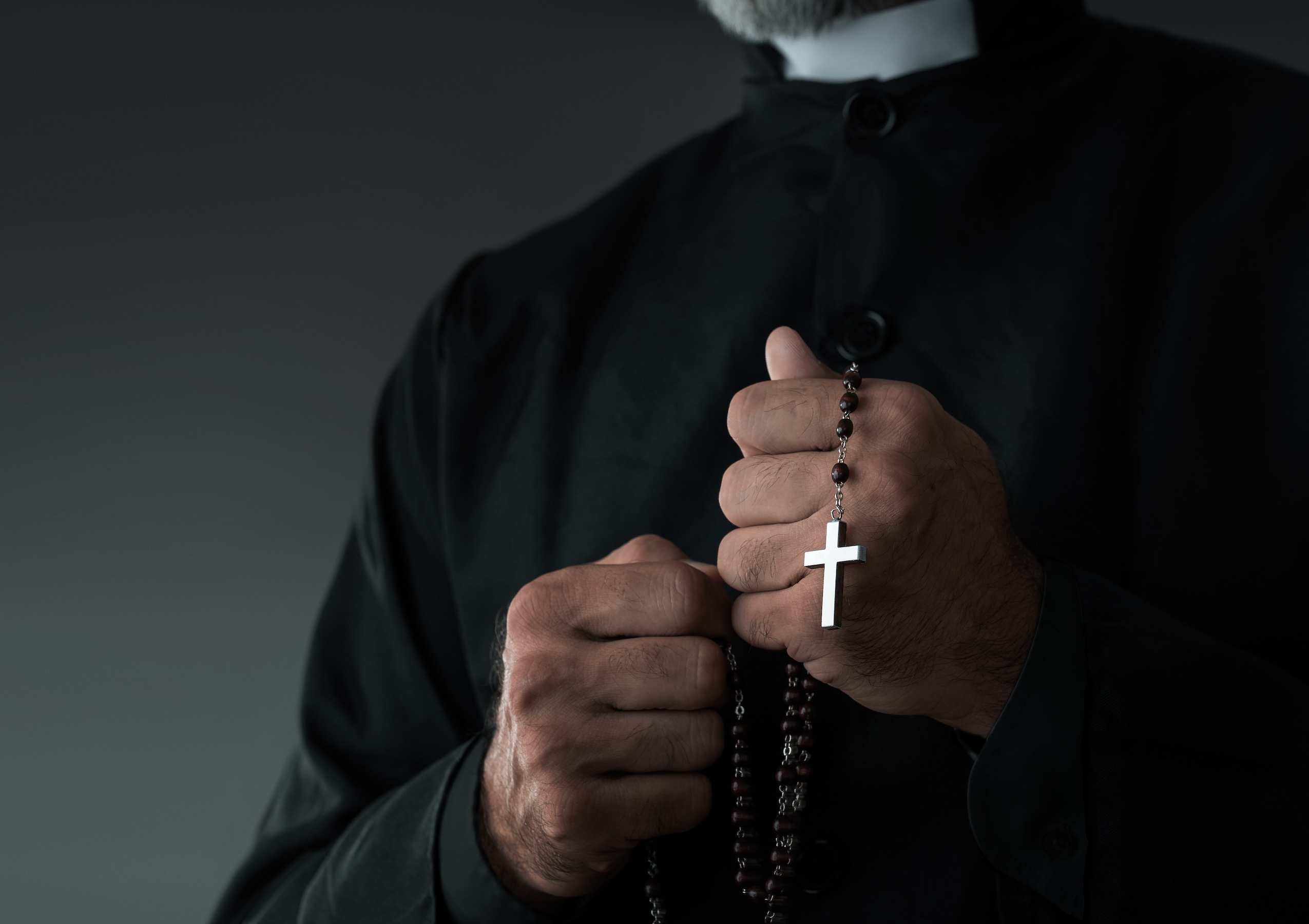
I should refrain from sarcasm. Polls regularly show that more than half of us believe in Satan and his demons. This past March, Pope Leo XIV met with leaders from the International Association of Exorcists, which has received the Vatican imprimatur. Warning of a rise in demonic possession, they asked him to make sure that every Catholic diocese has at least one trained exorcist.
WashU’s department of anthropology recently hosted Dr. Thomas Csordas, an anthropology professor at UC San Diego who has studied the resurgence of exorcism in the Roman Catholic church. In Italy, he sat in on one of the training courses offered by the International Association of Exorcists. In the U.S., he made contact with priests who were doing exorcisms.
“And they agreed to talk?” I ask, startled.
“They can be very secretive,” he agrees, “and there are levels of secrecy. Some bishops have officially appointed exorcists, some unofficially have a guy they can call, and some try to keep the whole thing at arm’s length. If you identify a priest who is an exorcist, some are willing to grant an interview, but the second level is getting them to put you in contact with people they have exorcised, and the level beyond that is getting permission to actually attend sessions of an exorcism.”
Csordas managed to be present at a handful of exorcisms. “It’s not simply reading a rite from a book,” he tells me. “There is a substantial amount of improvisation in finding out what the afflicted person’s background is and how they should pray. The core of the ritual is identifying what evil spirits are afflicting people, allegedly, and having those spirits name themselves through the person.”
I can see how that name and constellation of traits would revealing, whether the priest considers the information spiritual or psychological. As can Csordas, who has spent years investigating the power of religion and ritual. He is not a believer; he simply wants to understand how these beliefs and acts are therapeutic, and how they affect us both individually and societally.
“The main transformation,” he tells me, “is a transformation of meaning. The meaning of experience, the meaning of symptoms, the meaning of suffering.”
In his current project, he is also “trying to describe the logic of exorcism.” At the individual level, “the signs and manifestations of the demon are spontaneous behaviors or vocalizations. You are interpreting, or reinterpreting, things that are natural and spontaneous.” We all have intrusive thoughts that startle us, and we wonder, Why was I thinking that? Once we are possessed by a demon, however, that intrusive thought takes on supernatural weight. Even a burp or a yawn can be perceived as ominous and significant.
At a higher level of logic, Csordas continues, the system is based on patriarchal authority, on the one hand, and benevolent paternalism on the other. “The discourse of patriarchy is a discourse of evil at large in the world: the patriarchal power of God needs to be mobilized in order to suppress Satan. The discourse of paternalistic healing is directly addressed toward individual suffering and pain. The logic of exorcism is based on this interaction of patriarchy and paternalism.”
Meanwhile, in the middle, you have the drama of free will, as the individual struggles, with the help of the priest’s authority and care, to free themselves. “It’s ironic in a way,” Csordas remarks. “You exert your free will to get liberated from the devil, but you are expected to submit your free will to God. I don’t know if that’s trading allegiances, or what!”
When did the resurgence begin, I ask, and he places it around the turn of this century; he started his research in 2010. Why at the new millennium? The world was growing more fragmented and more chaotic. We had lost the good-versus-evil clarity of World War II and the freedom-versus-tyranny motivation of the Cold War era. Now the good was less obvious, harder to distinguish. And anxiety was magnifying a sense of pervasive evil.
Also, there was a new rite of exorcism to refresh our interest.
The original Roman rite was published in 1614, and it was not revised until 1999. Vatican II had ordered a revision of all church rites and rituals back in 1963. Exorcism was the last to be touched.
An exorcist’s “weapons” remain unchanged: the holy water, the sign of the cross, the laying on of hands. But now illness, mental or physical, must be ruled out before an exorcism can begin. The tone has changed, too, losing the vitriol formerly hurled at Satan and substituting calm, sober words for the lurid epithets and raging insults. Satan has lost some personality, becoming a “spirit without body, color, or odor” whose main aim is to deceive. Though they will still command the demon to leave, exorcists are now more likely to first plead with God for deliverance from the evil.
“A lot of exorcists are conservative,” Csordas notes, “and some didn’t like the revision and would rather use the 1614 rite.”
As he speaks, I am remembering a former colleague, Rich Roberts, who interviewed Jesuits who had been involved with the famous 1949 St. Louis exorcism. He then flew to Arizona to interview Fr. William Bowdern, who had been the lead exorcist. My family knew Fr. Bowdern, and I had always heard that he had a nervous breakdown after the ordeal. Rich told me that when he arrived, Bowdern leaned close and said, low and fierce, “You don’t know what you’re dealing with.”
Rich was so scared, he tore up all his notes. I groaned when he told me. The eyewitnesses had since died; their experience is lost forever.
Tom Csordas did not tear up his notes. But he was a little taken aback when one priest told him, “I would feel uncomfortable having you in one of the sessions because it could be dangerous for you.” Was it dangerous because I was not a believer, he wondered later, or would it be more dangerous if I were one?
He also had a Catholic clinical psychologist ask him, after a session they observed together, whether he felt anything. “What do you mean?” Csordas asked.
“Oh, like a prickling of the hair on the back of your neck….”
When he said no, the psychologist looked disappointed.
Csordas has written a book about his findings: The Devil You Know: Catholic Exorcism in the 21st Century, which will be published by Bloomsbury. Does he, I have to ask, believe in evil in any form?
“I’ll refer you to a book I co-edited: Encountering Evil. There’s a debate within the book where I say that evil is a real but completely human thing. The issue is not theodicy.”
Our panicked personification of evil does seem to cycle. There are waves of witchcraft scares, waves in which entire groups are thought to be possessed, waves of rumors about satanic rituals. As more people leave the comforting folds of religion, I wonder aloud, where will those beliefs move? Religion gives evil a structure—and a remedy. Scientific method has not even fathomed psychopathy yet, let alone evil’s contagion.
“I think there’s a kind of reenchantment of the world in process,” Csordas says. “The Enlightenment is not something we can take for granted anymore.”
I nod, not sure whether to be chilled. Questions and fears loom large these days, and people feel a need to look beyond science, beyond empiricism, beyond rationality. In the best case, that restores a sense of wonder, mystery, sacredness, and warmth to what was a coldly mechanical world. In the worst, it opens the door to distortions, magical thinking, medieval superstition, and a dark swirl of evil, however you define it.
“You might say that the resurgence of exorcism is an instance of reenchantment,” Csordas remarks. “But from the standpoint of the exorcists themselves, the resurgence is a stand against reenchantment.”