Is Frivolity Always Frivolous?
August 30, 2026

Once, I had to fly to Oklahoma to write about a woman who had been killed and buried in her own garage, her near-term baby cut out of her by a woman so crazed for a child of her own that killing seemed a strategy. When the reporting was done, I browsed for a long time in a western-wear store before heading for the airport. Mind dulled, heart frozen in self-defense, I flipped idly through purses and found myself buying one. Not on sale. Not my style. Did not need it.
When I wrote about a young woman who had been diagnosed with aggressive breast cancer early in her first pregnancy—only to learn, after both breasts were sliced from her body, that the pathologist had misread the slide and she had a rare but benign growth instead—her voice haunted me for days, saying through sobs how she had yearned to nurse her baby. That time, I bought perfume.
The pattern did not even dawn on me at first, but after another grim story and frivolous consolation prize, it was obvious what I was doing. I felt guilty at my unconscious yet deliberate, near compulsive, juxtaposition of sorrow and silliness. Clearly I was doing this on purpose: reminding myself, whenever reality was a little too much to bear, that the world also held beauty and lightness and fun.
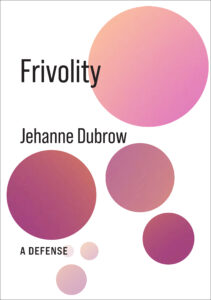
Frivolity, for me, was a defense. But frivolity can also use a little defending—hence Jehanne Dubrow’s new book: Frivolity: A Defense. She glides through fashion, romance, film, drama, poetry, and painting, dipping and dabbling, frivolous even in form.
Much of the frivolity she analyzes is feminine in nature. She warns us of this at the outset, pointing out that “men’s passions are taken seriously. The games they play as children become their weekend hobbies as adults, even if now they only watch a ball being hurled back and forth from the marshmallow cushions of their living rooms. Men are permitted to be fans. They can wear jerseys that hang to their knees, baggy shirts in primary colors, without censure. And the game (whatever that game might be) is never a frivolity.”
A woman who indulges in a vial of perfume, on the other hand, is forsaking gravitas. I felt it that way, and so did Dubrow, writing about her passion for scent in an earlier book by saying, “In a dark time, I am in love with something frivolous.” In the new book, she invokes Emma Bovary as she falls in doomed love with a young man, both of them hungry for art that “raises up the soul and feeds a feeling of infinity.” When he goes off to law school, Emma goes shopping. “She bought a Gothic prie-dieu, and in one month she spent fourteen francs on lemons for cleaning her nails; she wrote off to Rouen, to order a blue cashmere dress….” She had no other way to feel free, to express herself, to soothe herself, to regain control.
If anyone should understand this, it is I. Yet Emma is hard to love; she really does seem unbearably shallow, however you intellectualize it. I feel better when Dubrow quotes the French playwright and novelist Yasmina Reza: “I find frivolousness to be very deep. The frivolous is the foam that floats over the depths. Human drama doesn’t consist of big tragic incidents. Naturally, they happen in the course of a life—but for the most part, it’s full of small details, minor scrapes, wrinkles, micro-events, that together make up the struggle of being.” Reza traces the ways “the fabric of a life wears out,” using its trifles as signposts. “I choose to pick at what seems most irrelevant, most superficial, most unfit to dig into, and I dig into it—that’s how I write.”
Reza’s best known play is God of Carnage, and Ralph Fiennes had the lead. Hardly a trifle, then. Dubrow is still trying to convince herself that an entire book about frivolity can also have substance. Is her project inevitably shallow, she wonders. Even, perhaps, narcissistic? “We hate Narcissus for tumbling into his own watery reflection,” she writes. “But…a face that can’t stop staring at itself is really searching for a way to fall asleep or melt into numbness.”
Slowly, she wakes, peeling back the feathers and fluff, showing how frivolity is intricately bound up with the serious. Think of the protesters in silly costumes, disarming power. “Political speech as whoopee cushion,” she calls it, levity for the public square. And we all have private frivolities, too: even the soberest of judges and sternest of clerics indulge some lightweight idiosyncrasy.
By the book’s end, Dubrow has realized that “the frivolous may summon us back to ourselves.” Often it is what the body asks of us, and relishes. Often it is the mind’s necessary escape. “Some frivolities wear satin bows or ribbons to conceal their solemnity,” and what seems feminine has always been dismissed as somehow less weighty. But always, she writes, “the frivolous asks us to examine what we find worthy and what we dismiss.” And why.
It feels, Dubrow concludes, “increasingly tired to pit frivolity against the serious.” They shape each other. The serious grounds us, and frivolity lets us fly away for a bit, so we can come back with the wind in our hair and settle down to work again. Inhaling Shalimar as we face life’s next grim assignment.