One Woman’s Provocative Challenge to Complacency
November 5, 2026
Three years ago, a friend did some historical research and created a character named Caroline, a woman who was enslaved here in Missouri. She did a few Q&A presentations in that persona. She wanted to tell kids, especially, about the history of enslavement—and also about the White German-American abolitionists who helped end it.
Then she set the period clothing aside and went on with one of her many other creative projects. Now seventy-six, she has an undiminished flow of energy and purpose that I envy. These last few years, though, she has conducted a relentless, exhausting search for hope. How could we restore even a bit of equilibrium and justice to a nation in freefall? The midterm elections were, she figured, the best hope of all. But when she listened to the Black community around her, she found herself worried sick. So many people sounded disinclined to vote at all. Nationwide, political analysts were reinforcing this, saying that even though the Black vote was a very significant vote, oftentimes, in the midterms especially, people did not turn out.
What if Caroline—whose people had even less reason to hope but never stopped fighting—delivered the message?
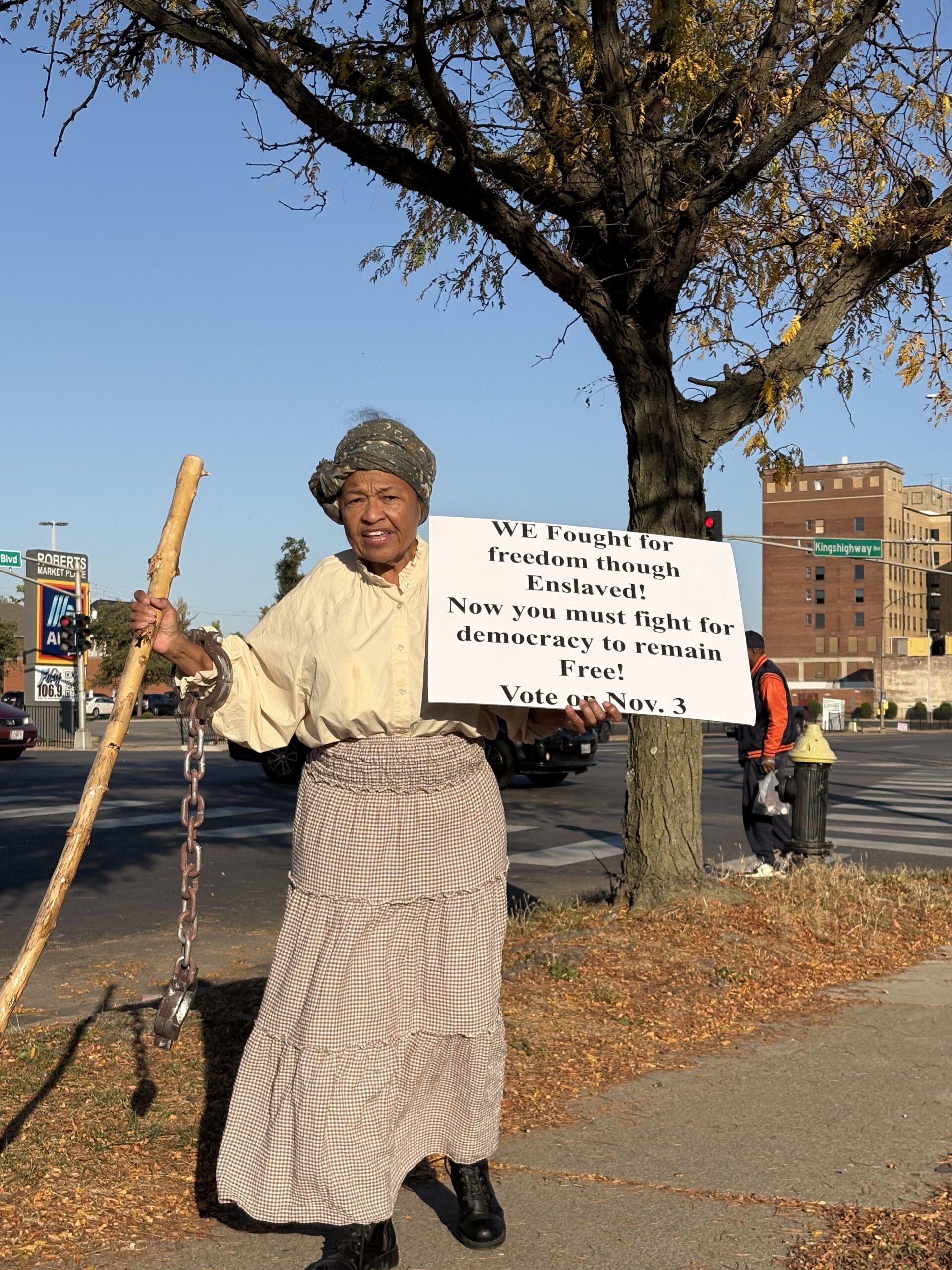
My friend (just call her Caroline, because she does not want her identity to distract) put on her faded skirt again. She hung a chain—a broken chain—from her wrist. Day after day, she took herself to various streetcorners of Delmar and Kingshighway and Martin Luther King and Skinker, and she held up a sign:
“We fought for freedom even though enslaved! Now you must fight for democracy to remain free! Vote on Nov. 3.”
People leaned out their car windows to take her photo. A Metro bus driver got off her bus while people were getting on, went over to Caroline, and said, ‘Honey, you sent chills down me. I’m coming to give you a big hug.’” A young man, not yet old enough to vote, said, ‘Thank you for doing this. Can I get you a coffee?’”
Caroline, who is as open as sunshine, grinned at him and said, “Y’know, I’m an old lady. If I drink coffee, I’ll need the bathroom.” The young man smiled back shyly: “That’s okay, ma’am. I’ll hold the coffee for you while you go.” She asked if he knew why she was doing this, and he nodded. She shook the hand attached to that broken chain and said, “If they could fight like that, then surely we can fight, too.”
Another guy, a bit older, came up and asked her name.
“Caroline,” she said, and left it at that.
He gave her a long look, then asked, “Why are you doing this?”
“Because sometimes we forget the legacy, the efforts of all those people who brought us to this point,” she replied. “We may be, curiously, coming closer to slavery than we ever have in history. They want you to know that it’s time for you to take action.”
He took that in. “You gonna do this some more, after the vote?”
She had not given that any thought, but the responses she had been receiving all morning prompted a slow nod. “I may.”
“If you’re on this corner,” he said, “I’ll be back.”
I put a photo of Caroline and her sign on my Facebook page, because courage has a way of spreading. Hundreds of supportive reactions came—but so did a few comments that troubled me deeply.
“So we out here cosplaying MUH victimhood,” one person wrote.
“That’s right, keep voting for the Democrat party who created and fought to keep blacks enslaved,” wrote another. “Was it the Democrat party that fought against the KKK? No, they actually created the KKK. Was it the Democrat party who fought for black rights to vote in 1964? No! They were unanimously against the voting rights of 1964. Who created the welfare system? I will wait… how about it was the Democrats!… I’m not saying the Republican Party of today is any better than the Democrats but at least history has shown us the Republican Party was created to abolish and fight against slavery.”
“Not exactly for altruistic motives,” my historian husband pointed out when I read this aloud. “This kind of political propaganda has been spreading for years. The history is accurate, but the party has changed radically.”
Part of me hoped Caroline would never see those comments. The other part wanted to know how she would respond. She was well used to conflict, resistance, and criticism. Anybody who puts themselves out into the world pushing for justice has to be, or they will break. So that evening, she and I talked.
“I know there are people who think that,” she said calmly when I read her the “cosplaying victimhood” comment. “My point was that not only are her chains broken, but even in enslavement, our people had agency.”
I read her the next comment, wondering aloud just how many people have been manipulated to confuse the past with the present.
“Most of the people I’ve been seeing? They are touched to the core,” she assures me. “The number of people who honked their horns and gave me a thumbs up? The story is in what happens on the street. Besides, I’m used to this. People have always challenged me. When I researched the White German abolitionists, Black people said, ‘Why would you do that?’”
Because she has never drawn lines that divide us.
The Monday before Election Day, a young man pulled up to the stoplight and beeped his horn. “Hey, that’s some action right there,” he called. “You’re the real deal!” Then he said, “What color do you like?”
What in the hell is he asking me about colors for? she wondered. “Purple,” she called back, just as the stoplight changed. He drove away.
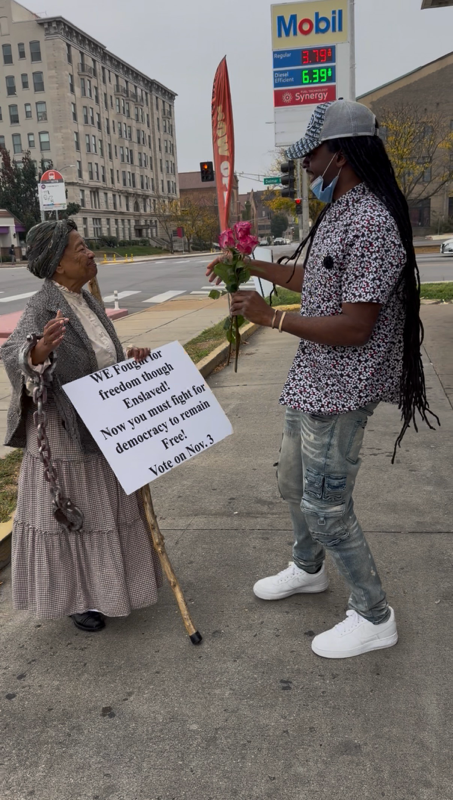
A few minutes later, Ryan Krull, a writer for St. Louis Magazine, showed up to interview Caroline. While they were talking, the young man returned—holding a bouquet of purple flowers. Krull grabbed a photo—it was a sweet and photogenic moment—but after the young man left, Caroline set the flowers down and said, “Here’s what I want you to look at. I want you to look at how people look at me when they first see me, and then what they look like when they finally react. When you see the contrast, you’ll see that by me being in costume and going back to that point in history and holding this sign, they get it.”
Many passersby wanted to know why she was doing this, and one young man was persistent in asking who she was saying he should vote for. Who was she voting for?
“If I tell you that, I’m doing you a disservice,” she said. “That’s the problem now: people are following other people without really looking at it. When enslaved people were serving dinner and heard the table conversation, they listened with a sharp ear. They listened to understand exactly what the impact would be on them. Henry Louis Gates points out that within a few years, two thousand formerly enslaved people had been elected or appointed to office. It took a knowledge base to move that fast. We were not dealing with people who did not have agency over the use of their own intelligence.”
“One elderly lady just stared at me, as if to say What…is…this?” she continues. “I could hear her brain! And after she stared for a minute, she gave me a thumbs up, and I raised my cane into the air to acknowledge her response.” Lifting the cane reminded her of the Olympic champions who raised their hands decades ago in the Black Power sign, a symbolic act that resonated around the world. She, too, was dealing in symbols. “Putting the chain on—I didn’t want people to just think I was African or Jamaican.” But the chain had to hang loose. Freed.
Back to her real self, Caroline spent Election Day monitoring a polling place in the city, then sat up in bed, feet and back aching, phone in hand, till the last of the election results came in. The next morning, she woke up jubilant—“but we’ve got some work to do with the disaffected,” she reminded me. “It was clear that the Latinos in Texas carried that state. They went back and forth because they were naïve about the system. Now they know what their power is. Missouri has a significant Latino community, but their voice has not come together.” At the polls, she spoke a little Spanish with young Latino voters—“but just for a little while, so other people didn’t feel alienated.” Mainly, she saw young women. “They are on it. But they need to be supported.”
I was puzzled that she was not talking about the disaffected Black voters—those who have given up participating to let God handle our future, and those who connect today’s Democratic party to enslavement and believe the Republicans have their backs.
She nodded. “I know some really fine people—I’d call them when I was pulling my hair out about the political situation—and they have become very religious. It allows them to say, ‘God’s going to take care of it. Don’t worry about it.’ I think with a lot of them, that’s more of an emotional blanket they put over themselves to deal with the moment. Because some of these people, I know them, and I know they are not holy rollers. I think people put that blanket on because they don’t know what to do, and they don’t think there’s anything they can do. That group is huge. It’s a defense mechanism, a blanket of the heart. Because they don’t know how they could have power and they don’t sense that they could have power at all. But the enslaved were religious, they loved God, and they still did what they needed to do. And we have Dr. King, and so many other examples.”
“Yeah,” I said, “but I can imagine people pointing to Dr. King and saying, ‘What good did all that do, if we can slide backward so fast?’”
She paused. “You know those drills they use to break up concrete? It’s long and arduous to get through all those layers, and I’m afraid that’s what is needed. Education, and getting into the churches, and talking about that issue. Talarico offers a model. When people look at someone like him, they should see power in faith.”
It is hard, though, to feel power when so many abstract forces swirl around us.
One man had said to her, “You know what, these folks have it wrapped up. They’ve got AI, and they’re doing exactly what they want. I’m not wasting my vote on that.” She picked up her cane, holding it off the ground, and said with a ferocity she seldom shows, “If we had thought like that when we were enslaved, you would not have freedom now!”
Repeating this exchange to me, she chuckled. “Hearing that from an enslaved woman, he had to think twice about what he was saying. It was almost like a trap! Black folks understand what slaves went through. It’s almost in our DNA. But sometimes we have to resurrect the image, so there is a consciousness of what our ties are to that period. If I get a look, which I do 90 percent of the time, I have made an impression. What was she doing, and why? So I’m getting into their brain. I’ve given them something to think about. I’ve challenged complacency.”
She mentioned a young woman she met on one of her Caroline days, how quiet but intelligent she was, how simple and strong her convictions. They spoke briefly; then the young woman’s bus came. But the next day, Caroline had a doctor’s appointment, and who did she run into at the hospital but the young woman, who somehow recognized her even in her street clothes. Caroline pressed a card into her hand and urged her to call so they could talk a bit more.
Several days later, on Election Day, she called. They had a good chat, and the woman, Lakeshia Starks, agreed to talk with me. I was curious what went through her mind when she first spotted Caroline.
“It was a picture of somebody I’d never seen before,” she said slowly, “one of my ancestors in chains, and I thought of all they fought for and had to fight for. It made me feel like I had to get up and do my part—voting, doing things in the community, just passing on blessings and knowledge.”
Starks had been stunned to recognize Caroline the next day, but somehow it felt meant. “That picture of her hadn’t left my mind. I’d thought about her all that day and the next day. She was giving us a vivid picture of what it looked like and what we don’t want to go back to.” Others might cringe at the chain, but to her, “it was a picture of strength.”
With that in mind, I checked to see how Caroline was holding up in the aftermath.
“It’s interesting how my body is reacting,” she said. “There is a connection between showing compassion in an assertive way and a certain amount of healing of your body. When I’m out there for long hours holding that sign up, even when my hands start to become a little numb because I’ve been holding up the sign too much, I say Oh, no we’re not going to let this happen, and I just switch hands, and when I come home, I’m exhilarated, and I’m feeling good.
“I’m one tired puppy now that I’m home,” she added, “but I feel good. I even forgot to eat lunch! I wish I could tell anybody over seventy: If you have cramps in your back and you can’t stand to exercise, get into something where there is compassion and service and kicking ass, and you will feel better. You may still have to go to bed early and watch what you eat, but doing this makes you feelbetter, and your overall well-being is a counter to the negative side of health issues.
“This was not easy to do,” she admitted for the first time. “But I couldn’t sit any longer watching what’s going on without reaching out to my people and drawing on the strength of the ancestors who worked constantly. I had to do something. I was tired of just using thinking and my mind to get angry at this man. I would much rather be smart about the strategy I need to use to be helpful. So I just told myself, Your old 76-year-old ass hasn’t got a thing to lose.”