The Halo Effect
November 1, 2026
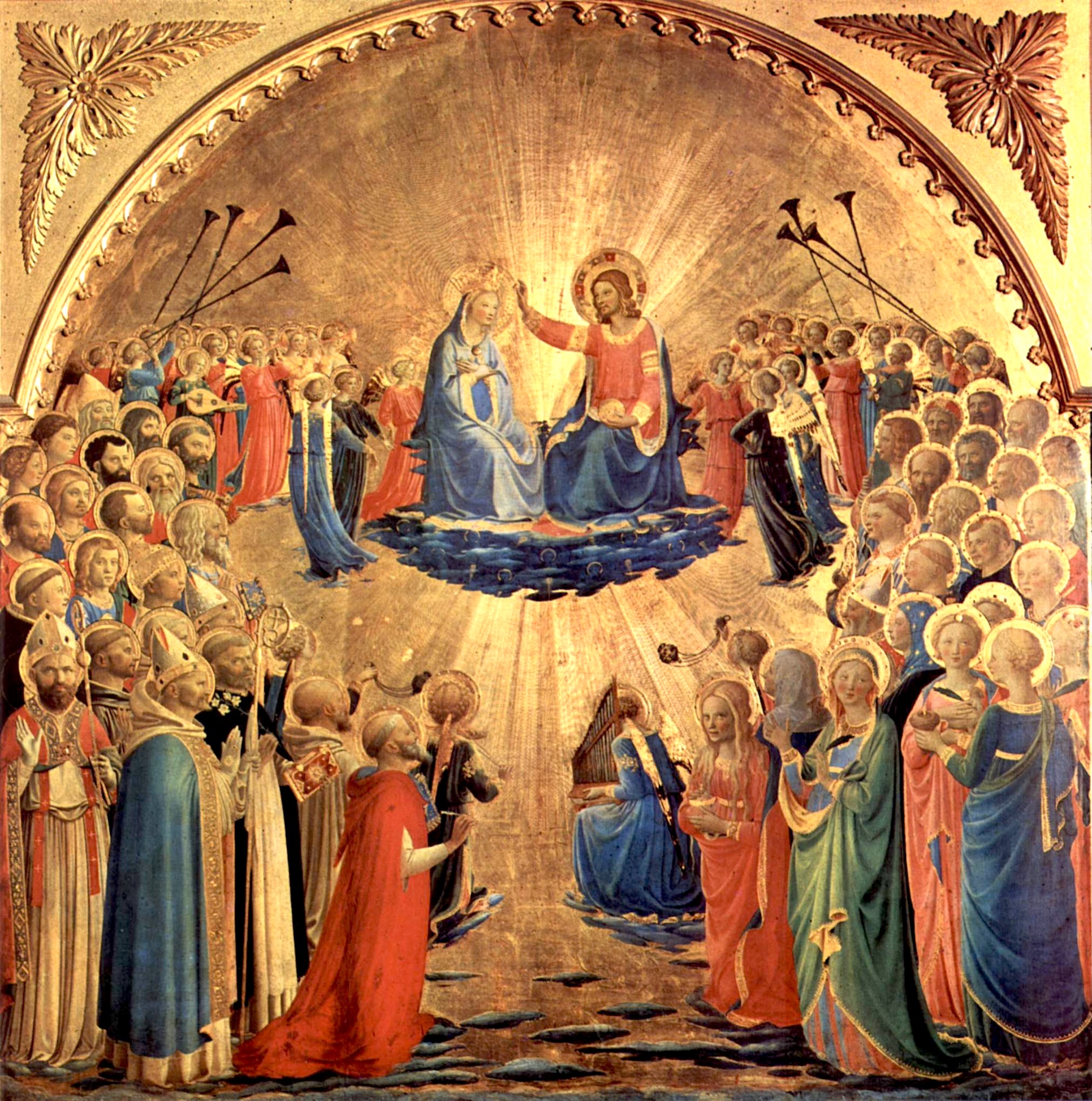
“You’ll laugh,” my friend warns, “but I could never figure out why all the holy people had a dinner plate behind their head.”
Obviously, she did not grow up Catholic. My classmates and I all knew what halos were—and that we would never have one. The nuns made that clear.
Later in life, I heard the phrase “halo effect” and watched it in action, as those who were beautiful or wealthy were assumed to possess a panoply of other fine traits as well. Symmetry, exquisite form, luck, and vast resources cast a glow around their person. Clearly they had been chosen, and they received raises, promotions, and perks accordingly. No proof of worth required.
We seem to need symbols to be sure of who someone is. And since one is supposed to avoid moping virtuously in sackcloth, a sign of holiness is helpful.
My friend has no patience with religion; she finds her peace in nature. There are halos there, too: glowing rings that often surround our sun or moon. They make these heavenly bodies look warm, backlit by another sun perhaps, but in truth, they are made by ice crystals. Light shines through the tiny crystals frozen inside high, thin cirrus clouds, refracting and reflecting.
Did the Zoroastrians look up at those bent circles of light in the 300s BCE and decide that such a ring should also surround Mithra, their god of light? A halo would be lighter and far lovelier than the heavy disk balanced atop the sun god Ra’s head in ancient Egypt.…
The custom spread fast, the images carried along trade routes. Buddhist artists took note; so did the painters of Roman imperial portraits. Those emperors were always casting about for ways to insist upon their own divinity. What could be better than a halo?
Buddhists used their halos quite differently, though. Fire, vines, lotus petals, or smoke formed the auras, keeping them natural and dynamic. A rainbow of colors carried different meanings. The entire body became radiant, not just the head. The whole of a person, in other words, not just the housing for the rational brain.
I would have expected the early Christians to seize upon the halo instantly. (I had always thought they owned it.) Instead, they hesitated, worried about its pagan origins. This concern finally faded when Christianity became the state religion of Rome. Now the halo could be used to demonstrate spiritual hierarchy. Jesus, for example, was the only figure entitled to a cruciform halo. His mother, the angels, and the saints received the circular halo. VIPs still living—popes, bishops, major donors—had square halos. And God’s halo was triangular, symbolizing the Trinity.
These Christian halos, painted into place from the fourth century through the Byzantine era, were flat and opaque. Rather like gold dinner plates, in fact. They obeyed none of the laws of physics; they simply sat behind someone’s head, stamping them with a gold seal of approval.
In the fifteenth century, though, the Renaissance awakened an obsession with dimensionality, perspective, and naturalism. This posed problems for the halo. What should it do if the person turned to their left or right? Giotto and Masaccio started tilting their halos, making them elliptical. Fra Angelico tilted too, and he also tried making his halos translucent. Eventually, Botticelli and Filippino Lippi did away with the flat gold disc altogether, replacing it with a golden thread or a subtle, delicate circle of fine gold dots.
Holiness was less obvious now, and more flexible. In time, Leonardo da Vinci would brush aside the halo altogether, impatient with its artifice. Light itself could show divinity, he reasoned, and he framed Christ in front of a big open window with sun streaming in around him. Caravaggio took the cue, darkening his canvas so an area of extreme light would have dramatic symbolic power.
Then, in the nineteenth century, something interesting happened. Van Gogh and Gauguin brought back the halo, but in self-portraits this time, illuminating their own psychological pain rather than God’s glory.
I suspect God would have approved.
What would not pass muster is what happened next. American advertisers started using neon halos and glowing graphics to insist on the goodness of whatever they were hawking. Pop-culture icons grabbed halos for themselves, not to illuminate suffering but to win attention. And if you bought a ring light during the pandemic, tired of seeing the circles under your eyes in Zoom meetings, you, too, had a halo to smooth away your sins and imperfections.
Halos lit up secular culture. Then they darkened. Creators began fiddling with them, using them to suggest megalomania, a god complex, or at best, detachment from flawed humanity. Instead of gold’s soft glow, there were holograms, neon rings, cybernetic auras. Those endowed with halos were sometimes psychopaths, sometimes superheroes, sometimes artificial intelligences demanding to be revered. In manga and anime, beings not entirely angelic, maybe angel-adjacent, sprouted wings and had to bake their own halos, which then fused with their being. In dark fantasy, the monsters were given halos, simply because the contrast, the coopting of divine power, would twist the dread and unsettle us to the core.
Broken halos are even more interesting. They take a sign that promised holiness and degrade it, corrupt it, steal its innocence, render it vulnerable if not entirely evil. The trope was inspired by Christianity’s fallen angels; the cracking of the halo signals rebellion, and a consequent loss of purity.
Today’s graphic novels are littered with dark or shattered halos. In DeadEndia: The Broken Halo, a miniature demon turns out to be a fallen angel. In Dark Halo, a secretive angel has a dimmed, shadowy aura instead of a pure ring of divine light. In Halo: Broken Circle, a fanatical religious group with a fake claim to divine transcendence must be shattered.
In physics, the most important halos are the darkest. “Galaxies announce themselves through the light of billions of stars, all embedded in vast clumps, or ‘halos,’ of dark matter.” It is thought that these dark matter halos—invisible, bound by gravity—surround a spinning galaxy and hold it together, stopping the outermost stars from flying away. Does holiness do that for us? Recent studies haveidentified a starless dark halo near the center of the Milky Way, and the Royal Astronomical Society waxed poetic: “’Dark matter, not a black hole, could power Milky Way’s heart.”
I do not understand one word of this. Nor can I fathom an analogy to the traditional sort of halo, which has gone through such a dramatic evolution that it fell from absolute purity to tragic corruption. Those early gold-plated halos guaranteed perfection. Maybe we had to turn that symbol upside down to admit our fragility, our struggle, and the inevitable breakage.
But does this mean we have given up on holiness altogether?