My Papa Was in Purgatory
September 27, 2026
“Your daddy is in Purgatory,” my devoutly Catholic great-aunt informed me.
At three, I stumbled on the syllables.
At six, I wanted to know where it was.
Ignoring my mother’s frantic, angry attempts to wave her quiet, Aunt Kitty proceeded to explain the theology. Because my father was not a Catholic, he could not go straight to Heaven. He had to do time in Purgatory, a sort of halfway house in which his soul would become penitent about his agnosticism.
Seeing my eyes widen, she added, her crisp tone softening, that this was only temporary. My father had been a good man, for a non-Catholic.
“So is he in heaven by now?”
“That’s up to God, dear, not us.”
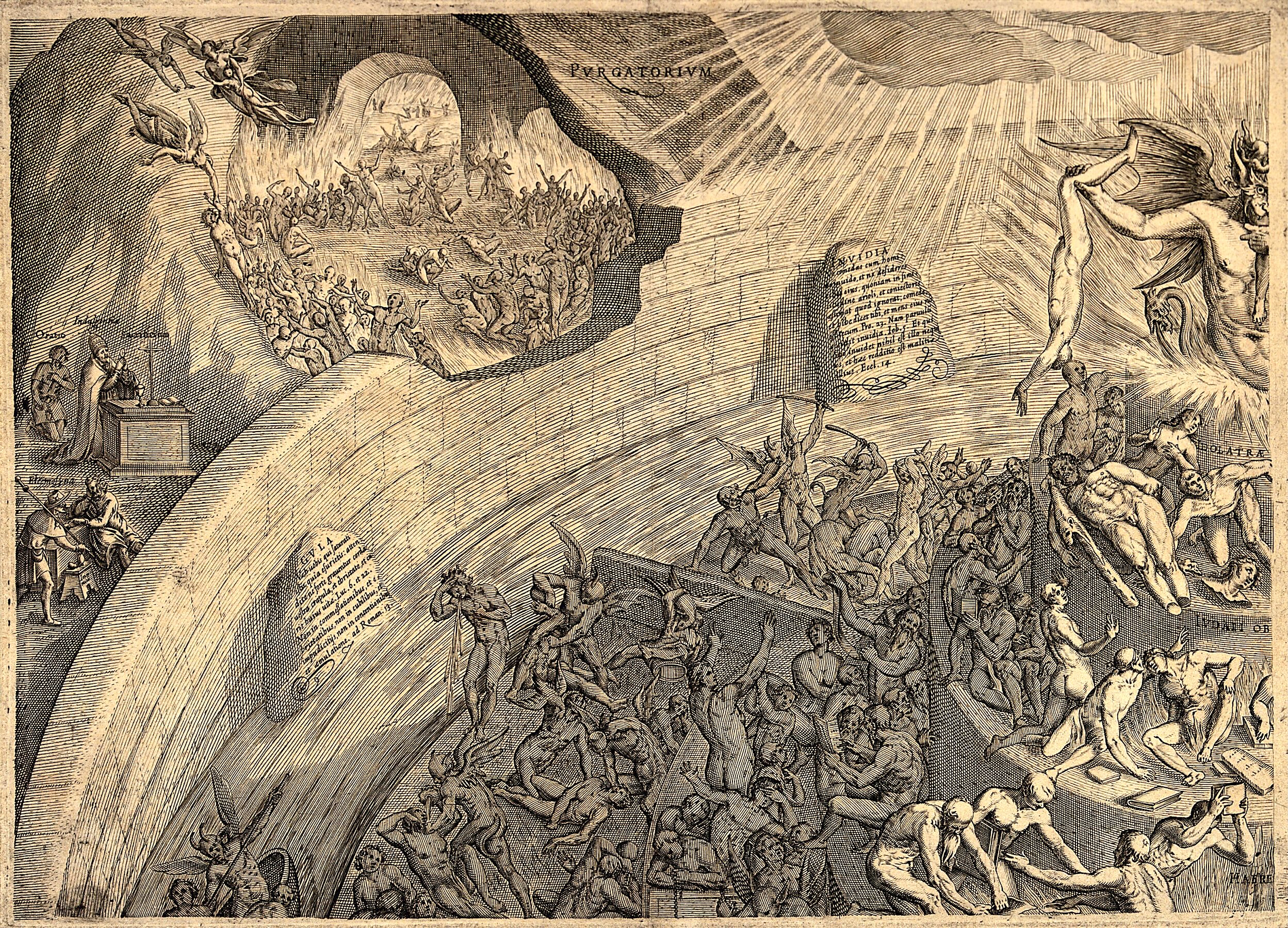
At twelve, I read that in Purgatory, souls were purified with a cleansing fire, removing small sins, whisking away tiny bits of filth, mending any cracks. My father had to be made ready to enter the presence of God.
So was he ready yet? Aunt Kitty weighed in again, telling me about the Communion of Saints. I thought that just meant they got to go to Communion first, but no, it meant that the souls of the living and the dead were connected. Apparently those in Purgatory could do nothing to earn merit, but those of us still breathing on Earth were able, with prayer, to win their release. Apparently I should have been praying for this all along but had missed the message.
I tried to console myself. The worst sins I had ever heard of my father possessing were second martinis at lunch and the pranks he and his partner played at their ad agency. Surely he had gotten sprung long ago, even without his daughter’s help? Besides, Martin Luther had objected to this notion, calling it a scam to sell indulgences.
But I could not be sure.
Various saints and mystics offered time frames for Purgatory, ranging from a few hours to many decades. Souls experience time differently, theologians pointed out, and Purgatory definitely ends with the Last Judgment. But that felt like an awfully long time for my dad to wait. In trembly misery, I set the question aside, helpless to fix the mess.
By twenty, I had decided it was all malarkey anyway. No loving God would…et cetera, et cetera. Catholicism had gotten stuck in the Middle Ages. (That, or I would be joining my father in that fiery carwash as punishment for thinking so.)
Over the next decades, I learned that this notion of praying for the dead, offering atonement to free their souls, long predated Christianity. Then, in the second and third century, early church fathers, I assume uncomfortable with the sharp dichotomy of heaven or hell, argued that some souls underwent a bit of postmortem touchup. In the fifth century, Augustine formalized the process later known as Purgatory. And yes, in the Middle Ages, its theoretical existence solidified.
C.S. Lewis thought the concept ordained and natural. “Our souls demand Purgatory, don’t they?” he wrote in Letters to Malcolm. “Would it not break the heart if God said to us, ‘It’s true, my son, that your breath smells and your rags drip with mud and slime, but we are charitable here [meaning, in heaven] and no one will upbraid you with these things, nor draw away from you. Enter into the joy’? Should we not reply, ‘With submission, sir, and if there is no objection, I’d rather be cleaned first.’ ‘It may hurt, you know’—’Even so, sir.’”
I was eight months old when my father died, but I have been told that I would nestle into his neck and we would both fall asleep in the rocker. I do not believe his breath was putrid. Also, the shirts were Brooks Brothers. And as for me, I would gladly accept love’s invitation to set aside my flaws and welcome me to joy.
I have not thought about that vague, godless liminal state of Purgatory in years. The very idea felt like a cruel distancing, as though God were the prim sort that sets boundaries and keeps track of your foibles. But then I came upon Plato’s Phaedo, in which Socrates, on the verge of his own death, offers us a fable about something suspiciously similar.
“Those who appear to have lived neither well nor ill, go to the river Acheron,” he wrote. They are carried, perhaps downstream, to a lake, “and there they dwell and are purified of their evil deeds, and suffer the penalty of the wrongs which they have done to others, and are absolved, and receive the rewards of their good deeds according to their deserts.”
Did Augustine read this a century later and stroke his beard, liking the sound of the place? Fire would be more powerful than water; a minor tweak. At least in Plato’s version, it sounds pretty efficient, a fluid process one could move through step by step until one reached the rewards.
He also had a lovely solution for those truly evil: they would be hurled into Tartarus, the deepest and darkest abyss of the Underworld, even worse than CECOT or Alligator Alcatraz, and they would never come back out. Those who had committed some evil deed but repented heartily for the rest of their lives would also be plunged into Tartarus, but a wave would wash them forth exactly one year later.
See? It is good to have time limits. Easier for loved ones to contemplate.
The wave would send the dead out via underground rivers—either the river of fire or the river of lamentation—that would carry them to the shore of the aforementioned lake. There, they had to cry out to those they had wronged. If their victims heard and forgave them, they could enter the lake. Which sounds altogether fair—unless you happened to wrong someone especially stubborn or vindictive, in which case you were screwed and you had to go back into the river to try again. And again.
Plato ends by saying, in Socrates’s voice, that those who have “purified themselves with philosophy” could go on to live without a body, “in mansions fairer far than these.” A promise akin to seventy virgins.
Cui bono? Priests collecting indulgences had good reason to persuade the faithful to ransom their dearly departed. Plato had good reason to elevate a life of philosophy as a promise of eternal delight. Slowly, over centuries, we are learning to be suspicious of any theory of the afterlife that pays dividends to its originator.
But I bet there are still a lot of people haunted, in shadowy corners of memory, by the stories they were told as truth.