Brooklyn Band Starts Classical Music Season Early with Collaborative Composition Initiative
By Chris King
August 11, 2026

St. Louis being one of the nation’s most dedicated baseball cities, there is widespread local consciousness about things like the date when pitchers and catchers first report to Spring Training and opening day for the St. Louis Cardinals. Though not as obvious an aspect of our civic self-consciousness, St. Louis is no less an American powerhouse for classical music. Really, opening day for the St. Louis Symphony Orchestra—this year, September 16 in a free concert on Art Hill in Forest Park—should be greeted by citywide recognition akin to the ubiquitous red worn to harmonize with Cardinals games.
Classical musicians, conductors and composers do not have anything quite like a collective Spring Training, though most have off-season (for classical music, that is summer) commitments that keep their chops sharp, nurture relationships elsewhere, and supplement their incomes.
This classical music off-season, St. Louis is hosting something of a classical music talent combine for new composers and the creative musicians who perform their work. Coming this week, on the cusp of SLSO opening day, let us call the Collaborative Composition Initiative a summery Spring Training for the classical music season to come.
The Collaborative Composition Initiative is a partnership between the Brooklyn-based Unheard-of Ensemble, their friend the composer Christopher Stark, and Stark’s academic home, Washington University in St. Louis. A week of workshopping new premieres then presenting concerts, installations, and happenings across the city got Monday night underway with an opening concert at the gorgeous Christ Church Cathedral downtown, which sponsored the concert.
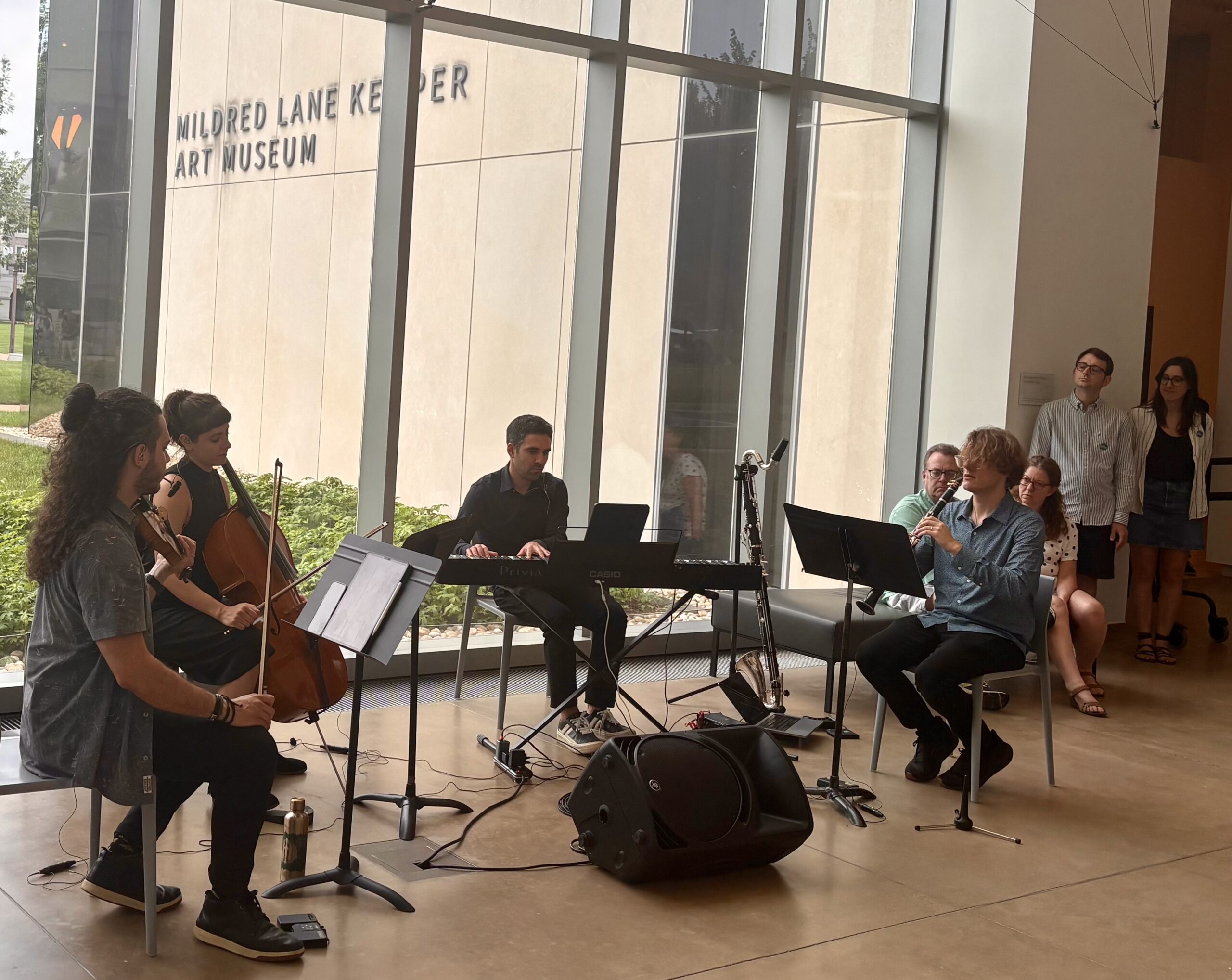
WashU is in recess (universities and symphony orchestras have very similar seasons), so no surprise that its institutional power was a bit muted. The opening night concert had the scrappiness of traveling musicians who charmed their way into a unique and historic venue opening its doors for them to play for free rather than fancy academic trappings. It was possible to imagine the Unheard-of Ensemble (four young musicians) sleeping after the gig on the church pews like a punk band on basement couches after a house concert.
The ensemble opened with After the End of Time by Lilia Ugay, who joins Stark as resident composers at the heart of this collaborative initiative. She was not recognized from the floor—the musicians set up on the floor of the church, not up on the pulpit—so apparently the composer had not yet reached town. A native of Uzbekistan, she teaches at Florida State University in Tallahassee. But the Unheard-of Ensemble brought her music alive in her apparent absence.
After the End of Time is written for a quartet of the same configuration as this ensemble: clarinet (Ford Fourqurean, what a name!), violin (Matheus Souza), cello (Iva Casian-Lakoš) and piano (Daniel Anastasio). That is no coincidence. Fourqurean said their ensemble was formed deliberately in the configuration for which Oliver Messiaen wrote Quartet for the End of Time (1941), and Ugay’s piece is a meditation on Messiaen written for those same instruments. Messiaen’s choice of instruments, according to one of music history’s most raw origin stories, was limited by the musicians who happened to be starving alongside him in the Nazi prisoner-of-war camp where he composed and premiered this quartet.
Ugay confronted the COVID-19 pandemic, not the horrors of war with Nazis. As such, she required less time for her meditation on the end of time than Messiaen (about 15 minutes to his about 45), with five movements compared to his eight. That still provides ample scope for big ideas and huge sounds.
After the End of Time opened with an ensemble shriek that nailed the iconic murder-weapon-reveal flourish from a thrilling horror movie score, with microtones from the strange range of instruments (clarinet, violin, cello, piano) available to Messiaen in the prison camp that Ugay and the Unheard-of Ensemble adopted in his honor. Ugay aptly titled this opening movement “Chaos.”
The cathedral also rang out with the uptempo ensemble attack of the third movement, “Protest.” But to honor Messiaen’s piece, Ugay had to explore the tiniest of sounds, the edges of notes, the way instruments whisper. Anastasio’s piano took the puzzled steps of someone surprised to be alive. Fourqurean’s clarinet explored what is eerie about an eerie wind. Souza found music in the violin without bowing the strings. Casian-Lakoš bowed her cello down to the end of sound. The best that can be said of Ugay’s quartet is it deserves to be mentioned in the same conversation and performed alone on the same bill with Messiaen’s masterpiece.
Anastasio and Souza spoke to clear the atmosphere between the two quartets. Their remarks, which came off as unscripted and spontaneous, pierced to the heart of this music. “He only had what he had,” Anastasio said of the accidental instruments Messiaen called upon to express this music. Souza said the composer took these four random instruments limited by war and chose “a very limited collection of notes” to play on them.
Anastasio said, “We add color and light and texture in our own individual ways.” Souza said Messiaen “was hallucinating sometimes because of hunger and this shows in the music.”
Seeing them perform this startling music right next to us, in essence across the next pew at church, made for a rare physicality of experience. Casian-Lakoš’s face was in our faces providing a read-out of the music’s evolving emotions. She looked like someone gravely facing a long story of pain.
Messiaen told us he was writing “for the end of time.” The apocalyptic dimension of that phrase speaks for itself (and is terrifyingly applicable today). For people playing music, which is an art over time, the end of time also means the bottom dropping out of the art form they are playing while they are playing it. The Unheard-of Ensemble was equal to the task of making the disintegration of tempo and tone sound musical.
Maybe I am just trying to look on the bright side of the end of time, just trying to look ahead from this summery Spring Training to the cool of the coming classical music season, but these traveling musicians from Brooklyn also showed us how Messiaen and the rest of his quartet had fun playing in the ruins of time. A starving prisoner of war playing a crumbling musical instrument is still a musician with a gig. They played mad klezmer. They played Dave Brubeck before Dave Brubeck did.
I knew we were listening to music in a church and that the last movement of the music praises the universality of Jesus Christ, but I walked out of the cathedral thinking secular thoughts about how much fun it is to make music out of nothing and to play it with other people and what a great city St. Louis is to do those things
The Collaborative Composition Initiative continues in St. Louis throughout this week, and all concerts are free. See