Are Flash Mobs Over or Just Ruined?
October 24, 2025
A friend texts me a video of pianist Julian Cohen. A kid asks him to play a certain song, then startles everyone in the restaurant with his gorgeous voice. A sucker for any spontaneous musical performance or revelation of young talent, I ignore all the other directions my fingertips should be flying on the keyboard and watch to the end.
“I’m sitting here grinning like an idiot,” I text back. “I thought these flash mob things had faded away. The good ones are so human, so collaborative and spontaneous and in love with the music. People’s faces just light up.”
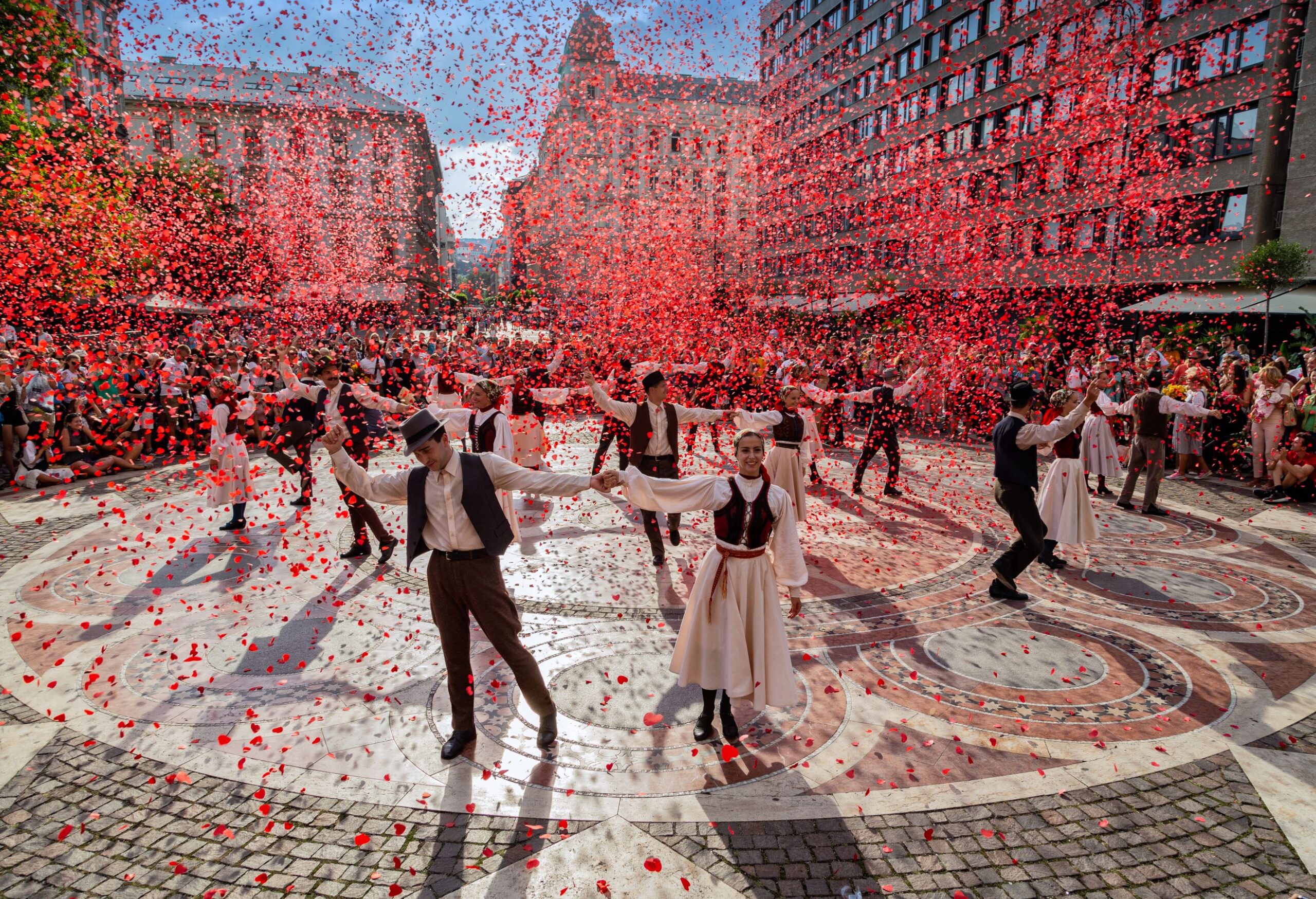
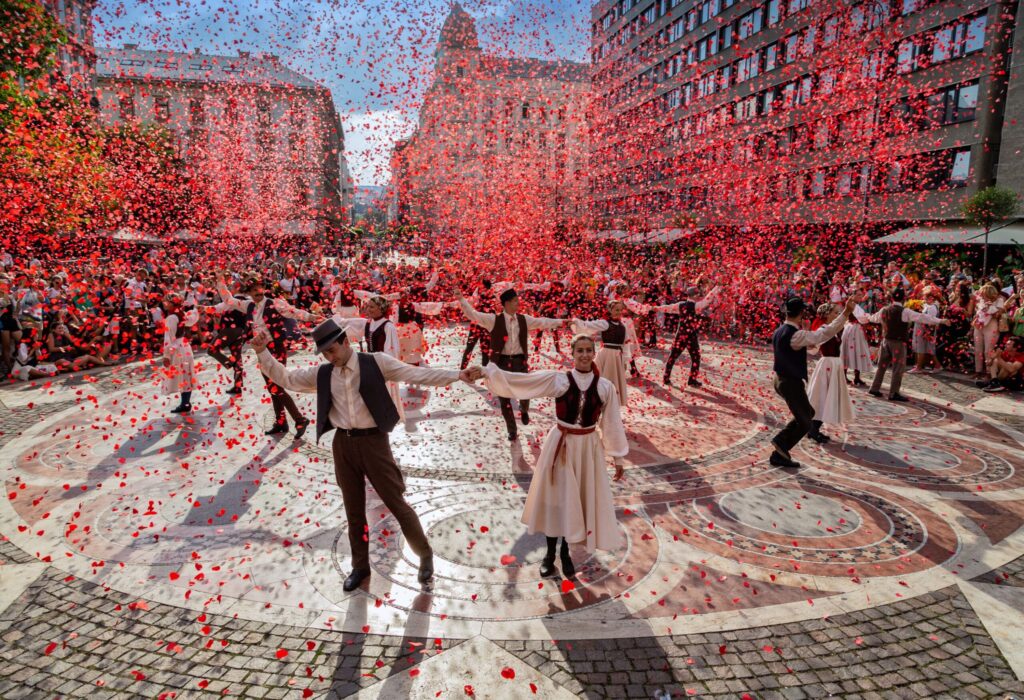
To be clear, I am not talking about the hokey, overscripted events that have invaded the category. I am talking about Beethoven’s Ode to Joy, anthem of the European Union, performed in public squares in Geneva, Nuremberg, Strasbourg…. About Hungary in 2021, when four hundred musicians performed Pink Floyd’s “Another Brick in the Wall” in Dunaújváros. About the flamenco flash mobs across Seville and Andalusia back in 2013, sophisticated political protest.
Of course, the best flash mobs have no agenda at all. Cohen has orchestrated quite a few, and they always go viral—especially the tour de force of Queen’s “Bohemian Rhapsody” in Paris earlier this year, with an uber-cool long-haired eleven-year-old slinging his electric guitar like Freddie Mercury. Singers pop up all over the Place de la Contrescarpe, and Mickey Callisto sings the lead. His later comment to reporters reassures me: “It was nerve-racking, though, as there was so many musicians and we didn’t get a chance to rehearse.”
Just what I had hoped. Collaboration in the moment, uncanned and unrehearsed. A heartfelt tribute paid by musicians on the fiftieth anniversary of an amazing song. And a crowd clearly delighted, grateful even, to be surprised by joy in these tense times. These events feel like humans at their best.
But we can even screw up a flash mob.
Searching out more of Cohen’s videos—many of them smaller, almost intimate, in hotel dining rooms or at the bottom of an airport escalator—I find stupid captions overlaid, telling us how to react. “Wait for it.” “Look!” “Her voice.” “Watch what this guy does next.” Oh, for God’s sake. Do we need instructions in emotional response? Are they afraid we will lose interest, get distracted if they let us alone for a second to have the experience for ourselves? The intrusion—overscripted, ruining the surprise—is an annoying disappointment. So is the stagey, excessive choreography of some flash mobs, and the way onlookers now know to make their mouths big O’s of delighted surprise for the video’s sake. A flash mob is no longer a rupture in everyday routine; it is a mediated event that will live on, via TikTok and all the other platforms, and we all know this.
But that is hardly the worst of it.
The flash mob phenomenon began in 2003, when Bill Wasik, senior editor of Harper’s Magazine, sent more than 130 people to the ninth floor rug department in the Manhattan Macy’s. They were to say that they lived together in a warehouse and were shopping for a “love rug.” Next, 200 people poured into the Hyatt and applauded, in perfect synchrony, and a shoe boutique in SoHo was swamped with pretend tourists. By 2004, “flash mob” was in the Concise Oxford English Dictionary, with one of the criteria that it be an “unusual and pointless act.”
Wasik wanted to show us how hungry we are to conform and be part of the next new thing—but he also described the flash mobs as, in a reporter’s paraphrase, “a playful social experiment meant to encourage spontaneity and big gatherings to temporarily take over commercial and public areas simply to show that they could.” In other words, though he mocked the old hippie culture, he wanted power to reside with the people, not the institutions of commerce.
Flash forward, and guess what? Flash mobs are now, quite often, commercial. By which I do not mean the 2009 flash mob in Antwerp, where 200 people broke into a performance of “Do-Re-Mi” in the Central Station to promote an audition for The Sound of Music. I mean an event organized to sell something, with professional organizations hired to choreograph and execute the product launch or ad campaign. You know, “generate buzz.”
Last year, for example, the headline “Amazing Flash Mob Leaves Londoners Speechless!” reeled me in—until I found out all the music and dance was being done to celebrate a new store’s opening. And the people walking past the dancers were not even glancing up.
Academics have also done their part to subtract happiness: “The research methodology at the theoretical level is made up of the theory of the information society and the concept of ‘network identity,’ on the empirical level—the method of sociological survey with the subsequent compilation of contingency tables.” Seriously? Commerce and reductive social science should be banned from the public square. As should overthinking: Cayley Sorochan argues “that the irrationality touted by flash mobbers is a symptom of a collapse of belief in the critical public sphere under late capitalism.” Sorochan is reaching so hard, a tendon is about to snap. Must spontaneity always be irrational and subversive? Can it never simply be fun? What about the flash mob pillow fight in Manhattan, or the flash mob snowball fight in D.C.?
That said, I have no problem with political uses. A political rally is planned in the small town where I live, and already the vicious exchanges on social media have begun. Might this play out more gently if the protest were a spontaneous musical performance? Would people gather fast and hurl the same insults? I doubt it. The arts can be fiercely political in ways that feel less combative.
Or maybe everything scares us now. Maybe joy feels like chaos?
The city of Braunschweig, Germany, stopped flash mobs by requiring permits. The British Transport Police wanted them banished from railway stations. Wasik has been blamed for inspiring “flash mob thuggery,” sudden violence by a large group now easily organized with social media. “It’s hard for me to believe that these kids saw some YouTube video of people Christmas caroling in a food court and said, ‘Hey, we should do that, except as a robbery!’ Wasik retorted. More likely, they realized, as he had, that today’s tech means “you can coordinate a ton of people to show up in the same place at the same time.”
What happens next depends on who is involved, and why.
Read more by Jeannette Cooperman here.