The Lessons America Has Taught Me
A new conservative book tries to make the case for America the Beautiful.
By Gerald Early
July 4, 2026
The Case for America: An Argument on Behalf of Our Nation
1. Beverly, New Jersey
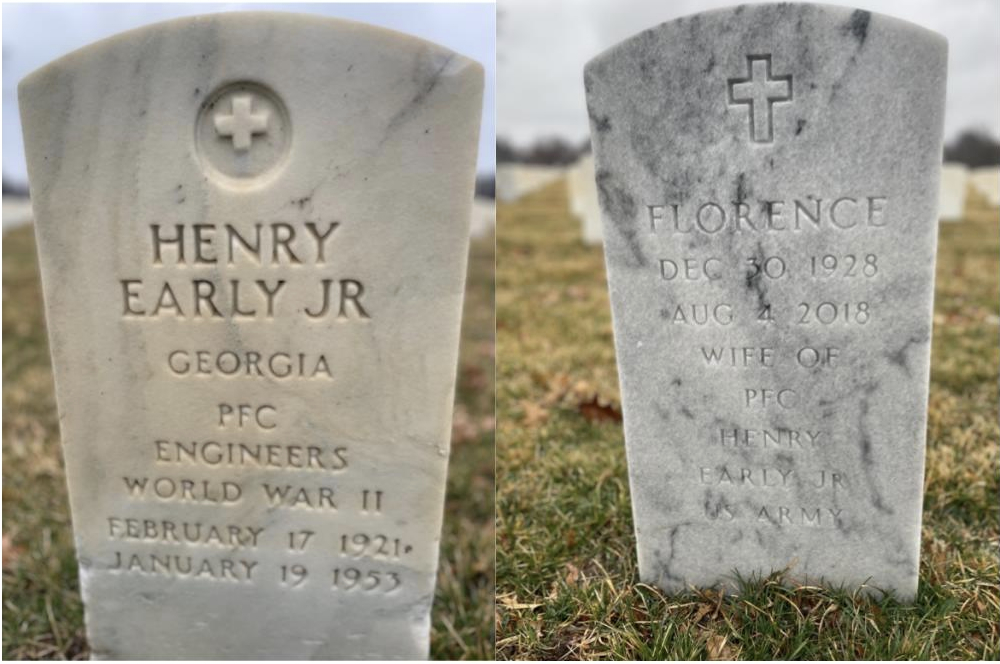
My parents are buried at Beverly National Cemetery, a short drive from Philadelphia. My father, Henry Early Jr., is buried there because he served in the United States Army during World War II. He died in January 1953 at the age of 32 from a brain aneurysm, untimely, to be sure. He was not a particularly good soldier. He could not abide the fact that the American military was segregated at the time he served. He told my mother the story of how he was guarding German POWs in Texas, unnerved and angered by the fact that he felt that they were being treated better than he was because, despite being “the enemy” they were not being Jim Crowed. He did not like the idea that he was supposed to put his life at risk to fight Germans who were considered better than he was by the White soldiers he was assigned to fight with. Was he not an American? If he was not, because of his skin color, what was he supposed to be?
He went AWOL for a good while and had no intention of going back until my mother’s mother convinced him to do so by telling him that he would ruin his life if he got a dishonorable discharge. He almost did, anyway, (get the dishonorable discharge) when he surrendered himself, and only my grandmother’s intervention (she was an organizer for the Democratic Party in Philadelphia and had “influence” of a sort) got him a mild punishment, an honorable discharge, and the right to be buried at Beverly.
My mother died in 2018. She had long planned, as was her right as a war widow, to be buried with my father, despite the fact that she had remarried when I was 26 years old. I could not tell if she did this because my father was the love of her life or because it was as economical, as being buried with Henry Early Jr. in Beverly was free. She never talked very much about my father. I learned little about him. But she was adamant about being buried in Beverly, and so she is.
On June 19, 2026, my wife, Ida, and I drove to Beverly National Cemetery. It was the third time I have done this since my mother died. I had never visited when only my father was buried there. Because I have some business that will take me to Philadelphia annually, I have decided to visit the cemetery every year for at least the next few years. Each time I have gone, the cemetery was completely empty. I was the only person there. I wonder when other people come. I imagine many do so on Veterans Day or Memorial Day.
The next time I come, in the fall, I will plant an American flag by each grave. Some may wonder why I would do that. Some people I know are not much enamored of the American flag. They have reason, or, shall we say, they have their reasons. My parents have made the flag real for me, vivid, compelling, almost breathtaking in how they have ennobled it.
The symmetry of the headstones and the precise, slanted lines of thousands of graves have a somber glory. I stand by their graves, section L, numbers 249 and 250, for a while. I suppose I am thinking about my parents, in a way, not necessarily more about my mother than my father. I am proud that my parents are buried in a national cemetery. It makes me feel quite American as I think of them as Americans too, the first Americans I ever met. They were also the first Negroes I ever met, before I learned I was, at that time, a Negro myself.
The next time I come, in the fall, I will plant an American flag by each grave. Some may wonder why I would do that. Some people I know are not much enamored of the American flag. They have reason, or, shall we say, they have their reasons. My parents have made the flag real for me, vivid, compelling, almost breathtaking in how they have ennobled it. My parents were members of the greatest generation, the last of a breed, survivors of the Great Depression and World War II. I looked up to my parents’ generation: they taught me the wonders of Negro life in my native land and never to renounce being an American. My father, I suppose, wanted to do something like that when he went AWOL, but he was talked out of it. Well, he discovered that he could not run away from it. You cannot outrun your fate. Maybe that is why he chose to be buried in a national cemetery, or maybe it was simply because it was free. He had earned it. My parents made it easier for me to be an American, and that, I have been told, is what American parents are supposed to do for their children. In fact, it has not been hard at all for me to be an American. I owe them a lot for that, believing in the place as they did, bestowing upon me the grand and curious fate of loving a strange, rich, lucky, violent country built on the turbulent energy of one big idea.
2. Bret Baier’s case for America
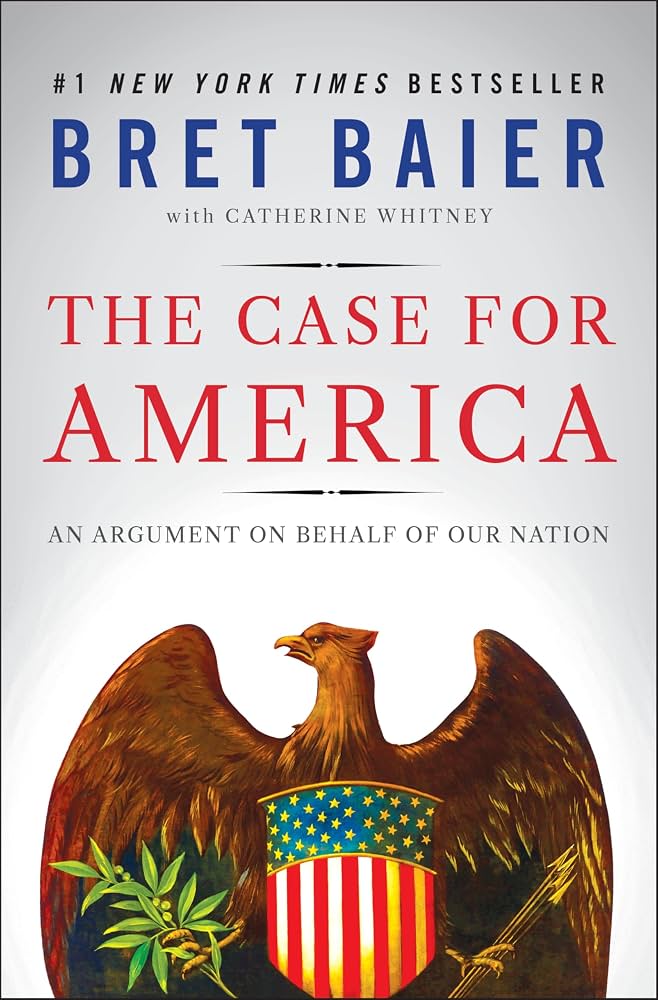
Fox News Channel’s political anchor Bret Baier’s new book, The Case for America, is just in time for the 250th anniversary season. It feels a bit hasty in its composition, which gives a reader the sense that it was a book aimed at a ready market: people who want a book that is positive about the United States at this particularly divisive juncture, when many think the country is on the verge of its third political divorce. (The first was from Great Britain, the second was the Civil War.) “In a sense, as we reach our 250th year, America is on trial. People are asking if we can fulfill the destiny of what we always called the great experiment. So, as I make the case for America, I imagine that I am in a courtroom speaking to a jury of my fellow Americans.” (x) He ends, unsurprisingly, with “The case for America is strong.” (210)
Baier, who has written six popular biographies of American presidents—Eisenhower, Reagan, Franklin Roosevelt, Theodore Roosevelt, Grant, and Washington is as qualified as anyone in the popular media to write a book of this sort. He offers a center-right perspective of the American past, which automatically would not fixate on America’s sins. The readers targeted for this book have heard enough about slavery, systemic racism, sexism, anti-queerness, the carceral state, wealth inequality, the evils of capitalism, environmental injustice, and all that. (And none of that is mentioned in Baier’s book.) They might even think that America must be a great country since many people have wound up making a good living complaining about how awful it is. As my mother used to say, those people “are crying all the way to the bank.”
But what Baier provides ultimately, although he does not use this expression, is a case for American exceptionalism, hardly a concept or belief that is held in high regard these days, particularly among much of our educated elite. American liberals were caught in a bit of a bind when Barack Obama was president, as they, on the one hand, in their globalism, said there was no such thing as American exceptionalism, yet, on the other hand, thought we were exceptional in electing a Black president. What Baier identifies is American uniqueness, “The strongest argument for America is that there has never been a nation like it.” (207) That is a fair observation to make in underscoring our country’s dedication to freedom, its resilience (one must wonder why the country has managed to survive for 250 years with the world’s oldest governing constitution), its energy and obsession with innovation and newness, and its “powerful vigilance. Thousands of reporters, podcasters, scribes, and ordinary observers have eyes wide open in observation. There are no hidden chambers. Secrets eventually leak out.” (208-209) The last is one reason why I did not believe that the Trump assassination attempt in Butler, Pennsylvania, was staged. “If it was staged,” I told my colleagues, “Someone would have leaked it and been richly rewarded for it.” We live in a world suffused with images where everything seems staged like a movie.
The readers targeted for this book have heard enough about slavery, systemic racism, sexism, anti-queerness, the carceral state, wealth inequality, the evils of capitalism, environmental injustice, and all that. (And none of that is mentioned in Baier’s book.) They might even think that America must be a great country since many people have wound up making a good living complaining about how awful it is. As my mother used to say, those people “are crying all the way to the bank.”
Baier has a chapter devoted to the Declaration, particularly its famous opening paragraphs, what a revolutionary document it was, and how remarkable it was that the American colonists won a war against the major military power of the day. There are chapters about American unity (bipartisanship, which underscores some of the greatest legislation) despite our tradition of dissent; America as a beacon of freedom; American resilience; America as a land of opportunity; and a plea for civic education. The book is built around interviews with various people, from CEOs to politicians, from academics to philanthropists. There are three cheers for immigration and American ingenuity, disapproval and shame for the internment of Japanese Americans during World War II, and positive quotes from both Democratic and Republican presidents. There is nothing wrong with the patriotic goulash. What people in the book say about the country is right, as far as it goes.
The major Black voice in the book is Condoleezza Rice, a highly accomplished person. One would hardly expect Baier to interview journalist Nikole Hannah-Jones, as her commentary would have been a poor fit for the book. But it was a bit surprising that Black conservative voices like Clarence Thomas or Carol Swain, who, in some ways, would have been better than Rice because of her personal story, were not included. Baier praises Patrick Henry for his militant eloquence (77-79) but makes no mention of Henry the slave holder, whose mentally impaired wife was cared for full-time in a separate portion of Henry’s home by an enslaved Black woman. It can be an indictment of the Founding, and it can be a story about a kind of humanity and feminine caring arising from an inhumane system of labor. Baier writes about the bicentennial of 1976, when I was still living in Philadelphia and felt oppressed by the celebration that seemed to blanket the city in commercial patriotic slop, but does not mention how the publication of a particular book that year, Roots by Alex Haley, changed the way we understood American history and brought a detailed harshness to slavery that overturned, finally, the southern apologia of Margaret Mitchell’s Gone with the Wind. It was probably the most important cultural event of 1976. The television series adaptation of Haley’s book, broadcast in 1977, would change network television and the presentation of slavery in popular culture. Roots was the Black immigration story, how Black people became Americans. (When Baier talks about immigration, he does not mention enslaved Africans.) There is something to be said that America made everyone anew. Albert Murray suggested that even though Black people were enslaved, they were captivated by what the White people had invented. America was new. And Black people, as co-inventors of this place, became new people too.
Of course, no one would expect Baier to write some leftist j’accuse about America. In a way, it is a relief for me that he did not. But his book seems an act of avoidance. But Baier was arguing for the defense, not the prosecution. Why favor the prosecution by admitting their evidence? But the irony here is that Baier’s book—a plea for unity and love for and appreciation of our country on its 250th birthday because, despite its flaws, the country deserves its greatness—becomes just another sign of the depth of our division.
3. Valley Forge
In the fourth grade, my Black classmates and I were taught a patriotic song by our Black teacher, Miss Perkins, called “I Like It Here.” Some of its lyrics were:
I like the United States of America
I like the way we all live without fear
I like to vote for my choice, speak my mind, and raise my voice
Yes, I like it here
I am so lucky to be in America
And I am thankful each day of the year
I can do as I please
Because I’m freer than the breeze
Yes, I like it here
We loved the song and always sang it with gusto. The song made such an impression on me that, even in my old age, I remember all the lyrics and can sing the song perfectly. We loved reciting the Pledge of Allegiance. It might have seemed odd that we ragamuffin Black children were so patriotic, but we did indeed love the country a great deal. We did a school play about the Revolutionary War, where I played Patrick Henry and declaimed the concluding lines of his “Give Me Liberty or Give Me Death” speech. I played John Wilkes Booth in a school play about Lincoln, shouting, as he did, “Sic semper tyrannis,” having no idea what that meant. I lived ten blocks from the historic district of Philadelphia—Constitution Hall, Independence Hall, the graves of Ben Franklin and Benjamin Rush, the Betsy Ross House, Carpenters Hall, Elfreth’s Alley, and all of that. As the blocks were short, and my friends and I were walkers, there was hardly a week when we did not pass by these historic landmarks. In the sixth grade, my class took a trip to Valley Forge, which is about 20 or so miles from Philadelphia. I was sick and missed it. It upset me a great deal, for we had spent a great deal of time studying about Washington’s army bivouacked there.
My children were teenagers the first time I went to Valley Forge. I suppose they got something out of it, but I cannot be sure. It was cold, raining, the ground was muddy. My oldest daughter, who is a social studies teacher, has made a few trips to Valley Forge since then. So have I.
The last time I was there was June 20, 2026, the day after my wife and I visited Beverly Cemetery. It was a beautiful day, mild, not hot, sunny. The lush rolling hills seemed transcendent. We saw a park ranger load and fire a flintlock. We watched a film about Washington’s six months at Valley Forge. We took a bus tour of the encampment, the barracks, and the various monuments honoring everyone from the Black soldiers who were there to “Mad” Anthony Wayne, Washington’s trusted general. I was familiar with the story, of course, of the hardships at Valley Forge, how Washington and the rebels had been run out of Philadelphia by the British, how he lost nearly 2,000 men to disease and illness during the winter at Valley Forge, how it was a miracle that the soldiers did not simply pack it in and go home. Valley Forge was a charnel house, unsanitary, stinking, wet, poorly provisioned. Many of Washington’s men did not even have shoes. Yet the 10,000 men who survived, including 700 Black soldiers who were not segregated, trained vigorously. Washington arrived at Valley Forge in December 1777. When he left in June 1778, he had an army that fought for another five years. I am always moved and inspired whenever I hear this story. It makes you think that there was something miraculous about the founding of this country. Of course, I love my country. The Black classmates of my boyhood make it vivid, too, whatever may have happened to us ever after. Valley Forge makes it vivid, too. How could one not love the origin of the glory of, to borrow Edmund Wilson’s phrase, our patriotic gore?