Why Dutch Pluralism and Tolerance Need Bragging Rights
By Ben Fulton
June 19, 2026
It is foolhardy to assume we can know a foreign country enough to draw lessons from it after just nine days of indulgent tourism. It is also foolhardy to assume tourists would learn nothing from that foreign country at all. Building that bridge between innocence and experience is what makes foreign travel the multi-billion-dollar industry it is, not to mention all the fun and culture when the exchange rate is right.
Few European destinations draw more guffaws of foregone conclusions than a trip to the Netherlands. Millions of Americans, and even Europeans, and especially young British men—the current scourge of the Dutch tourist market, so much so that there is an Amsterdam city campaign to keep British men away—know it as the land of loose drug laws and legalized prostitution.
After the jokes about reckless hedonism die down, you can turn the conversation toward the Netherlands’ almost unparalleled record of economic and cultural success over time. This is a story far greater than the “Dutch masters,” great as those painters were.
After defeating the mighty Spanish Armada with the aid of the English navy, the Dutch became such fierce sea merchants and traders during the seventeenth century that they preceded the British Empire by almost a century. Instead of devolving into war and barbarity after the Protestant Reformation, as the rest of continental Europe did during the Thirty Years’ War, the Dutch managed to find equanimity and tolerance between its Protestant and Catholic citizens. And centuries before either of those events, the Dutch learned how to patiently, but effectively, battle their geographic destiny to the sea, along with a marshy inland that required constant weaves and dodging against the tide of water, water, everywhere. The result is the world’s most sophisticated system of draining lakes, storm surge barriers, dikes, and levees. That resourcefulness and inventiveness stretched on into the present day, in which this nation of only 17 million has innovated in fields as diverse as agriculture, and lithography machines for the manufacture of AI microchips. The vast majority of Dutch people speak not just English—and better than most Americans, to boot—but are also likely to speak German and French fluently.
To visit Amsterdam and the Netherlands today, as I recently did with my girlfriend, is to find a city and small country mazed by waterways that also embody the intermingled flow of people in all forms and of all creeds. It is tempting to say that almost every third woman wears a hijab. Indonesian-Dutch and people of international descent abound. Amsterdam has long been a hub of gay tourism. And yes, the scent of cannabis can be overwhelming, but not more than the sheer novelty that the Dutch manage to squeeze out of drug use itself. The newest product in shops near the red-light district was a skin serum infused with ground psilocybin mushrooms. Who could resist the chance to moisturize and microdose?
Backlash from those who have “had enough” has been on the ascent. The Netherlands’ far-right Party for Freedom, led by Geert Wilders, tallied more seats in parliament in the Hague in the 2023 elections. The country’s most stalwart Calvinists in rural areas refuse vaccines. The Dutch are clearly capable of complaining about immigrants and immigration, but not nearly on par with Trumpist America. Rob Jetten, the country’s current prime minister, is the first to be openly gay. Yet what surprised the Dutch far more was not Jetten’s sexuality, but instead his youth.
What seems to prevail in the Dutch zeitgeist amid these challenges, and contrasted against alarming trends of far-right populism in the United States and across the world, is the lesson that tolerance and pluralism do not sustain themselves. No, tolerance and pluralism must be nurtured and, in some cases, even bragged about.
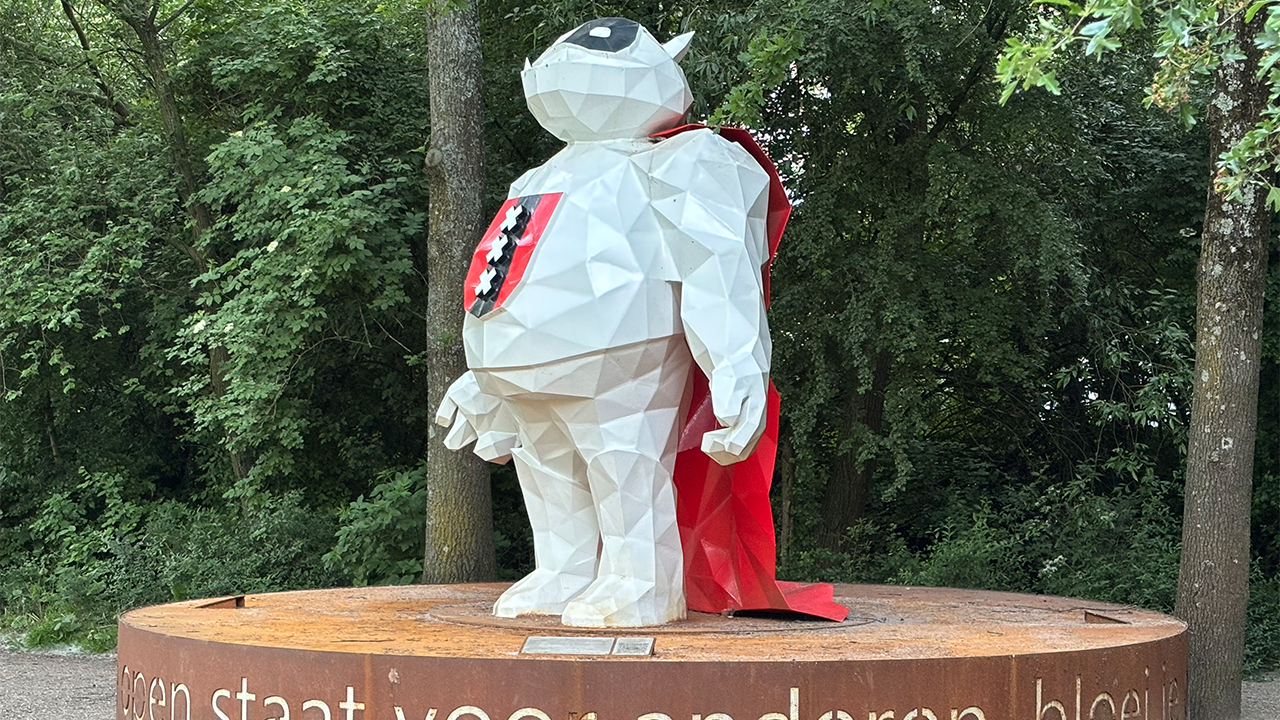
Case in point: the charming (although some might say tacky) sculpture of “Moki, The Stoic Hero,” found arms spread at a far end of Amsterdam’s Vondelpark. “When you are open to others, you blossom,” its mounted inscription reads, translated from Dutch. A closer walk to the base of this curious work reveals fine print as well: “Moki stands for the courage to be open to others, a core value of Amsterdam that has delivered prosperity for all for 750 years. This statue is made of 1375 individual pieces of recycled shipping steel, all connected to each other. Just like Amsterdam—it represents many different people coming together to create something strong and beautiful, because ‘When you are open to others you prosper.’”
Created by artist Damen Shiprepair (could an alias possibly be more Dutch?) to celebrate Amsterdam’s 750th anniversary, the sculpture draws looks both bemused and knowing. Mostly, it draws no looks at all from Dutch who have known long before Moki that tolerance and pluralism speak for themselves. Does the freedom of individuals, and the safety of knowing you are free to be an individual in the sea of what it means to be Dutch, need an endorsement? No. And certainly not when you walk the streets of Amsterdam, and travel the rest of the Netherlands, to enjoy that freedom and safety first-hand.
Moki could stand accused of being a simple-minded marketing stand-in for the Amsterdam Monster Factory that helped create and install it in a public park. Right-wing Americans would no doubt find its message both eye-rolling in its naïveté and patently offensive. Even left-leaning historians would probably pounce on its declaration of “prosperity for all for 750 years.” The Dutch ran major routes of the transatlantic slave trade, and waited 30 years longer than the British to outlaw slavery in its colonies. The somber tourist attraction of Amsterdam’s Anne Frank House stands as an unspoken testament that the Dutch actively resisted the Nazi occupation of World War II, even if some historians believe that resistance was more passive, or, in the unfortunate case of the Dutch fascist party NSB, even collaborative.
“For a new cohort of readers the core-text of the Dutch Holocaust—Anne Frank’s diary—was now read in a very different light,” wrote the late British historian Tony Judt in his magisterial volume, Postwar, citing the latest documents on the Netherlands’ wartime era. “Anne and her family, after all, were betrayed to the Germans by their Dutch neighbors.”
It is hard to stand in judgment when so many other countries were, on balance, no more blameless, and in the case of some countries, far more blameful. The Dutch have since World War II enjoyed an incredible run of luck, albeit a “luck” based largely on a foundation of hard work and resourcefulness. What they seem to acknowledge today, and for the foreseeable future, as nations around them risk plunging back into the waters of far-right ideology, is that maintaining an open society is its own hard work. As a tourist experiencing the wonder of the Netherlands in all its beauty, culture, and efficiency, it is tempting to say the Dutch make it all look so easy. It is in their unguarded moments that they, too, might admit the fear that everything they worked hard to build, and build through a spirit of welcoming cooperation with others, could be far more fragile than feared. Tolerance and pluralism take centuries to build from the ground up. And because these virtues took so long to build and also preserve, the Dutch have every right to brag, even if only through a silent sculpture standing vigil in a park.