James Merrill: The Poetics of Place
August 5, 2026
One can, of course, judge a work of art on its own terms, carefully setting aside the life of its creator, with its cascading influences of love, pain, or situation. But for me, there is something rich and compelling about imagining what WashU Libraries just showed us: “James Merrill’s Poetic Places.”
The exhibition is now over, but the centennial celebration of Merrill’s birth continues. And thanks to its photos and explanations—and a free commemorative postcard book of Merrill’s rough drafts—I feel far closer to the poems themselves. I will remember how excited young James was, writing in his journal for English class, about his “best Christmas,” when “at the bottom of the tree, there were mysterious packages. I tore the paper off one and there was…guess what! A real typewriter from Papa.” The instrument of Merrill’s future.
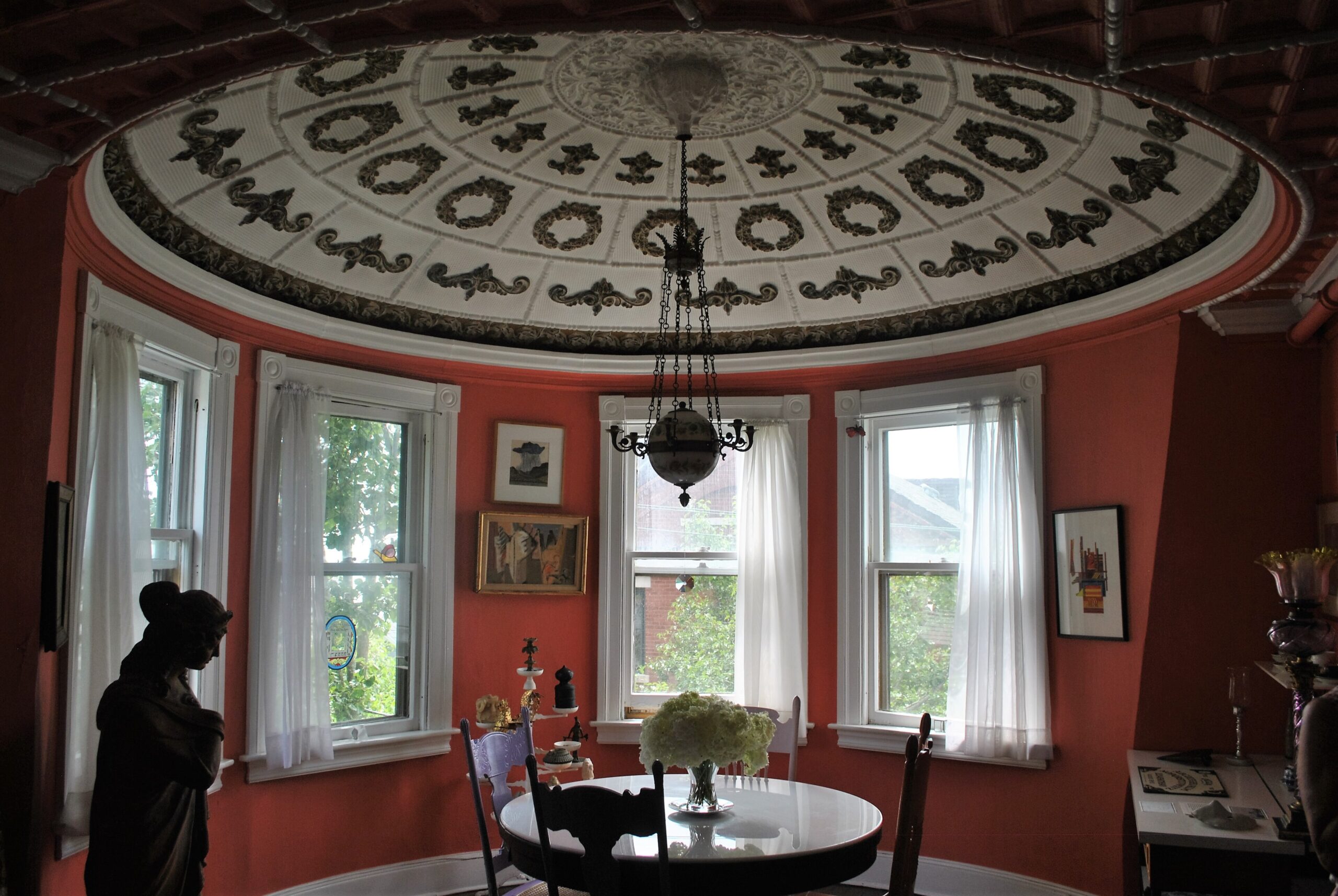
I can also imagine him scooting his chair closer to the round table where for decades, he and his partner set out the Ouija board after supper. Resting slender fingers on an upside-down teacup, he held his breath while it glided, spelling out inspiration. A lesser poet would never have won a National Book Award with poetry that claimed to be a transcription from the spirit world. But what Merrill had the spirits say, freely editing his notes from those sessions, attained both truth and beauty.
Besides, the exhibit reminded me, he had always loved puzzles. The crosswords he solved with his beloved governess, Mademoiselle, aka Zelly, “stout, plain, carrot-haired, devout,” show up in “Lost in Translation,” allegory for the writing and translation of poetry. And I suspect Zelly’s steady devotion and care helped make his poetic feats possible.
Though Merrill traveled the world, he was never nomadic. Homes meant a great deal to him; he absorbed and alchemized them. His first, an elegant old mansion in Southampton, New York, named The Orchard, was a world unto itself, a safe and beautiful container for his childhood. He was, after all, the son of Merrill Lynch’s cofounder. The mahogany and chandeliers his father could afford would later inspire a dream house, Sandover, as setting for some of Merrill’s finest poems.
As cushioned as his childhood was, though, it could not save him being trampled at boarding school by rude, competitive jocks: “This time, Toots, it’s your pants up the flagpole!” But adulthood inverts those school hierarchies and alters the prophecies. Just three years later, James’s relentless arch-nemesis, David Mixsell, would die fighting on D-Day—and haunt him ever after. “The nothing you’d become took on weight,” Merrill writes in “Days of 1941 and 1944.” He still remembers how bare David’s school locker was compared to his: “Oh, you didn’t need/cushions, posters, cotton for nosebleed/…. Or did you? Three more years and you would die/For lack of them, perhaps.”
The rich, soft kid who could only write poems was the one to survive. And he would spend hours interrogating a board to hear voices of the dead. Merrill and his partner, David Jackson, held those Ouija sessions in their dining room in Stonington, Connecticut. (I would have chosen Merrill’s study, simply because one entered it via a movable bookcase.) That Stonington house is now The James Merrill House, which hosts writers in residence, traded drafts and artifacts with WashU for the exhibit, and will, in October, hold a centenary festival celebrating Merrill.
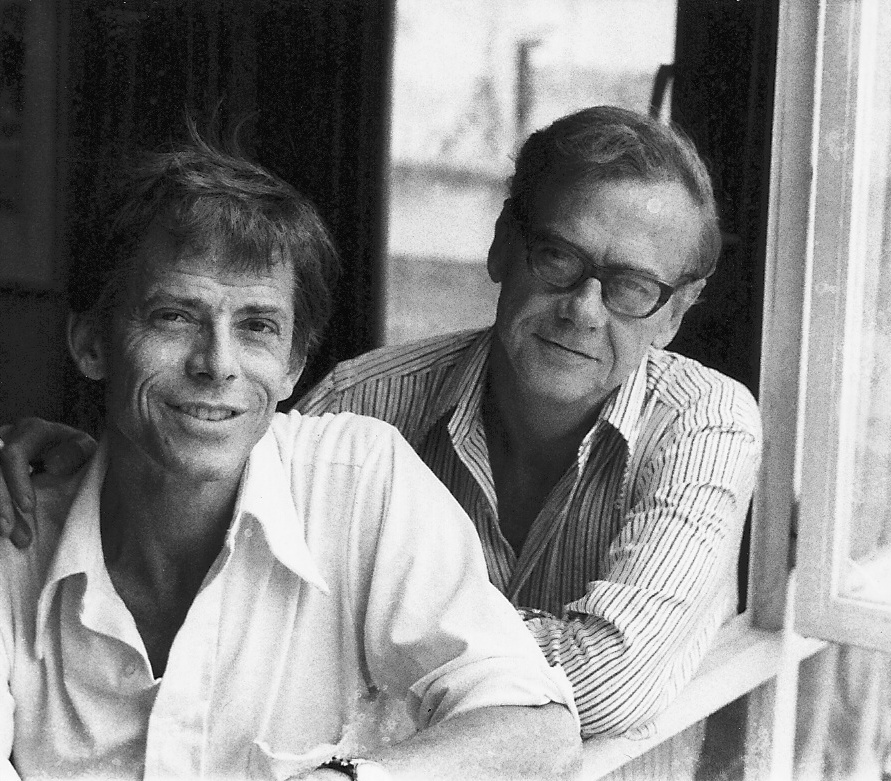
The next place in the exhibit was Athens, where Merrill produced many of his most acclaimed poems, moving deeper into his own heart and experimenting, in the bleaching sun of Greece, more freely. In a writer’s notebook, he describes the islands’ colors: “mauve, exhausted blue, tanned rose, here and there gently wrinkled to catch the sun.” He writes of a woman whose “body was strong and graceful, her features first darkened, then silvered by the dry summer.” She “had wound a thin night-blue shawl around the upper part of her body, to produce an impression of deliberate, coquettish antiquity….. She had said she was going to the pharmacy, not that there was anything to do now but wait.” A few lines earlier, he has told us that “at the top of a hill she met Orestes,” a tight, eloquent introduction of ancient tragedy into the mundane.
From Greece, Merrill and Jackson moved to lively Key West. In a draft of “Clearing the Title,” he describes “this near-tropic point of the U.S./Where we’ve been warned the ‘in’ groups gather/Till everyone’s an island, linked together/By causeways bridging the vast shallowness.” Jackson has apparently already bought them a house, and Merrill is getting used to that fact, examining “these wood floors/Between the muddy varnish of whose lines/(Do you expect to live here? And expect/Us to swelter, year by sunset year,/Beneath these ceilings?—which at least aren’t low.” Their chiffonier, which he cheerfully misspells chiffoneer, will have to go, he decides, “or else be painted white…)/More brightly with each word the future shines.”
They had the house remodeled, and the future shining, by the time Merrill won his second National Book Award, in 1979, for “Mirabell: Books of Number.” It is the second poem in the Ouija trilogy, which ends with the sharp lightness of “The Ballroom at Sandover.” We watch the guests begin to materialize: “There’s tiny Pope! There’s Goethe/Drumming his fingers while Colette and Maya/Size one another up through jet-set eyes./Mallarmé looks blank. With a stern nod/Dante agrees to change seats, so that Proust/Be as far as possible” from the floral arrangement that is making him sneeze.
For Merrill, the Ouija board was a playful collaborator, a shared ritual, a poetic device, a prompt that let him bypass his own rational ego—then reinstate it to craft poetry from the meanderings of his Willowware teacup. The spirits are not actual ghosts, but a psychological framework, just as a Tarot reading unlocks insights you already possess.
The James Merrill Papers are available in WashU Special Collections, and the postcard book is free for all who love poetry. (Take it without love, and you will unsettle those spirits.)