Misterioso Music in the Old Germantown Cathedral
By Chris King
September 15, 2026
Misterioso.
This Italian direction for a mysterious presentation of music appears untranslated in German musical scores, such as Gustav Mahler’s Symphony No. 3 in D minor. Mahler directed his symphony’s movement IV to be performed, among other ways, “Misterioso.” This concept would apply to the entire concert in which Mahler’s 3rd was performed Sunday evening at St. Francis de Sales Oratory.
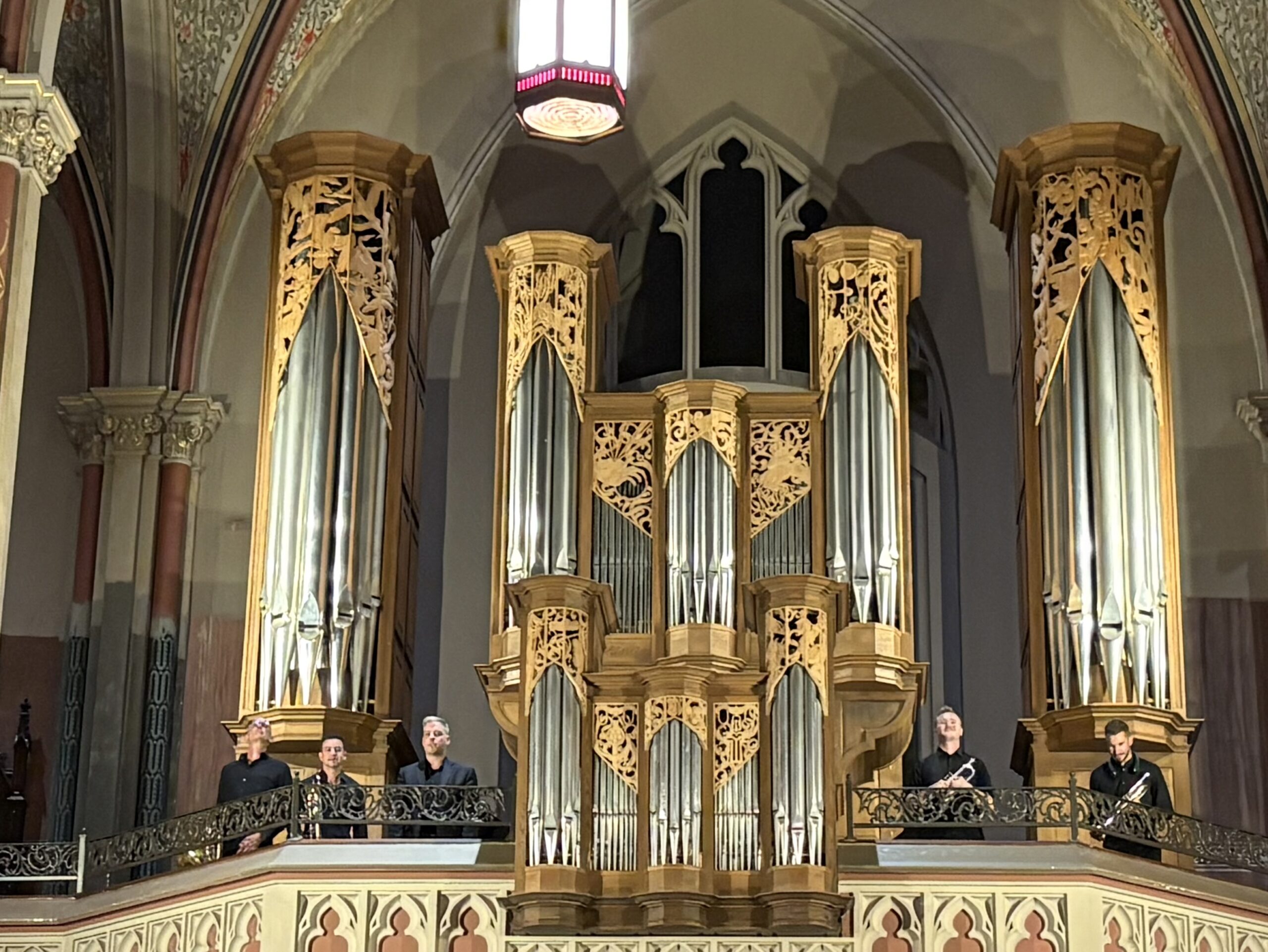
Four members of the St. Louis Symphony Orchestra’s brass section performed alongside organist James Marck, music director at St. Francis. This was part of SLSO’s inspired Symphony in Your Neighborhood series, in this case the city’s old Germantown neighborhood on the near South Side, now known as Fox Park and no longer notably Teutonic.
I walked into this massive, stunning Gothic revival structure—in most American cities, it would be the most impressive Catholic church in town—and found a seat in a pew near the front. A man in clerical attire climbed up to this little crow’s nest of a pulpit and introduced himself as the Rev. Canon Benjamin Coggeshall, rector of this century-old Roman Catholic church. He welcomed us to his sanctuary, then climbed back down without giving us much clue about what to expect from the concert, which would enable the Misterioso vibe.
When the music started from behind us without any musician ever setting up a music stand on the altar in front of us, I realized I had not thought this thing through very far. A grand old Catholic cathedral like this would have some massive organ on a balcony at the back of the building, where the horn players would be set up with the organist. Although the overwhelming feeling, when you hear music performed behind you inside a church, is that a musical procession will be coming your way toward the altar, these musicians were not going anywhere. This entire concert would happen up in the air behind our backs.
We had been promised an evening of German music in keeping with the neighborhood’s Germantown roots. They opened with the first movement of a violin concerto by Antonio Vivaldi, who is about as German as tagliatelle with ragù. The Vivaldi concerto was arranged by Steven Franklin, SLSO trumpet player. With Marck arranging a Mozart church sonata and Thomas Jöstlein, SLSO horn player, arranging the Mahler symphony that closed the show, fully half this program came with fresh arrangements by musicians on the gig.
Not that I could always tell who was playing what, which helped further develop the Misterioso atmosphere. St. Francis has an organ (I did my homework later) custom-built by the Canadian craftsman Karl Wilhelm that has 2,670 pipes. With 2,670 pipes warbling into the vast, echoey sanctuary, how could the ear pick out four distinct horns? (Franklin and Jöstlein were joined by George Goad on trumpet and Jonathan Randazzo on trombone.) Without being able to see where any of this music was coming from, the horns sounded like so many more pipes on the organ, so many more melodies floating in the vast cathedral’s echoes and overtones.
Misterioso.
I noticed Stéphane Denève, SLSO music director, seated a few pews ahead of me. Like the rest of us, he had resigned himself to doing the only thing we really could do, which was stare ahead at the empty altar. Even if you turned around and craned your neck, which was physically awkward and felt wrong in church, you could see much more balcony than musicians way up back there.
My initial sense that we were left with nothing to look at gave way to the realization that there were actually all kinds of things to look at: painted wallpaper, painted walls, painted ceilings, stained glass, ornate architecture, art inset even in the swinging wooden gates that led into the sacramental space, and scads of statues. There were statues of Jesus and Mary, of course, but also statuary of random saints and angels galore.
Peering around at all those angels in the dusky sanctuary as ghosts of echoey melodies sounded down on us from sources unseen, it was almost rational to hear the pipes and horns as the voices of the angels.
Misterioso.
Over the course of an hour of this angelic music (including Prelude and Fugue in G minor by my go-to composer, Johannes Brahms, whose music I would want to hear in heaven if there were one), I stopped looking at anything. I closed my eyes. I tried to relax. I meditated, kind of. I must have been the last person in the cathedral to realize that this would be a pretty good opportunity to pray.