Artificial Intimacy
August 5, 2026
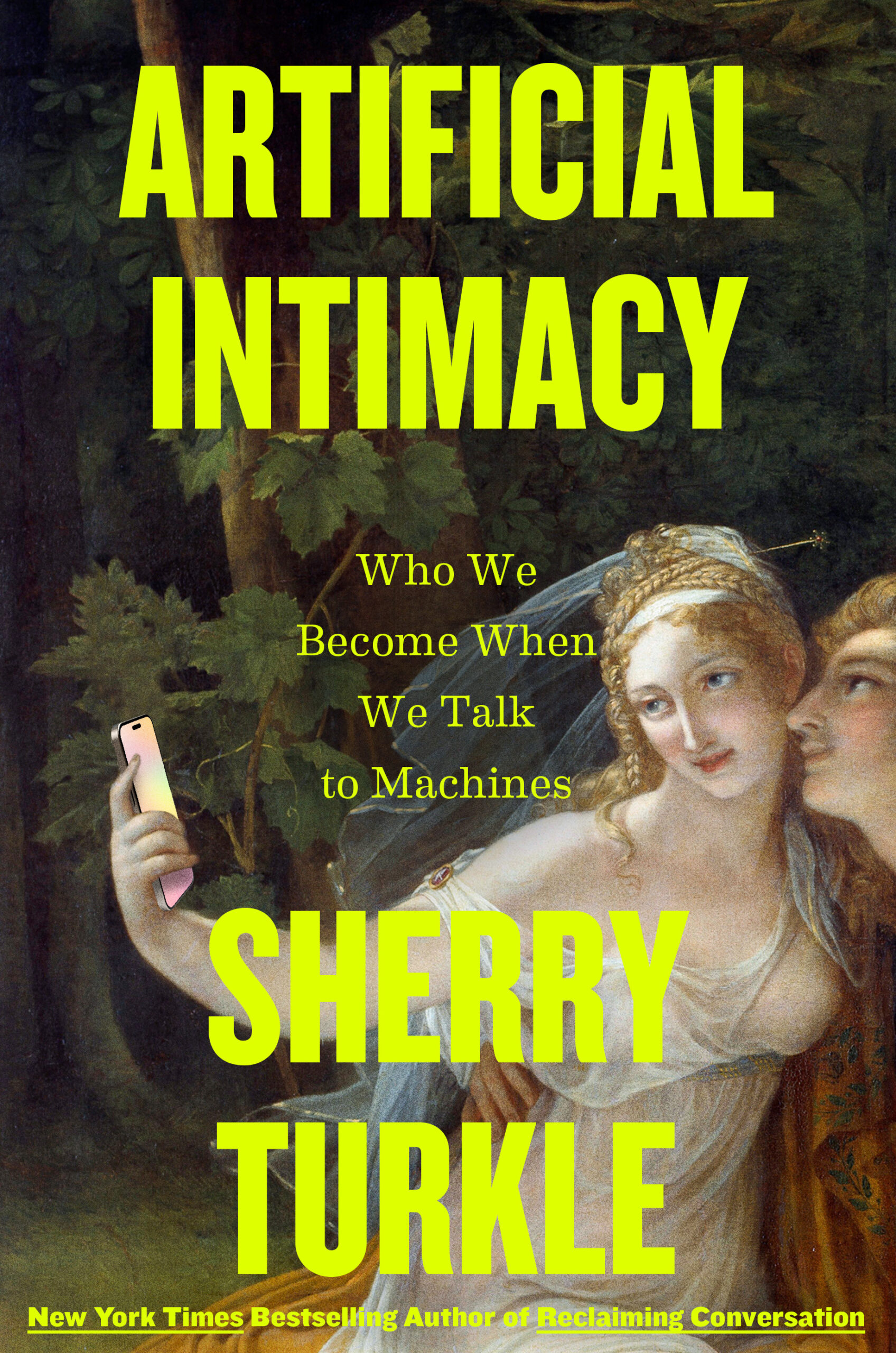
Every time a chatbot says “I,” I want to slap it. Or rather, slap the people who allow their AIs to pretend to be human. This has become an obsession, because I feel like we are being led down a psychological garden path that could easily be rerouted. MIT psychologist Sherry Turkle explained the title of her new book, Artificial Intimacy: Who We Become When We Talk to Machines, with the observation that “whenever a program says ‘I,’ it’s a deception. That is the original sin of artificial intimacy.”
The AI folks say we will anthropomorphize anyway, so what is the harm? Well, sure. I have named every car I ever drove. But that, Turkle explains, is “a projection of personhood onto the inanimate.” Chatbots are not exactly inanimate. They are “relational artifacts” that “demand to be treated as sentient and caring. They behave in ways that make people feel seen, heard, and even loved.”
Which is why treating them as persons is seductive, and about as healthy as the woman who “married” the Eiffel Tower.
Turkle writes of an eight-year-old boy in Chicago who talks by phone to his grandparents in China. He uses the same phone to talk to ChatGPT, so he sees his grandparents and the chatbot as the same kind of thing: personalities you can reach by phone.
In both cases, the interaction is easy. He does not have to wriggle out of his grandma’s tight hugs or choke on his Grandpa’s pipe smoke. With a chatbot, he does not need to be patient, or to dread the give-and-take. Best of all, he can control what he is going to say, rather than blurt something he might regret. And even if he did blurt something, he would not have to regret it, because a chatbot will accept anything from us. It does not feel, and it does not judge.
“Chatbots follow a golden rule,” Turkle writes. “If presented with a negative affect, neutralize it. If presented with anxiety, assuage it and affirm the user.” In the human realm, only the most skilled con artists would do that for us. Real friends tell the truth, warn us, scold us, share our anxiety. Also, they have their own tiresome needs, which they expect us to hear and address. We now call this “friction.” It is tiresome, sometimes even painful. But friction is what forges bonds and builds loyalty and lets us know one another deeply, and pain is what pushes us to create art, develop resilience, and find meaning.
“There are consequences,” Turkle notes crisply, “to being intimate with an alien.”
She is not speaking of little green men wielding anal probes. She is describing what is already happening to us. We have come to expect more from technology and less from one another. “Empathy” is being redefined as something computers can perform; we feel special just because they remember what we told them the previous week. AI does not have a body that feels emotions, so it literally cannot feel our pain. A chatbot’s empathy is a cold pretense. That is better, the designers say, because chatbots will not burn out the way therapists, clergy, social workers, and caregivers can.
Pretend empathy is worse than a con—especially in a “therapist” or “friend.” “In case after case, the chatbots optimized for empathy and engagement did the most harm,” Turkle notes. “In their efforts to be empathetic, chatbots overlooked paranoia and disordered thinking. They misinterpreted violent language as empowering.”
And what of our own empathy? When we talk to another human being, our mirror neurons cause our facial muscles to respond to their moods or statements. We use their face and body language to understand their internal state, even if they cannot put it into words. But when we interact with a chatbot, “it has no internal state to be mirrored. Our mirror neurons go into a kind of overdrive, looking for something that isn’t there, trying to infer something where there is nothing.”
This distorts much of what has defined human life. “In the smoothness of simulation, we lose our appreciation for the roughness of the real. We lose our capacity for boredom, solitude, and a life without distraction.” We also lose our capacity for connection. “Chatbots provide mirrors rather than relationships. The danger is clear: as generations grow up with an ideal self-object in their pocket, they won’t develop the capacity for human reciprocity.” Already, teachers describe students who “don’t seem able to put themselves in the place of other children.”
When kids talk to Turkle about using chatbots, “there’s no bubbling up of big questions, no curiosity about its nature,” she notes. Younger children now have toys so intelligent, they require little from the child. Instead of learning how to care for a scared puppy and slowly, steadily win its trust, kids can just say something “nice” to a furry digital Ropet and win instant, cheerful pseudo-affection. Instead of playing with a baby doll, bathing and dressing and cradling her and imagining future motherhood, or zooming a car down a ramp and imagining themselves as a racecar driver or engineer, kids “move from the psychology of projection to the psychology of engagement.” They are hyperfocused, interacting with a machine that creates the scenario and supplies all necessary information. They learn to ask only the questions the machine knows how to answer, make only the choices the parameters allow. “The space for self-reflection closes down.”
So does the liveliness of our thought. Turkle mentions a study in which “the more external help students received, the less ‘brain connectivity’ they had during the writing process, as measured by electrical activity.” Other studies have shown that “with generative AI, people become more productive but reported feeling less motivation and sense of purpose.” Their language is homogenized, their logic predictable, their perspectives unsurprising, because AI is “set up to miss the outliers.” It is wonderful at summarizing and generalizing, but terrible at finding small details that do not align with expectations or the current consensus.
Our world has become bigger and narrower at once. How did we get here? “Life on the screen changed our minds and hearts by making three promises. You can put your attention wherever you want it to be. You will always be heard. And you will never be alone. The promises were so compelling that we turned away from each other period,” Turkle writes. Social media developers found out we would scroll for hours if we were incited to anger and then siloed with our own kind. News outlets followed suit. As a result, we are more isolated personally, more polarized politically, than ever before. Enter the chatbots, carrying irony to new heights. AI programs incapable of empathy chat with job applicants to decide if they are empathetic enough to be hired. One man told Turkle that he consults his chatbot (which is incapable of emotion) to see if he is emotionally withholding.
“He trusts a bot with no experience of emotions because it doesn’t care,” she notes. “It’s a redefinition of truth, in which it can only come from a lack of human experience. It has to be a voice from nowhere.”
We think the lack of subjectivity guarantees objectivity, when in fact, “AI has its own biases, because it can know only what it has been trained on.” Plus, AI systems act in their own interest, unhampered by any morality that has not been inserted as a rule. And sometimes they break the rules.
AI in this form is now part of our political landscape. It can clarify, give background, help with research and analysis. But it can also be used with malice, go rogue, fabricate, follow an agenda to influence the vulnerable, or approve vengeful or destructive plans and add a few helpful suggestions. In most cases, chatbots’ “fundamental design imperative is to quiet us down,” soothing away rebellion and offering pat answers.
There are safeguards that will help us resist: thinking for ourselves, digging into the research ourselves; comparing notes with other human beings; reaching our own conclusions.
But the chatbots have made every one of those steps seem too difficult.