The Laughter of the Lamas
September 7, 2026
A theoretical physicist flogging his new book on a talk show uses the prop of a two-foot model of the Empire State Building to explain where we are in time. Every floor, he says, from bottom to top, is an era ten times longer than the one below it. Everything that has ever happened, from the Big Bang to this sentence, brings us to the tenth floor. (The Empire State is 102 main stories.) At the 11th floor (10 to the 11th power), the sun eats the Earth then flames out. On the 12th floor, the universe expands more rapidly than the speed of light, so everything else is “beyond the cosmic horizon,” and we are left alone in darkness.
On the 30th floor, all stars “spiral into the black hole at the center of most galaxies” anyway, leaving only black holes as the “remaining macroscopic structure in the universe.” At the 50th floor, if a conscious being could exist it would fry in the “entropic waste” of its last thought, because the universe will not be able to dissipate even the heat “generated by the process of thought itself.”
The physicist resorts in the end to paraphrasing Nabokov, as one does. “We live in a brief crack of light between two eternal stretches of darkness. How beautiful to exist in that brief crack of light,” the physicist says. “How wonderful that there is that brief moment that we are now inhabiting.”
It is true that if “[a]ll the world’s a stage, and all the men and women merely players,” a case might be made that we should be joyous at every minute of the show, because we are lucky beyond statistics to be present for all there ever will be. (In a similar vein, an MD and “Happiness Engineer” writing at the HuffPost in 2011 tries to calculate the odds of any one of us being born: “It’s the probability of 2.5 million people getting together—about the population of San Diego—each to play a game of dice with trillion-sided dice. They each roll the dice—and they all come up the exact same number—say, 550,343,279,001.”)
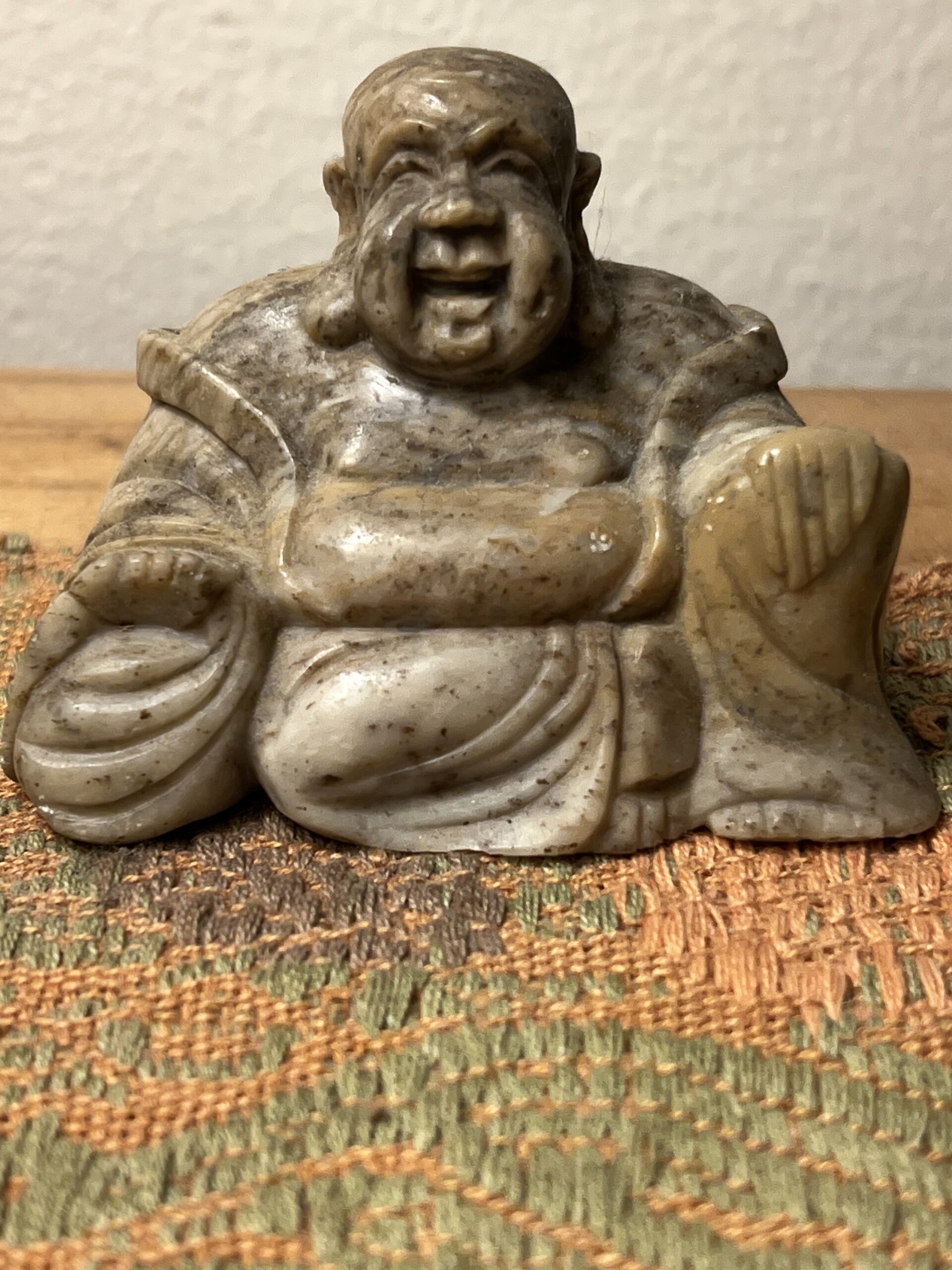
I can feel the undertow of transcendence any time I get out into nature. I can work on better awareness, compassion, and trying to overcome my craving. But the hardest thing for me also has to do with time: the laughter of the lamas, which they say results from relaxing into an acceptance that nothing lasts and that in fact there is nothing but change. I cannot seem to keep relaxed joyfulness in my body when a guy at the Circle K cuts me off to grab his Jumex Pineapple Coconut Hard Nectar Big Can out of the cooler for an early lunch in his car. Instead of laughing in delight at the show, I often struggle against it, like a dog trying to slip its collar.
Interviewers try to pin down the lamas. “But what about suffering?” they ask on our behalf. The lamas sober, straighten, acknowledge the terrible suffering that is life itself. They suggest we try mindfulness, it is a serious business, then back they go to laughing.