Anselm Kiefer: Becoming the Sea
October 21, 2025

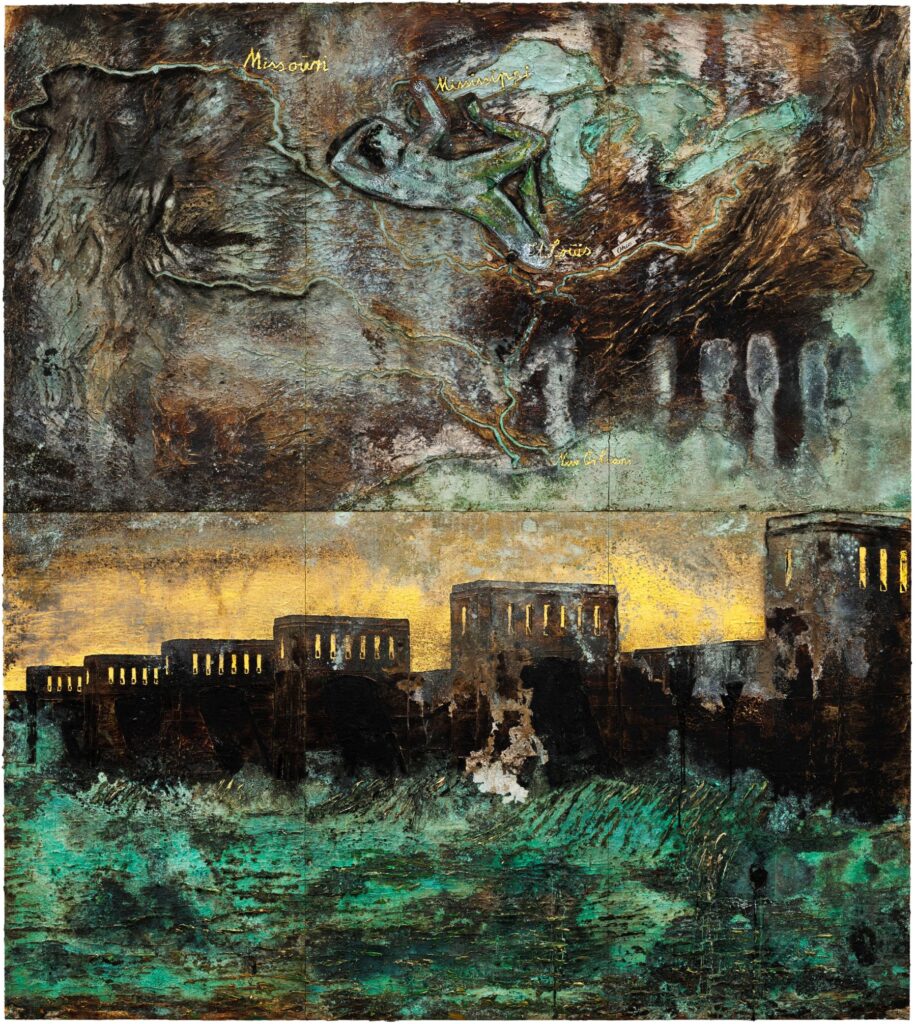
You have probably walked into the Saint Louis Art Museum’s grand Sculpture Hall before. But you have never walked in and seen it like this.
Five new works by Anselm Kiefer, each the height of a three-story building, surround you. They glow dark, gold leaf vibrating against rich blacks and a shimmering sea green made from copper sediment. The textures are so thick, your body feels them.
“Anselm Kiefer: Becoming the Sea” is the first exhibition of his work in this country in more than twenty years. SLAM director Min Jung Kim fought hard for it. Or maybe not that hard—the two know each other, and Kiefer remembered his visit to St. Louis in 1991, when he traveled up the Mississippi River by boat, stood at the confluence of our two mighty rivers, saw the Alton dam, and dined at a house on the bluffs of the Missouri. The Rhine River had figured large in Kiefer’s boyhood—he would gaze across at France, wondering about the people on the other side, or play in the forest above the banks, a shady refuge from Germany’s war-torn streets.
It was time, he decided, to articulate his ideas about rivers.
So along with many of his favorite canvases and sculptures he loaned for the exhibition—twenty of the forty pieces done in the past five years—he offered to do new work for SLAM. Two canvases inspired by his boyhood along the Rhine; two by the Mississippi and Missouri rivers. And a fifth to title the exhibition, triggered by thoughts of the afterlife in a poem by Gregory Corso: “Spirit is Life/It flows through the death of me/endlessly/like a river/unafraid/of becoming/the sea.”
Deeply spiritual, though he left his childhood Roman Catholicism long ago, Kiefer probably is unafraid of whatever comes next. But death does not loom: he is vigorous at eighty and still making art, some of the best in his sixty-year career. And he knows exactly who he is and how he wants his work to be shown.
Dusty, for example. Assistant curator Melissa Venator was forbidden to clean the steel exhibit tables he had shipped from his studio in France, let alone remove the grime from his ivory resin and bronze bridal gown sculptures. Several of the new works arrived with the paint still wet. He wanted none of them roped off; if you see a discreet cord protecting one of the artworks, that means it is on loan from another museum. Those he owns, you can come close to—the artist’s books on those steel tables bear a sign inviting you to page through, handle them—and in two of the galleries, he insisted that the curtains be drawn back so sunlight can pour in.
If that sunlight fades the art, so be it. Kiefer understands that what he has wrought will change with time. He ages many of his canvases outside; his subject is often decay and regeneration. Gazing, you have the sense that you have just unearthed these works yourself, excavated them from someplace deep and dark.

Kiefer is, if anything, a neo-Expressionist—but he mixes forms and smashes categories. At a time when this was seen as naïve and backward, he dared to be representative, giving us familiar objects but making them strange enough to evoke new meaning, supported by historical references he refused to divulge. Critics have called his work luminous, ravaged, transgressive, colossal, uncomfortable, transcendent. They have called him ambitious, magnificently grandiose, brooding, fearless, and “a master of subtle irritation,” the sort that creates pearls from dark grit. Born in 1945 in Germany’s Black Forest, he spent his early years struggling with the guilty silence that surrounded him.
Just as Kiefer refuses to guard or sterilize his work, he insists there be no helpful accompanying text. This, I resent. The man has studied poetry, literature, the Bible, the Kabbalah, German history, classical antiquity, eastern spirituality and mysticism. He has specific, recurring influences and motifs. He is, for example, fascinated by the ancient Norse mythical character Wayland, who possessed magical powers that could repair the past. Something Kiefer has been trying to do his entire life.
But he will not unpack any of this for us.
“He really doesn’t want the experience of his art to become a sort of Where’s Waldo, an exercise in decoding esoteric references,” Venator explains. “He doesn’t want to dictate your experience, or suggest that there is only one interpretation.” I blurt that this is like trying to read T.S. Eliot’s The Wasteland without footnotes. She smiles. “He loves that poem. Also the poetry of Paul Celan. But what he’s trying to capture is not an objective truth about those works, but the way they made him feel.”
For viewers’ sake, Venator did create a brief guide to the works, but she exercised remarkable restraint. The idea is for us to have a visceral reaction to the art as an object. “And he thinks that if he draws you in with a beautiful object,” she adds, “you will find your way to meaning.”
“I can find my meanings,” I grumble. “I want to know his.” This is a man so soaked in the world’s geological, cosmological history that he knows our lives are “not even a drop of rain,” proportionally. He exists “in all time,” he has said, “inside the stones and part of the erosion…. We are not the only ones with consciousness. I believe that objects and materials already have a spirit inside of themselves, and the artist has to discover it, uncover it.”
And so, instead of explaining, he gives us comprehensive lists of his materials: Straw, which he loves for its sunny energy. Clay. Wood. Ash. Broken glass. Sunflower seeds. Oils and acrylics. Hair. Gold leaf, because he tried less expensive facsimiles but “nothing looks quite like real gold.” Lead, the alchemists’ favorite, which he somehow turns into peeling bark, airy and organic. Or, at other times, allows to stay heavy. “People search for lightness,” he once said, “because they shy away from burdens.” Not Kiefer. He embraces the lead, beats it, torches it, distresses it every way he can. He does to his paintings what Earth’s most violent fires and storms do to the land. Yet he finds beauty, always. After submerging lead in an electrolysis bath, he tried the same procedure with copper and noticed an exquisite sediment collecting in the bottom of the bath. Scraping it up, he mixed it with shellac and binders and used its miraculous verdigris color as a paint, lifting the work to a place no paint could reach.
Frustrated by his deliberate opacity, I watch the masterful Anselm documentary. (SLAM will screen it in 3-D on November 23.) Luckily, director Wim Wenders does not honor Kiefer’s deliberate reserve. He opens with the artist riding a bike through his cavernous warehouse, lifting a bit of draped texture then letting it fall and cycling on. The sheer magnitude of the work and raw materials stored in this place leaves me faint. Kiefer brakes to gaze up at airplane wings, murmuring the names of angels.
The film slides from the warehouse to a dark tangle of fairytale woods and an operatic track. Kiefer’s youth, presented as he no doubt felt it. We see a small boy walking past bombed-out buildings—he played in bunkers and built things from the blasted-free bricks. We meet him at age seven, thinking, a pencil in hand, then starting to draw. He hums, then sings, a bleak lullaby: “Ladybird, fly home. Your father is at war.” We flash forward to white rubble in one of his future installations. Then we are shown a canvas dedicated, bitterly, to Martin Heidegger, who refused to pull away from the Nazi party: “Nothing but silence,” says Kiefer, “from the great philosopher.”
His consolation for human cruelty has always been nature. Kiefer—the surname means pine tree in German—loves forests and water and boulders; he braids landscape, myth, and history into his life story. When he uses Siegfried, Parsifal—the Nazi heroes—he is accused of being a German nationalist. No, he says, these mythic figures were abused by the Nazis. The myths should not be discarded.
Other Germans resent him. Their rancor sharpens in 1969, when he dons his father’s Wehrmacht uniform and photographs himself giving the banned Nazi salute at politically significant European sites. Not as provocation for its own sake, he insists, but to protest the forgetting. “I held a mirror to everyone’s face.”
In the following years, German history and Germany’s sins are hard to extricate from his body of work. Kiefer is making landscape painting possible again, but in a new way, as the ground of history. “You can’t just paint a landscape when tanks have driven through it,” he remarks. Remembering his childhood love of Jason and the Argonauts, and how Jason sowed dragon’s teeth that grew into an army of warriors he had to defeat, Kiefer begins to incorporate ceramic or plaster teeth into his heavily textured canvases.
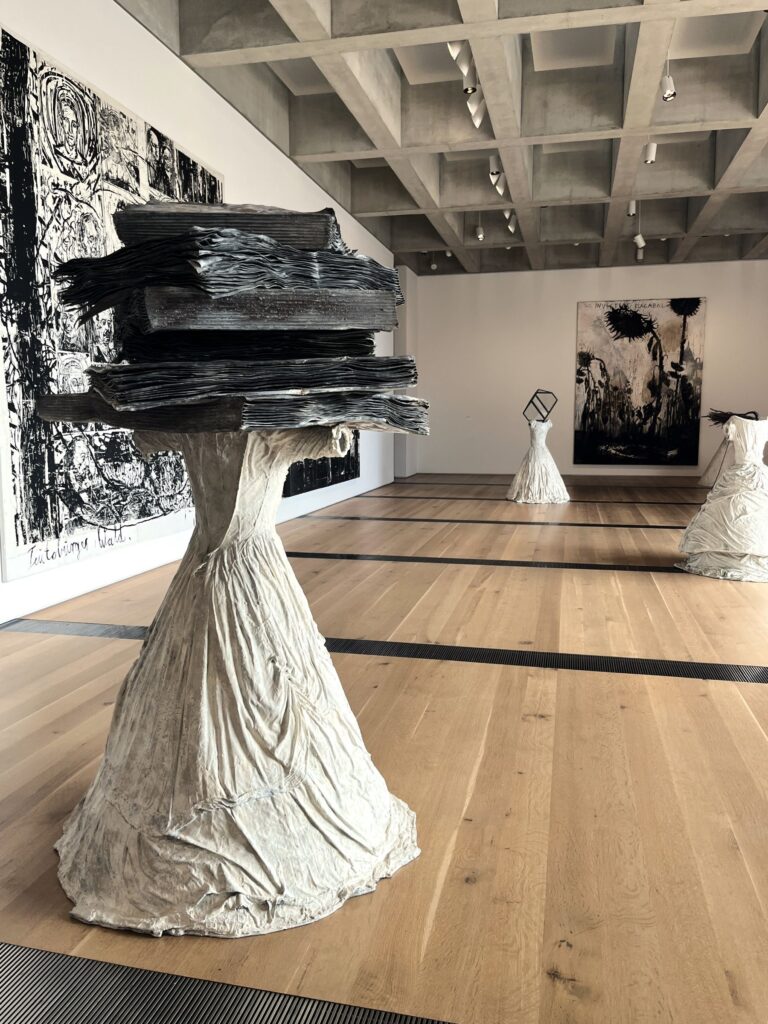
He also grows interested in the women excluded from history. A group of sculptures in one of those sunlit galleries at SLAM is titled “The Women of Antiquity”; Venator says he “wanted to recognize underappreciated contributions women have made.” The effort seems a bit backhanded: these are antique bridal gowns frozen in place, empty, the women they represent faceless, their “heads” symbolic objects. One of the five is not an actual woman but Melancolia, inspired by Albrecht Dürer’s engraving of the same name. A female personification of the mood of melancholy, it has for a head a truncated glass polyhedron, meant to suggest an incomplete shape that she cannot summon the will to sculpt. Then we have Eulalia, a Christian martyr whose head is a leather whip. Sappho, crowned with lead books. Thusnelda, a German tribal queen who was captured and displayed as a victory trophy, and whose head is a crisscross of sticks from the forest. And thorny vines atop Arria, wife of a Roman senator. He was given the choice of an honorable death by suicide or a public execution and was too cowardly to kill himself, so Arria wrenched the dagger from him and stabbed herself, saying, “Paetus, it does not hurt.” Shamed, he follows suit.
The sculptures are haunting, rich with story, and formally interesting, though I might have chosen a different selection. Still, I am willing to give him the benefit of the doubt, not only because much of his work is feminist in spirit, but, less rationally, because a friend of mine knows his lover and witnessed a surprise delivery of one hundred red roses. More telling: his ex-wife stayed on good terms with him. And the best proof yet: he is preoccupied, not scared, by Lilith, the rebellious first wife of Jewish lore who insisted on equality with Adam, thus was branded demonic.
Kiefer is interested in justice. In regeneration. In confronting truth. But he is utterly uninterested in art celebrity. As a young artist, he held trendy minimalism in contempt. He lived in woodsy, solitary places. After his 1987 retrospective in Chicago, he became internationally renowned—yet he tells Wenders he does not feel he has “arrived” at all. He still feels…banished.
At SLAM, though, his work could not feel more at home. The museum has one of the world’s largest and most diverse collections of twentieth-century German art, and this show is an important one. Preparing for it took two and a half years, a logistical and financial undertaking proportional to the monumental scale of the work itself. Now SLAM wants every St. Louisan to have a chance to see the exhibition, so it will be free to all, every day, with accompanying talks and events, right through the holidays.
The exhibition closes January 25 but will live on, becoming part of anyone who saw it.
Read more by Jeannette Cooperman here.