David Hockney, by Surprise
By Ben Fulton
June 12, 2026
David Hockney’s works never had the reputation in contemporary art of conveying intellectual dilemmas, much less casual profundity. They were much too fun for that. Or, as art mavens have been fond of reciting for at least the past two decades, “calling [insert cultural issue of the day here] into question” was not his concern. Looking at his most famous works, you felt right away that he only wanted to dazzle and charm.
That aim is not nearly as frivolous as it sounds. Those who have had the privilege of sharing the same space with one of his masterpieces know there is no disputing Hockney’s technical mastery, a mastery that gave his paintings a steely intensity, but also a warm sense of honesty and integrity. One glance at his most famous work, A Bigger Splash (1967), made you feel you were at a Southern California poolside. Maybe A Bigger Grand Canyon, created more than twenty years later in 1998, could not quite replicate the sensation of witnessing Arizona’s landmark geography, but it convinced you dead to rights that Hockney, for all his status over the decades as a jet-set figure of international stature, knew landscapes far better than 99 percent of all realist landscape painters.
Hockney’s recent June 11 death has, of course, brought out all the necessary tributes and analyses of the art world by those who watched the quiet young man from Bradford, Yorkshire UK, evolve into the famous artist who bestrode the world like a colossus. Openly gay at a time when the world was even more openly homophobic, Hockney thought it only honest, and therefore best, to portray his sexuality on the canvas as he chose. An unrepentant smoker, Hockney had no right to live to the age of 88, except that he filled every year to the brim with his incredible work ethic, creating everything from photography to ballet and opera set designs, including Die Zauberflöte, then circling back to photography when it turned digital.
There is a widespread sense among so-called everyday people that art as a pursuit has passed us by. Most modern art presents itself as inscrutable, and the occasional news of auction prices for original works makes the head reel. As a person of barely modest means, I decided some 15 years ago, when my sister’s destination wedding planted me in Florence, where every sight screams Middle Age or Renaissance masterwork, that money would never get between me and great art. So I scraped. I saved. I subscribed to email alerts for flight deals to European cities with galleries, museums, and limited exhibitions.
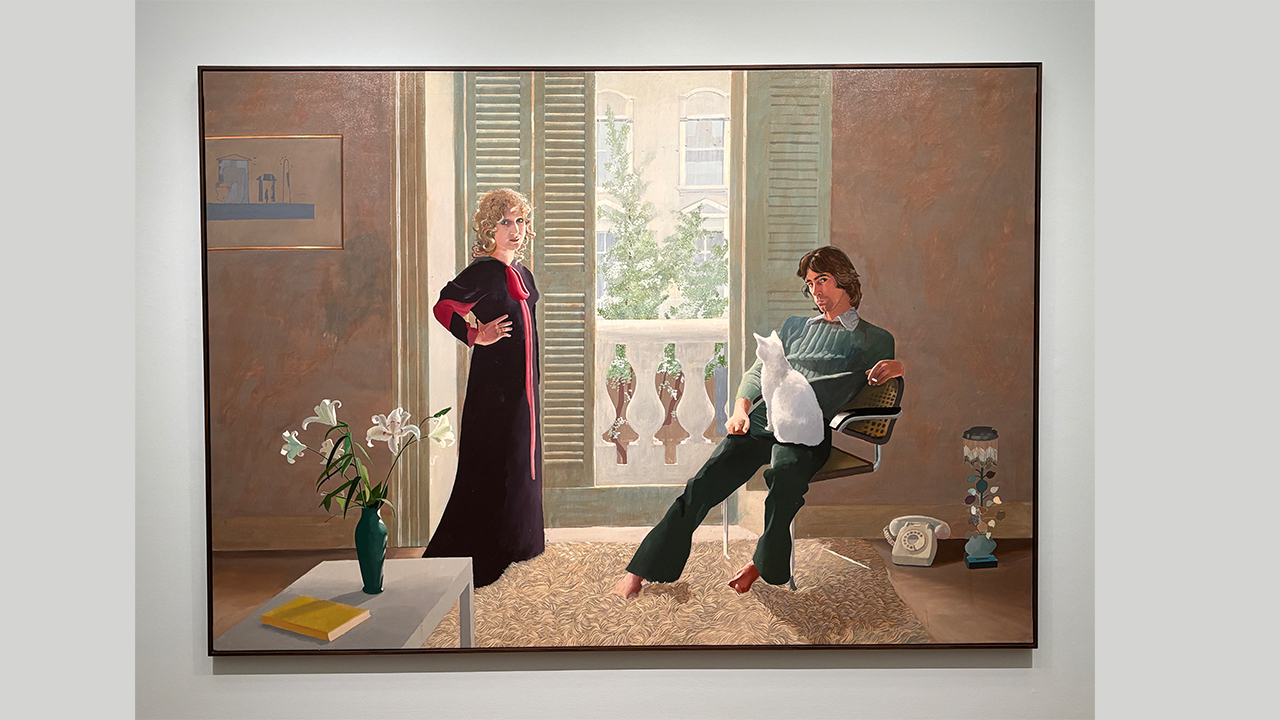
Hockney’s Mr. and Mrs. Clark and Percy, a large 1971 painting that spoke to me even in basic reproductions, was a painting I longed to see in its original form. Before a trip to London years ago, I knew from checking the Tate Britain website that it was not on exhibit. Oh well, London by itself is so chock full of art masterpieces, a trip there can never be wasted if art alone is on your mind. Years afterward, I searched the internet to find Mr. and Mrs. Clark and Percy, traveling far and wide, to Seoul, then other foreign galleries too far afield to make a trip worthwhile.
Traveling recently to the Netherlands, I banked on taking in as many Rembrandts, Vermeers, Van Goghs, and other Dutch masters as possible. Ditto for the more esoteric tastes of modern painters such as Piet Mondrian. The disappointment was real upon learning that Anselm Kiefer’s Inneraum (1981) was not on exhibition at Amsterdam’s Stedelijk Museum. But the hunt for visions continued. Without warning or notice, a motherlode waited south of Amsterdam at London Calling, a collection of postwar British painting at the Kunstmuseum Den Haag. Paintings by Lucian Freud, Francis Bacon, Paula Rego, and Michael Andrews alone would be enough to satisfy a sweet tooth for great art. Freud’s Two Plants (1977) and Girl with a White Dog (1951) thrilled by balancing realism with tones of graphic, uncanny unease. Andrews’s beguiling Melanie and Me Swimming (1979) brings a lump to your throat with its eerie, but poignant, depiction of a father and daughter at play.
Stumbling upon Mr. and Mrs. Clark and Percy by surprise, though, was like waking up to Christmas morning, but reborn as an adult. The size, vibrancy, and overwhelming stillness of this painting are so impressive that it works almost as a trance, or incantation, of natural light. A visit to the Hague’s Mauritshuis museum offers magisterial lessons in the supremacy of Johannes Vermeer, who captures the physics, and even the magic, of light on water in his View of Delft (1661). He leaves you suspended with the thought that you actually share an exchange of glances when you behold Girl with a Pearl Earring (1665). Hockney seemed to work with light at an altogether different angle.
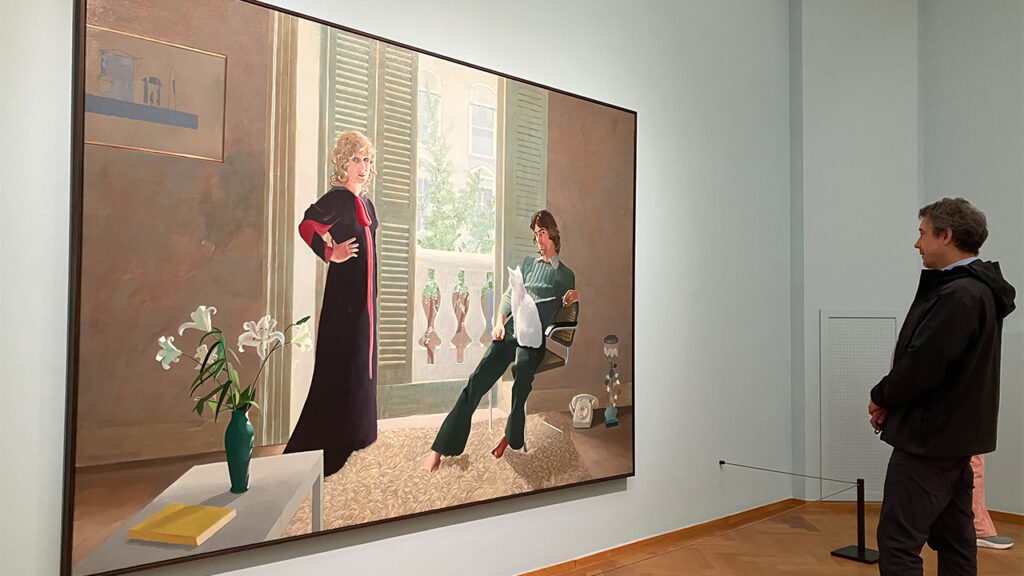
Light for Hockney is not a mirror into ultimate reality, or a means of persuading you that you, too, are there. Light for Hockney, or at least in this work, is the portal to where we have always wanted to go, but where we can never enter. The light filling the London city street and balcony outside the room where fashion designer Ossie Clark, his wife and textile designer Celia Birtwell, and their cat Percy all pose and recline is the serene, controlling mechanism that keeps our sights in focus. Its shadows make every other detail possible, from the delicate vase of flowers and book on the table, to the curling multitudes of the shag rug, shimmering chrome chair, and even the old-fashioned landline telephone. That final reminder of a world without cell phone screens is enough to make most of us pause for relaxation, but the work as a whole is calming enough to induce a longing ache for a peaceful, long, and lazy weekend afternoon. If it is true that artists recreate in paint the senses and emotions they feel in their heart, we can hope that Hockney himself remembered the peace and satisfaction he must have felt after finishing this beguiling work. I am fortunate beyond words to have witnessed this painting in its first and original form eleven days before Hockney passed away.
There is no need to belabor the point where great paintings are concerned. Pursuing them is far more fun. Ernst Gombrich, Robert Hughes, Simon Schama, John Berger, and other great critics and scholars of art have their lessons and wisdom to impart. What I am here to tell you, after standing before a painting I longed for years to see, and now that David Hockney has departed forever, is that nothing will replace the thrill and joy of seeing original works for yourself. See as many as you can, while you, too, still walk this precious Earth.