Comedian Tim Robinson Reveals the Humanity of the Absurd and the Absurdity of Being Human
By Ian Scholes
May 1, 2026
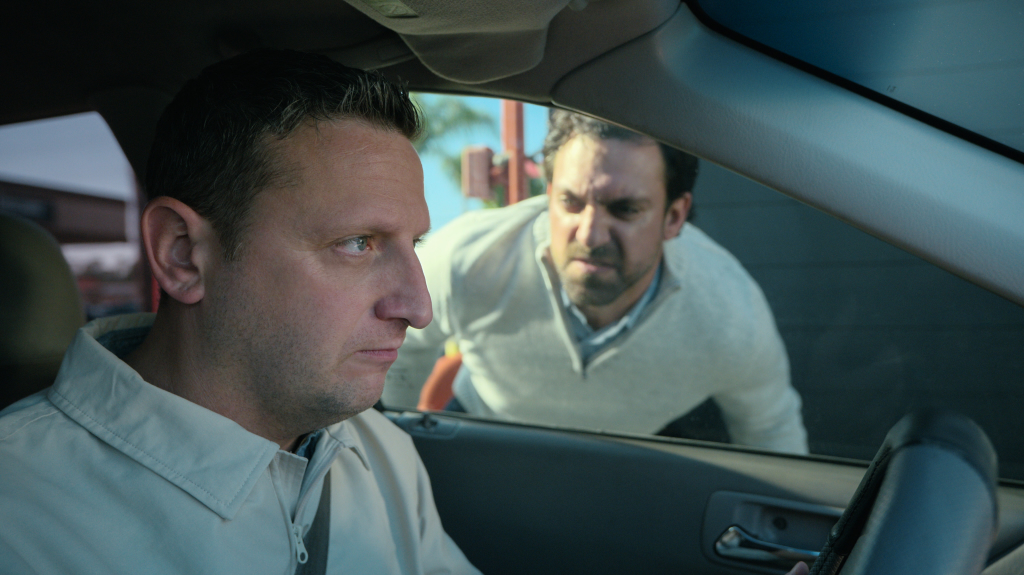
Tim Robinson’s sketch comedy show I Think You Should Leave (which, humorously enough, feels the need to announce itself as “a comedy show”) seems absurd on first watch. And truthfully, it is absurd on every watch. But as I sat in my bedroom alone one Friday night, watching the show did not seem so absurd anymore. Nor did it even seem like “a comedy show.” I realized that each absurdity in I Think You Should Leave reflected an absurdity of modern life that we take as “normal.” Robinson does not show us anything more absurd than the everyday world we live in. A great comedian is a mirror. One of the more popular sketches from the show, entitled “Pay It Forward”, features Robinson as a man in a fast-food restaurant’s drive-through. As the employee gives him his credit card, he looks back at the vehicle behind him for a moment, before getting the worker’s attention again.
“You know,” he tells her with kindness brimming in his blue eyes. “I’d like to pay for the guy’s meal behind me, too.”
“Oh wow! That’s really nice of you!” the young employee tells him as she takes his card back.
“Yeah, who knows?” Robinson muses in his khaki windbreaker. “Maybe it’ll catch on.” He shrugs humbly.
The employee turns back towards him. “Have a great day, sir!” she beams at his kindness.
Robinson glows with goodness.
Suddenly, a shadow passes over his face. He hammers his gas pedal, maneuvering his silver Honda sedan around the restaurant, nearly colliding with a woman trying to enter the drive-through.
“STOP! STOP! STOP! PLEASE LET ME GO FIRST! I’M DOING SOMETHING!”
Gone is the serenity of a man who has done a good deed. In its place is a lunatic, eyes bulging, face flushed, spit flying everywhere. As he pulls up to the menu, he shrieks his (second) order—an obscene amount of food totalling nearly $700.
It seems ridiculous that anyone would ever do something like this, and yet, which version of Robinson do we imitate? The kind, compassionate man who just wants to do something nice? Or the lunatic selfishly exploiting his own charity. We may not loop around the building to immediately profit from our “good deeds” but we hardly let those deeds go unnoticed. How many students at this university, like myself, have rows and rows of volunteer information on our resumes and LinkedIn profiles? Perhaps we are more insane than Robinson’s lunatic. After all, all he wanted was $700 worth of food (a basic need). We are striving to add a line to a piece of paper to enhance our reputation. And we laugh at the clown, not realizing that beneath the makeup, he is no different from us.
The sketch “Darmine Doggy Door” begins simply enough. In infomercial stylings, Robinson, as a salesperson for Darmine Devices, advertises the company’s new sensor-activated doggy door that ensures “you’re not gonna get vermin, you’re not gonna get intruders, and you’re definitely not gonna get this thing!” A monstrous quadrupedal beast bursts through the doggy door, screaming violently. Robinson loses his professional composure as he reaches out to steady himself on the commercial set’s “front door.”
“Cause I saw that thing. That thing came in here while I was on the couch.”
After a string of expletives, he explains that the “monster” was really a pig in a Richard Nixon mask who his next-door neighbor forced through his doggy door since the two have had a dispute over a property line. Why?
“To call me a liar and a thief like Nixon and a pig,” Robinson says. Of course, a sleep-deprived Robinson did not immediately assume that the creature was a pig with a Nixon mask strapped to its snout. He assumed, as he shouts at the audience, that he was going to be eaten.
“And when you think you’re gonna get eaten and your first thought is ‘Great! I don’t have to go to work tomorrow,’ you’re relieved you don’t have to go to work because you thought you were gonna get eaten?” Robinson’s ill-fitting plaid shirt loosens from his khakis as he screams the lament of a distracted generation lost in meaningless individuality and a modernity that only serves to primitivize: “What have they done to us? WHAT DID THEY DO TO US?!”
What did they do to us? Why would we rather be eaten than go to work? Why have we become so hostile, and our relationships so fraught that our only interactions with our neighbors are property line disputes? Why have silly arguments escalated to the point that we send a pig in a Nixon mask into our neighbor’s doggy door, or worse, talk about their “misdeeds” to our other neighbors, tarnishing their name? Who is not guilty of blowing a tiny dispute up into a massive conflict? And worse, why does our online internet culture approve this type of behavior?
The word “they” is doing remarkably heavy work for Robinson. This almighty “they” who force us into the jobs we hate, fire us when their bottom lines need improvement, only give to charity for tax write-offs, who start wars and raise taxes, then pump us full of an addictive numbing agent in the form of smartphones, social media, and the news, all while profiting both fromour dependency and apathy, and taking trips to the U.S. Virgin Islands.
What did they do to us?
When Robinson, in his poorly fitting outfit that he most likely refers to as his “work clothes,” describes an incident in which a monster barrels through his doggy door, we laugh. But when he points at the camera and screams, “WHAT DID THEY DO TO US?!” who can laugh?
Who, honestly, can write him off as absurd? After all, we are the neighbor, and we are Robinson as well. We are both aggressor and victim, all controlled by the almighty “they” that force us to buy cheap on Amazon, pay for LinkedIn Premium, use Duo to open our emails, and use Homebase to open our doors.
Tim Robinson is no absurdist. He is merely the only person sane enough to call out everyone else.