Thomas Sowell Is at It Again
The legendary conservative economist’s newest book covers old ground.
By Gerald Early
October 20, 2023
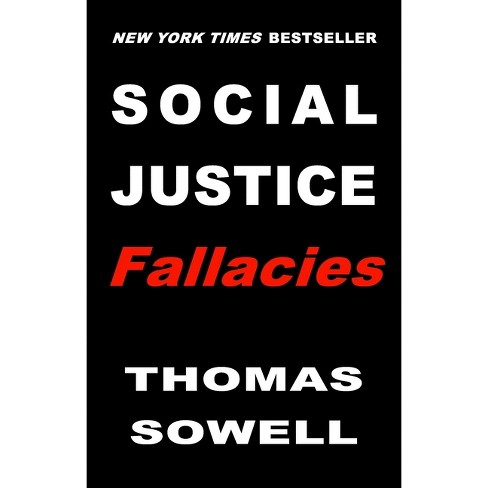
Social Justice Fallacies
This past June, economist Thomas Sowell turned ninety-three years old. It is remarkable that he is still writing books, even if his arguments and adversaries remain unchanged. One would think that he would think that he has said all that he has to say. But there is something to be said for someone who wants to fight the good fight until the very end; die in the saddle, so to speak. Regardless of how one feels about Sowell’s ideas, there is something to be said for the seriousness of his commitment to his enterprise. The fact that he has been so persistent is worthy of, at least, a grudging respect from his detractors.
Sowell has been an ardent critic of liberal and leftwing social and economic policies since he emerged in 1975 with Race and Economics, and especially in 1981 with Ethnic America: A History. His 1980 Fairmount Conference address, which so deeply affected Clarence Thomas, one of the attendees who would become a Sowell disciple, did not open up the debate he wanted with Black liberals about the civil rights establishment and its goals, did not quite legitimatize the “alternative” thinking he felt was necessary, but, whatever its failures, it served nonetheless as his shot across the bow. (Here is Sowell’s opening address at the Fairmount Conference where he lays out his intention to challenge “conventional” Black liberal thinking.)
Regardless of how one feels about Sowell’s ideas, there is something to be said for the seriousness of his commitment to his enterprise. The fact that he has been so persistent is worthy of, at least, a grudging respect from his detractors.
He has been nothing, if not prolific. He has published close to fifty books—from basic primers on economics to autobiographical works, from historical treatises on race, migration, and conquests to polemical essays espousing a free market, conservative viewpoint, from evaluations of American education to historical considerations of intellectuals. His biographer, Jason L. Riley called Sowell, “one of America’s leading social theorists.” (Maverick: A Biography of Thomas Sowell, Basic Books, 2021, 2). It would be hard to gauge how comfortable Sowell would be with such a designation. He has constantly emphasized his skepticism about theory, his insistence on facts and experience, and his suspicions about people who are largely book-oriented or, for lack of a better term, intellectuals, those he feels are the armchair vanguard of the revolution. His Intellectuals and Society (2010) and Intellectuals and Race (2013) were scathing critiques of intellectuals as a peculiar class in western society. At times, he almost sees them as parasitic.
In Social Justice Fallacies, he excoriates intellectuals like Jean-Jacques Rousseau, John Dewey and William Godwin for proffering theories untethered to reality and for dismissing the opinions and ideas of people who are not intellectuals. In short, he thinks intellectuals are often, not always, self-aggrandizing snobs whose knowledge about the world is less than they think it is. He also thinks that leftist intellectuals can be ruthless. But many intellectuals of any political persuasion can be ruthless in the pursuit of influence and power because they are convinced that their ideas ought to prevail.
“Many intellectuals with high accomplishments seem to assume that those accomplishments confer validity to their notions about a broad swath of issues, ranging far beyond the scope of their accomplishments,” writes Sowell. (100) Of course, he himself would be considered not just an economist but a public intellectual, who, during the time he was a newspaper columnist, commented on sundry political and social matters on which he was not an expert. His comments, in these instances, were sometimes interesting, sometimes labored. He criticizes Nobel Prize winners doing this sort of thing on page 80 of Social Justice Fallacies. Maybe having public intellectuals is simply a way for a society to stimulate thinking on subjects or perhaps merely to entertain people. (IDEAS AND OPINIONS FOR SALE!) That intellectuals can function as entertainers of a sort in a market-driven society where ideas can function as consumable fashions is something that may or may not have occurred to Sowell. I think he often functions that way for many of his fans.
In Social Justice Fallacies, Sowell judges knowledge by how “consequential” it is, how much it matters for the mundane but practical aspects of living. He warns against scaling knowledge as “higher” or “lower” or prizing knowledge on the basis of how complex it is. “Knowledge … does not exist in a simple hierarchy,” he writes, “with the kind of special knowledge taught in schools and colleges at the top, and more mundane knowledge at the bottom. Some knowledge—in either category—is more consequential than other knowledge, and that varies with specific circumstances and the kinds of decisions to be made, rather than varying with the complexity or elegance of the knowledge itself.” (72) (This, to me, seems a reasonable assertion.) He is especially wary of how leftist intellectuals manipulate language for their particular ends. Two of his examples in Social Justice Fallacies are “merit” and “exploitation.” The subtitle of his 1984 book, Civil Rights: Rhetoric or Reality, reveals the binary he thinks separates leftists from thinkers like himself. There is rhetoric as the mask and there is reality as what is beneath the mask. Here leftist intellectuals would accuse Sowell of being simplistic: rhetoric is a form of reality, not its antithesis. God gave people the power to name things and shape reality through language. He would probably respond by saying the leftists always want to hide behind “complexity” and its automatic validation of their ideas. (In The Vision of the Anointed, published in 1995, he writes that calling a formulation “simplistic” is a trivializing tactic common to leftist intellectuals.) To name things is a responsibility, not an indulgence. But at this point, Sowell and his critics would be talking past each other.
That intellectuals can function as entertainers of a sort in a market-driven society where ideas can function as consumable fashions is something that may or may not have occurred to Sowell. I think he often functions that way for many of his fans.
He accuses intellectuals of amassing power through assuming the task of making decisions (“surrogate decision makers”) for other people about how they should live and how society should be configured. He derides this, well, conceited idealism. He prefers the realism of the empiricist. The idealists indulge themselves with remaking the world in their own image; the realists discipline themselves to face the intractable nature of the world. This is Sowell’s view, which, as with all intellectuals, inevitably flatters himself. He certainly is right in warning readers about the limitations of intellectualism, and about the dangers of its vaunting ambition. Intellectuals have their place but, as Sowell suggests, they are never held accountable when their ideas fail.
In some of his previous books, the dragons Sowell has gone forth to slay were the civil rights establishment or “the anointed.” In Social Justice Fallacies, it is the social justice warriors, as they are called, the latest iteration of progressives, those who can see further into this life than the rest of us and have the vision to correct our evils and ills, if only given enough money and enough power. He tries to slay them with the same ideas and facts he used in his earlier battles. This may be good if the dynamics of the conflict remain unchanged or it may be a case of a general constantly re-fighting the last war. Sowell, of course, is thinking that it is Black people’s fixation on racism as the cause of all their problems that is making them re-fight the last war.
Most of what Sowell argues here is not new. Versions of his critique have appeared in his other books:
- Blacks made greater economic strides between 1940 and 1960, before the civil rights legislation and the advent of charismatic leaders, than they did after, as Black poverty rates have remained virtually unchanged since the 1970s.
- The unequal distribution of social demographics in professions is not necessarily a sign of racism or racial discrimination. No society in the history of the world has ever had a perfect or even roughly comparable distribution of its population across the spectrum of its professions.
- There is a distinction between what is desirable and what is feasible. Social justice warriors do not understand that. To try to bring about the desirable when it is completely unfeasible will only hurt the very people the social justice warriors want to help.
- Affirmative action in college admissions has been disastrously bad for Blacks by mismatching them with universities and colleges that are more challenging than their educational backgrounds can deal with. This has resulted in Blacks graduating in the lower half of their classes at high-prestige schools, whereas they might have done much better at schools where their educational background matched better with those of their peers. He offered evidence that Blacks who attended medical schools and law schools where they more closely matched the intellectual abilities of their peers had higher rates of passing the United States Medical Licensing Examination and the bar exam than those who went to schools where they were mismatched. (122-123) High-prestige universities are simply using Blacks as a presence for selfish institutional purposes, mostly federal money. (125)
- He accuses social justice warriors of seeing the people they are trying to help as “inert chess pieces” who can be moved in any way they wish to move them. This is particularly true with issues like the distribution of income and the wealth gap and with minimum wage law. (48-70) Income distribution is fluid, and no working person stays at the bottom for his or her entire working life. The same is true for the top bracket, Sowell argues. Minimum wage laws have always hurt Blacks and he uses Black teenage employment statistics to prove his point.
Sowell has argued these points for years in many of his books. Some replies might be:
- Yes, Blacks made considerable economic strides before the civil rights legislation of the 1960s, but it still may have been in part because of the welfare state. Even if Blacks did not benefit as much from Social Security and the GI Bill as Whites did, many did benefit from them. (My own family benefited monetarily during my childhood and teen years from the fact that my deceased father was a World War Two veteran.) Also, Blacks, with boycotts, the March on Washington Movement launched by A. Philip Randolph in 1941, the Black press pushing for Black access during World War Two, and the like, were making use of pressure politics—before the advent of the Civil Rights Act of 1964—to improve their lot. I agree wholeheartedly with Sowell when he says that Blacks improved themselves during this era almost exclusively by their own efforts. But the welfare state and agitation played important roles that he does not acknowledge. Sowell may think that welfare state programs that did not specifically target Blacks helped them more than those that did.
- No society has ever had a broad demographic diversity in its professions or in its labor force because every society that has ever existed has practiced some form of social discrimination that skewed the results. I agree with Sowell that no society can control completely the results of its social bias and social bias is impossible to eliminate, but a society can create tendencies and steer people into areas they may have gone into if the bias did not exist. Sowell’s point about geography (lack of rivers or dearth of draft animals) and biology (women) generating inequality within groups and between groups seems valid to me.
- Yes, there is a distinction between what is desirable and what is feasible. But people who have been opposed to any sort of reasonable change have always argued that the change is not feasible. In the push for integration in this country, White segregationists frequently argued that the desired change was not feasible, violating custom and disrupting settled norms.
- I agree with Sowell about some of the worst effects of affirmative action in college admissions. Having been an affirmative action baby myself, I know close-up and personally how much of a mixed bag the college experience of many of Black peers turned out to be, and how much we felt that high-prestige colleges were using us as guinea pigs. Sowell touts Black students being among their intellectual peers, yet nearly all Black colleges, for instance, have lower graduation rates than the Black graduation rate at predominantly White schools. Check out articles like this, this, this, and this. In other words, the problem with Blacks graduating or doing well in college is more than being mismatched by affirmative action. Sowell touches upon this when he discusses the overall decline of Black scholastic achievement over the last thirty to forty years. (129)
I remain a fan of Thomas Sowell, even as I disagree with some of his points. In fact, I enjoy disagreeing with him. I find it enlivening. And Sowell’s writing has always possessed a swagger and sarcasm that are enjoyable even when you dissent from his view. If he continues to write, I will continue to read his stuff. I regret that he did not stay in academia and produce graduate students who could have pushed his ideas more. It is so easy now for him to be ignored in the academy on any convenient ideological grounds or simply because he is part of its authenticating apparatus. I envy that he has been so productive and so tenacious in his views. He will never be as influential among the conservatives as someone like James Q. Wilson, but he is important to that sector, nonetheless. What racial arguments would they have without him? If Amiri Baraka was the godfather of the 1960s Black Arts Movement, Sowell is the godfather of Black conservatism. And Black conservatism is as important to African American Studies as the Black Arts Movement no matter how disagreeable many of us in the field may find many of Black conservatism’s assumptions to be.
The problem with Blacks graduating or doing well in college is more than being mismatched by affirmative action. Sowell touches upon this when he discusses the overall decline of Black scholastic achievement over the last thirty to forty years.
Sowell remains a lucid, engaging writer. Social Justice Fallacies is not a necessary book for those who have read his more important works. For others, who know little or nothing about him or who have only heard of his ideas through the megaphone of his critics, this short book is a good place to start.