To Vote Where Genocide Is Remembered
By Ben Fulton
September 3, 2026
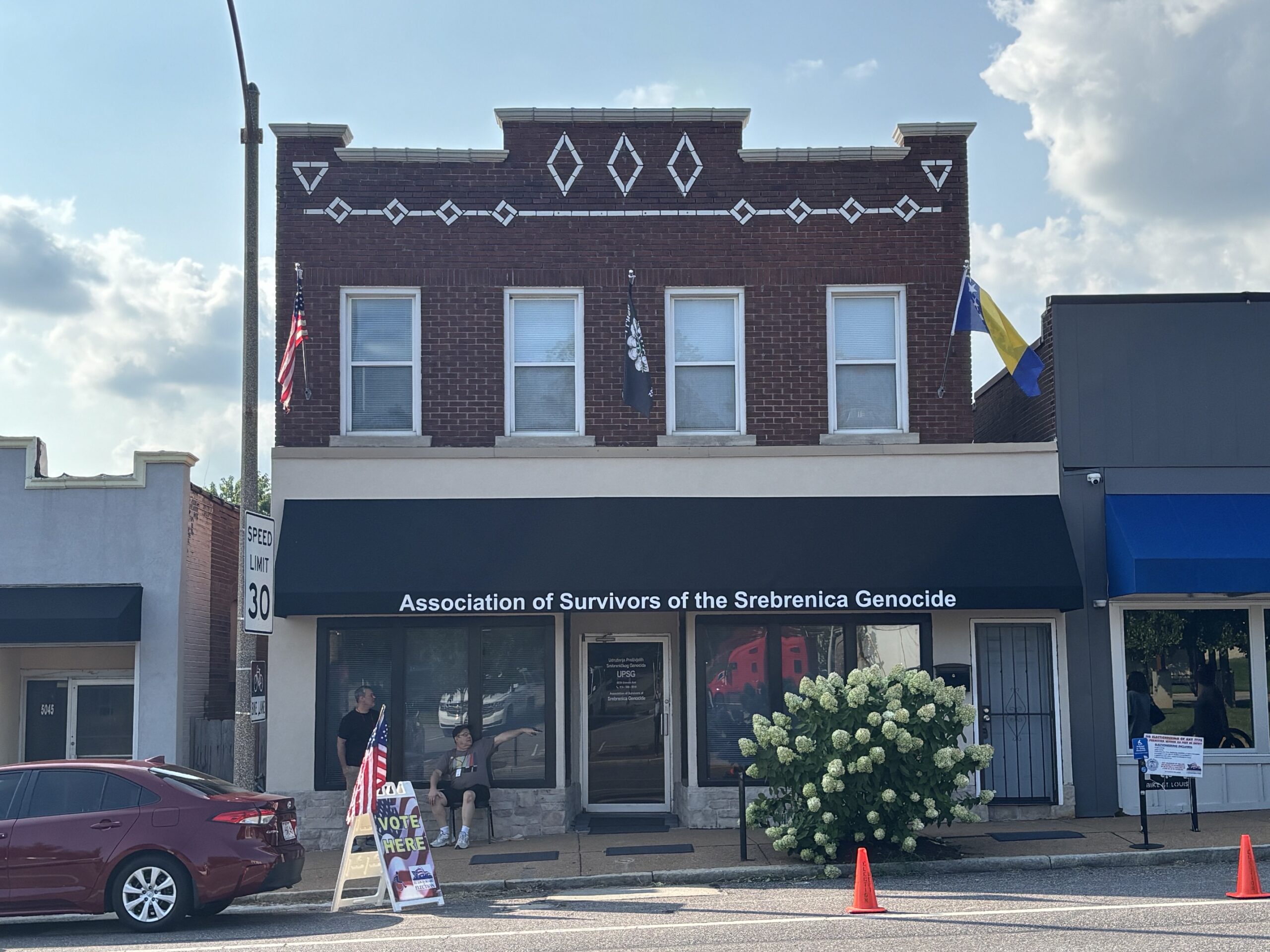
Election day notices are the sort of mail most of us plunk on the kitchen table with lukewarm interest at the end of a working day. This year’s Board of Election Commissioners mailer, printed for last month’s August 4 election, had all the usual features—instructions, sample ballot, et al—but among the polling locations, one above all stood out: Association of Survivors of the Srebrenica Genocide, located at 5039 Gravois Ave in St. Louis.
After years of voting in schools, libraries, and civic centers, who could resist the opportunity to vote at a location so off the beaten path? When a polling place lists a space dedicated to remembering the brutal slaughter of innocents, how could you contemplate voting anywhere else?
Walking through the doors of the Association of Survivors of the Srebrenica Genocide is a mostly nondescript experience—until your conscience is shattered and your attention riveted. Then it becomes uniquely, upsettingly somber. An array of printed material, combining maps with documentary photography, lays out the facts of July 16, 1995, when more than 8,300 Bosniaks—or Bosnian-Muslims—were executed by Bosnian Serb forces in what remains the most horrific—or, if you prefer more clinical terms, “largest”—act of mass murder inside European borders since World War Two. Adorning the walls are photographs of mass graves exhumed and refugees in mourning, along with testimonies of atrocity, but also survival. A book by Ramiz Tiro perched atop a bookcase is titled From Darkness to Dawn: A True Story of Perseverance in the “Herzeg-Bosnia” Concentration Camps.
To take your eyes off the Association’s office walls to focus solely on voting for constitutional amendments and propositions on whether to “modernize language describing City departments” seems wholly out of place. The choice between Cori Bush and Wesley Bell, and vice versa, became something of a non-issue. I was tossed about in a constellation of emotions, including, but not limited to, the gift of living in a relatively stable and free democracy, the blessing of living next to neighbors different from, but unafraid of, me. Mostly, I felt the dumb luck of never having to live through war or conflict. The gradual disintegration of Yugoslavia that upended life for millions of Bosniaks, Croatians, Serbs, and ethnic Albanians and Slovenes is more distant for us than even the Clinton years, Spice Girls, and Seinfeld, during which the disintegration of Yugoslavia occurred. The recent death, in prison, of Ratko Mladić, known for his prominent role in the massacre, might pull the years back, but just barely.
Before Croatia and Slovenia declared independence in June 1991, Yugoslavia was routinely referred to as the brightest and most liberal of the East European countries under Soviet domination. Josip Broz Tito, born to a Slovene mother and Croat father, was a minor celebrity when contrasted with the brutal leaders of other Soviet states. By 1993, two years before atrocities in Yugoslavia progressed and the Dayton Accords concluded, President Bill Clinton was turning the pages of Robert D. Kaplan’s Balkan Ghosts. My father’s girlfriend hosted a teenage student named Jasna, born to a Serbian father and Croat mother, who wrote letters soon after returning to her home village, telling us that every young man she knew had enlisted in armies along ethnic-national lines. A Croatian secretary I knew while working a college internship stopped eating during lunch breaks. Instead, she listened in anger to BBC radio broadcasts about the widening Yugoslav war, cursing the Serbian army before returning to her desk. I remember the conversation I once struck up with a Serbian woman at an airport. “We remember history, and we should remember history,” she said. “But what the war in my country has also taught me is that there is a time to let go of and even forget history. You have to let go of its most painful memories that feed conflict. You cannot let history make you bitter and hateful.”
That St. Louis is home to the largest population of Bosnians outside of Europe—more than 70,000—who fled their country between 1992 and 1995 is a source of civic pride. It is no small embarrassment to say that, short of visiting their wonderful restaurants, I still know little about this community. Last year’s thirtieth commemoration of the Srebrenica massacre was my first attempt to break that indifference. Bosnian Journeys: A Musical Tribute to Remembrance and Resilience brought Bosnia’s pain and beauty to St. Louis all over again. Bosnian folk music—played by musicians from the St. Louis Symphony Orchestra alongside recorded testimonies of war survivors—can hardly be called “entertainment,” but the glory of music is that it sets so many different lessons to heart.
What thundered in my head after this commemorative concert were the words of one Bosnian survivor, paraphrased and emphasized repeatedly by other survivors as well. No one had ever thought the horrors they witnessed, or the fear that surged through their bodies when they realized their neighbors were out to kill them, had even the most remote chance of happening. We never thought it would happen to us was the common refrain. In Yugoslavia of the early 1990s, it simply “did not matter” who was Serbian, Bosnian, or Croatian, because everyone lived in the same cities and neighborhoods, intermarried, and worked together in the same offices, factories, and farms. Then, all of a sudden, to their shock and disbelief, these latent, long-dormant differences mattered in terrifying ways.
It is cliché to the point of numbness to point out that our political climate has vilified immigrants, whether “illegal” or holding H-1B visas, for so long that even to raise the subject invites an eye-rolling exasperation or cool indifference. The reality of people living together despite their differences now seems so remote that we have forgotten the power and significance of believing in that reality at all. Social media teems with divisive, bigoted rhetoric serving up menus and lists of “others” who are the problem. Ostracism and xenophobia have for years been the currency, if not the corrosive battery acid, of our nation’s political dialogue.
We forget that words, spoken often enough and loudly enough, have an accreting, accumulating force. Repeat something often enough, say it long enough, and words climb to the peak of our thoughts where they scream to become manifest in policy and physical acts. But even as words pointing to “others” gather force and momentum, we dismiss them as mere “words.” Until, that is, we hear the words of Bosnians and others who survived the horrific disintegration of Yugoslavia, and the final words of those who did not: We never thought it would happen to us.