Strange Days at the Soccer Jock Party Apartment
By Chris King
April 2, 2026
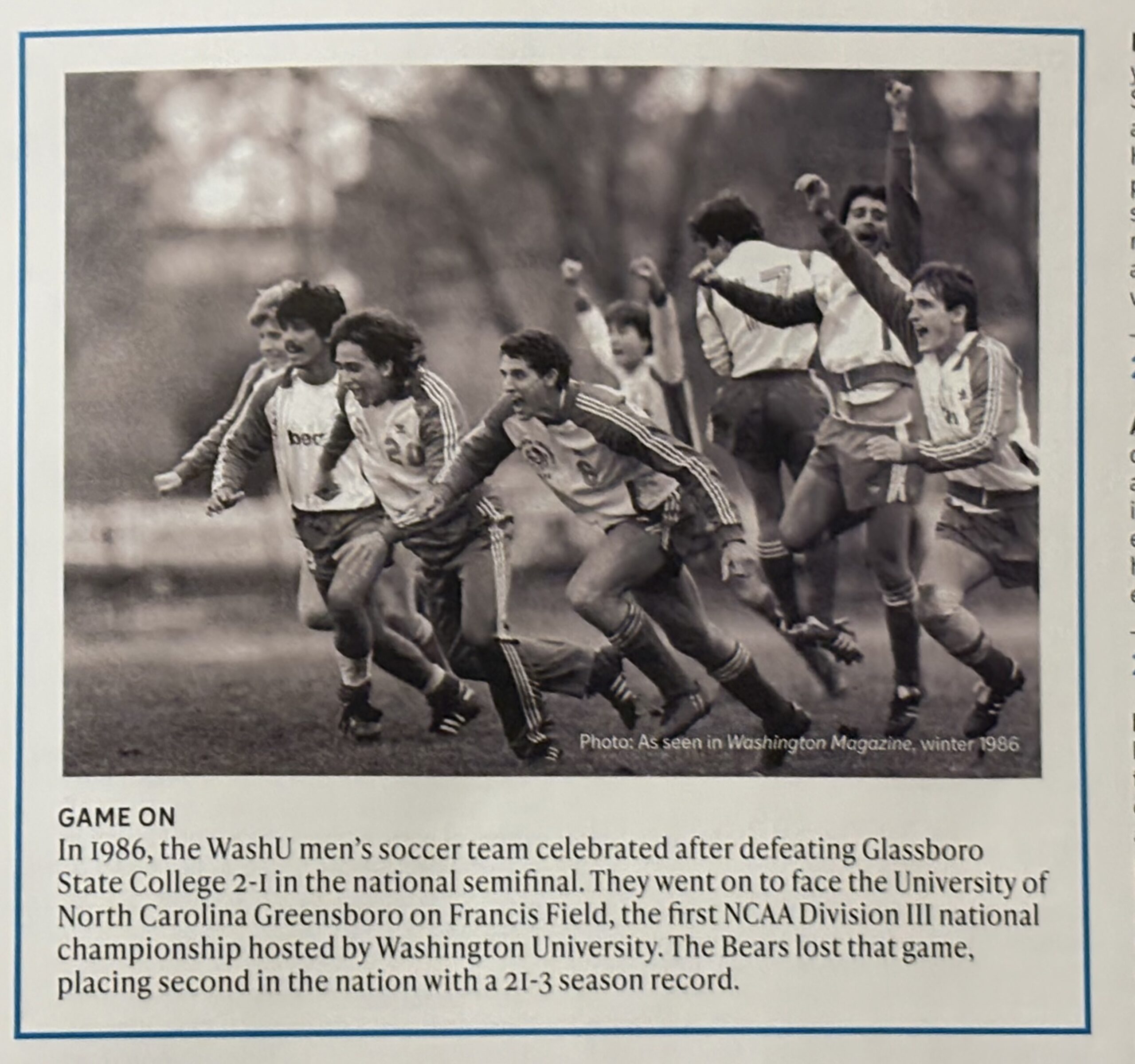
I am mailed a free copy of the Washington University in St. Louis alumni magazine. It is, of course, a development document geared toward securing contributions to the university from its alumni readers. I have not lived my life as the sort of economic agent who puts himself in a position to donate significant sums to the alma mater, but I have a high opinion of the people who attend and have attended this university. The magazine is a good read.
The most recent such document that appeared in my modest rental abode in Ferguson had a photograph that nearly knocked me off my chair. It is an uncredited photograph from 1986 of a cadre of WashU men’s soccer players whose team has just sunk a winning goal in the playoffs, and they are running with evident glee and assorted celebrations, presumably toward the off-camera goal line that the ball had crossed. I am the farthest thing from a soccer player or soccer fan. I frequently say that if I had the misfortune of ending up at a professional men’s soccer game (I have a soft spot for all women’s sports), I would turn around and look in the opposite direction of the game. Because anything would be more interesting to me than watching a bunch of men in shorts running around a field, kicking a ball.
But this photograph is absorbing: the desire and passion on the unnamed young men’s faces; the contortions of some bodies as they jump and twist in celebration; on others, the long, shaggy hair, which, even at the distance of 40 years, just look like really cool hairdos. Leading the charge is a handsome, swarthy man who appears to be of Indian descent with an ample, curly, dark mustache, and the muscly legs of a competitive athlete. I know that guy. I went to high school with that guy. I lived with him for a while when we were both students at Washington University. His name is Dave Sheikh.
In fact, I also lived with three other WashU student soccer players, who were living with Dave when I moved in with him. I do not remember much about them except they were all named John and one was from Kentucky. The story of these four men and the place we lived together in the Central West End deserves to be told as one of those freak flags that humanity flies, at times, for no reason, to no purpose, mostly unobserved, left as another puzzle piece of the human condition.
Dave Sheikh had been a year older than me at Granite City High School, in a gritty steel town just across the Mississippi River from St. Louis. We both played on the same varsity baseball (my sport) team, but were better connected through his little sister Lisa, my classmate. Lisa Sheikh and I shared a highly amusing trait, or rather two traits. Granite City had two sets of Class Traits decided by student vote every year, the school newspaper Class Traits and the yearbook Class Traits. Bizarrely, our senior year, Lisa Sheikh and I were both voted Class Brain in one tally and Class Mooch in the other. This raised what I still consider to be an unanswered question: are smart people mooches, or are mooches smart?
When I ran into Dave Sheikh on campus at Washington University one day, I was a misfit of the highest order. I was a transfer student. I learned the hard way that universities treat transfer students like cross-eyed, redheaded stepchildren. There must be some hard-nosed, probably uncodified notion that transfer students have already screwed up at one university, and they do not merit the same kind of treatment as the first-year students who will spend one-fourth more money on the university than a second-year transfer. I had not screwed up at Boston University, but I went there on a Navy ROTC scholarship. Our ROTC unit was run by a Marine Corps captain who treated us as Marine Corps cadets, not Navy midshipmen. Every summer deployment BU offered had a strong Marine Corps presence, and I was deployed (in the Summer of 1985) on a helo carrier in the Mediterranean with a bunch of Marines who had seen active duty in Ronald Reagan’s dirty wars in Central America. I was flash-fried in a military culture with a covert gunboat diplomacy that shocked and scared me, so I relinquished my Navy scholarship after one year of indoctrination and a summer of active duty, which was my prerogative. I transferred to a better university much closer to my hometown.
Not many students from places like Granite City end up at elite universities. Even fewer of those kids are fresh off the gunboat where they played poker with Marine Corps veterans of undeclared wars who passed around their personal pornography portfolios. I felt extremely out of place and older than even some of my professors. When I ran into Dave, I had not yet discovered the campus music scene where my friendship circle would be found, a circle that still surrounds and supports me to this day. When I saw the smiling, familiar face of Dave Sheikh on campus, I was elated, and when he invited me to a party at his apartment, of course I went.
The party was in a large, sprawling apartment in a complex in the Central West End that no longer stands. It was built for the 1904 World’s Fair as an amenity for wealthy families coming overseas and staying a while. It had five bedrooms, three baths, and 12-foot ceilings with private maid’s quarters off the kitchen. It was a fantastic historic building since demolished to make way for a parking garage there, but the building was in pretty rough shape and would have cost a fortune to restore to its original beauty.
The party Dave invited me to was a huge and happening party. I was struck by how many people fit into this gigantic apartment and how little furniture stood in the way of more people piling in. As a transfer student, I was not housed on the South 40 where most students live, and as an off-campus sophomore, I was not invited to any campus parties. Previously, I had run into another Granite City kid—a dentist’s son, as Dave Sheikh was a doctor’s son; my single-parent mother was a low-level federal budget analyst with a high school degree who had worked her way up from secretary. The dentist’s son had invited me to his fraternity, where I found myself the life of the party, teaching the boys drinking games I had learned in the Navy. I had a thought then that stuck in my head for more than 30 years before it ended up in a song I wrote (with yet another friend from Granite City, Sean McGovern): “If I’m the life of the party, I’m at the wrong party.”
I was not the life of the party at Dave Sheikh’s apartment. These were mostly soccer jocks, their friends, and their camp followers. One of their camp followers ended up alone with me in one of the bedrooms at the apartment, making this the kind of party that leaves you wanting to be invited to the next one. When I told this to Dave the next day, he said, “Hey, we have an empty bedroom right now. Why don’t you move in?”
That was not a difficult decision. My current off-campus housing assignment at WashU was in a building the university rented from neighboring Fontbonne College. That building, the diametric opposite of the sprawling, faded beauty in the Central West End, had been built as housing for nuns. As such, it had all singles with the tiniest, most Spartan rooms—just enough space for a nun to sleep and pray. I do not remember how I wrangled out of my university housing contract or if decided to pay double, because the rent at Dave’s apartment was extremely modest, a fraction of what I was paying the university, for a reason that contributed to the strangeness of this experience.
When Dave was moving me in, he explained that the landlord was a soccer booster. Many years before, the booster had rented the apartment to a group of varsity soccer players and made an unusual agreement: if they kept the apartment among varsity soccer players, he would never raise the rent as long as they never came to him for maintenance. He basically handed over the keys, with a flat rent in perpetuity, and turned his back on the place as one of his supports of the WashU soccer program.
One consequence of this arrangement had to be seen to be believed. As I was finding my way around the chaotic kitchen, I found not one or two or five or seven but something like nine coffeemakers, nine fondue pots, nine meat thermometers, nine of every gadget you can imagine in a kitchen, just stuffed in all the cabinets and drawers. I could imagine generations of soccer players moving into this apartment with a coffeemaker, a fondue pot, a meat thermometer, a what have you, then moving out and leaving it all behind. Since the landlord never inspected the place, there was no need for anyone to ever leave with anything that they did not want to take with them.
There was an advantage to the current residents of having all these extraneous things around. This also explains why there was so little furniture in the apartment. Dave and the three Johns had a peculiar hobby. They liked to listen to Led Zeppelin at a thundering volume, get drunk, drag things into the public space of the apartment, and destroy them together. I do not remember firearms, because certainly that would have drawn the attention of the police. Soccer players notoriously do not have things like sticks or bats as part of their sporting equipment, but they must have had hockey sticks or baseball bats for the purpose of destroying, say, a coffeemaker or a fondue pot or a television set. Under the spell of Jimmy Page, Dave also had picked up the electric guitar and sometimes would perform a kind of live score to the group destruction of orphaned kitchen appliances, clearly enacting some kind of rockstar fantasy with the help of his friends, the three Johns (and sometimes a fourth John, a varsity soccer player who came to all the parties but not did not live in the apartment).
I never saw too much of this madness. When the boys got in their demolition mode, I would hit the streets. It was wonderful living somewhere I could walk out of the front door into the city and see all the people and places. I do not remember ever getting up my nerve to ask my fellow lodgers why on earth they did what they did. Fortunately, they liked to have big parties all the time, so they had to clean up all the destroyed coffeemakers, fondue pots, and television sets so they could invite a couple hundred people into the apartment. So, on a regular basis, the place was—I would never say “cleaned”—cleared of rubble from the Led Zeppelin-fueled nights of demolition and drinking.
I was living with Dave Sheikh and the three Johns in that battered vintage 1904 apartment when I started to find my people in the campus post-punk rock music scene. Dave ended up being kind of like a starter college friend for me, the way some people have starter plants. His adventures in playing electric guitar a la Led Zeppelin were connected to a deeper personal interest in music and creativity. When I started making records with my new rock music friends in Tietjen’s – the recording studio on campus where WashU musicians cut their teeth, built in a handsome stone building on Forsyth now slated for destruction to open up ground for more dormitory housing—Dave showed interest and came around to the studio, presumably trailing one or more John.
We were working on a new blues I wrote called “My Doggy Died in Prison.” Many people on campus could play some electric guitar, but Dave made his most unique mark on tape with some improvised mouth music, silliness in keeping with the goofy material. The narrator is all busted up because, as the title of the song indicates, his dog has died while the varmint was behind bars. The verses are mostly self-pity of the raw kind associated with losing an animal companion, spoofed with gratuitous carceral imagery (“My doggy died in prison a-wearing those zebra clothes. Sometimes lying in bed at night I can still feel his cold, wet nose”). There is a big reveal at the end: details of the dog’s criminal acts that landed him in the slammer, now his crypt. “My doggy died in prison for being a Russian spy. Yeah, my doggy died in prison. Vladimir was a Russian spy. Hey, I ain’t no Commie, neither! But why did my doggy have to die?” Dave Sheikh’s mouth music burbles through his mustache in between the verses, his simulation of a signature solo instrument for the blues, the harmonica. I suppose I was using humor to work out my feelings about having been a teenage Cold Warrior for Ronald Reagan. I still had some hard, cold, violent anti-Communist indoctrination to giggle out of my soul, and Dave Sheikh accompanied me.
I left that unforgettable apartment in the Central West End under another remarkable circumstance, which showed another very different side of Dave Sheikh, whom I always have enjoyed and admired. I was lying on my bed one night studying when Dave came home, knocked on my door, and let himself in. He sat down on the side of my bed and looked at me. The way he handled what he had to say sticks with me today as if it were yesterday, and remains to me a model for handling something like this when it comes my way.
He said, “Chris, everything is going to be OK, and nobody was seriously hurt or killed, but I got a call from a nurse at the emergency room in Granite while you were out. I didn’t want to just leave you a note.” This was long before the era of cell phones. “She said there was a fire at your mom’s house, a fuse box fire, and she burned her hands trying to get her dog out of the house. The dog is fine. Your mom is fine. Everything is going to be OK. But there was a fire in the house, and she did burn her hands, and she wants you to come and see her. Let’s go – I can give you a ride.”
I have often wondered if having a physician father somehow gave him such a graceful bedside manner. Was it innate in him?
After the accident, my mother needed my help around the house while the terrible burns on her hands healed. We decided that we would take the money I was paying in rent and invest in an automobile for me to commute back-and-forth to classes so I could help her around the house. I moved out of that grand, rambling apartment with Dave Sheikh and the three Johns. I would imagine that I left them a coffeemaker, a fondue pot, and a meat thermometer.
Dave Sheikh (BS Chemical Engineering, ’87) now the CEO and founder of ZeCoat Corporation, which develops and manufactures optical coatings for space-based telescopes, approved this story.