Remembering the Remarkable Ray Hartmann
“The Common Reader” pays homage to the late founder and publisher of “The Riverfront Times,” “Donnybrook” host, and political gadfly who shaped St. Louis journalism and commentary for almost half a century.
May 20, 2026
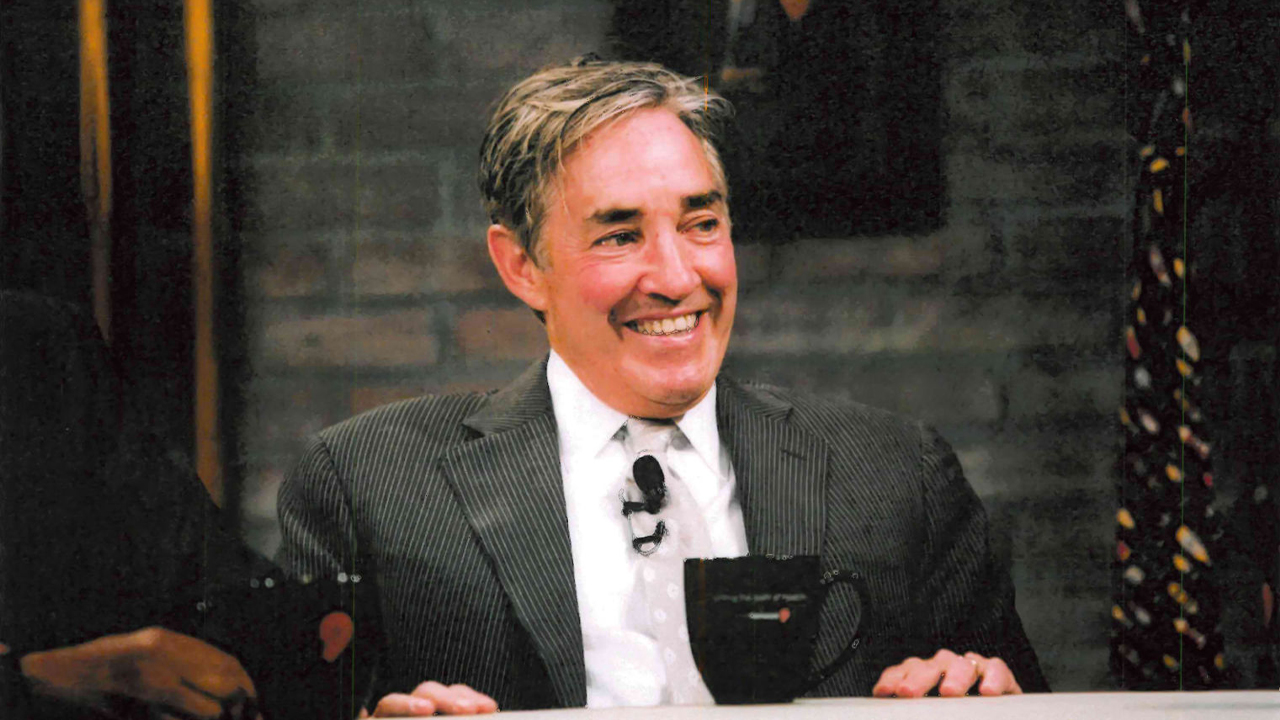
Introduction by Cliff Froehlich
Like many in the St. Louis community, I was both shocked and profoundly saddened when journalist Ray Hartmann was killed in a freakish highway accident on April 23: It seemed impossible that someone as vibrantly alive as Ray was no longer among us.
Because I worked for Ray at The Riverfront Times for 18 years, my thoughts immediately turned to the many other RFT alums who loved and admired him. Over the next several weeks, I contacted more than 50 of my old colleagues and asked them to contribute remembrances of their often life-changing time at the RFT and to reflect on Ray’s impact on both them and St. Louis. Almost everyone said yes, and this tribute is the result.
Ray, of course, was more than just the RFT. Most St. Louisans, in fact, are likely more familiar with Ray from his long tenure at Nine Network’s Donnybrook, and after he sold the RFT to New Times Media in 1998, he continued to own and guide St. Louis Magazine (SLM)—a moribund publication that he resurrected in 1995—for nearly two-and-a-half decades. He later hosted a KTRS talk show and, at the invitation of editor Sarah Fenske, revived his “Commentary” column in the RFT. Then, in a typically quixotic move, he ran for Congress against incumbent Republican Ann Wagner in Missouri’s 2nd District. Sadly, he lost, but Ray again forged ahead, launching a popular Substack, Ray Hartmann’s Soapbox, and working as a contract fundraiser for nonprofits he admired.
But all of his other accomplishments flowed from the headwaters of The Riverfront Times, which he founded in November 1977 at age 24, after first failing with a short-lived publication called Profile St. Louis. (Mark Vittert, also the longtime publisher of the St. Louis Business Journal, was actually a silent partner in the RFT and, later, St. Louis Magazine, but he deferred to Ray in editorial matters.) The RFT—which initially focused on downtown St. Louis—took several years to find its editorial footing, and for its first half-decade, Ray was listed only as publisher, with first Mary Huss and then Don Patton Jr. serving as editors. The paper cautiously increased its frequency, starting as a monthly, moving to a biweekly, and finally becoming a weekly in March 1979. Throughout those early years, Ray contributed articles and very occasional opinion columns, but he waited to assume the title of editor/publisher until April 1981, and his weekly “Commentary” did not make its belated appearance until mid-1982.
In addition to chronicling a crucial part of Ray’s life and career, these remembrances provide a prismatic view of the RFT’s history during that period, but the portrait is admittedly incomplete …
By this point, the RFT was recognizably a paper of growing substance—still underfunded but scrappy, opinionated, unafraid, defiantly left-leaning—and under Ray’s leadership, it grew over the next 16 years to become one of the country’s most successful alternative newsweeklies. The remembrances featured here primarily cover what I (and many others) regard as the RFT’s prime years: 1981-98. In late 1998, the paper was sold to the New Times Media alt-weekly chain, and the character of the RFT changed significantly when the new owners asserted firm control in 1999.
In addition to chronicling a crucial part of Ray’s life and career, these remembrances provide a prismatic view of the RFT’s history during that period, but the portrait is admittedly incomplete, with many important contributors to the paper not included. Especially missed are the voices of those essential RFTers who died before Ray, including Dick May, Paula Wills, Julie Lobbia, Joe Bonwich, D.J. Wilson, and Ed Bishop.
As a helpful reference, the RFT’s early offices were in the Syndicate Trust Building and the Mansion House, but the spaces most referenced here are its Hartmann Publishing Co. HQs at 1915 Park Avenue in Lafayette Square (beginning in September 1981), the ninth floor of the Shell Building at 1221 Locust Street in downtown (beginning in January 1988), and the second and third floors of the Tivoli Building at 6358 Delmar Boulevard in the U. City Loop (beginning in December 1996).
For those who want a chronology of the RFT’s owners, here is a brief rundown: Hartmann Publishing Co. (1977-98); New Times Media and its successors, Village Voice Media and Voice Media Group (1999-2015); Euclid Media Group (2015-23); and Big Lou Holdings (2023-24). The paper was then sold to an anonymous buyer in May 2024, and the print publication was shut down and its staffers fired. On the RFT website, the owner soon scrubbed virtually all traces of the paper’s extensive post-1999 archive, and the site essentially became a promotional vehicle for OnlyFans content. As a functioning news outlet, the RFT is effectively dead, although the name and website still exist.
Regrettably, if you want to read any of the work cited in these remembrances, the options are dismayingly limited. WashU Libraries Special Collections now houses the RFT bound volumes, and the Hartmann Publishing Co. years are nearly complete (the elusive first issue is missing, and the volume containing the January-June 1990 issues somehow was misplaced before delivery to WashU). Accessing those volumes, however, requires an appointment, and there is no index to help locate specific articles. Eventually, the library intends to digitize the volumes, but that is still in the future. Some RFTs from the 1980s and 1990s are on microfilm at the St. Louis Public Library’s Central Library, but the catalog entry, which hopscotches back and forth between years, indicates that the collection has serious gaps. There is better news for anyone interested in reading RFT material from after the paper’s sale to New Times in late 1998. Although the current owner of the RFT name eliminated access to the paper’s online archive, the material was preserved on two internet sources, and both provide excellent access to material from November 1998 through May 2024. The first is an issue archive on the Internet Archive’s Wayback Machine; the second, RFT Database, is actually searchable, though it is more limited in what is available.
What is left of the paper are primarily fond memories, which RFT former writers, editors, and art directors share in abundance here. So many RFTers responded to my call for remembrances that The Common Reader, which graciously offered to host them, cannot publish all of the contributions. The remainder appear on my free Substack, Re/Views, and they can be found here: Part 1 and Part 2.
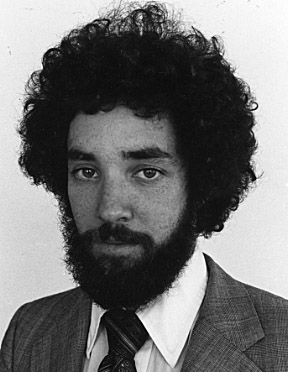
Each remembrance is introduced by the contributor’s RFT and St. Louis Magazine (SLM) titles and the years worked at the publications. If not addressed in the body of the piece, the contributor’s post-RFT career is summarized at his or her article’s conclusion.
• • •
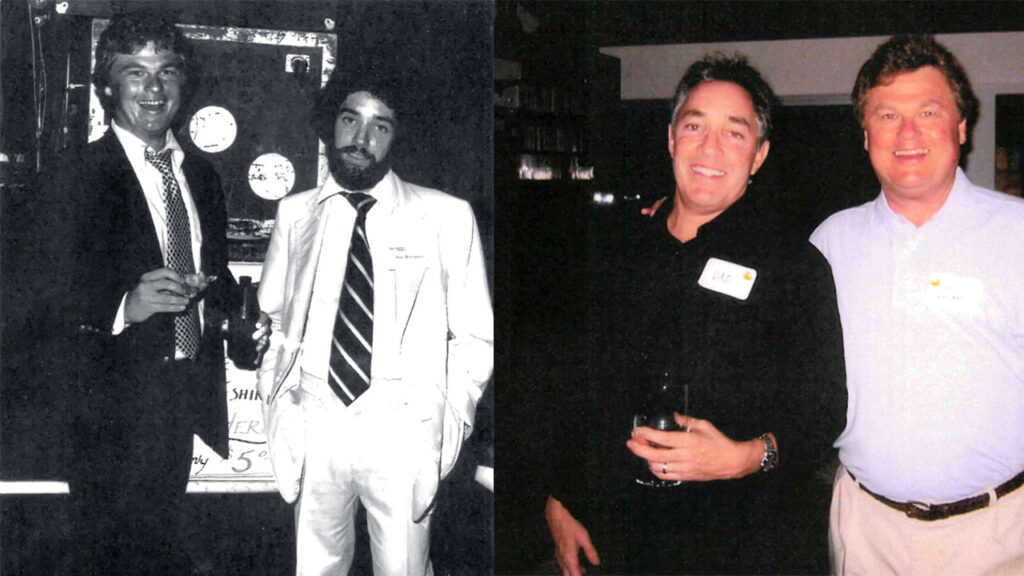
Safir Ahmed
RFT managing editor and editor, 1991-2002
It is an odd feeling to learn of the death of somebody who was an important part of your life once, but with whom you have had no contact for many years since you moved to another place.
I first experienced that after I moved to the United States (from India) in the 70s (at the age of 19) and learned, some years later, through an aerogram from my mother, that an elderly family friend I had known since my toddler years as Chandramma, had passed away. I immediately recalled her exceptionally dark skin and the sweetness of her smile, and many memories of how gentle and loving she was with me and my siblings and parents. I reflected on how she had always been a part of me and how I would carry a bit of her with me for the rest of my time on earth.
News of her passing, harsh as it may sound, didn’t land with an emotional thud because I hadn’t seen her for years and was unlikely to see her again, and yet I quietly grieved her death and cherished my memories of her.
I went through a similar internal experience on April 24 when I read an early-morning text on my phone about the passing of Ray Hartmann. Many pleasant memories surfaced, and yet it felt a bit strange as I had not seen him for many years and always knew it was unlikely I would see him again, so his dying seemed somewhat distant, though I was pained and shocked by the horrific manner of his death. I prayed for Ray that day.
I had no contact with him since I moved to San Francisco in 2004, and we had already drifted away from each other a year or two before that for reasons not worth mentioning, as they were quite trivial in the larger scheme of things.
Ray and I, a couple of years apart in age, had a solid relationship for a decade through the ’90s, he as publisher of The Riverfront Times, me as editor. I recall my years at the RFT as filled with confidence, excitement, and an overall awareness of the paper’s important role in the public life of the St. Louis area: influencing—and sometimes setting—the agenda for the sociopolitical public discourse in the city and county. And throughout those years, Ray was a trusted and excellent partner: He gave me near autonomy, supported my decisions on stories we published, and regularly consulted me (and others) on the passionate and provocative missives he wrote each week, which were likely the most-read part of the publication. Above all, he was always pleasant and cheerful, and I loved talking politics with him. We were professional hell-raisers working as partners, though not as friends who hung out together.
I was well aware of the faults and shortcomings of Ray that were off-putting to many around him and also colored—or rather discolored—his public persona a bit, but I saw those as neither significant nor relevant to our relationship. I had no friction or fights with him, and I carried no scars. I mostly recall the excitable, passionate, jovial Ray, and that is the part of him that lives on within me. All of us are fallible and have indiscretions of our own, and may we always look past those of others and choose instead to see their virtuous traits.
When Ray first approached me in early 1991 with an offer to serve as the managing editor at the RFT (he was publisher and editor), I had been at the St. Louis Post-Dispatch for eight years and had ambitions of moving to the P-D’s national bureau in Washington D.C., and hoped to report from the Middle East (the Gulf War had just begun with the bombing of Iraq). At my third meeting with Ray, over breakfast at a Soulard restaurant, I declined his offer, saying I wanted to report national and international news. Ray accepted my decision graciously and wished me the best.
But he was tenacious to a fault, something I learned about him over the years. Not long after, he called me and upped the offer, throwing in a Middle East trip at a time of our choosing. Meanwhile, James Millstone, the wise and nurturing mentor I had at the P-D who was grooming me for the D.C. bureau, was diagnosed with brain cancer, ending his career (he died a year later). I set aside my dream of becoming an intrepid international reporter and took the plunge. I accepted Ray’s offer, and not once have I regretted that decision.
Ray and I shared a vision of reporting local and state news, political and cultural, that we felt was conspicuous in its absence in St. Louis. The ’90s were a simpler time in terms of media outlets, with one daily newspaper, an “alternative” newsweekly, and a handful of local TV and radio stations. Ray had already developed an “anti-establishment” voice for more than a decade when I joined. I knew from my years at the P-D how the Pulitzer family paper covered local news—with objectivity their principle—and, more importantly, what they did not cover. Swapping objectivity for fairness, and adding advocacy, I felt quite liberated at the RFT.
Ray and I had great fun coming up with story ideas, investigations, and profiles of public figures both good and bad, many of which provided fodder for Ray to bring up on his weekly Donnybrook show. Ray would pass along tips that he heard to me, and I would find the perfect writer—and we had a motley crew of talented writers—to turn them into exclusive stories. We became bolder in taking on local bigwigs with well-reported stories, and we supported those who were marginalized by the P-D and local TV, whether they were politicians, artists, entrepreneurs, or oddballs and cranks.
In a couple of instances, when we received a letter threatening a lawsuit the day before publication, I asked the writer to add a paragraph in the story about the threat and quote from the letter. We were civil yet in your face—a defining characteristic of Ray’s RFT.
A small anecdote about Ray’s partnership with me seems appropriate here. About a year or so after serving as managing editor, Ray and I traveled to the national convention of the Association of Alternative Newsweeklies. When we checked in for registration at the conference, they gave us our name badges on lanyards, and I saw that my badge said “Editor,” so I turned to Ray and said, “Oh, man, they made a mistake—they left off the ‘Managing’ part!” Ray, with his signature mischievous smile, said, “No, they didn’t.” He flashed his badge, which said simply “Publisher” minus his editor title, which he had long held. It was his playful way to tell me I had been promoted; he was unconventional as always in everything.
As a news publisher, Ray was unlike any other, especially when it came to publishing investigative stories or unflattering profiles that were sure to offend advertisers or public figures; at times, he would double down and write his own column to support the news story. He knew many of them would call him to complain, and he relished receiving their angry calls and sometimes would have me sit in his office while he talked with them so I could hear their complaints. On occasion, I would scribble and slip a note to Ray so he could counter their argument or correct their assertion. Among the major ones we regularly offended were Civic Progress (28 all-male CEOs), Anheuser-Busch, Monsanto, all major universities in town, city mayors and county executives, Missouri governors, U.S. senators, prosecutors, commercial developers, and on and on. We had our share of lawsuit threats before we went to press; fortunately, Ray was unflappable. We also had, in Ray’s confidant Andy Leonard, a lawyer who not only was wise about the laws regarding libel, slander, defamation, and so on, but who knew the level of risk Ray was comfortable with. In a couple of instances, when we received a letter threatening a lawsuit the day before publication, I asked the writer to add a paragraph in the story about the threat and quote from the letter. We were civil yet in your face—a defining characteristic of Ray’s RFT.
Ray always backed the writers, whether it was me or a staff writer. Once, after I had written stories about TWA and its brutal cost-cutting under the corporate raider Carl Icahn—and Ray had written editorials critical of Icahn—he left a message for Ray to call him. With me in Ray’s office, we called Icahn back and told him we would be happy to interview him and get his side of the story; Icahn agreed. Ray and I hopped on a plane and headed to Mount Kisco, New York, and did an hour-long interview with Icahn. We were polite but antagonistic, and after the interview, Icahn insisted on making a copy of the tape recording and mailing it to us the next day. We foolishly trusted him, and it never came. Ray ended up having the last word: He wrote a scathing column revealing the slimy sleight-of-hand Icahn pulled with us.
What stays with me about Ray, all these years later, is, I suspect, what defined his public life in St. Louis: He was a master at influencing the public discourse. He knew all the media bigwigs, he knew all the politicians and other prominent people in the civic life of the area, and he got along with those he disagreed with (the “polite conversation” of Donnybrook comes to mind). He was never an “insider” with the rest of the media, though he was not completely outside, either. And he had a flair for bon mots and deployed them to his advantage. I recall a hoity-toity St. Louis Press Club awards dinner at a hotel ballroom in the mid-’90s, attended by all the glitterati of St. Louis, when they gave Ray the Media Person of the Year award. Ray began his acceptance speech by saying how uncomfortable he was in that milieu, a sort of I-am-not-a-member-in-this-club opening remark. Then he said this: “I feel like an Armani suit in Bill McClellan’s closet.” It brought the house down.
Ray had his finger on the pulse of the city and county, he had a passion for making persuasive arguments to improve the civic life of the region, he cared for and supported the local nonprofits in their various causes, he advocated for the disenfranchised, and he scolded the powers-that-be. And although he inarguably had a large ego, he never let that get in the way of pursuing social change.
Ray has passed away, but he lived a life that left its mark on St. Louis, mostly for the better. And here I am, still carrying with me a part of Ray that I admired and truly respected. I offer the Qur’anic verse translated as “We belong to God and to God we return.” I pray for solace and ease for Ray’s wife and children, and I pray that his soul rests in peace.
Safir Ahmed is director of the Department of Publications at Zaytuna College in Berkeley, California, a Muslim liberal-arts college. He helped found (in 2016) and serves as editor of Renovatio, a publication that asks writers to examine timeless questions and today’s moral challenges by drawing from the texts of faith traditions and current thinking. Before that, Safir worked as an independent book editor for several years, an editor of Alternet, and communications director for the U.S. Senate campaign of Nancy Farmer in Missouri.
• • •
Kerry Bailey
RFT and SLM copy editor, 1997-2003
When I came to work as a copy editor at the RFT, my new colleagues warned me about Ray’s legendary tardiness and, as some called it, nitpickiness, but I quickly discovered that he operated in this way because he was determined not just to get his opinions across but also to be as accurate as possible in his reportage.
People who only knew the RFT as “that liberal rag” never knew the care we all put into getting things right, or that Ray was passionate about making this region a better place, even for the people who disagreed with him.
I will always remember Ray fondly for his quiet kindness and how that translated to our workplace culture. When any of us experienced a personal or family crisis, there was no talk of “But when will you be back?” or of lost pay or vacation time—and I knew that attitude came from the top.
He was an extraordinary man.
After leaving the RFT, Kerry Bailey continued copy-editing St. Louis Magazine, off and on, for the next two decades. She also copy-edited the Illinois Times and other publications, and developed online courses for nursing and allied-health students. In 2018, Kerry returned to school for a nursing degree, and she is now an R.N. in an area emergency department.
• • •
Tom Carlson
RFT production assistant, RFT Graphics supervisor, RFT and SLM design director, New Times Media/Voice Media Group editorial design director, 1984-2015
I owe my entire graphic-design career to Ray.
It was 1984. Armed with a B.F.A. in studio art, I was putting on a necktie and selling stereo equipment in St. Charles. I had some friends in a band who had just changed their name to Common Ailments of Maturity, recorded an EP, and were going to play some shows around the Midwest. And their sound guy had just bolted to California. They asked me if I wanted to mix them. Why not!
So I gave my notice to CMC and was about to embark on the highly lucrative, van-setting life of a Midwestern New Wave/post-punk live-sound engineer.
Stop laughing.
I was going to need to pick up some dough between tours. College friend and frequent partner-in-crime Bruce Kinsey was production manager for a little weekly newspaper that featured the all-important nightclub listings, a laugh-out-loud personals section, and feature stories like “Downtown’s Orneriest Secretary.” For real.
“You can do paste-up. It’s easy, I’ll show you,” he said. It was only part-time, so I could go off on my little adventures and have some work when I got back. So up the side stairwell I went to the third floor of 1915 Park Avenue and started playing with X-Acto blades, wax machines, border tape, and stat cameras. There were soft spots in the carpet where you did not step. The floor shook when the Compugraphic typesetter spat out articles and ads.
And there I met the boss: editor and publisher Ray Hartmann. He drove a beat-up little Datsun and actually did not have a lot to say until he got to know you. When payroll was running short, he would go down the street to Park Chop Suey and add more weeks to their ad contract for a wad of cash. They were on the back page for years.
We worked hard. We played hard. Like clockwork at 5 pm, someone would throw up their hands and say “HAPPY HOUR!” and a little parade of RFT employees would walk east to Ronayne’s (Square One Distillery’s currently in that building), where we would eat and drink our fill of potato skins, chicken wings, and pitchers of draft Bud. When that hour was up, Ray or associate publisher Dick May (also RIP) or someone else with manager status would sign the tab, and back to the office we would march. Strong black Ronoco coffee. More X-Acto play. Keep going till we had done enough to call it quits for the day. And go out and play some more.
That band? They played to smaller crowds leaning more on their originals than they had when their sets were mostly covers. Eventually, they moved to Boston, where they got a little more notoriety.
Me? I stayed here. I must have gotten pretty decent at the layout job. They let me keep coming around and took me on full-time.
There were soft spots in the carpet where you did not step. The floor shook when the Compugraphic typesetter spat out articles and ads. And there I met the boss: editor and publisher Ray Hartmann. He drove a beat-up little Datsun and actually did not have a lot to say until he got to know you.
The stories we published also got better and better. More serious journalism. Fewer ornery secretaries.
I guess it was sometime during ’85 that Ray and Bruce bought a little AB Dick press and installed it in a back room of the ground floor. Last time I was there, it was Bailey’s Chocolate Bar. The concept: We would print all of our business forms—ad orders, rate cards, media kits. We were already paying retail for those. And we could charge our advertising client base for typesetting, layout, and printing services. RFT Graphics was born.
One day, Ray comes up to me while on break on the sidewalk in front of the office. “You know, if someone would learn to work that press, he’d have me by the balls.”
“So, Ray, do you want me to learn to work that press?”
“Yep.”
I learned to work a press.
I met my future wife there, who spotted a guy she liked making copies at the sales department Xerox with cut-off shorts and a Johnny Rotten T-shirt. We had a dress code at the office. You had to be dressed.
Ray also frequently said we had a drug-testing policy. You had drugs. We will test them.
He is a Gemini. And so is he.
He had a routine.
We were doing a lot of printing for entertainment clients around town, including Mississippi Nights, Cicero’s, Fox Associates, Contemporary Productions, and SLU’s Theater Department. When we got busy enough to justify hiring a second body, Mississippi Nights’ manager Pat Hagin suggested we talk to one of his bartenders, John Cavanaugh. John became another longtime member of the RFT family.
Wind blows pages off the calendar, and now it is 1988. The office had moved to the ninth floor of the Shell Building downtown. Art director Margaux Medewitz was moving on. Ray said he liked the creative work I was doing on concert posters and the like. Did I want to do covers and layouts for him? Hell, yeah. So began my time as the RFT’s art director. John took over the print shop.
Publishing technology was going through major changes. Soon, there were no more X-Actos or wax machines. The boss trusted me to learn and then switch us to desktop publishing. And he was fine with investing in scanners, image setters, color proofers, Mac workstations, QuarkXpress, whatever we needed within reason. Alt-weeklies were printing money in the ’90s. When I started, the paper was lucky to exceed 48 pages. By now, we were regularly at 100 pages or better and distributing 100,000 copies.
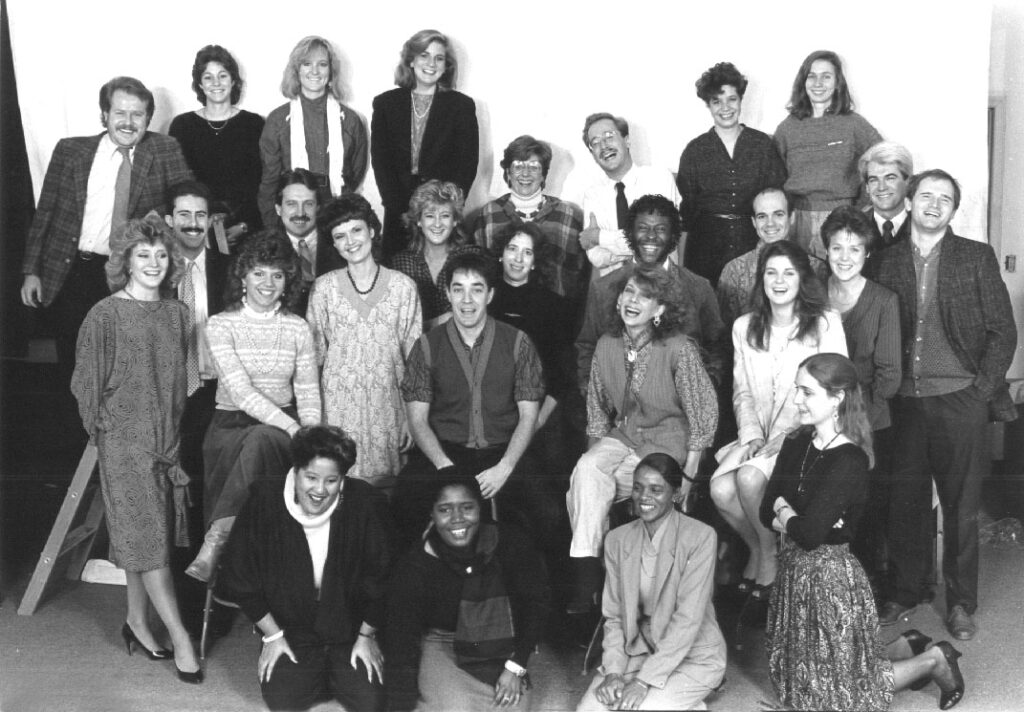
Ray could drive you mad as a boss sometimes. That mostly involved his editorial—always the last thing to get filed on deadline day. One pre-election issue, he went into an endorsement frenzy. We kept on ripping up completed pages so he could write more. And more. Cliff Froehlich, Ray, and I left the Shell Building as the sun was coming up. We missed our press window. No RFT that Wednesday. Advertisers were pissed and told him not to do it again.
I think it was ’93 or ’94 when we started a quarterly-style supplement called Vision. The first issue was an oversized glossy. Then it turned into just a section of the paper that made very little sense to a lot of us. We were all about “afflicting the comfortable,” not telling them what stylish ties they should buy.
This was around the same time Ray and Mark Vittert bought the rights to the dormant St. Louis Magazine title. “Kill Vision” was frequently said at our occasionally hilarious management meetings—smart people are often also funny people. We eventually succeeded in our “Kill Vision” quest by agreeing to publish St. Louis Magazine.
So I art-directed that, too. Put Sheryl Crow on the cover of that first issue. I drove back with a few boxes of them from the printing plant in KC just in time for the launch party.
We staffed up and gave more responsibility for the paper to assistants. We became slightly more professional. Stop laughing. The mag quickly went from quarterly to bimonthly to monthly.
We moved to the Loop in ’97. That was a fun change. More places to grab lunch than 13th and Locust. More options after work, too.
Ray passed up many good opportunities to shitcan me through the years. He was a forgiving boss if you were honest, owned your mistake, and promised you would not do it again. It was in his office on Delmar, talking about other things when he told me, “I could not fire you even if I wanted to. You’ve worked for me for too long. I’d be paying you severance forever. I might as well have you doing a good job for me.”
A year later, Ray came back from the alt-weeklies convention with news. He was selling the paper to the New Times chain out of Phoenix. He said he was giving me a choice—stay with the paper or keep working with him at the magazine. A few days later, he changed his mind. “You’re an RFT guy. You’re staying with the paper.” So I did. But in November, “Camp Hartmann” ended.
He used a portion of the proceeds to give bonuses to the staff. And structured those bonuses so that New Times did not roll in with wholesale firings as they had a reputation of doing. He did not have to be so generous. I know of employees at other papers that were sold who did not get diddly.
I talked with him occasionally post-sale. He confided he had no idea how he would have handled the internet-fueled collapse of the classified and personals business that was so central to his success in the ’80s and ’90s.
One time, after his non-compete ran out, he asked if I would like to come over to SLM. There was an opening.
But, no, I was too big a smart-ass to care about arranging fashion shoots.
I stayed with the RFT until it was again sold in 2015. By then, I had been promoted to national editorial design director for Voice Media Group (the corporate name that was adopted after the New Times chain merged with the Village Voice Media chain), supervising art directors at 11 papers. I was remotely art-directing New York’s Village Voice. And still art-directing the RFT. I did two, sometimes three, covers a week. But when The Riverfront Times was sold to Euclid Media Group, I was not included in the deal.
In the fall of that year, I moved to Phoenix, Arizona, and took over art direction of Phoenix New Times.
The pandemic pretty much ended my career as an alt-weekly art director. Full-time positions were now hourly with no benefits, no vacation, no respect. Editors were slaves to hit count quotas, and reporters could no longer devote themselves to the deeply reported long-form stories that were once our bread and butter. More listicles, please! So I retired before I was really ready.
In May 2024, we sold our Tempe, Arizona, house and came back to St. Louis so we could be closer to my mother-in-law. I planned on dropping in on Sarah Fenske and my other RFT comrades at the paper’s Shaw Avenue office on the Hill while we holed up in temporary quarters and looked for a house. But the news dropped: The RFT was sold. The staff was let go. The institution so many of us had built now exists to promote OnlyFans “content creators.” Current headline: “Pink Slip to Blue Light: Why Laid Off Tech Workers are Turning to OnlyFans.” I shit you not.
Ray was running for Congress. I thought about dropping in on one of his “meet the candidate” events but unfortunately never did. Many discussions of ex-staff get-togethers. Few actually happened.
On April 29, at Ray’s funeral, a lot of us former RFTers had that reunion we had been threatening. But the reason was devastating. It is hard to come to grips with the fact that the guy who so affected so many of us is no longer among us.
I was recently talking with former RFT editor Tom Finkel about his well-deserved retirement from Miami New Times. He remarked how his time in St. Louis was different from his tenures in Minneapolis, New York, or Miami. No matter how many years it was after Ray sold it, when Tom talked with someone about The Riverfront Times, the person would want to talk about Ray. It was Ray’s paper. Such was his impact.
In my career, I have had a lot of laughs. Made lifelong friends. Earned a decent income. Won a bunch of design awards. And now get to hang out in my home studios, making and exhibiting paintings. All because I was lucky enough to get caught in Ray’s orbit.
Thanks, Ray.
• • •
Diane Carson
RFT freelance film critic, 1989-2006
Ray Hartmann and I first met in 1989, when I began contributing film reviews to The Riverfront Times. Though my direct editor was Cliff Froehlich, I would see Ray in passing during my early years at the paper when I delivered film reviews in person to the Shell Building office. Always pleasant with casual exchanges, never interfering with anything I produced (nor did anyone at The Riverfront Times, and I still miss writing for it), I did not know Ray well. Yes, a couple of holiday parties let us all indulge another part of our personalities. No one, Ray least of all, ever pulled rank or acted superior to the freelance writers. We all participated fully, congenially in holiday celebrations.
But then, completely unexpectedly, I discovered there was more to Ray’s and my mutual interests when, one early morning (8 a.m., which was early to me), I nervously paced before a running event. In those days, I entered races of various distances almost every weekend. To my and Ray’s surprise, there we were together, stomping to keep warm, stunned to see each other out of our usual context. Discovering that we shared a passion—and, more importantly for runners, that we ran about the same pace—Ray and I added a personal chapter to our heretofore professional relationship. He was fun to run with because, although neither of us had extraordinary ability, we loved the competition, more with ourselves than the other runners. Athletes, even us amateur ones, know how this can consume us, always aiming to set a PR (personal record) and to finish feeling good, i.e., pacing intelligently so as not to flounder and die during the race.
The 10K on May 12, 1990, is the one I remember best, with amusement and a bit of cringing. It started on the north side of St. Louis Community College at Meramec, continued along Rose Hill to veer down Couch to Craig Drive, then over to Ballas Road. Running down the steep Ballas hill is great, encouraging everyone to feel a bit giddy and energetic. But then, as bicyclists and drivers know, there is a fairly formidable, tough hill from Ballas up to Dougherty Ferry. This race included it, then followed Dougherty Ferry east, all the way to Geyer, before heading back to Meramec. I knew the route well because I live near Meramec, and this big loop always challenged me on training runs.
So here we are, 8 a.m. at the start line, as Ray and I exchange greetings. As usual with runners for a specific race they have not undertaken in earlier iterations, Ray asks me how hilly the route is. Foolishly, regrettably, I describe the only tough part as the first few miles, early in the race, going up the daunting Ballas hill to Dougherty Ferry. Good enough, Ray says. And we are off, panting, sweating, working, drawing on reserves as we fly down and then struggle up Ballas. He is ahead of me, I am ahead of him, he is ahead of me. And we turn onto Dougherty Ferry.
When describing the course to Ray, I had dwelled on the Ballas hill and somehow blissfully ignored the very slow uphill grind that greets runners turning onto Dougherty Ferry. Darn. A few hundred yards farther along Dougherty Ferry, Ray turns to me and growls, “You said there were no hard uphills after Ballas!” Oops. Geez! We are both gasping for air by then, so I cannot even answer, and Ray just keeps up the pace. But at the finish line, I fail to hide fast enough, and Ray finds me! Following runners’ etiquette, I immediately apologize for describing the route as easier than it was, knowing quite well that mental expectations for a run make a huge difference, equal to physical preparation. Because of my erroneous representation of the difficulty, Ray (and I) had used more reserve energy than warranted on Ballas. We did make it in fine form, I must add, more painfully than anticipated, but with a respectable 7:35 pace. We laughed about it, to Ray’s credit. Runners are a forgiving lot, especially when we are completely exhausted. I did not ever live it down, of course. We had shared a tough morning, pushed ourselves, and left quite exhilarated.
I discovered there was more to Ray’s and my mutual interests when, one early morning (8 a.m., which was early to me), I nervously paced before a running event. In those days, I entered races of various distances almost every weekend. To my and Ray’s surprise, there we were together, stomping to keep warm, stunned to see each other out of our usual context.
I did not see Ray at many races in later years. But we always laughed about that memorable 10K.
After he sold The Riverfront Times, Ray called me into his office to talk about his decision, a truly kind gesture, an indication of who he always was. The RFT kept me on, though now only for short film blurbs because film reviews came from a stable of critics who worked for the new owners. I continued to enjoy contributing occasionally until I became the faculty mentor and visiting film lecturer at Canterbury Christ Church University in Canterbury, England, for St. Louis Community College’s Semester Abroad Program. When I returned in 2006, I no longer wrote for the RFT, though I still wrote reviews for KDHX and now contribute to the St. Louis Arts Scene Substack.
I valued Ray’s support as a runner and a writer. We had a lot of good times. And though I did not see him over the last few decades, I loved his presence and spirited interaction on Donnybrook, admired his candidacy for national office, and was stunned and deeply saddened by news of his death.
Here is to you, Ray. You were a great one.
• • •
Jeannette Batz Cooperman
RFT freelance writer, staff writer, columnist, and senior editor, SLM staff writer and editor, 1991-2019
Jeannette’s remembrance is found here on The Common Reader site.
• • •
Thomas Crone
RFT intern, freelance writer and music critic, and staff writer, 1989-99
Ray Hartmann founded The Riverfront Times the week I turned 8 years old, and so I will confess my ignorance of the RFT’s content for most of its first decade. But by the time I was 17, I was picking it up routinely, deciding that it would be the place I would work someday. This was a self-driven, self-fulfilling mission. Two collegiate internships at the RFT would eventually be completed, those experiences opening up a brief, quirky stint as the sole employee of the St. Louis Journalism Review. Taking a leap of faith, I quit that job and started regularly stringing for the RFT, landing a staff job there (at age 22, maybe 23) through sheer force of will. Honestly, I just started showing up at the Shell Building offices until a position opened up.
And here I pause to praise the energy of youth. Ray’s first. Then mine. And that of all the other young, hungry folks who would push themselves into the ranks of RFT interns, staffers, and eventual alumni. Cheers to our coolness and ambitions! Now back to the narrative …
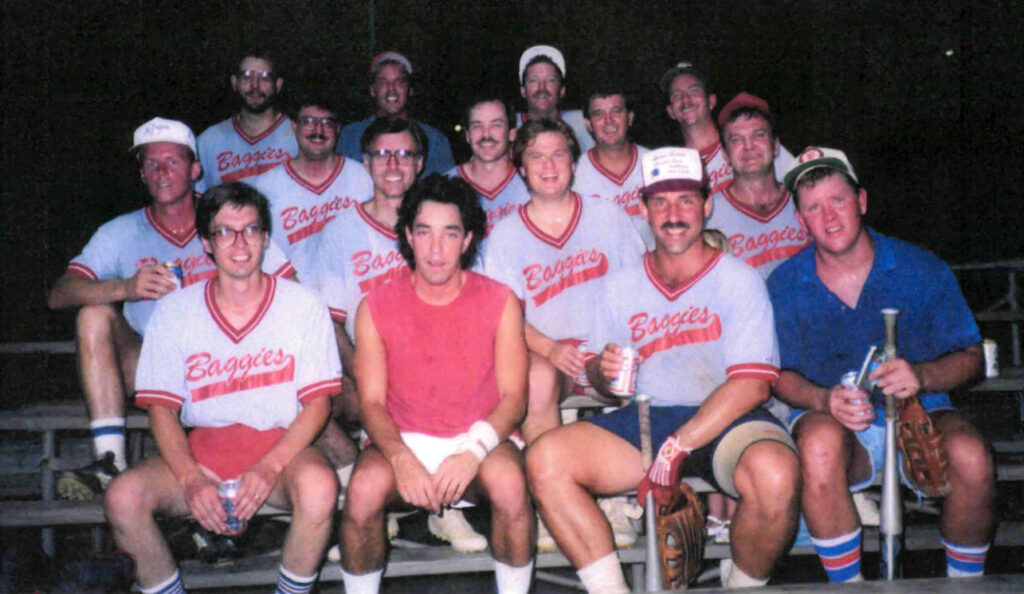
To be fair, Ray was not the person who hired me for many, if any, of the positions that I would eventually hold at the paper, though I do believe he was responsible for my several years as a back-of-book sportswriter, a weirdly fun time in my tenure. Instead, I was taken on board for college credit (and then for money) by J.A. Lobbia, Cliff Froehlich, and Safir Ahmed. Meetings with Ray, during those early years, mostly meant quick conversations in the Shell Building elevators or afternoon chats on the softball field. I cannot lie: I think I avoided longer stays in the editorial doghouse thanks to having a pretty decent bat and glove. (We also both rocked righteous mullets at times, so maybe this was our true bond?)
That is guesswork, of course, but I do not need to speculate about this: If Ray had not started a newspaper during my childhood, I would not have had a target workplace when I was in college or an actual place to hang my professional hat for the entirety of my 20s. And, as it happens, after Ray sold the paper, I did not last long as an RFT employee, destined to be one of the first casualties of an aggressive staff makeover by New Times.
Through no plan of his own making, Ray gave me a place to grow into adulthood—and to do so publicly. Very publicly. Toting up a ledger board, there were definitely pros to this approach. I learned to write quickly and on subjects that did not necessarily call out to me. I was allowed the opportunity to meet politicians and activists and authors and athletes and so, so, so many musicians in a way that I would not have under any other circumstance. Over time, I was able to give ink to a lot of people for the first (and, sometimes, only) time. I had life experiences that came to me purely because of my affiliation with the RFT.
Meetings with Ray, during those early years, mostly meant quick conversations in the Shell Building elevators or afternoon chats on the softball field. I cannot lie: I think I avoided longer stays in the editorial doghouse thanks to having a pretty decent bat and glove. (We also both rocked righteous mullets at times, so maybe this was our true bond?)
Mind you, I also made an ass of myself in print from time to time. A byline hound, I cared a lot, but I did not always put in the care that I should have when filing multiple pieces a week. Deadlines tripped me up on occasion. I routinely took part in petty office politics (along with extremely elaborate prank wars). I somehow survived the churn of intra-office relationships and flings, which is not to say that I did not take part in them—but those are stories for the real world, if even there.
For anyone I offended with an offhand, quickly written burst of words committed to a desktop computer under deadline pressure on a random Tuesday in 1997, well … I am sorry. I am sure you will let me know IRL, as many others have done for the past 30 years.
In some ways, the gig spoiled me for the many that would follow. I never paid for a concert ticket in my time at the RFT, and my modest salary was augmented by a lot of literal meal tickets that came from ad trades, often doled out via little stacks of business cards by Ray himself. There was even a symbiotic work relationship with South by Southwest, allowing me to travel to ’90s-era Austin and to grow in that awesome environment shortly before SXSW’s explosion. Really, I benefited in so many ways from being a part of the paper, and all of this counts as a pro. But a little bit of notoriety, swimming as a midsize fish in a midsize media pond, got into my head a bit, and the resulting ego trips we will call cons.
So many goods, bads, and indifferents during that magical run of the 1990s. So much life lived.
Not too long before Ray sold the publication to New Times Media, I had quit to pursue some wild hare or another. I eventually crawled back to my staff job within the year, at a reduced hours-and-pay rate, though I was still logging regular bylines and time at my desk, now found upstairs at the Tivoli. And the kicker: Just when I came to appreciate my role a whole lot more, the end was nigh. All thanks to that first culling, ordered up from the New Times editorial offices in Denver. A shame in that I was rounding into a better, rangier writer, doing so as a full-on adult, not a full-size boy playing one.
Though I had a few mini-comebacks as an RFT contributor post-New Times—and even enjoyed a decade of contributing to St. Louis Magazine during Ray’s ownership (thanks again!)—I long held on to an irritation about Ray selling the RFT when he did. Not just because of my own professional demise but because of the loss of our collective crew. It was a really fine newsroom for a good while. We did solid work, and a lot of it. Alas.
Sitting here, typing words I was pondering not writing, I am nothing but grateful for the experiences the RFT afforded me—and thankful for Ray’s ultimate role in helping me find a life’s path.
After leaving the RFT, Thomas Crone wrote for several publications, including STLtoday.com, St. Louis Beacon, and St. Louis Magazine, and made occasional returns to the RFT’s pages. He worked as an adjunct professor at Webster University while always maintaining a foothold in the service industry, including some ownership and management stints. Currently living in New Orleans, he soon will move to Salt Lake City, where he will serve as the programming manager of the community radio station KUAA (99.9 FM).
• • •
Tony DiMartino
RFT associate arts editor and staff writer, SLM editor-in-chief, 1992-97
Ray Hartmann was not easy to work for. He was moody and often indecisive.
He ran hot and cold. He would sing your praises one minute and insult you publicly the next. You never knew which Ray you were going to get.
But I never took it personally. How could I? It was just Ray being Ray.
Safe to say he did not excel at one-on-one relationships with employees, but people who make things happen in this world are not always nice. Ray was a sharp businessman who built two publications where I made lifelong friends, met my husband, and did some of the best work of my career. I was glad to get away from him, but I do not regret working for him. He was a completely different guy outside of the office, and I have poignant memories of good talks we had during trips to City and Regional Magazine Association conferences in San Francisco, New Orleans, and Memphis. I will never forget the night in New Orleans when he treated all of us to dinner and a great bottle of wine, followed by an evening of jazz at Preservation Hall. At 2 or 3 in the morning, I found him sitting on the curb with his arm around a stray dog, having a serious and very sweet conversation.
He was a complicated guy, but friends and foes alike agree on one thing: his unquenchable passion for social justice. I once pitched him a story for the RFT about an eminent-domain situation in a downtrodden neighborhood. He looked me in the eye and asked, “Tony, are poor people getting screwed?” I answered, “Yes, Ray, poor people are getting screwed.” He immediately gave me the go-ahead to do the story.
I will never forget the night in New Orleans when he treated all of us to dinner and a great bottle of wine, followed by an evening of jazz at Preservation Hall. At 2 or 3 in the morning, I found him sitting on the curb with his arm around a stray dog, having a serious and very sweet conversation.
Some people say he lacked self-awareness. That is not true. When I left Hartmann Publishing, I did not use him as a reference because our relationship had been so contentious. But when I applied to work at another publication, the executive editor called him anyway. Ray had nothing but good things to say, ending with, “Is she going to be in charge of editorial?” When the exec editor said yes, Ray said, “Good. She deserves to run the whole show without me standing in her way.”
After SLM, Tony DiMartino spent 10 years as senior editor at Mary Engelbreit’s Home Companion Magazine, a national homes/lifestyles publication, followed by two years as senior writer at Ladue News. She was a founding editor at Town & Style Saint Louis, where she worked from 2011 until her retirement in 2015.
• • •
Daniel Durchholz
RFT calendar editor, music critic, and associate arts editor, RFT and SLM freelance writer, 1989-98
I have often said that I owe my career as a music journalist to Axl Rose—it is a long story—but the truth is, I probably owe it to Ray Hartmann more than anyone else. After all, The Riverfront Times was his creation, and that is where I got my start. True, it was as a lowly calendar editor, but the RFT was the kind of place where, if you showed what you could do, you eventually got to do it.
It was also a place where the inmates ran the asylum. It takes a certain kind of person to want to work at an alternative weekly, and the RFT, circa 1989-92—the years of my brief full-time tenure there—drew all manner of wonderfully talented, knowledgeable, and opinionated cranks, oddballs, and boho wackos. There were just enough people in charge who possessed the necessary cat-herding skills—and in one case I mean that literally—to keep the whole thing moving forward.
And then there was Ray. He made sure the paper did things that mattered. Under his direction, the RFT lived up to the classic dictum “comfort the afflicted and afflict the comfortable.” And in the case of the latter, boy did we ever. And it was just what St. Louis needed.
That was the work of the front of the book. But what those of us in the back of the book did was important, too. It is a little hard to imagine now, but if you went to just about any bar or restaurant back in the day, everywhere you would look you would see people gazing at the RFT’s movie and music pieces, band listings, and the kind of thoughtful cultural coverage you could not get anywhere else in town.
And, again, leading the charge for all this was Ray.
The reason I am writing more about the RFT and its importance than Ray himself was, during my time there, I only had a couple of direct encounters with him, and one of them involved him—justifiably—yelling at me. The other involved him dropping by my desk to tell me that something I had written was the best thing I had ever done. That it was also possibly the shortest thing I had ever done makes me wonder now, just as it did then.
Since I left and went on to other journalism gigs—which included writing the cover story of the first issue of the Hartmann-era St. Louis Magazine—I have enjoyed much more face time with him than I did back then. And those encounters were uniformly wonderful.
I only had a couple of direct encounters with him, and one of them involved him—justifiably—yelling at me. The other involved him dropping by my desk to tell me that something I had written was the best thing I had ever done. That it was also possibly the shortest thing I had ever done makes me wonder now, just as it did then.
The last time I saw him was in 2024, outside the Daniel Boone Library, where I was in line to vote, and Ray was making his case for his congressional candidacy. We had a nice chat, and of course, I voted for him. It is a damned shame he did not win.
I will leave the wilder stories about Ray and those about his considerable impact on the city—and there are plenty of each—to others. But I will sum things up this way: In the words of Lord Buckley (via Hunter S. Thompson), Ray stomped on the terra. May the rest of us follow that example in the time we have left.
P.S.: If the opening of this piece is the first time Ray Hartmann and Axl Rose were mentioned in the same sentence, I am happy to be the one to have done it.
Daniel Durchholz is the co-author of three books on music. A fourth, Neil Young: All the Albums, is scheduled for an April 2027 release. He was an editor at Request and Replay magazines and STLtoday.com. He has written for many national and local publications, quite a few of which, like the RFT, are no more. He swears it was not his fault.
• • •
Theresa Everline
RFT copy editor and music editor, 1995-97
What I remember most about working for Ray Hartmann at the RFT is an absence—specifically, the absence of the copy for his weekly editorial. Each week, the deadline to send the paper to the printer loomed. The staff had dwindled to the handful needed to finish the job. The sky outside darkened. The stars brightened, but our moods did not. It would be relayed to us that Ray was going to send his copy in a half-hour, or maybe an hour, or—why speculate?
As for Ray’s presence, I had few interactions with the man himself, and others can attest to his role as a force for good in the political life of St. Louis. He oversaw a publication where I got my first real job after quitting the Ph.D. program in English lit at WashU, and the job was pretty much pure joy, creativity-wise. For one RFT story, I wrote a long, wry ode to the beauty of St. Louis beer gardens. For another, I got sent to Los Angeles (that really happened, I think now), interviewed Mike Judge about his Beavis and Butt-head movie, and peppered my feature story with quotes from Jack Kerouac.
I doubt that the news-obsessed Ray Hartmann ever read my stories, but as a benign overlord, he implicitly trusted me and the other RFT arts-and-entertainment writers to follow our quirks in a way that, from the perspective of today’s media landscape, seems astonishing. I sometimes joke that I hit my employment high point in my late 20s, which is not exactly true, but also is not exactly not true, and I have Ray to thank for that.
After the RFT, Theresa Everline worked at various publications in roles including managing editor, travel editor, and editor-in-chief. For the last 10 years, she has been a marketing writer for Children’s Hospital of Philadelphia.
• • •
Sarah Fenske
RFT managing editor, editor-in-chief, and executive editor, 2010-11, 2015-19, and 2022-24
Ray Hartmann sent me a note to say “good job” when I was brand-new in St. Louis. It was 2011, and I had written a tawdry investigative story about a Missouri politician for The Riverfront Times, where I had just been brought in from Phoenix to be the managing editor. I did not know anyone important in town yet, but I knew Ray Hartmann was a big deal. Everywhere I went, when I mentioned the RFT, people asked about Ray. He had sold the paper a dozen years earlier. But he was still the first thing people thought of when its name came up. His note meant everything.
Why did Ray cast such a long shadow? In his decades on Donnybrook and on the radio, he became larger than life, an avatar for crusading liberals who wanted St. Louis to be a better place. He defended the downtrodden—often not a popular position in Missouri. He was unapologetic about what he believed, and even many people who loathed his opinions got a kick out of his feisty verbosity. It helped that he really cared about shaping his arguments. Any friend of Ray’s knew not to pick up the phone on Thursday afternoon; he would painstakingly workshop his commentary for that night’s Donnybrook, and woe to anyone trying to get a word in edgewise.
Ray the Pundit was such a seminal figure that it is easy to forget he was also a great writer—and, indeed, an entrepreneur. The Riverfront Times was not just an idea that he lucked into. He hired incredible people and let them do what they did best. The paper was a juggernaut in the 1990s, one of the most successful alt-weeklies in the country. When he sold the paper to Arizona-based New Times Media in 1998, it reportedly commanded $15 million. For an alt-weekly! And when still publishing the RFT, he restarted St. Louis Magazine, and that is having a good run as well. He created the conditions that let countless journalists get their start, do their best work, and thrive.
Everywhere I went, when I mentioned the RFT, people asked about Ray. He had sold the paper a dozen years earlier. But he was still the first thing people thought of when its name came up. His note meant everything.
Ray sold the magazine in 2019, long before I came on board at SLM. At that time, in fact, I hired him to write a column for the RFT. You may wonder what it was like editing the founder of the paper, but the truth is that Ray did not need editing. He just needed someone to get him to file—a sounding board, I suppose. That part was not always easy. I was busy. I just wanted him to file already! He accepted my impatience, but it never changed a thing. He could no more change his spots than a leopard in the zoo.
I was amused to see the woman Ray desperately wanted to send packing from Congress, Ann Wagner, issue an anodyne statement about his death. It was exactly the kind of gesture he would have loved to rip into on Donnybrook. It breaks my heart that he will never have the chance.
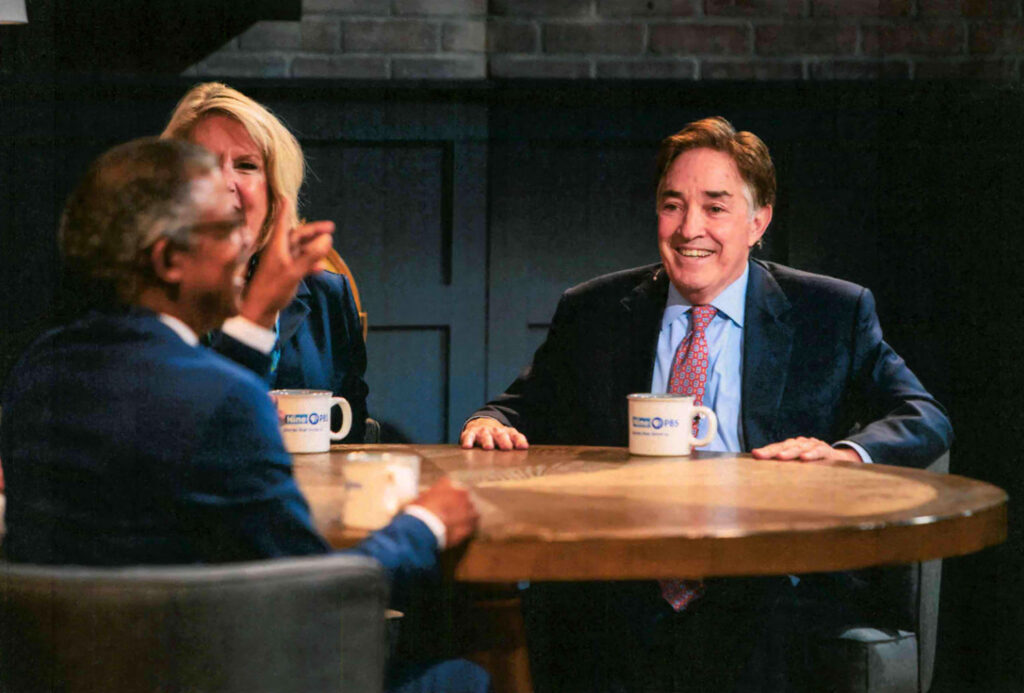
After her two stints at The Riverfront Times in the 2010s, Sarah Fenske returned to the paper to serve as executive editor of Euclid Media Group and then Big Lou Holdings, two of the RFT’s many ownership groups, from 2022-24. She is now the executive editor of St. Louis Magazine and a panelist on Donnybrook, sitting in what will always be known as “Ray’s seat.”
• • •
Joan R. Ferguson
RFT nightclub-listings coordinator and music writer, 1984-1996
Ray Hartmann was liked, loved, and loathed; he lived a full life as a son, husband, father, friend, and foe.
He was a skilled speaker and a master debater who seldom lost an argument, discussion, or dispute. He lived his life out loud and believed in using his voice, position, and power to challenge the status quo and make a difference in St. Louis and the lives of its citizens.
Ray was instrumental in my life’s trajectory, and some of the best years I can remember were spent at The Riverfront Times.
Ray, as you make your way through “Heaven’s Bar,” please tell Julie, Dick, and Paula that I said “Hello,” and y’all save a seat and a shot for me.
Rest in bliss.
After leaving the RFT, Joan R. Ferguson worked as a consultant with the American Red Cross and the U.S. Centers for Disease Control and Prevention, implementing evidence-based HIV/AIDS interventions internationally. She is currently employed at a private university and building organizational capacity in her nonprofit, which is focused on holistic health and wellness.
• • •
David Folkers
RFT entertainment editor, 1984-86
Forty years have passed since I worked at The Riverfront Times, but I remember Ray Hartmann as if it were yesterday.
To my suburban-raised, corn-fed brain, Ray was a rare breed. He was decent to a fault, he believed in defending the underdog, and he seemed to have an informed opinion about everything. Over morning coffee, Ray could send the RFT staff rolling on the floor with laughter, and by lunchtime he would have us hiding behind our desks if he were on the warpath. But anyone who had the privilege to know Ray can attest that just being in his orbit was a guaranteed supply of stories you could dine on for years.
I will always remember Ray’s sense of right. In the mid-’80s, Ray wrote a scathing takedown of the St. Louis Post-Dispatch after they printed the names of men arrested after a gay-entrapment sting in Forest Park. This was before Madonna made gay cool.
Ray’s weekly editorials were a marvel, by the way, not only for their substance and ability to piss off the St. Louis establishment, but for the speed at which he wrote them. Every Tuesday afternoon, a mere hours before the paper went to press and much to the chagrin of art-department cracks Tom Carlson and Margaux Medewitz, Ray would close his office door and start typing. In record time, Ray would produce a polished, thoughtful opinion piece that became the centerpiece of every issue.
I was once witness as Ray skewered a St. Louis Post-Dispatch reporter over the phone. She had written an article about the gruesome murder of Julia Miller Bulloch at the hands of her husband, Dennis Bulloch. Soon after their wedding, Mr. Bulloch allegedly tied his wife to a chair and set the house on fire. The couple had met through the RFT’s personal ads, and the article implied the RFT was implicated in the crime. Several of us listened outside Ray’s office door as he surgically rendered the woman a new orifice from which to do a whoopsie.
Personally, I will be forever grateful for Ray allowing me to be a part of his quirky and unique newspaper family, many of whom helped to shape my worldview and send me off onto other pathways: certifiable loons like Paula Wills, the smart and protective Susan Hegger, and the talented, passionate Julie Lobbia.
I loved everything about my time at The Riverfront Times. I only wish I had had the opportunity to tell Ray how much this experience changed the trajectory of my life before he left Earth’s orbit.
Since 1988, David Folkers has been living and working in Madrid, Spain. He completed a master’s degree in applied linguistics and taught English as a second language at the Universidad Europea for 25 years. He currently teaches at the IT consulting firm NTT Data and is a contributing freelance writer and translator of English textbooks for Oxford University Press. By the end of 2026, he will be granted Spanish citizenship, after which you may address him as Señor Folkers.
• • •
Cliff Froehlich
RFT freelance film critic, arts-and-entertainment editor, senior editor, executive editor, and associate editor, SLM managing editor and executive editor, 1983-2001
During my college days, besotted by the movies, I set a lunatic goal of landing a position as a film critic. I still remember the involuntary laughter of my then-girlfriend’s brother-in-law when I casually mentioned that ambition at a dinner. Although his reaction stung, amused skepticism was undoubtedly the correct response to such a daft notion.
But five years later, miraculously, Ray Hartmann made my dream manifest in the pages of The Riverfront Times.
In early spring 1983, after graduating with a master’s degree from Mizzou’s School of Journalism, I was working as a manuscript editor trainee at the publisher C.V. Mosby when I received a call from Joe Bonwich, a friend from my Saint Louis U. undergraduate years. Joe and I had worked together on the school’s newspaper, the University News, and he was now a staff writer at the still relatively young alt-weekly The Riverfront Times, which was only then beginning to find its mature editorial voice. Joe told me that the RFT was on the hunt for a second film critic, and he had kindly recommended me to the paper’s managing editor, Susan Hegger, on the basis of my reviews at the U. News. I freely confess that I was not a committed reader of the RFT—I mostly picked it up for a quick skim when I was at a bar – but that did not stop me from enthusiastically applying for the position.
I provided Susan with some samples—likely a few reviews from the Columbia Missourian and an unpublished piece on Alan Alda’s The Seduction of Joe Tynan written for a class—and, dumbfoundingly, she hired me. My first review, of Betrayal, appeared in the May 4, 1983, issue, with my last name vexingly misspelled (typos in my published reviews irritated me throughout my freelance years). In the article, I made a feeble attempt to mimic the trademark cadences of the film’s screenwriter, Harold Pinter, but Susan appeared not to mind my modestly experimental approach, and I continued to contribute reviews for the next 16 years, initially as a freelancer and later as a full-time RFT editor.
To this day, I remain gobsmacked that the process was so absurdly easy, especially given my thin portfolio, which consisted of a dozen-or-so reviews written for the U. News, maneater (Mizzou’s student newspaper), and Missourian. Perhaps Susan was unduly impressed by the fact that my master’s thesis chronicled the history of Film Comment magazine. (A good-sized portion of that epically long work eventually appeared in Film Comment and, somewhat astonishingly, remains available online.) In the process of writing that thesis, which stretched over two-and-a-half years, I had given myself an extensive (if spotty) self-education in cinema, so I was not entirely unprepared for a regular gig as a weekly film critic, but I still suffered from a mild case of imposter syndrome. That self-doubt, however, failed to stop me from bloviating.
But where exactly is Ray in this origin story? As the founder of the RFT, he obviously created the venue for my reviews, but his behind-the-scenes role in my hiring was more substantial than that. As noted, I was recruited to serve as the paper’s second film reviewer because Robert Hunt was already in the saddle. Unfortunately for Robert, who is a formidably talented and knowledgeable critic, Ray preferred popular film fare, and he found Robert’s more refined, highfalutin views irritating. A pan of An Officer and a Gentleman particularly rankled—Ray loved the film—and Susan was eventually charged with finding a supplemental reviewer, ideally one who was more aligned with Ray’s less exalted take on movie excellence. And that is how I landed the position. I am sure that I swiftly proved a crushing disappointment to Ray—Robert and I actually shared a similar critical approach—but he apparently despaired of ever finding a critic who aligned with his own film opinions and grudgingly accommodated himself to my snooty tastes. Less happily, Robert took offense at these (failed) attempts to make the RFT’s film pages more populist, and he left a month after my arrival. Because I so admired Robert’s work, I was delighted when I was able to woo him back to the paper several years later, first as a video columnist and then, after he left his job as Tivoli manager, as one of our regular film critics.
During my four years as a freelancer, I had very little experience with Ray, and my interaction with the RFT in general was fairly minimal: I would call Susan to detail the films I planned to review that week, and I would then drop off my copy on Sunday night or Monday morning at the RFT’s grimly ramshackle offices in Lafayette Square. My sole in-person encounter with Ray in those early days was at an RFT party, which I believe was held at his apartment. I introduced myself, and Ray immediately told me, self-deprecatingly and only half-jokingly, that he understood no more than a portion of any of my reviews because my vocabulary was so bafflingly vast (or should I say capacious?). This became a running gag, repeated whenever he mentioned me in a public context, and Ray was still deploying it nearly 40 years later, when he toasted me at my Cinema St. Louis retirement event.
Of course, even though I did not have direct contact with him, Ray did exert an outsize influence over me. When I started at the RFT, I earned a meager 30 bucks each week—the same amount whatever the number of films I reviewed. I was seriously impoverished, earning a paltry $11,000 a year at my full-time job, with my wife still finishing her law degree and bringing in a pittance from part-time work at Legal Services of Eastern Missouri. Because of that, I regularly petitioned Susan to ask Ray for a bump in my pay, and she would patiently explain to me why that was not a good idea: Asking for more money might make Ray reconsider whether I was worth even keeping. I was entirely unaware that, in those days, the RFT was seriously cash-strapped, and Susan’s refusal to pass on my demands no doubt prevented Ray from giving the boot to an ungrateful freelancer. When the paper was slightly more flush, I did eventually receive a raise—to a lavish $40—and at my urging, in late 1986, Susan even recruited a second reviewer, my longtime colleague Susan Waugh, when I complained that one critic could not adequately cover all the film in St. Louis.
After several years lurking in the background of my life, Ray moved decisively to foreground prominence in August 1987, when managing editor Ed Bishop—who replaced Susan as my contact after she left for the Post-Dispatch—recommended me as the RFT’s entertainment editor (I quickly petitioned for “arts and” to be appended to the title). Ray had to sign off on the hire and negotiate my salary—I somehow ended up taking a pay cut from my PR job at the WashU Medical Center—and that interview constituted my first extended conversation with him. For accuracy’s sake, let me amend that: Ray talked, and I mostly listened—a dynamic that seldom changed in all the time I knew him.
In my first few years on staff, Ray and I had relatively little face time. Although many readers picked up the RFT exclusively for its nightclub and band listings—and, let us be honest, the personals—Ray paid only glancing attention to the arts coverage that I oversaw. Other than his own commentary, the cover story was Ray’s primary editorial focus, so Ed, staff writers Joe Schuster and Julie Lobbia (non-gender-specific J.A. to readers), and photographer Mike DeFilippo coped with most of his story directives and last-minute interventions. Ray did not ignore me, but I remained largely in his peripheral vision.
Ray talked, and I mostly listened—a dynamic that seldom changed in all the time I knew him.
One 1988 incident—still vivid in memory—made it clear that staying out of Ray’s line of sight whenever possible was good policy. Ray, who was chronically late with his editorials, on this occasion pushed the needle into the red zone: By the time his copy was finally typeset, we were in grave danger of missing the paper’s print window. In the mad scramble to get the flats out the door, art director Tom Carlson mistakenly switched two columns of text during the hasty pasteup, and Ed failed to notice the error when he approved the page. The next day, when Ray discovered that his commentary was garbled by the flopped columns, he rolled like a Midwestern thunderstorm into production and started to rain vituperation down on Tom. As the abuse continued unabated—with a gape-mouthed crowd gathering to witness—I became increasingly ticked: Yes, Tom made the error, but Ray was ultimately responsible because of his blown deadline. I turned to Julie and announced that I was going to intercede and tell Ray exactly that, but despite her diminutive 5-foot size, she physically restrained me and steered me away from the scene. Tom survived the attack to become the RFT’s most essential and longest-lasting employee, but if I had challenged Ray’s authority at that early stage of my tenure, I doubt I would have been similarly spared. Like Susan with her earlier safeguarding measures, Julie tamped down the flames of my outrage and prevented a self-immolation.
Such volcanic eruptions were by no means the norm, but we always knew that an intimidating Mr. Hyde lurked within Ray’s generally benign Dr. Jekyll, and on one occasion I became the locus of his anger. This occurred much later in my time at the RFT, after the publication of a “Best of St. Louis” edition. The content of such special issues was my purview, and those projects inevitably contained a ticking time bomb that would eventually detonate. The RFT was generally fearless, and if an article threatened to cost us an offended advertiser or two, Ray never hesitated to proceed with a story because of a potential revenue loss. But our annual poll-driven “Best of St. Louis,” “Restaurants,” and “Music Pages” issues were treated differently: They were supposed to celebrate the choices of our readers’ voting, not offer any criticism (even when deserved), and the aim was unalloyed positivity. In this case, however, theater critic Harry Weber—the writer I had assigned to address that year’s Best Gay Bar—was insufficiently fulsome in his praise of the winner, and Ray received a haranguing phone call. When he beelined to my desk the morning after the issue was published, I suspected that Ray was not intending to offer a congratulatory atta-boy, and, sure enough, he immediately started to berate me for my astonishingly poor editorial judgment.
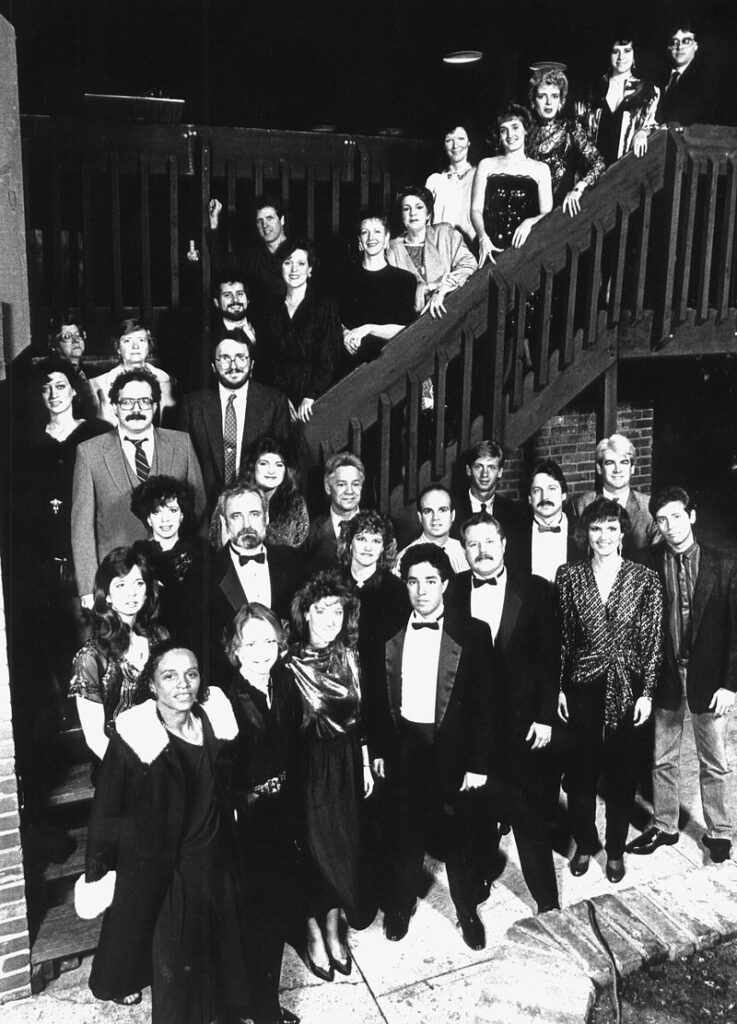
Now, “Best of St. Louis” was a massively heavy lift for much of the staff—issues topped 200 pages—but I lived with these projects for longer than most of my colleagues because I also had to recruit, hire, and supervise the large cadre of poll-workers who hand-counted the ballots both day and evening for several weeks beforehand. Only after those results were in could I finally assign and assemble the many editorial elements. As Ray continued his tirade, I therefore grew more and more aggrieved and finally reached a tipping point: Hurling the issue in his direction, with the many pages fluttering to the floor, I bellowed, “You’re right, Ray, it’s just a piece of shit!” That outburst stunned Ray into silence—a surpassingly rare event—and he unexpectedly retreated to his office. By this juncture, I was sufficiently integral to the RFT’s operation that I was not really concerned about blowback, and Ray later buttonholed me, apologized, and even acknowledged the overall quality of the issue.
Again, let me emphasize that these more extreme incidents were infrequent, but it is also undeniable that Ray regularly served as a Loki-like chaos agent in the editorial department.
Although Ray preferred to retain the title of editor for most of his years at the paper’s helm, the folks listed in the staff box as the managing editor—successively, in my years, Susan, Ed, Julie, and Safir Ahmed—were actually in charge of the RFT’s news side on a day-to-day basis. Ray continued to make the final call on all major (and even some minor) editorial hiring decisions, but he seldom line-edited a story, and he did not read most of the RFT’s content until well after it was in print on Wednesday. In fact, I can say with some confidence that of the hundreds of reviews and articles I wrote for the paper, Ray read only one before publication—my 1997 cover profile of Tony LaRussa—and even then we primarily debated, at painful length, the piece’s headline (writing cover heads was always an agonizingly prolonged process at the RFT). Because he was consumed with his many responsibilities as the paper’s publisher, Ray for the most part allowed us inmates to run the editorial asylum, and we were forever grateful for the liberating freedom of his hands-off approach.
There was, however, one monstrously huge exception: the RFT’s cover story. Strolling into the office on Monday—the day before deadline—Ray would inquire about the status on that week’s cover piece, and only then would he offer his belated take on the story. Generally, he would request only minor tweaks, but wholesale changes were sometimes ordered up, and occasionally—to everyone’s horror—Ray would insist an entirely new cover story was needed. Because the RFT never banked articles, that dire command meant a beleaguered staff writer had to report and write a significant piece in 24 hours.
Tuesdays could also be a trial. As Ray developed his commentary for the week, he would wander from desk to desk and essentially talk through his evolving thoughts with various editors and staff writers. (He made similar rounds on Thursdays, before Donnybrook taped.) If he were writing about the subject of that issue’s cover story, the reporter of the piece received particularly intense and unwelcome attention, often delaying the completion of the actual article. Because virtually all of us were striving to meet our deadline, these interruptions by Ray upped our already high stress levels, and we were always relieved when he at last retreated to his office to begin writing. That process, of course, came with its own set of frustrations. On all too many nights, long after the rest of the paper was put to bed, hours would tick slowly by as a core handful of us waited until Ray mercifully delivered his copy.
In one amusing instance, Ray even managed to stir up his signature deadline turmoil when not physically present in the office. Headed off on a trip—no doubt to Aruba, which was his go-to escape—Ray left the Shell Building for Lambert Airport with his commentary barely started. Rather than allowing us to explain his column’s absence with the usual boxed announcement that he was on vacation, this time Ray decided that he would continue writing while in the air. But instead of finishing the piece and then calling in with the completed copy, he insisted that a staff writer talk with him as he painstakingly composed and revised in real time. Using one of the Airfones then available on planes, Ray proceeded to spend hours on the line as the increasingly agitated writer took intermittent dictation, with the rest of us keeping vigil and offering the victim our silent sympathy. Given the extortionate prices of calls on airline phones, the ultimate cost of that conversation likely soared beyond a stratospheric $500.
Even though he was forever upsetting our editorial routine, Ray offset that by fostering an atmosphere of iconoclasm and rambunctious fun: In our freewheeling office, the normal rules of decorum seldom applied. To cite one small example, when Dan Durchholz interviewed for the paper’s calendar editor position, he dutifully reported to the Shell Building wearing a business suit and tie, and I greeted him in my standard summer garb of shorts and T. After he landed the job, Dan said my shabby attire had confirmed that the RFT was the place he was clearly meant to work. During our meeting, I no doubt also gave Dan my usual warning when vetting potential hires: Anyone offended by an unceasing firehose stream of profanity had best look elsewhere for employment. Sailors cursed like us.
I will resist further plundering my trove of Ray stories and simply stipulate that he was a truly crazy-making boss: mercurial, uncompromising, surpassingly difficult to please. But however exasperating Ray’s behavior, his unwavering aim was always, always, always to make the RFT and his own column as compelling and indispensable to readers as realistically possible. And Ray succeeded—wildly—in that tireless pursuit of excellence: By the mid-1990s, the RFT was inarguably among the finest alt-weeklies in the country.
The RFT’s growing status eventually made the paper an attractive takeover prospect, and predators—most prominently, the New Times and Village Voice alt-weekly chains—started circling and stalking. The RFT’s writers and editors were unenthused about the prospect of any chain ownership, but if we were fated to be sold, our general preference was the Village Voice. Regrettably, Ray chose New Times. (As it turned out, the RFT would have ended up in the same hands regardless, with New Times swallowing the competing Voice chain in 2004.) By the end of 1998, the deal was finalized, and Ray turned the keys of the RFT car over to New Times, and the new owners soon steered the paper in directions I preferred not to go.
However exasperating Ray’s behavior, his unwavering aim was always, always, always to make the RFT and his own column as compelling and indispensable to readers as realistically possible. And Ray succeeded—wildly—in that tireless pursuit of excellence: By the mid-1990s, the RFT was inarguably among the finest alt-weeklies in the country.
No one blamed Ray for selling, of course, and his timing proved impeccable: The alt-weekly bull market was near its height, and the disastrous effects of the internet and social media on newspapers were still far in the unknowable future. To his great credit, Ray generously shared his good fortune: After deservedly cashing in, he wrote checks—some quite substantial—to dozens of the people who helped build the paper on the sturdy foundation he laid.
Just as important, Ray also attempted to establish a firewall to prevent New Times from taking its usual scorched-earth approach to acquisitions: Existing staff was to remain in place—at least for a defined period—and Ray was supposed to retain at least a small measure of influence over the paper’s direction, including the right to continue his column. A testy get-acquainted visit from New Times’ brash editorial honcho Mike Lacey—who took perverse delight in referring to himself as “a prick”—did not exactly reassure the skeptical editorial staff, but during our early honeymoon period, the paper functioned largely as it always had, albeit with an an increased ad-to-edit ratio and a tighter page count (Ray could sometimes be suckered into adding an eight-page signature when we had a superabundance of worthy editorial). As summer 1999 approached, however, the clampdown began, and dictates from New Times’ editorial office in Denver became more frequent and more onerous.
On a personal level, the most distressing orders I was forced to execute were the dismissals of our full-time calendar editor—that protective firewall was quickly breached—and our freelance theater and film critics. Although I kept my own job as an editor, I felt at least some of their pain: Because New Times insisted that the RFT feature only film reviews from the chain’s existing stable of critics, I was largely banned from writing about cinema. Quotas for writers and editors were then instituted, and although staffers were expected to produce a minimum number of cover features and shorter pieces each year, the available space in those 52 issues ensured that some of us were guaranteed to fall short.
The changes soon accelerated: New Times required that the RFT employ the same design and editorial template used in the chain’s other publications, and an array of our longstanding editorial features were kicked to the gutter and curb-stomped, replaced by repeating elements (such as restaurant capsules) that consumed precious column space. Far more dismayingly, as New Times tightened its grip, we were pushed to adopt the snarky and reflexively pugnacious tone that characterized their journalistic approach elsewhere. Under Ray, the RFT was an advocacy paper, proudly supporting a progressive agenda and addressing issues of social and racial justice, abortion rights, political and corporate malfeasance, environmental abuses, and economic inequality. New Times’ papers, by contrast, were primarily oppositional: If the wrong people (from their perspective) were for it, New Times was against it. The journalism produced was often of undeniably high quality—and my colleagues at the RFT continued to produce fine work—but the paper’s culture changed radically, especially as Ray-era staffers were tossed overboard one by one.
Ultimately, I chose to jump rather than wait to be pushed, and I left the paper in April 2001, becoming the executive director of the St. Louis International Film Festival, whose name was soon changed to Cinema St. Louis (CSL) to reflect an expanding roster of other film fests and events. When I exited, the RFT staffers arranged for the Tivoli Theatre to hold a private afternoon screening of the Coen Brothers’ Oh Brother, Where Art Thou?—a film that appropriately begins with a prison escape.
I did not quite make a clean break: For a few months, I served as one of the RFT’s theater critics, until I realized I could not both freelance on a weekly basis and properly handle my new job’s many responsibilities. Later, I filled in remotely for vacationing copy editor Kerry Bailey, but a few unbylined pieces in the 2001 “Best of St. Louis” issue served as my final contributions to the RFT for a very long while. However, like Jack’s unbreakable connection to Ennis in Brokeback Mountain, I found that I could not entirely quit the RFT, and after New Times sold the paper to Euclid Media Group, I returned in 2015 for another stint as a freelance film reviewer (earning $25 a review—even less than my paltry $30 payment in 1983). After several months, however, the weekly deadlines again proved too overwhelming. Then, in 2023, following my CSL retirement, editor Sarah Fenske kindly invited me to become one of the paper’s rotating crew of film critics, and I wrote monthly reviews until the RFT was again sold—and essentially killed—in May 2024.
I also found it difficult to leave journalism behind, and after only two years at CSL, my old RFT editor Susan Hegger—who had ascended at the Post-Dispatch to become assistant managing editor for features—asked me to apply for the A&E editor position at the daily. The temptation proved too strong to resist, and after a series of hoop-jumping interviews, I (unfortunately) landed the job in 2003. But history sadly repeated, and when Lee Enterprises purchased the paper from Pulitzer Publishing in 2005, I saw the same darkly ominous clouds building on the horizon that I previously spied when New Times bought the RFT. Fortunately, CSL invited me to return as executive director, and I finally put full-time newspapering behind me in 2006.
During my post-RFT years, Ray did not disappear from my life, but we saw each other only occasionally. Even during my years at the paper, we ran in different social circles, and I seldom encountered him outside the office except at RFT parties, picnics, and softball games. Well, that is not altogether true: Because of my longtime involvement with the Metro East Humane Society (MEHS), Ray recruited me to check in on his two much-loved kitties when he was on vacation, and for several years I visited his apartment or house to tend to the cats’ litter boxes and feed bowls while he was away. On one memorable night, when Ray lived at the Dorchester high-rise across from Forest Park, I arrived to find the door to his balcony—many stories up—had somehow come off its tracks and was on the floor. Frantic that the cats had escaped (or, worse, had plummeted to their deaths), I searched the apartment and, thankfully, found them cowering together in Ray’s bedroom, as far from the open doorway as possible.
If we did not hang out, however, I always knew that Ray would give a prompt, enthusiastic yes whenever I asked for help, and he served as an emcee at several CSL and MEHS events over the years. That was another Hartmann trademark: Ray never failed to show up when needed. During his time as a radio host at KTRS, Ray also provided me with many welcome opportunities to promote CSL’s festivals on his show. Those interviews had an added bonus: They were the only times in our long relationship when I managed to talk more than Ray. My last extended interactions with Ray occurred last year, when I tried to persuade my fellow board members of the River City Journalism Fund (RCJF) to use him as a contract fundraiser. After he lost his bid for Congress, Ray had carved out a role as a rainmaker for select nonprofits, and I thought he was a perfect fit for our organization. Regrettably, the overly sensitive younger members of the board found Ray’s blunt, unfiltered opinions problematic: They thought he might offend potential donors and voted not to hire him. I found their attitude both depressing and hilarious, given that Ray’s refreshingly frank, informed views, often delivered at undeniably high volume and great length, were what made him such a vital and essential voice in St. Louis for nearly 50 years.
I count myself lucky to have found not one but two jobs as fulfilling as my matched set of 18 years at both the RFT and CSL. As much as I loved my time at CSL, however, in a better world, I would never have stopped working for Ray at the RFT.
But we are all too painfully aware that the world is far from ideal. And that is especially true now that Ray and the magnificent newspaper he created are no longer part of it.
After his CSL retirement, Cliff Froehlich started a free Substack, Re/Views, that often resurrects and recontextualizes his old RFT work. Once a month—under the auspices of Oasis St. Louis—he continues to force his film opinions on audiences during post-screening discussions at CSL’s Hi-Pointe Theatre. He also serves on the board of the Metro East Humane Society, which he co-founded 41 years ago.
• • •
Melinda Roth Haanpaa
RFT staff writer, 1992-2000
It has been almost 30 years since I worked as a political reporter for The Riverfront Times, and I realize—now that Ray Hartmann is gone—that every job I have had since has been held up to that standard. None compare. He gave us this job to do, to save the world, to save anything we saw worth saving, and that is pretty heady stuff when you are young and full of glorious ideals.
I look back on those years as the defining period of my professional life. I was so proud to be a staff writer for the RFT. I think we all were: Tom Crone, Jeannette Batz, Wm. Stage, D.J. Wilson, Richard Byrne, Safir Ahmed, Roland Klose, and all of the people who worked there. I think we shared the same devotion to Ray, whose full-throated fight for social justice was probably the closest thing any of us will ever experience to what Napoleon’s soldiers must have felt: That you were not merely doing a job but making history, led by a man who was somehow larger than the room he stood in and who made you believe the impossible was not only possible but absolutely required.
Since leaving the RFT, Melinda Roth Haanpaa has worked as a political press secretary at the state and federal levels and written five nonfiction books (one ghostwritten). She is now three chapters away from finishing her first novel. Melinda and her husband have seven children and 15 grandchildren between them.
• • •
Susan Hegger
RFT copy editor, calendar editor, assistant editor, managing editor, and editor, 1981-87
Ray Hartmann was a risk-taker.
Why else would he have hired me—an overeducated academic with zero experience in journalism and newspapers? OK, maybe my willingness to accept a low salary at the then-shoestring operation known as The Riverfront Times helped grease my path.
Or maybe Ray saw something in me. Which is, of course, what I prefer to believe.
Ray was my teacher and mentor. He taught me everything I know about journalism. How? By throwing me into the deep water, by being demanding, by having high expectations, by insisting that I would not sink. I would swim.
These were, after all, the early freewheeling days of the RFT, the “Hey, kids, let’s put out a newspaper” days when you had to be agile, ready to shift gears at a moment’s notice. Ray flourished in the chaos, the energy, the unpredictability. That hyper-drive and determination kept the paper afloat at some precarious moments. It was all exciting and cool.
And also unsustainable. In the beginning, Ray reported and wrote many of the RFT’s stories. But as the paper grew and became more popular, he focused more on his role as publisher (by necessity) and on his beloved editorials (his passion). He could still be manic, jittery, nervous—and sometimes just plain exasperating. (How many hours did I spend holding his hand, wiping his metaphorical nose, as he agonized over every word of his editorials? It was then that I saw the insecurity behind the outward confidence.)
He taught me everything I know about journalism. How? By throwing me into the deep water, by being demanding, by having high expectations, by insisting that I would not sink. I would swim.
As the RFT became bigger, the ambition that underlay its founding became more apparent. Ray always wanted the RFT to be more than a place to go for personal ads or to find out who was playing where—although arts and entertainment were always important.
He wanted serious journalism. He wanted to tackle critical local issues like historic preservation, reproductive freedom, Civic Progress. He wanted the RFT to be taken seriously as an alternative voice. So when the RFT made money, Ray spent it on the paper—hiring more staffers, giving raises, investing in his dream.
Yes, Ray liked the spotlight; he was good in the spotlight. He loved being on Donnybrook. He was brash, unapologetically liberal, funny. But the spotlight was not really for his personal aggrandizement. It was for shining attention on the things he thought important. Ray was a softie when it came to social justice.
So St. Louis lost a champion with his death. And that is to be mourned. But for those of us who knew Ray or who worked with Ray, we are mourning something else, too: the loss of a truly decent, compassionate, kind, and caring man.
That is the Ray I saw when I told him it was time for me to leave the RFT. It is the Ray who had such sweet, consoling words for me after my husband died. It is the Ray I talked to only a few short weeks before his untimely death. It is the Ray I will remember most.
After Susan Hegger left the RFT, she worked for 20 years at the St. Louis Post-Dispatch as an editorial-page copy editor, editorial writer, arts-and-entertainment editor, and assistant managing editor for features. She then was a member of a group of former Post journalists who founded the St. Louis Beacon, a nonprofit online news source. Susan served as the politics and education editor, continuing in that position when the Beacon merged with St. Louis Public Radio. She is now retired and spends as much time as she can manage traveling the globe.
• • •
Robert Hunt
RFT freelance film critic, 1981-83 and 1989-98
Like everyone in the area, especially anyone involved with local media in the last 45 years, I was shocked by the news of Ray’s death. But it also reminded me of how far we have moved from the salad days of alternative weeklies to our current state of intravenous media feeding. I am not sure that my own thoughts on Ray Hartmann would be worth making public, largely because I am afraid that they would give a negative impression, which is in fact quite the opposite of how I came to regard both Ray and the legacy of the paper he created. And as someone who was, at best, on the fringes of the RFT, I am sure my views of Ray and his management of the paper are seriously limited.
If you worked downtown in the late ’70s and early ’80s and had at least a passing interest in local media, it was almost impossible not to be aware of The Riverfront Times in its earliest days. In a town that already boasted two daily papers, old and venerable traditions, along came a tabloid! You know, like the Village Voice, the shaggy little hovel next to the temple of Serious Journalism. And even though the first thing most people mentioned about the RFT was its (nudge, nudge, snigger, snigger) personal ads, it was also evident that it was trying for a fairly competent level of reporting and—more likely to catch my eye—wide and varied arts coverage. Nonetheless, I cannot say I was a regular or devoted reader, but one day in September 1981, I picked up the latest issue solely for the purpose of finding the current Washington University Film Series schedule and noticed that there no longer appeared to be a film-review section. I worked up the nerve to call an editor listed on the masthead—Lou Schuler—and ask somewhat disingenuously if he accepted work from freelancers. He asked what kind of work I had in mind? “Oh”—disingenuity going into overdrive—“maybe some … film reviews.”
To my surprise, his answer was an eager yes.
Did I say disingenuous? What I did not realize—and what Lou probably thought I was opportunistically exploiting—was that the very same issue of the RFT I was holding had an item on page 2 announcing that their regular film writer had been dropped for plagiarism. (I will not mention the writer in question, other than to note that I had seen a few of his pieces that seemed … questionable).
I dropped off my samples a few days or so later and was more or less immediately accepted. (Coincidentally—or is it dramatic foreshadowing?—I believe my first visit to the RFT office was also the day Susan Hegger interviewed for a position as copy editor.)
I am spending so much time laying out my own entry to the RFT because I think I should point out that any opinion I developed of Ray in those early days was unavoidably filtered through the views of Lou and later Susan, both of whom had occasional editorial collisions with their boss. My impression was that, although the editorial staff was given a lot of space, the bottom line was that it was Ray’s paper, and anything that appeared in it was subject to his approval. (As Lou rather uncharitably put it after a column he had written was shut down, “Ray does not want anyone in the paper to be funnier or smarter than him.”)
When Ray made the decision to sell the RFT in 1998, I was not entirely surprised to hear that he intended to share a considerable portion of the proceeds with the staff members, but I was surprised to discover that his generosity even extended to at least one lowly freelancer who once (mistakenly) thought that Hartmann had a grudge against him.
As I saw it, there were two factions at work within the RFT, a distinction made physical by the fact that they operated on two different floors of the old office in Lafayette Square. There was the editorial side, with Lou and the other writers and designers who actually filled the paper’s pages. And there was the corporate side, with Ray in the executive seat, but also consisting of the folks who sold advertising, paid the bills, and kept the operation running. (I saw another visual reminder of this dichotomy when I attended an RFT holiday party at the Lemp Mansion. The sales staff and executives were on one floor schmoozing with the advertisers, while the editorial staff and the freelancers remained as close as possible to the food.)
Although I met Ray on one of my earliest visits, my only communication with the RFT was through Lou (and later Susan and the many fine editors who followed). Nonetheless, my image of Ray was that he was without question “the boss.” (Reading the articles that appeared after his death, I was surprised to consider that he was not that much older than me; there was never a time that he did not seem in total control.) He was the RFT. I think most of the staff recognized his dedication to the paper, but that did not stop them from colliding with him. Sometimes those conflicts would trickle down to me, and I would receive not-so-subtle hints from Susan (who was now serving as managing editor, with Lou having left the RFT) that Ray found my tastes out of sync with the general public. (My mean-spirited translation: He liked Porky’s, I did not).
Things came to a head in the most 1980s way imaginable when I was informed that there was no way that the paper would risk allowing my elitist ramblings to spoil the public’s enjoyment of Return of the Jedi. (Ironic postscript: I still consider Return of the Jedi to be the cornerstone of the entire unstable Star Wars galaxy.) I was young and naïve and also a bit of a pompous jerk in those days (I am no longer young), and I let the idea that I was being placed under a one-step-removed editorial eye get to me. Channeling my inner Rumpelstiltskin, I indulged in a bit of petulant foot-stomping and walked away from the RFT.
The RFT got along just fine without me, became more financially stable, and, surprisingly, welcomed me back into its pages a number of years later. Curiously, I still heard of editors and writers having clashes with Ray, but I somehow avoided his scrutiny. And that is when I had a pleasant surprise. My visits to the RFT office were irregular at best, so I did not cross paths with Ray very often, but one day in the early ’90s we ended up waiting for the same plane at LaGuardia Airport. We talked as if we were not necessarily old friends but certainly longtime associates. As the years went on, this became the norm whenever I encountered Ray. I believe that as time passed and the RFT grew, he saw me as one of the survivors, the old-timers: someone who had been a part in its early, struggling years and stuck around (my nearly six-year absence notwithstanding). There are, after all, a dwindling number of us who remember the pre-RFT media, or the years when the St. Louis Post-Dispatch refused to even print the name of its cocky weekly competitor. (The end of that edict is another story that some media historian needs to tell.)
When Ray made the decision to sell the RFT in 1998, I was not entirely surprised to hear that he intended to share a considerable portion of the proceeds with the staff members, but I was surprised to discover that his generosity even extended to at least one lowly freelancer who once (mistakenly) thought that Hartmann had a grudge against him.
My visits to the RFT office were irregular at best, so I did not cross paths with Ray very often, but one day in the early ’90s we ended up waiting for the same plane at LaGuardia Airport. We talked as if we were not necessarily old friends but certainly longtime associates.
I mention this for several reasons. The first is that I was broke at the time and the RFT windfall was very much appreciated; the second is that I do not think his generosity was publicized or noted in any way. But besides being an extremely kind thing to do for the dozens of people who had contributed to the RFT, my interpretation was that it also revealed how he thought about the paper he had created and guided, acknowledging the many hands and minds that went into it, even those he argued with, disagreed with, and occasionally outvoted. There is no question that Ray Hartmann was the RFT in so many ways, but so, he knew, were the rest of us who were allowed to share the experience.
• • •
Mike Isaacson
RFT freelance writer and theater critic, 1994-98
I owe Ray a lot.
When Cliff Froehlich hired me to be a theater critic for the RFT, I was told I was approved because Ray said, “He seems like he knows things.”
I loved that time at the RFT, learning so much about myself and writing, and interviewing some amazing people: George C. Wolfe, Barbara Cook, Michael Mayer, Ted Chapin, and many, many more.
I so miss weekly independent papers. They made cities great.
After the RFT was sold, Ray took me along to St. Louis Magazine and always supported my “voice.” At both publications, I occasionally wrote about subjects other than theater, even contributing a story on the best drive-through coffee (pre-Starbucks era) in SLM. (Congratulations, Hardee’s!)
When I ran into Ray at The Muny once, before I could finish with “You may not remember me,” he said, “Oh, yeah, you were the guy who knew stuff no one else did!”
RIP, Ray Hartmann. Cities need people like Ray.
After he stopped freelancing for the RFT, Mike Isaacson went on to become the artistic director and executive producer of The Muny, the third person to hold this position in the theater’s 107-year history. Isaacson is also a 10-time Tony Award-winning Broadway producer.
• • •
Chris King
RFT freelance writer, 1991-1998
King’s remembrance is found here on The Common Reader site.
• • •
Larry Levin
RFT freelance writer, copy editor, and associate editor, 1988-90
Imagine a Venn diagram with your personal-journey circle overlapping with those of others you have encountered along the way.
My circle and Ray’s intersected in a narrow but very important manner. Well, important to me, at least.
As with most humans, my life has had significant forks in the road. Despite having succeeded in competing with some of the best young trumpeters in the country, I opted for a liberal arts and law school path. And after seven years practicing law in St. Louis and then Chicago, I returned here and considered my options.
In an apartment off South Grand, I began composing music and writing short (and in my own mind) humorous articles. The music was catchy but far too fluffy, and although I proved to myself I could do the work, my heart was not in it.
The written pieces caught the eye of Ed Bishop, then the managing editor at The Riverfront Times. One thing led to another, and after the publication of several shorts in the Times Capsules section of the paper, Ed and Ray hired me as a part-time copy editor, and ultimately, the role grew into more hours and the potential for a full-time position.
Building on editorial roles from high school, college, and law review was a blast. As a copy editor, I had the privilege of working with virtually every writer at the RFT, both those on staff and the large number of freelancers. I will not name them all here, lest I leave out some deserving mention, but the skills that they exhibited were remarkable. It is no wonder so many evolved into exceptional talents in journalism and their other diverse fields of work.
And Ray had so much to do with that growth, both for them and for me.
As my work at the RFT grew to include more writing and reporting, I interacted more frequently with Ray. I learned that he cared immensely about the hook of the story, the kernel that would draw readers into it.
This was especially true of the cover stories; well, truth be told, often only the cover stories. I cannot tell you how many times on deadline night we awaited Ray’s tweaks or “suggestions” (read: demands) regarding the first few graphs of the lead article and accompanying headline. Not to mention the artwork, so often produced by the nonplussed graphic designer extraordinaire Tom Carlson or the uber-creative photographer Mike DeFillipo.
How did we know when the story was acceptable in Ray’s eyes? Many a time it was when the highly complimentary quip “That doesn’t suck” emanated from his lips. You knew it was a job well done and met his very exacting standards on what would draw readers into the story.
That same insistence on audience attraction informed our pitch sessions, when we brainstormed ideas for cover stories, sometimes with only a couple of days to deadline, if that. I can recall several times when we would offer a cover-story suggestion, only to have Ray brand it as lukewarm. But then he would return from meeting with his community connections and offer up the same idea as one we needed to pursue. “Nah, this is totally different from what you pitched” is a paraphrase of a not atypical response. We would collectively roll our eyes, but we also knew that when he got community buy-in, the story concept was almost always a go.
How did we know when the story was acceptable in Ray’s eyes? Many a time it was when the highly complimentary quip “That doesn’t suck” emanated from his lips.
I got to do some great writing at the RFT. I had a sports column for a while and covered the Blues with regularity. Several cover stories let me utilize my law and business background, as when we covered stadium-financing issues.
My stint there only lasted a few years, as the birth of our first child led me to return to something of a more lucrative nature (but not law!). But thanks to both my experience with the paper and the very kind and appreciated reference from a reporter at the RFT, my life took an unexpected turn almost two decades later.
When the market for commercial real estate tanked in 2007, following the residential collapse, I went to my boss at our development company and asked if I should be looking for work. Very kindly, he gave me several months’ head start, and the company nobly provided me with a very generous soft landing.
So when I looked for new positions, I was focused on the nonprofit sector, where I had previously had a stint as the St. Louis director of a national conservation group. One of the positions that became available was the publisher and CEO of the St. Louis Jewish Light.
Let us just say that having the weird and eclectic background of journalism, law, business, and nonprofit skills in my quiver did not hurt in my quest for that role, and I was very happy to accept it and remain at the paper for the better part of a decade. And my RFT experience under Ray’s tutelage and the aforementioned referral from a colleague there were integral to getting that opportunity.
Ray’s example also helped inspire me to innovate in the nonprofit sector. After my Jewish Light work ended, I created STL Nonprofit News, an online journalism publication that focused on people and organizations providing charitable and philanthropic services in the region. Although STL Nonprofit News gave way after several years to a number of other work responsibilities, I am glad to have created something new that was appreciated by those in the sector. I have another potential new nonprofit product coming out soon, again rooted in journalism. Ray’s bravery in trying new things is a notable contributor to my approach in starting new resources for our community.
So although the sliver of my circle that overlaps with Ray’s may be small, I am so grateful for the respect, opportunity, and creativity that he shared with me, which influenced my ability to further pursue journalism, one of the key threads in my life. And that certainly does not suck.
• • •
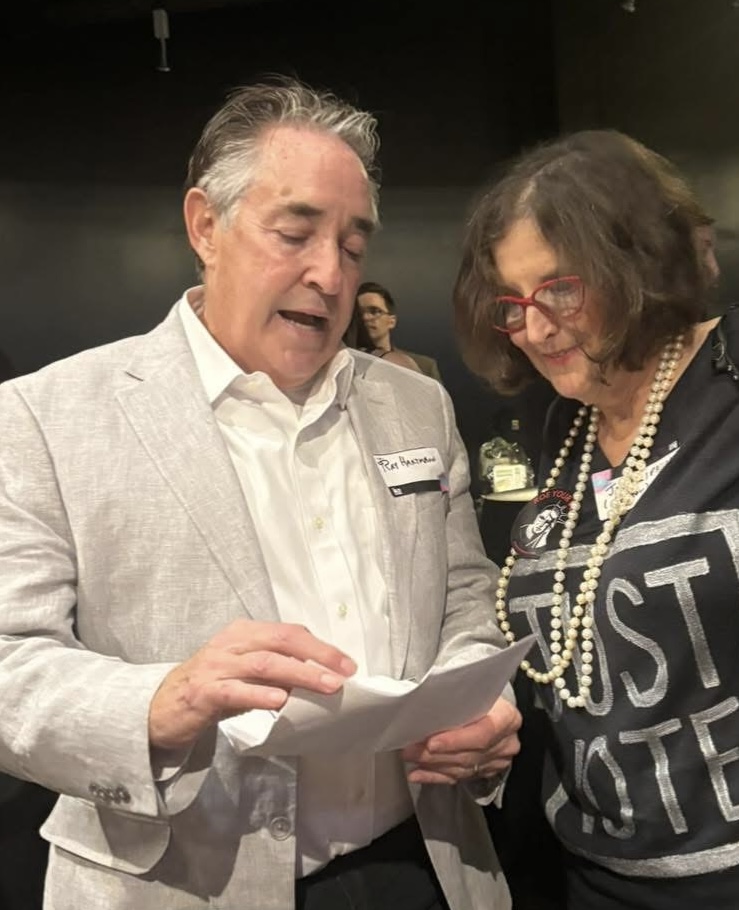
Joan Lipkin
RFT freelance theater critic, 1986-87
I never worked for Ray Hartmann, and that is probably a blessing. I do not mean that to be disrespectful to the many people who worked for and with him, and for whom the opportunities that Ray provided were game-changers.
But because I was never officially, legitimately on staff, I had a different measure of freedom and connection.
Actually, it is not quite accurate to say that I was not on staff. I was a freelance theater critic for the RFT for about five minutes.
As many may know, I take the efforts to create theater and the necessity to talk deeply about it very seriously. And when I was asked if I would review, especially because I wanted to help support and grow the arts community, I said yes.
But I only lasted for a few months because I tangled with the paper’s managing editor, Ed Bishop, who frankly was not interested in any of the nuance and thoughtfulness that I was bringing to my attempts. He purely wanted a thumbs-up/thumbs-down kind of response, and I am not that girl.
What also happened was that I realized I did not want to give public critiques to friends and colleagues because, as a fellow theater-maker, I was so aware of the labor involved and the sensitivity.
So I quit. I might have written a few additional articles, but I realized that doing that kind of journalism—as important as it is—was not the optimal lane for my temperament and aspirations.
So, unlike the staff members, I had very few dealings with Ray in the early days. But I feel indebted to him because, although he was particularly focused on politics and related issues, he was smart enough to understand the relevance of a thriving and bold arts community. That meant arts coverage, and that meant me, even and especially if I were not reviewing. The RFT covered almost everything we did. Full features on pieces like Some of My Best Friends Are … and individual reviews of every play of mine and every performer we presented. And we presented a lot.
Looking back, it is almost hard to imagine that a tiny theater company and an individual artist could get that kind of consistent coverage, which is so important for building audiences and awareness.
But we did. It was a very different time in our now-dwindling print world. And whether Ray actually asked for any of that or simply got out of the way and trusted his staff and great arts lovers and editors like Eddie Silva and Cliff Froehlich and Julie Lobbia, he made it possible.
I was on a cover wrapped in an American flag in one issue. On another, I was nude in a peace sign with about 70 other women when I produced Peace Out!, our artistic response to the anniversary of the war in Iraq.
He was on fire, as we know, and seemingly without any self-consciousness when he had a microphone in front of him on TV or radio. Or when he was penning his thoughts.
I think that later RFT editor Sarah Fenske said that nude peace sign was one of her favorite covers. It certainly was one of mine, and it certainly was controversial. But Ray did not shy away from controversy when it was needed.
So we had a distant relationship of mutual respect for years, and I occasionally guested when he was on KTRS.
We got to know each other much more personally when he ran for Congress. He would call me up and ask for my advice, and sometimes we would go to events together, and I would introduce him to people.
He was on fire, as we know, and seemingly without any self-consciousness when he had a microphone in front of him on TV or radio. Or when he was penning his thoughts.
But I essentially found him to be a shy man in certain instances, and I was a soft place to land. He had some sense of my politics and concerns, and I was safe.
Of course, I wanted him to win. Of course, I wanted this ridiculous grifter of an elected official who refuses to meet with her constituents out.
But it was a long shot. Still, he gave it his all, and, like many, my heart was a little broken when he lost. And even more broken by the ways that many abandoned him at that point. I fielded his calls as he struggled to figure out how to earn money in the aftermath because he still had two kids he adored, and they had needs.
Since he died, I have worried whether he knew that he was still loved and appreciated and relevant. I asked myself the perennial question of why and how we love people when they are on top of their game, often with little concern for the human being who may have lost their footing.
Ray was all of these things:
He was the king of the roost, the fearless publisher who was demanding and sleepless because of the intensity of keeping an endeavor like that going, not just for the city but for the people to whom he gave employment and opportunity.
He was a truth-teller on Donnybrook, never acquiescing to his colleagues when he did not agree.
He was an idealist who wanted to unseat a terrible incumbent.
He was a devoted father and colleague.
He was a visionary. And that means some ideas take root, and others do not, but a visionary keeps striving and casting their net because they live in possibility.
As we pay tribute to Ray, I hope we will remember and be grateful for the whole of his life, for his extraordinary accomplishments, and for the fact that many of us, including me, loved him.
Internationally recognized as a groundbreaking theater artist, educator, and social activist, Joan Lipkin works at the intersection of performance and civic engagement. The founder of That Uppity Theatre Company, Dance the Vote, and other projects, she is a member of the College of Fellows of the American Theatre and the recipient of numerous awards, including the 2026 Margo Jones Medal. Known for her work with short plays, rapid-response theater, and devising, she is frequently produced and published, and is featured in the book 50 Key Figures in Queer US Theatre.
• • •
Margaux Medewitz-Zesch
RFT production assistant and art director, 1984-88
It is funny how something as ordinary as an X-Acto knife can hold memories that are 40 years old. I have used the same one—complete with its little purple plastic stopper—ever since my days in the art department at The Riverfront Times. I cannot help but laugh thinking about everything that little knife has witnessed.
It had been a very long time since I had thought about my years at The Riverfront Times, but the sad news of Ray Hartmann’s passing on April 23 brought memories of my four years there rushing back with startling clarity.
One of the main things I remember is how hard everyone worked. At the time, I probably did not fully appreciate just how tirelessly Ray worked to keep the paper going—and, at times, simply afloat. He was always there, deeply involved in every aspect of the business. On the rare occasions when he took a vacation, I remember the staff briefly exhaling and enjoying a few quiet days before he returned.
I always thought I had high standards, but Ray pushed those standards to another level. He taught me that there was almost always room for improvement and that taking the extra time to make something better was worth it—even if it tested everyone’s patience along the way. Hence, the phrase “Hurry up and wait” became the mantra at the RFT.
A normal workweek in the art department really ramped up on the weekends. This was the pre-digital era, so border tape was everywhere, X-Acto knives were constantly flying, and there was always hot wax—lots of hot wax—for paste-up. Mondays were especially long days, but by late afternoon a group of staffers would head to Ronayne’s, a longtime Lafayette Park staple, for happy hour. Ray usually paid for the drinks, so we would thoroughly abuse our tab privileges before we would wander back to the office to finish whatever still needed to be done before the Tuesday noon deadline.
Tuesdays started very early, and the RFT was put to rest by noon … except for Ray’s weekly editorial. The “Hurry up and wait” mode activated. The art department was finished with our part, and then all we could do was watch Ray labor over the issue’s editorial. Ray never seemed to care how late it got, as long as the final product was exactly right. This was also before the internet, so the editorial staff would be sent into a frenzy of research, phone calls, and fact-checking until, finally, the editorial was born. Then the art department would typeset the piece, wax it up, slap it on the flat, and send it off to the printer—usually well past the noon deadline.
I remember one week, the editorial was so late that the rest of the material had already been sent to print. Ray generously tossed me the keys to his new sports car, and a fellow art department colleague and I drove to Washington, Missouri, to deliver the final piece to the printer. That car sure was swell compared to whatever I was driving at the time.
Ray never seemed to care how late it got, as long as the final product was exactly right. This was also before the internet, so the editorial staff would be sent into a frenzy of research, phone calls, and fact-checking until, finally, the editorial was born.
Ray hosted a wonderful little going-away happy-hour dinner for me at Ronayne’s on my last day. Ironically, I arrived late because I was still putting the finishing touches on a special section for that week’s issue. Sound familiar? I learned that from Ray himself—everything could wait until the job was done right.
When I walked out the doors of The Riverfront Times in 1988, I took that X-Acto knife with me. Not long after, publishing became fully digital and the old paste-up tools disappeared. But the work ethic I learned from my fellow staffers—and especially from Ray—stayed with me throughout a long and successful career in the publishing industry.
After leaving the RFT, Margaux Medewitz-Zesch worked as the art director for a portfolio of properties owned by Commerce Publishing (and its successors), including Decor Magazine, Decor Home, Art Business News, Volume Magazine, and Movie Maker Magazine. Margaux also served for several years as freelance art director for Cardinals Gameday Magazine, and she continues to work as a freelance designer.
• • •
Randy Osborne
RFT staff writer and associate editor, 1990-94
When he scored a point in debate (Ray loved not so much the donnybrook, I would say, as the spirited argument), his rectangular face brightened with a puckish grin. Listening eagerly, he might suddenly tilt his head, mock-stunned, an expression meant to convey that his opponent not only had failed to score but might be insane. His eyebrows, already high and widely spaced—abbreviated like the quick strokes of a brush—rose more, as if to take flight.
I studied him.
In my Riverfront Times years with Ray, an unforgettable figure was Julie Lobbia, managing editor when I came aboard. Petite fireball, Julie. The day after my interview with her and Ray, she phoned: “When can you start? Ray wants you.” Implying, I guessed, that she did not.
Nobody knew then, but Julie was almost out the door for a job at New York’s Village Voice. Top dog of alt-weeklies back when we had journalism, the Voice and Julie would fit perfectly, I reckoned. From any idle, pointless conversation in the RFT office, which was most of them, she simply marched away. “I do not have time for this,” she muttered. She was right. Nobody knew that, either. Julie died on Thanksgiving Day after the Twin Towers fell, at age 43.
Swedenborg said that humans, having shed our earthly meat bags and become spirit, relate to each other purely by affinity. Those, for example, who married out of lust or convenience may, in the afterlife, have nothing to do with each other. However, if you enjoyed a true affinity for someone while mortal, then you’ll find him or her in spirit, though “find” is probably not the best word.
At intervals he would emerge from his cave, from his throes of creation, to tell us that he was “almost done.” The door went shut. We groaned, a chorus. The finished piece would show no signs of arduous birthing, only crisp, tart, witty, and well-reasoned Rayness.
Anyway, Ray and Julie had an affinity. They laughed and bickered and fought. Each seemed to regard the other as a peculiar specimen, best handled gently except when roughness was called for, worthy of respect but not too much.
I studied them.
Three decades-plus are gone since I occupied an RFT cubicle, stone church gargoyles out my ninth-floor window. Three decades since Cliff Froehlich, Safir Ahmed, Rob Schneider, and I sat, stood, and lay on the floor at deadline (after deadline, typically), waiting for Ray to finish his column. At intervals he would emerge from his cave, from his throes of creation, to tell us that he was “almost done.” The door went shut. We groaned, a chorus.
The finished piece would show no signs of arduous birthing, only crisp, tart, witty, and well-reasoned Rayness.
On the Saturday when I packed my RFT junk, Ray happened to be on the premises. What did we talk about? An awkward situation—for me but likely not for him, a person of composure, success, and local fame. One not of my world.
With my box, with hobo panache, I trundled to the elevator and down. In the street, I made a final check on the gargoyles. They look much different from below. You can never tell, with those things, whether the face is a snarl or grimace or smile.
Randy Osborne writes from the South, figuratively and in Atlanta.
• • •
Steve Pick
RFT intern and freelance music critic, 1981-83 and 1996-2005
In early 1981, I secured the first internship position at The Riverfront Times. I was working on what was called a writer’s certificate at UMSL, and my advisor hooked me up to spend a semester giving the RFT a few hours of my time each week. I may have heard of the publication, but I know I was not reading it yet. In those days, The Riverfront Times was pretty exclusively available around the riverfront, on Laclede’s Landing, in parts of downtown, and in Soulard.
The first job they gave me was to maintain the music listings. Technology in 1981 meant that I had to call the 20-or-so nightclubs, bars, and restaurants every week to find out who would be appearing each day over the next week. I quickly asked if I could expand the listings to include bars with the original music bands I was so interested in at the time. As my time went on, I added more and more listings, beginning the process that became one of the two reasons everybody picked up the RFT for so many years: the personals and the ability to find out who was playing when and where.
I barely interacted with Ray Hartmann other than to say hello. But he called me into his office to talk about that piece. “If you were a sportswriter, you would not say anything bad about the Cardinals or the Blues, would you?” Well, actually, I can imagine scenarios where I would.
I also wrote a few pieces for the music section, which was much less formal in those days. It was edited by Michael Buchman, who was very open to new ideas. At some point, he came to me and asked me to write a feature on Mama’s Pride. Remember, I was 22 years old, a firm proselytizer for New Wave and punk. Mama’s Pride was a band I knew from KSHE and, as such, was the enemy to my mind. I interviewed two of them, and they gave me some great stories I wish I had understood better at the time. The story I wrote included plenty of those quotes, but also included quite a few of my personal opinions, which were not positive.
In all the time I was spending at the RFT offices in those days, I barely interacted with Ray Hartmann other than to say hello. But he called me into his office to talk about that piece. “If you were a sportswriter, you would not say anything bad about the Cardinals or the Blues, would you?” Well, actually, I can imagine scenarios where I would. Ultimately, he worked out with Buchman a way of letting me do a second interview and rewriting the piece to remove the offensive statements. I have since come to appreciate Mama’s Pride much more than I did then, so I am glad I do not have a hit piece on them in my past.
I went on to write for the St. Louis Post-Dispatch from 1983-96, until they decided they wanted to chase a younger audience. Editors at the RFT enticed me back, and for the first year or so, Hartmann was still in charge of the paper. Editorial policy was much more wide open, and although plenty of local bands were praised, it was not unusual to find some insulted here and there. I stayed writing freelance for the RFT after Hartmann sold it to New Times, but while I got to write some things I liked, it was not the same paper he had allowed to be so good.
After I left in 2005, I started writing freelance for multiple publications, co-wrote with Amanda Doyle a book on St. Louis music history called The St. Louis Sound, and eventually started a blog I really like doing called Steve Pick’s Writing Place, found on Substack.
• • •
Thomas R. Raber
RFT freelance writer and part-time copy editor, 1986-2006
Let us say you asked Ray Hartmann, “Hey, Ray, how’s the peanut butter on that sandwich?” He would reply, “No, the real question is the jelly. Now, about the jelly …”
I worked in and around The Riverfront Times editorial office for about five years and freelanced for many more.
If I ever spoke to Ray, he would put on his incredulous face to let me know whatever I was saying was ridiculous.
I never sat in a meeting with him, never talked to him on the phone, never rode in a car with him, or shared a meal.
But I observed the talented people who did, which reminded me of how Rob Petrie’s staff knew and reacted to Alan Brady.
• • •
Randall Roberts
RFT freelance music critic, music editor, associate editor, and staff writer, 1995-2007
Ray Hartmann was frazzled and doing a half-dozen things when executive editor Cliff Froehlich walked me into his office and introduced me for a scheduled interview. It was 1998, The Riverfront Times was a thick book rich with news features, profiles, essays, criticism, listings (art openings, theater rundowns, movie capsules, concert listings), and classified ads. Safir Ahmed, one of the best editors I have ever worked with, was running the news side then, and the paper had both ambition and swagger.
Ray was sitting behind his desk on the second floor of the Tivoli Building. A year or so earlier, the RFT had relocated from the Shell Building downtown to the U. City Loop, and his corner office overlooked a bustling Delmar Boulevard, somehow surviving despite the shocking lack of a trolley. We shook hands. I am not sure he knew why I was there. Cliff left.
Noting that he was not really a music guy, Ray was direct: “Well, Cliff says we should hire you, so that works for me.” Interview over. No questions, despite me having no journalistic experience or training. I was a Vintage Vinyl dude with an English degree who had started freelancing for Richard Byrne’s music section in 1995, but was basically clueless about what being an editor meant. No chitchat. Just trust in both his own judgment and his executive editor’s. Or maybe he was done paying attention to the day-to-day? He had been doing this for decades at this point. He would sell the paper later that year.
As I got to know the offices, I found the storage closet holding the bound volumes of the RFT, huge black books lined up on shelves like encyclopedia sets for degenerates and obsessives. I started pulling them down.
I would spend hours flipping through the volumes, and that is how I came to understand what the paper was. Not merely an alt-weekly stuffed with club ads and personals, but this giant ongoing argument about the city being carried out by people with wildly different voices. D.J. Wilson writing with loose, funny swagger. Jeannette Batz locking into sharply observed narratives. Eddie Silva covering the art and cultural scenes with a keen eye for history and context. Cliff Froehlich providing smart, expertly crafted film reviews. Thomas Crone documenting music and nightlife like a war correspondent for weirdness. Julie Lobbia infiltrating city politics with relentless reporting. Richard Byrne helping to build a music section that felt less like consumer guidance than a worldview, one that documented the lightning-in-a-bottle energy of Uncle Tupelo and the Bottle Rockets.
The paper itself felt oversize in every sense. Physically thick, intellectually restless, occasionally messy in the best possible way. Somebody always seemed to be disappearing down a rabbit hole for 4,000 words because the place still believed readers might come along for the ride. St. Louis’ wild history and machinations were worth paying attention to, and the paper treated them that way.
Over the next eight years, I moved through the building: music editor, then associate editor, then feature writer. I learned how to assign stories, edit sprawling drafts, report narratives, and survive deadlines. Most of what I know about editing still traces back to those rooms and that atmosphere of organized chaos Ray somehow fostered without seeming especially interested in micromanaging it.
The paper itself felt oversize in every sense. Physically thick, intellectually restless, occasionally messy in the best possible way. Somebody always seemed to be disappearing down a rabbit hole for 4,000 words because the place still believed readers might come along for the ride.
That stretch at the RFT led to a job at the LA Weekly in 2007. Two years later, I landed at the Los Angeles Times as music editor and pop-music critic, which still sounds improbable to me. No journalism degree or formal training. Just years inside a newspaper that believed smart, curious people could figure things out if you threw enough work at them.
And, really, all of it traces back to that five-minute interview in Ray’s office. Cliff saying I should be hired. Ray glancing up from whatever six things he was juggling and deciding, apparently, sure, why not. A whole professional life emerging because a busy publisher and columnist trusted his instincts and moved on to the next thing on his desk.
Now those bound volumes mean something else entirely. After the OnlyFans guys bought the paper, gutted it, deleted the digital archives, and effectively vanished a quarter-century of writing from public view, those giant black books became some of the only surviving evidence that all of it even happened.
The volumes eventually landed at Washington University, which means the story of The Riverfront Times now exists in the same physical form it occupied when I first encountered it: ink on paper, stacked on shelves, heavy enough to hurt your back if you carried too many at once. D.J.’s columns. Jeannette’s features. Eddie’s eye and writerly ear. Cliff’s spot-on assessments. Thomas’ criticism. Julie’s investigations. Richard’s music writing. Investigations, reviews, listings, arguments, strange little cultural moments that once felt disposable because another issue was always coming the next Wednesday.
Most of what I know about editing still traces back to those rooms and that atmosphere of organized chaos Ray somehow fostered without seeming especially interested in micromanaging it.
Those volumes survived Ray. They survived ownership changes, the collapse of alt-weekly economics, and the astonishing carelessness of people who treated an entire city’s cultural memory like disposable server space. Every time I think about the volumes sitting at WashU, I think back to that storage room in the Loop, to being some clueless kid pulling random editions off the shelf and slowly realizing he had stumbled into a place that mattered, one founded by a relentlessly consequential man.
Since taking a buyout from the Los Angeles Times in 2022, Randall Roberts has served as editor of Mizzou Magazine while continuing to write, edit, and consult for several Los Angeles-based music companies and host his long-running radio show, Sovereign Glory.
• • •
Rob Schneider
RFT copy editor, 1990-95
When I was hired as the RFT’s copy editor in May 1990, my immediate boss, senior (later executive) editor C. Wayne Froehlich, gave me a brief history of the publication. Centering his narrative on the paper’s founder and publisher, Ray Hartmann, he described a bootstrap endeavor that had gradually gained momentum and, by the time of my hiring, grown into a respected publication with a readership of 100,000—a voice for the underdog that often aroused controversy in its intrepid speaking of truth to power and that had won a number of journalism awards. By Cliff’s account, it seemed that the deep dive of the sociopolitical reportage was mirrored on the arts-and-entertainment side by similarly penetrating reviews and essays. The portrait Cliff painted matched closely with the impression I had developed of Ray himself before my hire, from his weekly RFT editorials and his participation in the passionate free-for-all of the weekly TV program Donnybrook. He was clearly the fuel source (solar, not nuclear or fossil, at this bastion of environmental advocacy) that powered the paper. Cliff concluded, “Ray is the RFT.”
I worked at the paper for a few weeks before meeting Ray in person. Before meeting him, though, I was introduced to Ray’s closed office door. It was about three hours before the week’s issue was due to go to the printer. Everything was ready except for Ray’s “Commentary,” which opened each issue. I learned that his legendary last-minutism was no exaggeration. I gathered that he needed the anxiety and adrenaline of the looming deadline to get it done.
In one of the first editorials I copy-edited, Ray could not spell “Noriega,” consistently transposing the “i” and “e.” Cliff and I received the piece so late that we had to combine the copy-editing and proofreading into one hasty co-editing side by side at the computer. Ray stood behind us, literally breathing down our necks as we sped through his copy. When “Noreiga” reared its erroneous head, I had to suppress the urge to apologize for slowing us down with the one-second correction. He grunted when I corrected the spelling, sounding more irked than appreciative, which was somewhat alarming to this newcomer.
Despite his trouble with the fallen dictator’s name, Ray’s last-second copy was miraculously clean and clear. He wrote forcefully but gracefully, dialing down his manic shouting on Donnybrook to a potent cogency. His profound knowledge of Missouri politics and St. Louis social issues was on display each week with his editorials. Except for the stress of the extreme time crunch, his writing was usually an easy pleasure to edit, allowing his well-written editorials to become central to this out-of-stater’s becoming familiar not just with the factual particulars of the city’s and state’s history but also the ongoing dynamic undercurrents roiling beneath the surface.
My time at the RFT was pivotal, even transformative. I had emerged from what to my restless young soul felt like the staid, stuffy realm of academia—an English-literature degree from the University of Illinois, a manuscript-editing stint at the University of Illinois Press, and an abortive year at Princeton studying French intellectual history. By dizzying contrast, the Hartmann-personified RFT was a wild, chaotic, exhilarating place, very stressful at times but never even remotely dull, and more fun than I had known a job could be by far.
But more important, all that careening energy was steadily distilled, focused, and channeled throughout each week as the wide array of stories and reviews by our collectively brilliant scribes came together for the upcoming issue. The experience of editing and proofing their pieces was vastly more exciting than any other encounter with language I had ever had, or even known of. The fierce and fearless sociopolitical drive of the often-muckraking news stories—again, personified by Ray, whose ferocious “Commentary” was the weekly tip of the RFT spear—was absolutely revelatory, an indelible lesson in how talent and education could be harnessed for the unwavering pursuit of truth and the defense of the underdog in economically and politically polarized St. Louis. And on the arts-and-entertainment side, the equally uncompromising pursuers of truth and beauty in the realms of film, music, literature, and theater provided me with an ongoing, endlessly illuminating multi-domain seminar.
In the days since Ray’s shocking and tragic death, as I have pondered the impact of his magnificent newspaper on my life, I have felt increasingly grateful for my privileged front seat in a five-year seminar on the unflagging pursuit of what is right and beautiful in the world.
Retrospectively and likely through the lens of the clinical psychologist I later became, Ray seemed—improbably—shy, a little anxious interpersonally in our few private interactions. That is possibly the reason he repeated the same set-up and joke for five straight years during my annual performance review: “Do you like working here?” “Yes, Ray, I love it here.” “Oh, that’s too bad! I was gonna give you a raise.” All delivered with a diffident half-smile, and a million communicative miles from the swagger and bombast of the indefatigable bare-knuckle brawler on Donnybrook. As Matthew Modine’s Private Joker says in Full Metal Jacket: “The duality of man—the Jungian thing, sir.”
Another indicator of Ray’s soft center was his deep generosity. In my case, he held my job and continued to pay me when I had to take two leaves of unknown duration, first when my mom’s cancer metastasized and again when my wife had a psychotic break.
Ultimately, I left the RFT to pursue a career in psychology. I carried with me a treasure trove of memories, the components of a five-year education in the ways in which knowledge and language can be deployed with a moral underpinning. My career as a psychotherapist, principally working with trauma survivors, has centrally used talk rather than writing to try to guide struggling people toward their buried capacity for healing and growth. But in the days since Ray’s shocking and tragic death, as I have pondered the impact of his magnificent newspaper on my life, I have felt increasingly grateful for my privileged front seat in a five-year seminar on the unflagging pursuit of what is right and beautiful in the world. That seminar’s founder and leader was, in crucial ways, the greatest professor I have had. In the 31 years since I left Ray’s employ, I have not met anyone remotely Iike him.
Like the dauntless, galvanic, galvanizing newspaper he created, Ray was one of a kind.
After leaving the RFT, Rob Schneider worked in mental health in Chicago, Illinois, and Little Rock, Arkansas, before completing a doctoral degree in clinical psychology at Baylor University. His career has focused on developing and implementing existentially/interpersonally based treatment for PTSD among combat vets and military sexual-trauma survivors (at the Veterans Administration) and among first responders (at Kaiser Permanente).
• • •
Lou Schuler
RFT staff writer and features editor, 1980-82
Nineteen-eighty was an objectively shitty time to enter the U.S. job market. The economy was in recession, the unemployment rate would soon hit double digits, and the newspaper industry was imploding.
It took me nine months after graduating from journalism school to land a job as the RFT’s lone staff writer. In retrospect, it was a lucky break, even though it did not feel that way at the time.
The salary was $125 a week, and my duties included driving a truck to the printer in Columbia every Tuesday afternoon, loading the papers as they came off the press, and then driving back to St. Louis in the middle of the night. I had never driven a truck before then, never mind a truck with a stick shift.
What I do recall is someone, possibly Ray, asking me to bring my own typewriter and office supplies. Within a week, my new co-workers had stolen all my pens and pencils, and I soon discovered they were also using my typewriter when I was not in the office.
That brings me to my first Ray-specific recollection. I told him I would take my typewriter home and write future articles in longhand, if I had to. So we walked to a nearby office-supply store, where he traded ad space for a used typewriter. It was the color of week-old vomit and the size of an engine block, but it worked.
Most of my memories of those early days at the RFT had little to do with Ray. From the first week, I was in over my head, trying to report on everything from business to politics to the arts with no sources and no subject knowledge. The RFT had only recently rebranded itself as an alternative newsweekly, so anything I covered was almost by definition fresh territory.
I told him I would take my typewriter home and write future articles in longhand, if I had to. So we walked to a nearby office-supply store, where he traded ad space for a used typewriter. It was the color of week-old vomit and the size of an engine block, but it worked.
I would look through the weeklies we were trying to emulate—the Village Voice, LA Weekly, Chicago Reader—and wonder how in the world we could get from where we were to where we aspired to be.
Our target audience certainly did not see it. If I mentioned working for the RFT, I got one of two reactions: surprise that it was an actual job or a wisecrack about the personal ads. A shocking percentage of the latter referred to the RFT being used to wrap fish or line the bottom of bird cages.
To paraphrase Tyrion Lannister, everyone who made a joke about the RFT thought they were the only person to make a joke about the RFT.
Ray must have seen the path forward, given what the RFT became in the years after I left. But I have no memory of him articulating it. At least not in those first few months, when he was just trying to keep the paper alive.
At some point in the early ’80s, the wolf at the door got bored and moved on to menace another fledgling publication. Ray gave me a promotion and raise, and paid someone else to drive the truck to the printer. I hired and fired people, and wrangled a growing team of mostly reliable freelancers. (A notable exception: the movie critic who plagiarized reviews from a magazine in Boston.)
I hope I played some role in the RFT’s transition from something mediocre people could put down to a vibrant publication discriminating people could not wait to pick up.
But if I am honest, I would say the best thing I did for the RFT, and for Ray, was to leave it in the hands of individuals with the passion and skills to move it forward. I applaud you all.
My RFT afterlife: I did not leave the paper entirely behind, contributing freelance pieces through the 1990s. I have been writing about health, fitness, and nutrition since 1992. I won a National Magazine Award in 2004, and had a pretty good run as a fitness-book author. I live with my wife and our three kids in Pennsylvania’s Lehigh Valley.
• • •
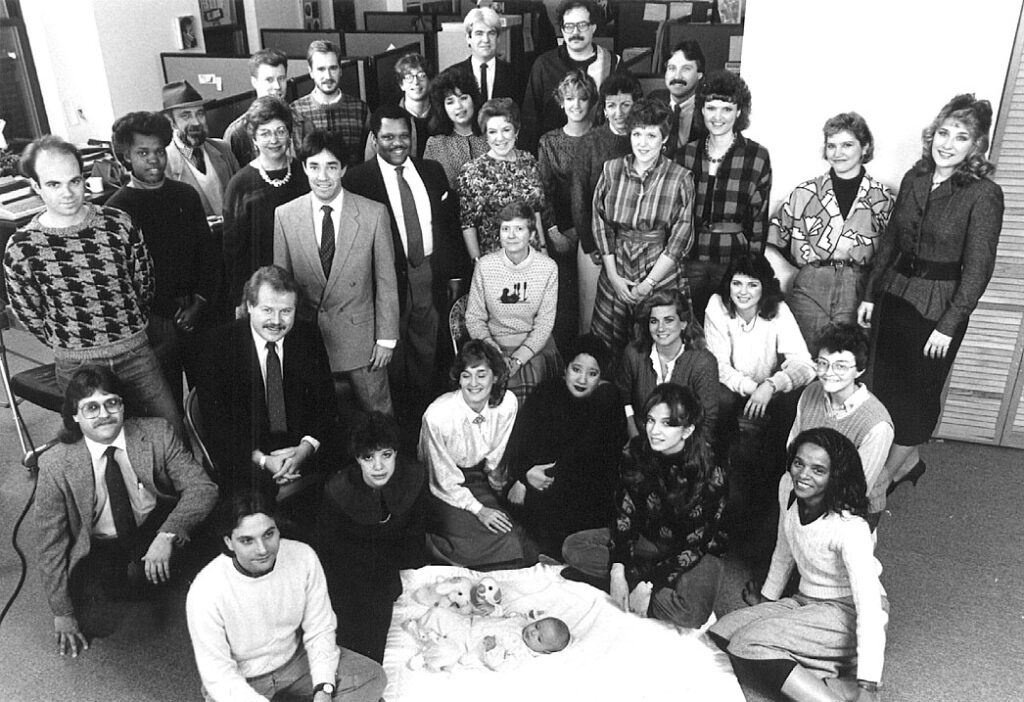
Front row (seated): Stefan Fitterman, J.A. Lobbia, Cindy Evens Badamo, Jamila Khalil, Kimber Mallet (with baby Montana Mallet), Alexis Williams; Second row (seated and kneeling): Mike Lipel, Dick May, Kathy Sheldon, Chachi Hawes, Lisa Dellamano, Unidentified; Third row (standing): Tom Carlson, Unidentified, Susan Hegger, Ray Hartmann, Unidentified, Unidentified, Unidentified, Unidentified, Margaux Medewitz-Zesch, Chris Wyrick, Hildegard Dodd, Kristie Knutson; Fourth row (starting behind Susan Hegger): Ed Bishop, Matt Flynn, David Folkers, Laurent Torno III, Jim Whiteley, Joe Schuster, and Pat Whiteley (Courtesy of Tom Carlson)
Joseph M. Schuster
RFT staff writer and freelance writer, 1986-1998
I went to work as a staff writer for Ray Hartmann at The Riverfront Times on St. Patrick’s Day 1986, six weeks after being laid off during a downsizing at St. Louis Magazine, where I had been associate editor. Although I was a pretty fair writer—a profile of a controversial federal judge I had written for the magazine had shared a local journalism prize, and a short story I had published in a literary journal was cited as “distinguished” in an edition of Best American Short Stories—I had no formal journalism training. Nonetheless, Ray took a chance on me, albeit at a 15 percent cut from my salary at the magazine and with the understanding that I would begin on six weeks’ probation. He made clear that was not merely pro forma, as, he cautioned, the writer I was replacing had lasted only a few weeks. Fortunately for me, the threat was coupled with Ray’s willingness to give me crash courses in journalism, helping me to see how to tighten my stories, how to organize them, how to make them stronger. I survived the probation, leaving the RFT in 1989 (and continuing to contribute occasional freelance articles until the paper’s sale).
I want to add that Ray was not always easy to work with. He drove his staff, expected near perfection, criticized us if we displeased him, and was slow to show appreciation. More than once, if someone complained about that tendency, he said, “If you want appreciation, get a dog.”
When I started, the paper was housed in cluttered and dilapidated offices and production space upstairs from a bar in Lafayette Square. The carpet (where there was carpet) was frayed and torn. At one place, the exposed wood floor had a hole large enough to fall through. There was so much dust in the air that it often corrupted the 5.25-inch floppy discs we used to store the work we wrote on rather primitive computers (256kb RAM, no hard-drive storage), meaning we would have to start over and pray that the next disc did not fail. I cannot tell you how often I worked in the office until 9 or 10 at night to re-create a story I had lost before deadline.
The staff was also stripped down, with only a half-dozen in the editorial department. Beyond Ray as editor and publisher, there was a managing editor, an arts-and-entertainment editor, a copy editor, and two staff writers, supplemented by freelancers. This meant the pace was frenetic. In my roughly two years at the magazine, I wrote a dozen major pieces and occasional short articles, while at the RFT, I was writing around a 100,000 words a year, primarily producing the long cover story every other week (alternating with the other staff writer, Julie Lobbia) but also writing inside features.
When I started, the paper was housed in cluttered and dilapidated offices and production space upstairs from a bar in Lafayette Square. The carpet (where there was carpet) was frayed and torn. At one place, the exposed wood floor had a hole large enough to fall through.
Four decades later, thinking about the work we did, I am struck by how ambitious it was, given how few of us there were putting out the paper every Wednesday—not only ambitious but often fearless, a quality that came from Ray’s vision, which seemed to be, if there is a giant, cut it down.
As one example, in 1988, a California woman became enmeshed in a bitter custody battle with an heir to the Anheuser-Busch fortune over a daughter they shared. When none of the major media in St. Louis would report from the mother’s point-of-view, Ray took it on as a crusade, assigning it to Julie. The story came to the RFT from a St. Louis Post-Dispatch writer who was angry the paper had refused to cover it. When the Post did run an article days after the RFT story, the woman insisted the Post include her appreciation of the RFT, which it did.
As another example: The RFT reported relentlessly about St. Louis’s secretive Veiled Prophet Organization, which counted among its members prominent men of the city. They staged both an annual debutante ball overseen by a masked “prophet” and the Veiled Prophet Fair (later the VP Fair and still later Fair St. Louis). Perhaps not surprisingly, given that it was founded in the 1870s by a group that included a number of former Confederate soldiers, the organization was often accused of racism. It did not admit its first Black members until 1979; during the VP Fair in 1987, St. Louis police closed the Eads Bridge from predominantly Black East St. Louis, Illinois, into downtown, as part of what fair organizers and police said was an attempt to reduce crime. After leaders of the NAACP filed suit, a judge ordered the bridge open. While nearly all St. Louis media focused on the fair, the ball, and the organization for “feel good” stories, here for Ray was a giant, and he went after it. Again, he assigned the stories to Julie—as he ought, because she was a bulldog of an investigative reporter, a product (like Ray) of the journalism program at the University of Missouri, then, as now, among the handful of best journalism schools.
One of Ray’s gifts, I think, was his ability to sense an individual’s strengths and slot them into appropriate assignments. For Julie, it was stories that required deep dives into records and the ability to ask tough questions that no one wanted to answer. As for me, early in my tenure, Ray saw that what interested me was talking to people about their lives. My family moved often when I was growing up—between kindergarten and finishing high school, I went to eight different schools, making me the perpetual outsider who was just as perpetually curious about the strangers I was always encountering. And that was what I primarily did, talking to people about their lives, starting with my first piece, a series of short profiles of St. Louisans with odd jobs: a couple who owned a pet cemetery, a man who was a reptile keeper, a man who bent neon, and a woman who worked as a freeze model in department stores and malls. Later, I wrote about a middle-age woman who entered a Mrs. Missouri pageant, an octogenarian who was still winning medals at track meets, cartoonists, an opera singer, a fashion photographer.
Although those features were perhaps on the lighter side, the primary focus of the RFT under Ray remained trying to find justice for people facing enormous opposition to their finding it, and so he had me write about migrant farm workers eking out livings picking crops in Southern Illinois, coal miners struggling with black lung, organizations that fed the poor and starving, immigrants trying to make a way in the United States, unemployed factory workers trying to land jobs in an economy where manufacturing was already disappearing. I wrote about poor families trying to find homes, about a minister whose church was twice torched by racists, political refugees trying to recover from oppression in their native countries.
“We just have to be better than this.” That, as much as anything, might capture what I think Ray thought about the world, which is poorer for his not being in it.
Sadly for the region, Ray sold the RFT nine years after I left it, in 1998. After going through several subsequent sales, the RFT is literally a ghost of what it once was—strictly an online publication, whose primary purpose seems to be to promote OnlyFans sites.
Ray, on the other hand, never stopped crusading—as a commentator on the local PBS channel’s current-affairs discussion show, Donnybrook; as a candidate for Congress in 2024; as a writer. Two months before the sudden and tragic accident that took his life, he contributed an op-ed to the Post-Dispatch, about an immigrant who had a job, a family, a Social Security number, and who was on the long path toward a green card and, the man hoped, eventual citizenship, and yet who was deported because of a technical mistake he made 14 years ago. After telling the man’s story, just before making a plea for readers to donate to the man’s family’s GoFundMe campaign, Ray dropped in a paragraph of one sentence, seven words:
“We just have to be better than this.”
That, as much as anything, might capture what I think Ray thought about the world, which is poorer for his not being in it.
How about that, Ray? My appreciation, and you did not even need a dog to get it.
After leaving the RFT, Joseph M. Schuster earned his M.F.A. in creative writing from Warren Wilson College. For 35 years, he was a member of the Communications and Journalism Department at Webster University in St. Louis, serving as department chair for 14 of those years, before retiring in 2018, Among other works, he is the author of two novels, The Might Have Been (2012) and Grace (forthcoming in 2028).
• • •
Eddie Silva
RFT freelance writer, copy editor, arts editor, columnist, and staff writer, 1995-2003
Ray Hartmann was a businessman. To put this in context, Ray was neither a Babbitt-like nonconformist nor a suit. He was a businessman but not a business type. During one fashion moment, he was a businessman with a mullet. He had no desire to become an oligarch, although he knew what an oligarch was and had no quarrel with its use in the paper, unlike a future owner who insisted our readership did not know what the word meant. That guy, he could have been an oligarch.
Ray was not a radical. He was a big-hearted lefty who founded, owned, published, and ran The Riverfront Times, an alternative weekly with a point of view. We wrote big-hearted lefty journalism founded on the belief that objective journalism was a lie. Ironically, our bias kept us more honest. If you approach a story subjectively, your way toward the truth is more transparent, with arguments in the open. At least that is a goal.
There were rubber-band battles. Swearing matches. My office mate was coached into calling the art director a “pig fucker.” Over my shoulder was a life-size photo of a dude raising his middle finger beside the caption: “Hey Eddie!” This was the mess that Ray made.
The paper also made money, which gave us license to follow our mad desires.
Many on staff were hired without J-school credentials. I arrived with an M.F.A. in creative writing plus a few years’ teaching experience. Those I worked with were: fathers and mothers; soccer and baseball fans; readers of mystery, poetry, history, and public-affairs journals; super movie nerds; bona fide socialists; rave mavens; ecstasy takers; writers caught between the last hangover and the next one; music connoisseurs of every type and taste in every club and concert hall. There were rubber-band battles. Swearing matches. My office mate was coached into calling the art director a “pig fucker.” Over my shoulder was a life-size photo of a dude raising his middle finger beside the caption: “Hey Eddie!”
This was the mess that Ray made.
The paper also made money, which gave us license to follow our mad desires. As common ground, we wrote of and for the community.
Each week readers grabbed their RFTs, gathered in bars and restaurants, and flipped open to the centerspread to see when and where the bands were playing. Heck, you did not know what to do with your week without the RFT. People read the stories and criticism, too, often as passionately as we had written them. That paper had bounce.
Ray made that happen. He did good business.
Following his years at the RFT, Eddie Silva worked in communications for the St. Louis Symphony Orchestra and the Contemporary Art Museum St. Louis. He worked at the Central Branch of the St. Louis Public Library before retiring in 2024.
• • •
Wm. Stage
RFT columnist and staff writer, 1982-2004
It is difficult to think of Ray Hartmann as gone. A freak accident took him, snuffed out his life uncaringly, and that is remarkable in and of itself. Just like Ray. Remarkable how a young man just out of college made his mark as a bold and savvy entrepreneur, founding a weekly tabloid that lasted almost a half-century. Remarkable how his political leanings, that of an old-school liberal, produced a continuous fountain of thought-provoking opinion in the form of editorials and, later, appearances as a panelist on the television show Donnybrook. His pronouncements were nothing like the blather of some crank caller to a radio talk show. They were well thought out and ably reasoned, often with facts to back them up and make his point. This is not to say his editorials were dry or boring—no, they were sometimes laced with vitriol and well-placed barbs directed at blowhards, rapacious developers, bent politicians, and others.
Ray cared so much about politics that he decided late in life to run against his nemesis, U.S. Rep. Ann Wagner, a conservative Republican, in Missouri’s 2nd District. We all know how that turned out.
Certainly, Ray was a catalyst of social change with his outspoken opinions, and he knew it. Out in public, he had to deal with strangers coming up and wanting to shake his hand, buy him a drink, or punch him in the face. That is how he knew he was getting through to people. And through it all, he was passionate about the liberal views he espoused, and he put his money where his mouth was.
I came on board The Riverfront Times in July 1982, fresh from a four-year stint as public-health officer at the St. Louis City VD Clinic on North Grand. I always wanted to be a writer, a producer of journalism and fiction. Ray, along with a cadre of very capable editors, gave me that opportunity, and I never took it for granted. I stayed with that paper for 22-and-a-half years, cranking out columns and features, enjoying all of it. I did not go to J-School, but I had a college degree, and I knew how to shape a story, make it fun to read. Ray saw that in me, took me on board, and for that I owe him so much. I know my life would not have been as satisfying had Ray passed me over.
Out in public, he had to deal with strangers coming up and wanting to shake his hand, buy him a drink, or punch him in the face. That is how he knew he was getting through to people.
During my long tenure at The Riverfront Times—which included delivering the paper on Wednesdays—I rekindled my yearning for writing books. While living on the West Coast in the ’70s, I began photographing advertisements for bygone products that were painted on brick walls in cities and towns. I had a decent collection by the time I got to St. Louis in 1978, but it was here in this old brick city that I found a trove of these signs. In 1983, I had an exhibit of these photos at Saint Louis University, and, in 1989, Ghost Signs: Brick Wall Signs in America was published. It was the first commercial book on the subject. Two more related books followed: The Painted Ad: A Postcard Book of Vintage Brick Wall Signs (2010), co-authored with my daughter Margaret Stage, and The Fading Ads of St. Louis (2013).
Ray was responsible for my next book, Mound City Chronicles, which was a selection of columns that appeared in the RFT for five years. The column was an eclectic compilation of facts and information about Mound City, our town’s once-established sobriquet. I pitched the idea for this column directly to Ray; in his wisdom, he approved it. Hartmann Publishing Co. then issued the book in 1991, and it was praised as “a virtual pageant of St. Louis arcana” by John Neal Hoover of the Mercantile Library.
Litchfield: A Strange and Twisted Saga of Murder in the Midwest (1998) was directly inspired by my RFT employment. This true-crime book, which sprang from my “Mississippi Mud” column in the RFT, detailed the investigation of a headless burning body found in a campground on a Friday evening in May 1993 in Litchfield, Illinois. The body, that of a woman, remained unidentified for 16 months; meanwhile, a St Louis man, Curtis Thomas, was broadcasting his concern over his missing wife. The body identified, suspicion turned toward Curtis, who could not seem to keep his mouth shut. Much of the book centered around his trial in Hillsboro, Illinois, represented by St. Louis lawyer Pat Conroy. Curtis had a newsstand in the Loop, but for a while he was also an independent contractor in the RFT’s circulation department. He was on my route, Route C, the biggest route. I was the driver on Wednesdays, delivery day. Curtis was one of two helpers in the open rear of the cube truck, slinging bundles at more than 100 stops. He could be charming, but on this job he was arrogant and annoying; he did not last long. He has spent much of his adult life in prison.
After leaving the paper at the end of 2004, I continued my work as a special process server—an occupation that continues to this day—and I devoted myself to penning more books, primarily novels. Process-serving is my vocation, authorship my avocation, but the two mesh perfectly. I write early in the morning and then hit the road, driving far and wide, knocking on strange doors, hoping to tender papers that people really do not want. My last three novels feature a likable character, Francis X. Lenihan, a bibulous process server who lives in Dogtown. In the course of doing his job, Francis finds himself in various dicey situations that require resource, wiles, and presence of mind to navigate. The second book in this series, A Friend of King Neptune, took first in the Indie Author Project Literary Award in the category of adult fiction.
To date, I have written 16 books, 13 still in print. What led to this body of literary work that I have produced over 37 years? My time at the RFT and the welcoming guidance of a string of great editors.
Forty-four years is a long time to know someone. It is an honor to have known Ray that long. I went to his wedding, he came to my book signings. At times, he confided in me. I would have done just about anything for him.
• • •
C.D. Stelzer
RFT freelance writer and staff writer, 1986-2001
In his eulogy to his father at Temple Israel, 22-year-old Benjamin Hartmann imparted a simple but profound truth. I was listening from one of the back rows of the synagogue with a few friends and colleagues from the old Riverfront Times, the St. Louis alternative weekly that Ray Hartmann founded in 1977. Ben told the hundreds of mourners in attendance that we all had different memories of his dad, that each of us knew him in different ways. Some knew him as Ray. Others called him Mr. Hartmann. But to Ben, Ray was just Dad, the man who loved and raised him, who provided a home, who listened, and, most of all, who was there when needed.
Ben’s words reminded me of Spoon River Anthology by Edgar Lee Masters, a book of poetry. The setting for the anthology is a small-town cemetery on the Illinois prairie, where the denizens of the necropolis reminisce from beyond the grave. The voices of the dead are all from the small town of Spoon River, Illinois. Their stories often intertwine, leaving the reader with different perspectives on the various denizens who are now all “sleeping on the hill.” Masters’ free verse loosely emulated ancient Greek eulogies, emphasizing the futility of human folly and the inevitability of death.
Spoon River Anthology was published in 1914 in St. Louis in Reedy’s Mirror, a literary magazine put out by William Marion Reedy, a St. Louis journalist and literary critic. It was a bestseller, a rarity for a volume of poetry. Other poets published in the Mirror included Carl Sandburg, Ezra Pound, and Vachel Lindsay.
The Riverfront Times did not publish poetry, but it did publish literary criticism and had a cornucopia of arts coverage, including reviews of and articles on books, movies, plays, film, and music every week. Hartmann was continuing the tradition established by Reedy.
When I was a freelancer, the newspaper office was located on the ninth floor of the Shell Building, an art-deco gem on Locust Street, where the newsroom’s windows afforded a view of the gargoyles on the baroque steeple of the Christ Church Cathedral. On occasion, I would go inside the sanctuary itself and sit in the back pew to decompress before or after an edit. It was cool, dark, and quiet. Dappled sunlight streamed through the stained-glass windows. This was an ancillary world that Hartmann indirectly created. I would not have sought refuge in the church if his newspaper office was not across the street.
Opposite the church was the Central Branch of the St. Louis Public Library, where I often went to troll through government documents or read old newspaper articles in the microfilm room in the basement. I liked the cranky old man who worked there for 40 years. To most people, he was invisible.
When he retired, I wrote a story about him.
Ray did not know the microfilm librarian. He barely knew me. But it was because he started The Riverfront Times that I could write about someone like this.
Upstairs at the entrance to the opulent Grand Hall, where the old oak card catalogs were located, stood two bronze busts. On one side was Mark Twain, and on the other was William Marion Reedy. I would rub Reedy’s nose sometimes as I walked by.
When they redeveloped the interior of the library years ago, they removed the busts. They should dig them out of storage and commission a third one for the founder of The Riverfront Times. The inscription should read: “Ray Hartmann—Newspaperman.”
My first RFT story appeared in 1986. It was a feature on Jimmy Gravity’s guitar shop on South Broadway. My last story appeared in May 2001, after I had been sacked by the new ownership.
When they redeveloped the interior of the library years ago, they removed the busts. They should dig them out of storage and commission a third one for the founder of The Riverfront Times. The inscription should read: “Ray Hartmann—Newspaperman.”
My first cover story appeared in August 1990 under editor J.A. Lobbia, who approved my idea to embed myself with radical environmentalists in the Shawnee National Forest in Southern Illinois, who were opposing a clear-cut. After Safir Ahmed became editor, I gradually started writing more hard news, with an emphasis on environmental reporting. From 1991 to 1999, I wrote more than 30 stories on the dioxin contamination in the St. Louis area and the EPA’s flawed clean-up efforts. In 1997, the Missouri Press Association awarded me first place in investigative reporting for a weekly newspaper for a story that exposed questionable practices related to the Times Beach cleanup.
During the entire decade, I was also working full-time as a fork-truck driver at the Anheuser-Busch brewery. I turned down overtime pay to write on weekends. I conducted interviews from pay phones in stairwells. I led a dual life: Carl Stelzer, the Teamster beer bottler, and C.D. Stelzer, gonzo journalist.
With the help of a friend, I set up a “home page” on the nascent internet—the Times Beach Chronicle. My online stories caught the attention of Irish author and environmentalist Robert Allen, who came to St. Louis to do research in January 1998 and June 2001 for his book The Dioxin Wars: Truth and Lies about a Perfect Poison, which was published by Pluto Press in London in 2004.
In the early 2000s, I traveled to England, Ireland, and the continent of Europe. My investigative series into clandestine U.S. military arms shipments that passed through Shannon Airport appeared in Ireland’s Island magazine in 2006. Also in 2006, I became a contributor to Illinois Times, the weekly alternative newspaper in Springfield.
In 2008, I received a fellowship grant from the St. Louis Press Club to investigate Gary Fears, an Illinois political operative who was a part owner of a Ukrainian air refueler. At the time, Fears was also the official foreign agent for the Kingdom of Morocco. His international lobbying firm was in a strip-mall storefront in Collinsville, Illinois. My two-part series on Fears’ dodgy enterprises appeared in Focus/Midwest online.
The St. Louis Journalism Review published my profile of the late J.J. Maloney, who was convicted of murder in St. Louis in 1959 when he was 19 years old. After he gained early parole, Maloney became an award-winning crime reporter for the Kansas City Star in the 1970s. I was set to write a biography on Maloney, but I got sidetracked.
At the RFT, I also reported on the radioactive waste in the St. Louis area, a byproduct from the making of the first atomic bomb. I revisited that subject in 2010, when I started working on a documentary film about the issue. With the help of my partner Alison Carrick, the project was completed five years later. The First Secret City debuted at the St. Louis International Film Festival in November 2015.
I am currently a recovering journalist.