Grassroot Chilean Heritage Workers Emerge From Underground
Coal-stripped Lota seeks a resurrection through the art and memory of the women who remember the mines and the life beyond them.
May 1, 2026
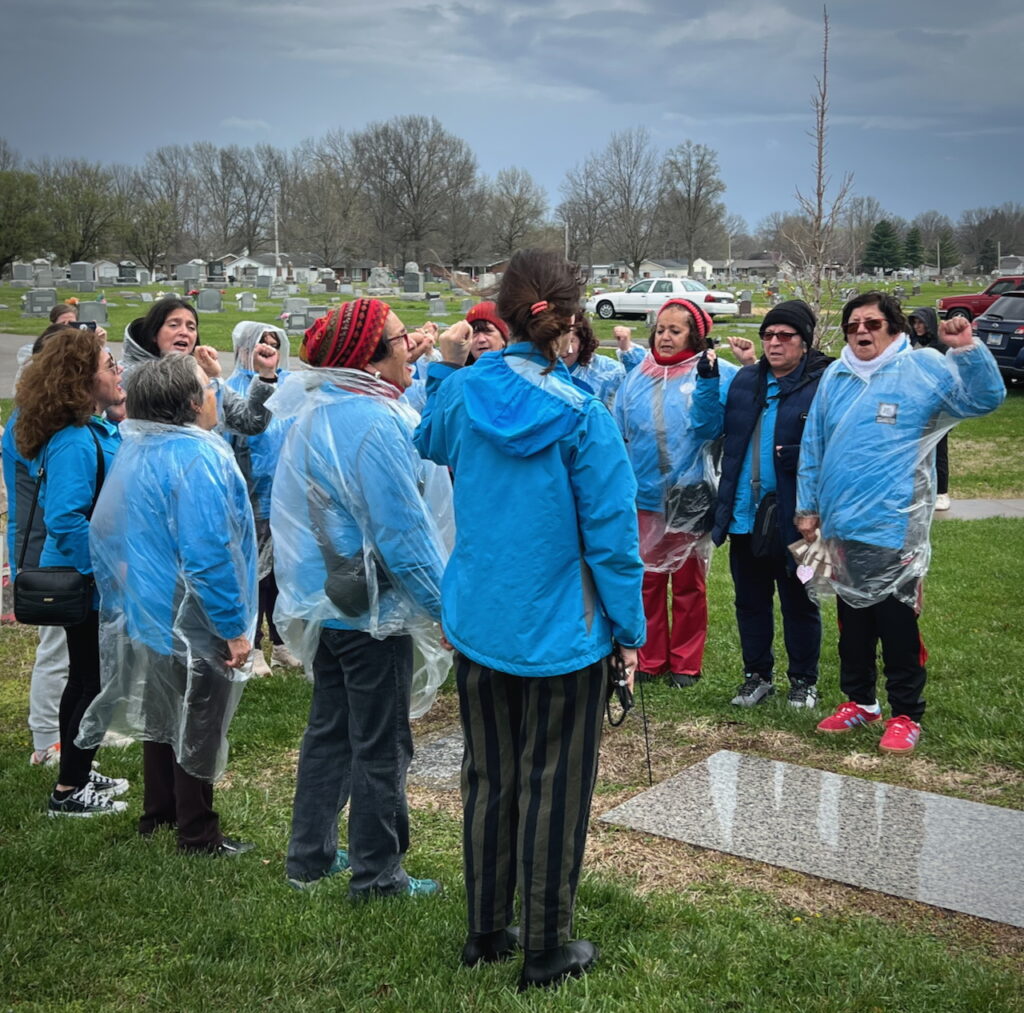
The women climbing down from the big charter bus parked next to the cemetery in Mount Olive, Illinois, were from Lota, a small city on the Bay of Arauco, six hours south of Santiago, Chile. For 150 years, Lota was the center of Chilean coal mining, and its labor provided an inestimable service in the form of cheap energy for industrialization, trade, transport, and modernization. The mine there, opened by industrialist Matías Cousiño in the middle of the nineteenth century, was unusual for its eventual depth (about 3,000 feet) and the fact that it tunneled under the Pacific Ocean, creating even more dangers than usual.
Lota lived over the years with most of the political manifestations of an extractive economy—colonist exploitation, gilded-age disparities between rich and poor, the “company town,” radical organization, authoritarian oppression and murder, and state ownership of industry. President Frei closed the Lota mine in 1997, when other fuels from other places proved to be more cost-efficient. The people of Lota have struggled ever since. Unemployment in Chile’s coalfield Biobío region, which includes Lota, is at 9.99 percent, and Lota’s median monthly income is $684, said to be a fifth less than what is needed to live.
These Lotinas represent a long feminist movement to preserve cultural memory and reinvigorate the economy of their city. At the end of March 2026, they flew more than 20 hours to be in residency for a week at the University of Illinois Urbana-Champaign (UIUC), where they would lead workshops on art “as a tool of historical storytelling and civic activism”; “[e]ngage directly with Illinois coal workers and families”; “[p]articipate in cross-border dialogues on economic transition”; and “[s]hare organizing strategies rooted in lived experience.”
The residency was designed to build international community on presumed shared interests: women’s lives, coal mining, the working class, social justice, and preserving authentic memories instead of sanitized, institutional versions. The women also said they hoped their work would help with Lota’s application to be designated a UNESCO cultural world heritage site, which might in turn lead to a viable tourist economy.
One Lotina said she hoped their visit would force those in the United States to see that, despite their government’s support for the overthrow of Salvador Allende in 1973, and the 17-year dictatorship and reign of terror of Augusto Pinochet, the community of Lota, which suffered badly, was still here. This was moving because it was so tragically hopeful about Americans.
The women’s visit to Mount Olive on April 2, 2026, was one stop in a day’s tour of former coal towns across central Illinois that also have post-industrial problems. The women would pay their respects in the Union Miners Cemetery to socialist organizer Mother Jones, whom a US attorney once labeled “the most dangerous woman in America,” with a wreath-laying ceremony. Jones died in 1930 and was buried “with her boys” in this, the only union-owned, cemetery in the United States, 50 miles from St. Louis.
It was cool, windy, and rainy. Except for a handful of aging union supporters whom I recognized from previous events—most mines are closed, and UMWA Locals have only retired members—attendees had come on the bus from the university with the Lotinas. Mother Jones re-enactor Loretta Williams, in period costume, spoke about labor struggles and human rights, without translation, and the Lotinas circled the real Mother’s grave and sang in solidarity, without translation. Event sponsors spoke (and were translated, to everyone’s apparent relief), and after group photos, the Lotinas were taken to tour the very good, one-room Mother Jones Museum in the Mount Olive City Hall building.
I have written here about Mount Olive, Mother Jones, labor tourism in the United States, and how a century ago this Illinois county (Macoupin) spawned an important, radical union that split from the UMWA. Back in the day, its people were accused of being Reds—communists, meaning socialists in American-speak—but now are some of the reddest MAGA believers in the state. The Lotinas’ visit—due to language, nationality, race (Mount Olive is 95 percent White and only .7 percent Hispanic or Latino), expected roles of women, labor attitudes, communal action versus rugged individualism, ideas about art and activism, relative material wealth, and of course the fact that Lota for the last century or more often had actual communists and socialists running things—could be seen as a hard sell for intersectionality in the age of Trump.
But as Dr. Magdalena Novoa, Assistant Professor of Urban and Regional Planning at University of Illinois Urbana-Champaign and the person most responsible for bringing the women to the United States, wrote in a 2018 paper for the International Journal of Heritage Studies, “Many mining cities around the world have become ghost cities due to changes in globalisation and neoliberalisation of capitalist economies and deindustrialisation. As mining production that supported those cities or towns fail… landscapes are reshaped and [‘authorized heritage discourse’] validates certain narratives about the past while other narratives, often in opposition to nationalism and colonialism, are controlled and regulated and the many stories and sense of identity of, for example, labour, Indigenous and ethnic minorities heritage are ignored.”
Part of the solution, Dr. Novoa says, is to use “invented spaces [as] unsanctioned actions intended to confront authorities and challenge the status quo. While neoliberal capitalism promotes a collective social amnesia…insurgent groups promote historical collective memories and historicise the problems arising from the actions and inactions of Authorities….
“Resistance, therefore, occurs through formal and informal, legal and extra-legal, political and performative, traditional and innovative tactics.”
Most of the Lotinas’ activities that week could be seen in this light.
• • •
In the documentary Lota Más allá del Carbón [Lota, Beyond Coal] (2019), a former miner says the town moved the whole country. A woman adds, “Lota was more like a father to Chile than a son.”
Lota was the first city in Chile to have telephones and electricity, they say. The first ten photographs ever taken in Chile were taken in Lota. But after 150 years of turbulent but proud history, some 1,300 miners and their families learned the mine was closed on the day it happened. (Another video on the history of Lota says there were once as many as 16,000 workers at the mine. “They are life stories that do not deserve the dark waters of oblivion,” someone says.) There was no warning from the press, and no severance period from the state-owned company.
“You cannot convert a miner, who worked for 30 or 40 years in a mine, into a hairdresser overnight,” says Susan Meneses of the organization Casa de la Mujer Lota.
Daniela Guerrero, a poet, says, “In other countries, the reintegration and conversion processes lasted as long as 15 years, 20 years…for people to maintain their history and identity, to rethink their future and move forward with hope. Here in Lota, it lasted three years, four years, five years? They trained 500 hairdressers and 500 bakers. For what? […] For cities that grow around industries, their entire systems of life depend on that industry. When that is broken, the people have to come together and ask themselves, ‘What do we hang on to now? What are we?’”
Lota was the first city in Chile to have telephones and electricity, they say. The first ten photographs ever taken in Chile were taken in Lota. But after 150 years of turbulent but proud history, some 1,300 miners and their families learned the mine was closed on the day it happened.
Government subsidies are “like a palliative for a nearly dead or sick person,” says Elizabeth Aguilera, President of Mesa de Ciudadana de Patrimonio, Cultura y Turismo de Lota (and one of the Lotinas who came to Urbana Champaign). “But there are people here who want to live. […] This city cannot die, because it has been too important.”
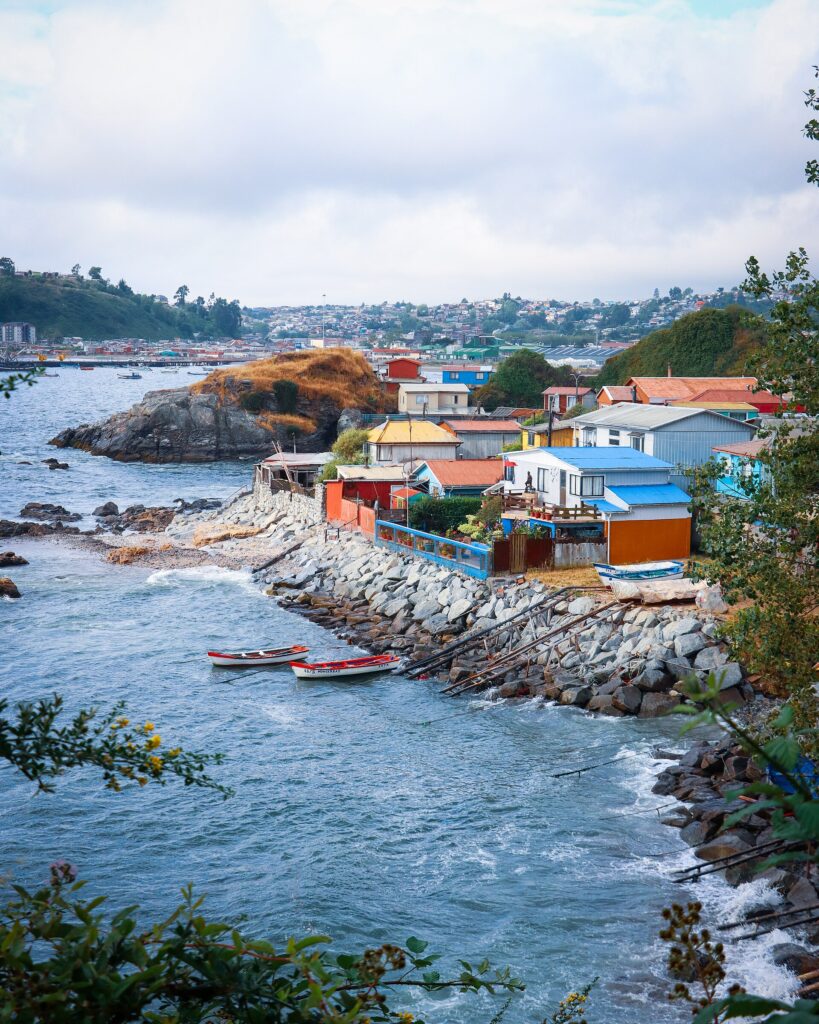
Lota has much to offer visitors: a beautiful city park (landscaped as a private botanic garden for the industrialist Cousiño), the old port and pier, a small fishing fleet, a stunning view of the ocean. There are hills, trees, beaches, architecture, and a large outdoor produce market, all walkable.
There is also the disused mine itself, of course, El Chiflón del Diablo (The Devil’s Blast), which is a national monument and offers (very limited) tours. The city contains twelve national historical monuments, more than any other region in Chile, but only two at the time of the documentary were being “administered for tourism.” All this aligns to what one paper on Lota calls the benefits of “mining heritage”: a geology laid bare [by shaft mining] to “allow us to understand and illustrate processes of formation and evolution of the planet”; and “a cultural landscape…that contains aesthetic and cultural values derived from its association with a historical event, activity, or figure,” which includes the discussions of labor and class.
(This is different from, say, central and southern Illinois coal towns, which are short on several of Lota’s landscape charms and often change, ignore, or self-suppress their histories.)
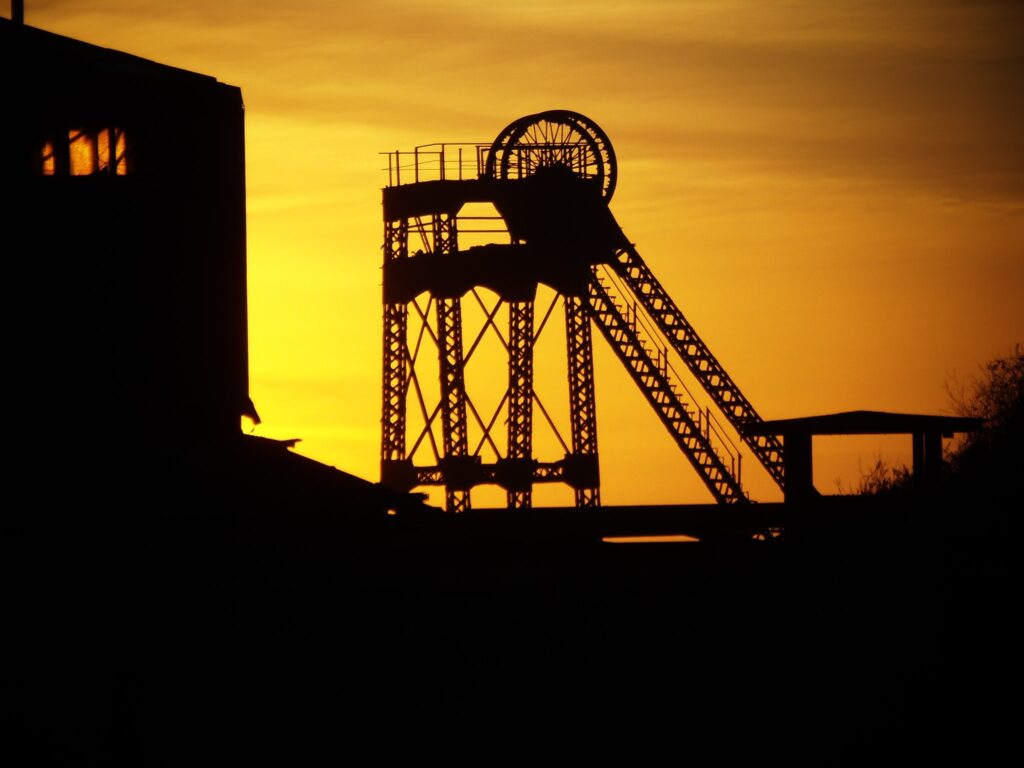
Still, tourism in Lota has not provided the hoped-for boon. A shop owner says in the documentary that day-tripping tourists in buses come and go without paying for hotel rooms, food, or entertainment. A woman says some of the few miners who are left “are dreaming of the day that the mines will open again,” despite the impossibility of that happening. Another woman speaks of Lota becoming a bedroom community for nearby Concepción.
Elizabeth Aguilera, again: “[W]e have to recover our faith, and the hope that we can become a thriving and beautiful city again. A city that contributes to Chile again, but this time not from under the ground. This time it should be in the sunlight, where everyone can see us.”
• • •
Dr. Novoa is also a native Chilean and is “interested in how cultural heritage and planning principles are mobilized by various actors to integrate or segregate historically marginalized groups, as well as the challenges that arise from the changing landscapes of cities.”
She wrote the paper I quoted earlier about Lotinos working to save and use a historic union building in the city. In it, she explains, “During the 2000s, a group of former miners, union members and their families began to see in their cultural heritage the possibility for economic and social development—a sustainable alternative to the government’s failed rehabilitation plans. […] The community organised into cultural and heritage associations that worked towards producing a collective strategy for converting the city into a historical attraction and preventing the increasing loss of heritage, culminating in a social organisation called ‘Mesa Ciudadana de Patrimonio, Cultura y Turismo de Lota’ (Citizenship Working Group of Heritage, Culture and Tourism of Lota).
“The organisation comprises social leaders, former union members, neighbours, local cultural managers, and artisans. Its members organise several annual activities, in collaboration with Lota municipality and the National Monuments, which have become cultural traditions as a means of preserving Lota’s local identity. The organisation also advocates for the protection and development of their cultural assets, claiming that Lota’s heritage is part of collective, national memory.”
“The history of working class struggles, such as for the Lota miners and their families, might be uncomfortable for the cultural elite because it is tainted by social injustice, which neither reflects national pride nor celebrates ‘high class culture’…. Nevertheless, it constitutes people’s own individual and collective memory work towards defining their identities and place in the world, and this ability to challenge and undermine misidentification is a politically powerful force.” Novoa’s experience with Lota eventually allowed her to conduct “a long-term collaboration” with Elizabeth Aguilera and Mesa Ciudadana de Patrimonio, Cultura y Turismo de Lota, on “the Chilean textile craft called arpillera made by women in Chile’s southern coal basin region of Biobio to create counter-narratives of their cities’ urban history from women’s perspectives and to influence historical preservation planning and policy.”
“Arpilleras are a radical feminist practice of storytelling and protest that became prominent in Chile during the Pinochet dictatorship… when women used them to denounce their relatives’ disappearances and political violence,” the exhibit guide says.
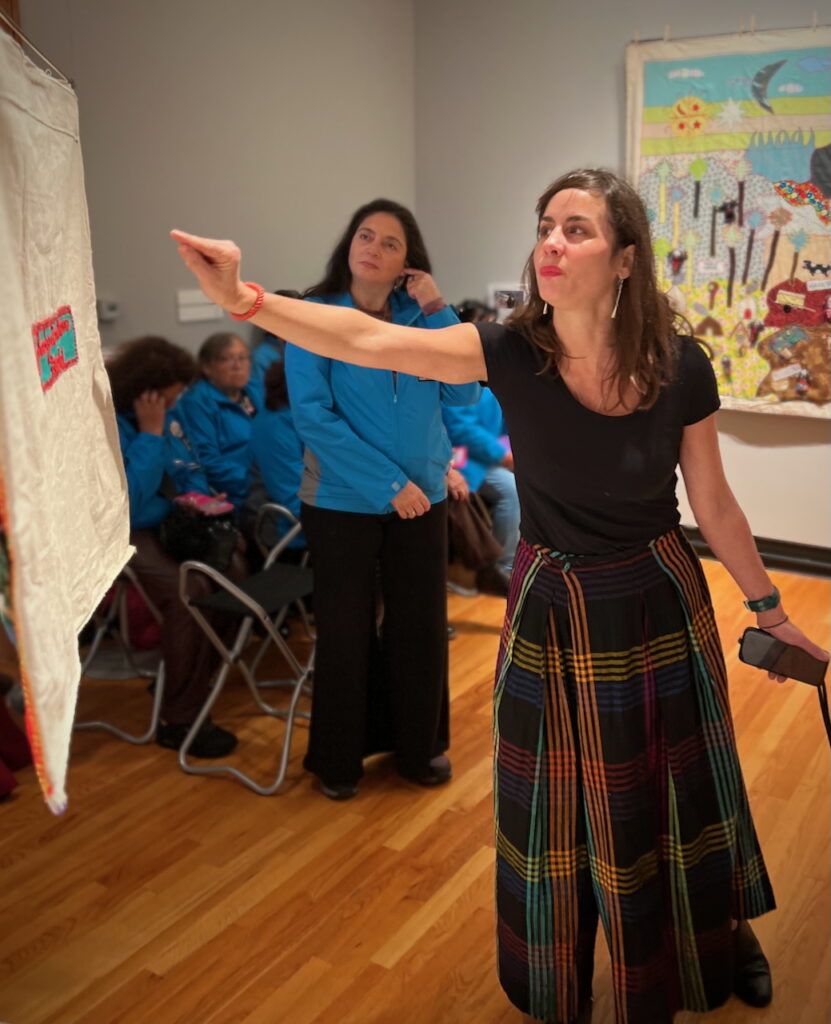
Some of these textile works are now on view, through September 5, in a gallery of the Krannert Art Museum at UIUC. Though the Lotinas also participated in a panel discussion at UIUC, a quilting workshop in the former coal town of Gillespie, and a tour of sites in Taylorville, Illinois, the main event of their visit to Illinois was the guided tour they gave, as a group, for their displayed arpilleras on April 3.
(Dr. Novoa laughed when she told me the arpillera collaboration was not the first project she proposed to the women; with the first proposal, they told her earthily to take her project elsewhere. Spanish has more interesting phrases than English does for this.)
“Arpilleras are a radical feminist practice of storytelling and protest that became prominent in Chile during the Pinochet dictatorship [as here]…when women used them to denounce their relatives’ disappearances and political violence,” the exhibit guide says. “Today, women experiencing marginalization continue to create arpilleras depicting poverty, gender violence, and survival strategies. The arpilleras have colorful stitching, applique, and embroidery; and they are created in group sessions where women share experiences, talking as they sew.”
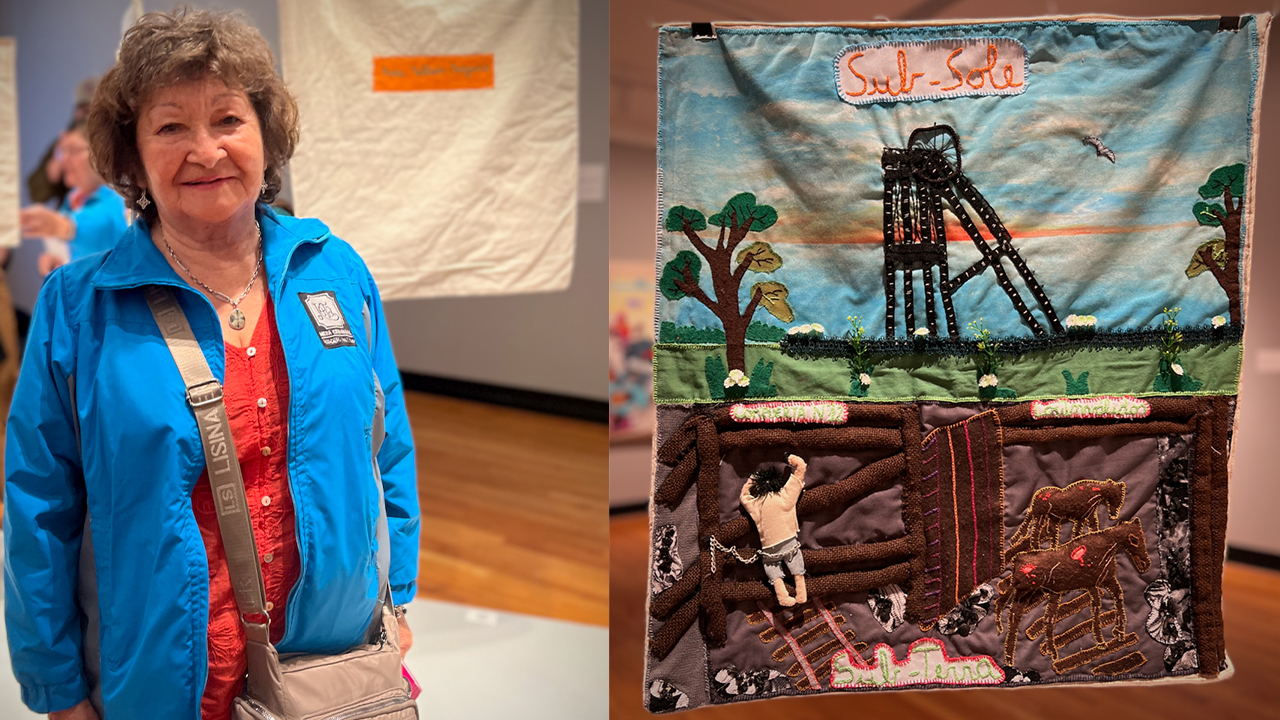
The exhibit comprises 22 smaller arpilleras with scenes such as the Lota train station, which is no longer there; striking miners and mine machinery; a picnic at Isidora Cousiño Park; a wedding at San Matías Apostle Church; and women’s everyday lives at the communal laundries and oven. Some reminded me of Hmong refugees’ fabric arts, depicting their escape from Laos to Thailand; others of Panamanian Guna Molas; and others of outsider-art quilt projects.
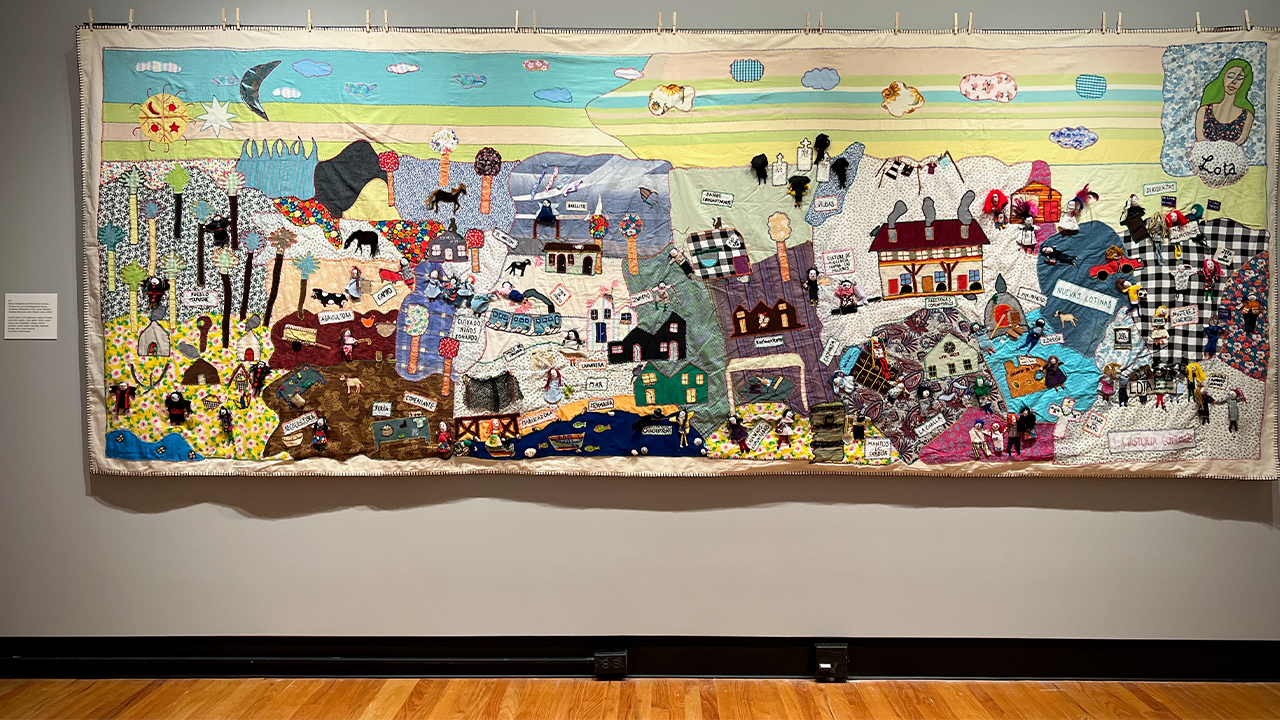
The largest arpillera, 16 x 6.5 feet, and the star of the show, was made by 52 women and “narrates the history and everyday lives of this former coal-mining city from a gendered perspective [including] memories of Mapuche women (the Indigenous people displaced from the area after colonization) [to] scenes of rural life, the coal industry, miners’ families, poverty and precarity, gender violence, neighborhood solidarity, humor, informal work, care practices, and current feminist struggles.”
Melissa Espinoza, who oversaw with her sister Noelia the creation of three arpilleras of this size, gave detailed explanations to the Krannert audience of images in the textile. “I want to highlight that women have always been entrepreneurs in every area,” she said, pointing to sewn figures. “We are collectors. Where there is commerce, women sell…. Lota is on the coastline, so many of the roles that women had were collecting seafood, collecting seaweed, and fishing. And one of the most characteristic roles that developed after the coal mining in the town was the chichabera[?]. The chichaberas were the women who took the coal out of the ocean. So, if you get closer, you’ll notice that she has this net in her hands. They would wait for the waves to come, and then they would put the net into the waves and collect the coal from there.”
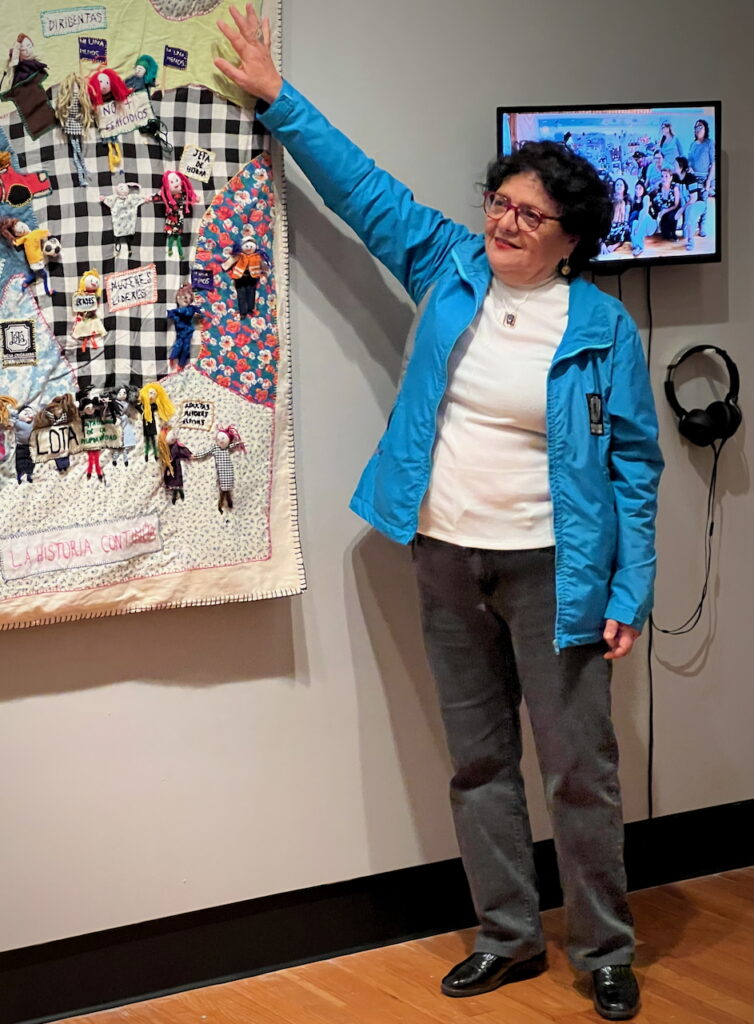
When the event was over, the museum was lively with talk and laughter. I asked arpillerista Rosa Beltrán Borguero, 79, if she would mind if I asked her some questions. We found a quieter spot among some paintings. I was curious about one of her arpilleras, which portrayed two stories from Chilean short-story writer Baldomero Lillo, who was from Lota.
I read much of Lillo’s collected work this month. Lillo (1867-1923) “left forty-two short stories, the majority of which are about the life of the coal miners,” Víctor M. Valenzuela wrote in 1956. (Lillo published only two books. The collection of stories Sub Terra (“underground”), is about miners; a Spanish-language movie adaptation was made in 2003.)
“He also wrote others describing, with his powerful realistic and unpolished style, the lives of peasants, sailors, and merchants, injecting into some of them a humor that is hard to conceive in this somber and tragic man. The common denominator of all his literary works… is the idea of human solidarity opposed to hate, avarice, and arrogance, considered by him to be the core of human suffering,” Valenzuela says.
Valenzuela makes the case for Lillo as a writer emerging from Naturalism into Modernism, before it was the style. Lillo is clearly a Naturalist under the sway of Zola and Maupassant, but there are a number of Chekhov-like biographical coincidences, from serving as a clerk in a store as a teen, where he heard stories he would write later, to wanting badly to write a novel he could never write, to his long dying-by-inches of tuberculosis. Another critic tries to argue that due to his stories having fantasy elements, Lillo is a forefather of Latin American Magical Realism. This seems a stretch. (This volume, free online at the Internet Archive, combines stories from the two collections, plus a few others.)
Rosa hinted at her life changing dramatically after the coup in 1973. Her students’ notebooks were checked by police to control her teaching, and she was accused of organizing them against Pinochet’s government. She and her 14-year-old son were investigated for three months, and her husband “was also detained and brutally beaten,” as she says in the exhibit notes.
Ms. Rosa and I chatted with the help of a grad student translator. Rosa had studied philosophy and language, she said, then taught at a local school. Lillo was on the curriculum for elementary students, and they were interested and took pride in the connection with their own history. She said Lillo is buried in Lota.
As we spoke, she hinted at her life changing dramatically after the coup in 1973. Her students’ notebooks were checked by police to control her teaching, and she was accused of organizing them against Pinochet’s government. She and her 14-year-old son were investigated for three months, and her husband “was also detained and brutally beaten,” as she says in the exhibit notes. “After the dictatorship, the psychological wounds were profound.” Later, Dr. Novoa told me that while there are completed oral histories for some of the women in the project, one has not been done for Rosa Beltrán Borguero.
I thanked Ms. Rosa and joked that I would like to visit Lota soon, and Lillo’s grave. She said seriously to just let Magdalena know, that Elizabeth rents a room she owns in one of the pavilions in town, old miners’ quarters from the nineteenth century. When we were done, she reached up and grabbed me, hugged me tightly, and kissed my cheek.
• • •
As I left Krannert, I was thinking how there has been a lot of talk from different quarters about how grassroots community is the thing that is going to save us, not some emergent national political figure, since all the political figures have proved themselves venal or accommodationist. Something similar was said about Péter Magyar’s defeat of Orbán, which supposedly was thanks to rural voters in Hungary who had gotten involved well before the election in communal activities—mostly nonpolitical, such as picking up trash or going to movie nights—that gave them back their sense of being citizens, not mere personality followers.
I thought of how I have been finding, slowly, one by one, figures working in the community and in volunteer organizations, who have made me feel more connected. When I started making a list in my mind of their names—Joann, and Heather, and Abigail, and Anna, and Lyn, and Inna, and Rachel, and Magdalena, and Rosa, for example—I realized they have all been women.