Thinking Outside the Box
Missouri Botanical Garden Lights Up HYBYCOZO
April 14, 2026
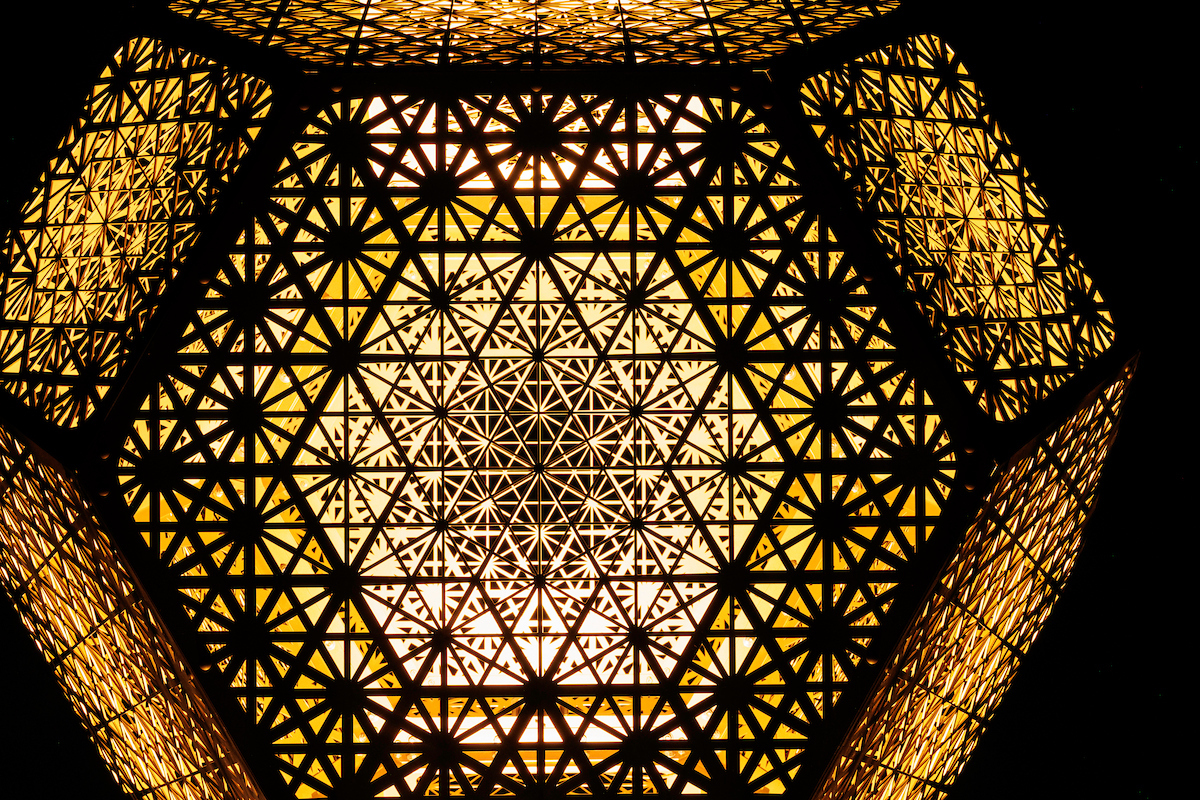
Rough polygon boulders, cylindrical tree trunks, full-circle petals, repeating fractals in ferns and branches—the Missouri Botanical Garden has more to do with math than you might think. And now giant sculptures, laser-cut with intricate patterns, are turning its geometry into a beautiful lesson.
There is Axis Mundi, which reaches twenty feet toward the sky; Insight, which lets you step inside and become part of the shadow’s pattern; Poetry in Motion, lit from within by colored lights; Pyrite Field, inspired by crystal formations; Sharjah, inspired by Islamic geometry and placed near the Ottoman Garden. The list goes on, but Yelena Filipchuk and Serge Beaulieu are waiting for me by what seems to be their favorite, Tesselation.
Barbie pink, sunny orange and yellow, spring green, cornflower blue—the colors reinvent the rainbow. Filipchuk and Beaulieu work mainly in matte gold or other metallic neutrals, but when the Garden invited them to exhibit, they thought about all the pastels and hot reds and oranges that would blossom around their work and decided to compete with a little color. It is acting as a magnet for visitors: on opening day, kids and adults were already trying to climb Tesselation; a sign had to be hastily erected.
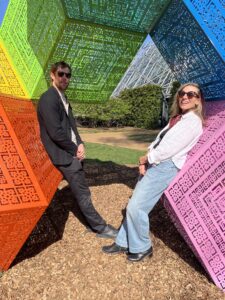
Touching, though, is safe and encouraged. Stepping inside their work for an interview, the artists lean against two interior sides, facing each other. “A nook!” Filipchuk exclaims, delighted. But Beaulieu soon breaks the symmetry, eager to show me how different the shapes look from other angles. When I ask what the name means, this giant playtoy is revealed as a geometric marvel.
Tesselation repeats a shape (or a pattern of shapes) again and again, covering a surface without any gaps or overlap. Only three polyhedrons can tesselate, and they used all three in this show: the cube, the rhombic dodecahedron, and this one, the truncated octahedron, with fourteen faces and an elaborate pattern carried all the way around each shape.
How better to echo the geodesic dome of the Climatron? When they learned there was a bit of open lawn next to “the second most iconic structure in Missouri,” Beaulieu says, they created this in Buckminster Fuller’s honor. “We feel like we are carrying on this lineage, not expressing personal experience,” adds Filipchuk.
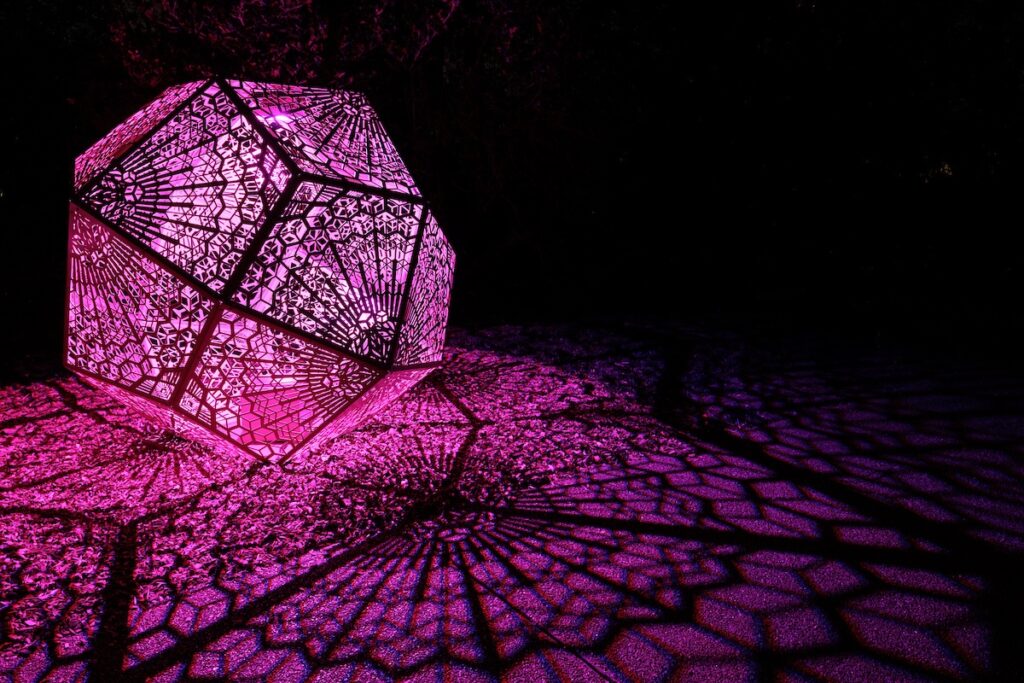
“That’s why we don’t use our personal names,” Beaulieu says. “We are showcasing geometry.” Their interest sparked more than a decade ago, and they began to look closely at Islamic sacred geometry, and geometry under a microscope, and the geometry of the universe. “We were fascinated by all these connections, and they were only viewable in a book or on a computer screen.” They began designing, taking the shapes and patterns as big as possible, wanting geometry to be “part of the zeitgeist, and in the vocabulary of all kids.”
They call themselves HYBYCOZO, borrowing the name of their first exhibit. Since then, their work has been exhibited at the Smithsonian and the Sharjah Museum in the UAE, commissioned by Crystal Bridges Museum, acquired by the Ulrich Museum of Art, placed on permanent display in Dubai, Istanbul, New Zealand, and California, and used as the centerpiece of Burning Man.
Filipchuk was born in Ukraine, but she earned a degree in conservation and resource studies at UC Berkeley, where she became fascinated by the patterns in the natural world. She went on to study art, fabrication, and digital design.Whenshe and Beaulieu began designing together, they were in love; they have since married. Beaulieu is Canadian, with a background in industrial design that helps him investigate materials, light, and processes for their sculptures.
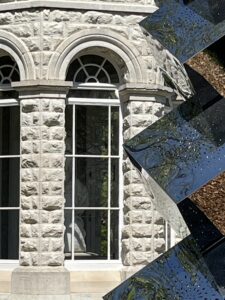
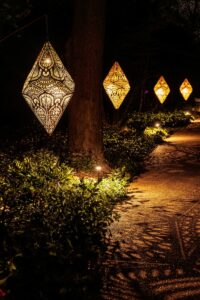
Over the (spherical) moon to be invited to exhibit at MoBoGa, they designed six new site-specific sculptures. Others, like Pyrite Field, fit their placement so well anyone would think they, too, had been designed specially for that spot. Some of the sculptures spin, animating the shadows; in others, colored lights change the feel at night. By day, a few have reflective surfaces (another first) that pick up sky and clouds or crumbly bark.
The show will stay until September 26, revealing different qualities of light and shadow as the seasons change. By autumn, all of St. Louis should be keenly aware “that there are more than ninety degrees.”
“We work in square rooms at square desks,” Filipchuk points out sadly.
“Why is the world so square?” I ask.
“Churches often have arches and buttresses,” she points out. “Maybe that was holy, and humans are not. Humans are plain.”
Ah, but what about all those squared-off palaces and villas? Her explanation is nobler, but I prefer to blame construction limitations, budgets, and a failure of the secular imagination.
“Vertical walls are easy, but you can get a lot more strength with angled or curved walls,” Beaulieu says, nodding at the dome behind him. “In every science fiction movie, every concept for a space dwelling, you see shapes like these. In zero gravity, load-bearing walls are not required. And there are smarter ways to pack things than a cube. The ideal way to experience our artworks, other than at a garden, would be floating in air. To be perceived right, geometry needs to be in its purest form, not cut off so it can be supported by the ground.”
When people see Sharjah, they say, “‘Wow, that looks like an ancient artifact from the Middle East,’” he adds. “Or, they say, ‘That looks like it just fell from outer space.’” Geometry’s beauty transcends time.And asense of the sacred lives in all these artworks, regardless what geometry is at work. “Especially at night, they are meant to be contemplative,” Beaulieu says. “People tell us, ‘I’m not religious, but when I visit your artworks, time slows down.’ We’ve seen people chitchatting, and then they approach the art, and their voice slows and softens…. Pattern and light are relevant in every religion.”
Filipchuk and Beaulieu also look to nature for their patterns, seeing the symmetry in an early pinecone or a dahlia. They have studied Islamic sacred geometry, which conforms to strict rules, with lines that have to be parallel and intersect in certain ways. They have researched histories of patternmaking and design, and for a sculpture at the US Embassy in Ankara, they explored nearby Bronze Age artifacts. They have also worked with Native American artists and studied woven quilts in Peru.
Geometry is universal, and “patterns,” Beaulieu says, “connect the whole world.”