Cartoonists of Instagram: Dave Contra
February 23, 2026
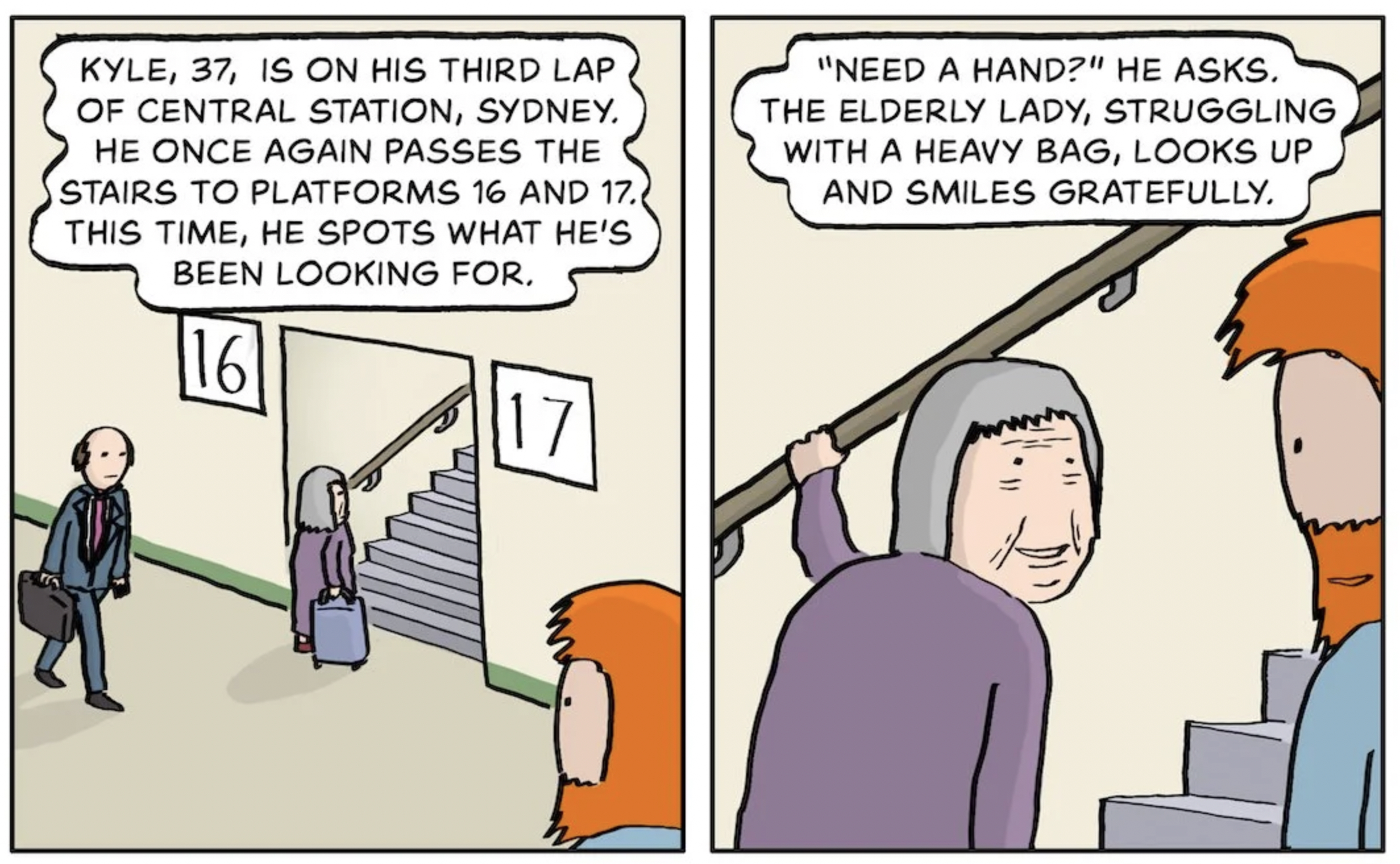
Cartoons are one of my favorite things on Instagram, especially when they touch on humor, confusion, sadness, practical philosophy, and cultural critique. Some of us old enough to miss Calvin and Hobbes can enjoy this resurgence of significant, paneled cartoons on something like a periodical platform, which the corporate mind did its best to kill in Bill Watterson’s heyday.
One of the cartoonists I like, “Dave Contra,” has 110,000 followers but is nearly anonymous online. Contra began posting four-panel, color cartoons in 2021 and tried other formats, including some black-and-white, single-panel cartoons that would not be out of place at The New Yorker. (A couple argues in a bathroom; the man points to the vanity mirror and says, “I have a reflection, Janet! I’m pretty sure ’emotional vampires’ don’t have those!”)
In 2024 Contra began to regularly use a tall, narrow, 10-panel format. The art, which he makes digitally, looks relatively simple. People’s faces are little more than dots for eyes and a line for mouths. Colors are often bright. But the outlook is dark, “mainly existential,” he tells me by email, and often absurd. Some of Contra’s edged absurdity reminds me of the cartoonist B. Kliban, and he sometimes has the bleak affect of Chris Ware.
Often, as in much stand-up comedy now, there is nothing “funny” in a Contra strip, except maybe in the irony of darker material appearing in a place we have come to associate with funny. When Contra does use humor, it can be many different things, including silly or scatological, but it serves the same worldview. In one cartoon, a salmon swimming upstream flies into a bear’s open mouth, is let through a velvet rope in the bear’s throat by fish bouncers, parties in a fish disco presumably in the stomach, and ends as feces exiting the proverbial bear in the woods.
In another cartoon, Contra aims at corporate television for children by showing a TV character dog (shouted at on set by a director: “Happier! Happier!”) living alone in a crummy trailer, drinking too much on a seaside promontory one night, asking the moon, “What am I?” and not showing up to work the next day. Contra’s readers engage heavily with him in the comments, and this cartoon agitated many.
But another commenter said, “I love how your work sometimes just.. Let’s it float. In an ecosystem of clickbait and quick shareables, you’re not afraid to let us sit with ambiguity, come to our own conclusions. I can’t stress enough how important that is.”
Another cartoon that suggests the idea of suicide is “Matthew,” a man shown at ages 19 and 37. Nineteen-year-old Matthew is in rough shape; 37-year-old Matthew (now Matt) has an “outlook on life [that] is perhaps a little ‘darker’ than the average person, but he also has the capacity for laughter, friendships, adventure, even love.” Matt “wants more than anything to be able to talk to Matthew—to tell him that things won’t be this bad forever.” He cannot, of course, but realizes, “There is no despair…now. Rather, there is an abundance of something that he had completely lost all those years ago…hope.”
This hope has become one of Contra’s hallmarks. One cartoon shows “Kyle” being forced to watch the heat death of the universe. “As the last light to ever exist fades, and time ceases to be, Kyle asks himself, ‘What was the point?’ Then he asks: ‘How do I stop feeling this way?’” The last frame shows him making the effort to help others, even in a small way.
Another cartoon shows “Jonathan,” the subject of a lab experiment, who experiences a million years in 72 hours in his sedated mind. The panels show him trying to live every possible way for the fullest understanding—a Groundhog Day scenario. In the last hours of the experiment, he takes the form of a star. The lab’s computers, “suddenly tasked with simulating the mind of such a heavenly body, are immediately over-stressed.” The star begins to grow exponentially, and the lab’s alarms go off as researchers scramble to terminate the simulation. When Jonathan is removed from the apparatus and is finally able to speak, he weeps and “utters one word…love.”
One of Contra’s most recent cartoons shows a hard-working father in a post-Earth future, who must make a decision about his pay that will mean either extra days off or having some thing to share with his son. He chooses to buy an antique copy of National Geographic from a trader and reads it with his son before bed, an ending that has the same gut-punch as many moments in the novel The Road (eg, the moment when the father, trying to find food on a defunct farm to keep his son alive, realizes cows have gone extinct). There have been 187 comments on that comic so far, mostly thanking Contra; some speak of tears and even an “ugly cry.”
Contra’s web page does not have much information about him, so I tried its contact form.
“There aren’t many good reasons for a human to communicate with a toaster,” it says. “But you might be special.” After the form sends, a message pops up warning you not to hope for much.
He did reply, though initially he reminded me of an artist friend who deflects questions with humor. Contra told me he “began creating comics to pass time during covid lockdown” and that he is “based in Sydney, Australia. His hobbies include surfing, swimming, and never looking in the mirror.”
When I pressed, we traded a few emails. He admits he would rather stay mostly anonymous but tells me he was born and raised to the age of 14 in Hong Kong and returned for a few years after going to the UK for college, where he studied film. “When I am writing my comics I still think in terms of ‘shots’ that need to be framed,” he says, “and i will write down ‘Closeup shot’ or ‘long shot’ etc.” [all sic] He is 45 now.
“Im not really into art in general,” he says, “although I have always had a thing for Van Gogh.” Other enthusiasms include Pink Floyd, Alan Watts’ book The Wisdom of Insecurity, Bret Easton Ellis’ American Psycho, and the films About Schmidt, Enter the Void, and Paolo Sorrentino’s The Great Beauty. (“Heartbreakingly beautiful,” he says.)
“The use of psilocybin (magic mushrooms) is probably the number one thing that has influenced my outlook on life,” Contra adds. “During my college years I struggled with a few things and it helped me change my life literally overnight. More recently, in an attempt to regain that kind of quick fix liberation I did some very controlled sessions with very measured doses, working up to the ‘hero dose’. That was terrifying for me and I haven’t done it again since.”
Contra says @Roryblank “was the original guy on Insta i looked at and thought ‘Huh, i could do this’. Now, my favourite artist on insta are @nowherelad and @beetlemoses.”
Present and future fans of Contra’s strip can delight in the 312-page, full-color comic collection he published independently, less than a year ago, titled, You Are Deranged For This. Reviews around the Internet are overwhelmingly positive.
“This book is for sufferers of existential angst who want to feel less alone,” the promo copy says.
Contra told me he is also planning to release a novel he wrote in his twenties, and one of five kids’ chapter books he has written over time, which “are extremely different to my insta work,” but might be of interest to his followers.