Journey to the Crossroads of America and the Hope of Obama Land
Reflections on the newly opened Obama Presidential Center and the meaning of the 44th presidency.
September 15, 2026
I take a cheap Flix bus to Chicago for the Juneteenth opening of the Obama Presidential Center. I love buses. They are democratic—no snobbish sorting into comfy elite seats and seats for the rest of us—and they feel chummy, not sterile and airless. They also give you plenty of time to let your brain empty out and open to other people’s worlds.
So here I am, feeling expansive and fond of humanity, my thoughts turning to Walt Whitman and then to Obama himself, with his expansive hope for all of us….
“There’s only one thing a snitch deserves and that’s lead between the eyeballs,” somebody behind me announces. An older woman gets on, scrutinizes the passengers, and carefully chooses an isolated seat. “What’s fucked up is why I’m going back to Cleveland,” blurts a guy in the back, outrage raising his voice. “My little brother—they smashed both his kneecaps and then they rolled over him with one of those trash compactors.”
America’s small talk, spattered with hate and fear and violence.
I forget that the next morning, though, as the crowd pours into the Obama Presidential Center. At the gala opening ceremony the day before, “it just felt like peace was floating over the area,” says a woman who went to the public watch party. Today is looser and lively, the guest list wide open, flooded with people who have traveled miles, huge family reunions in matching T-shirts, gay couples, biracial couples, veterans using motorized wheelchairs, kids in even more complicated wheelchairs. One staffer wears a sari; several women wear hijabs. The crowd is what used to be sought and is now condemned: diverse, with everybody made welcome. People relax into smiles as they walk, light at heart for a change.
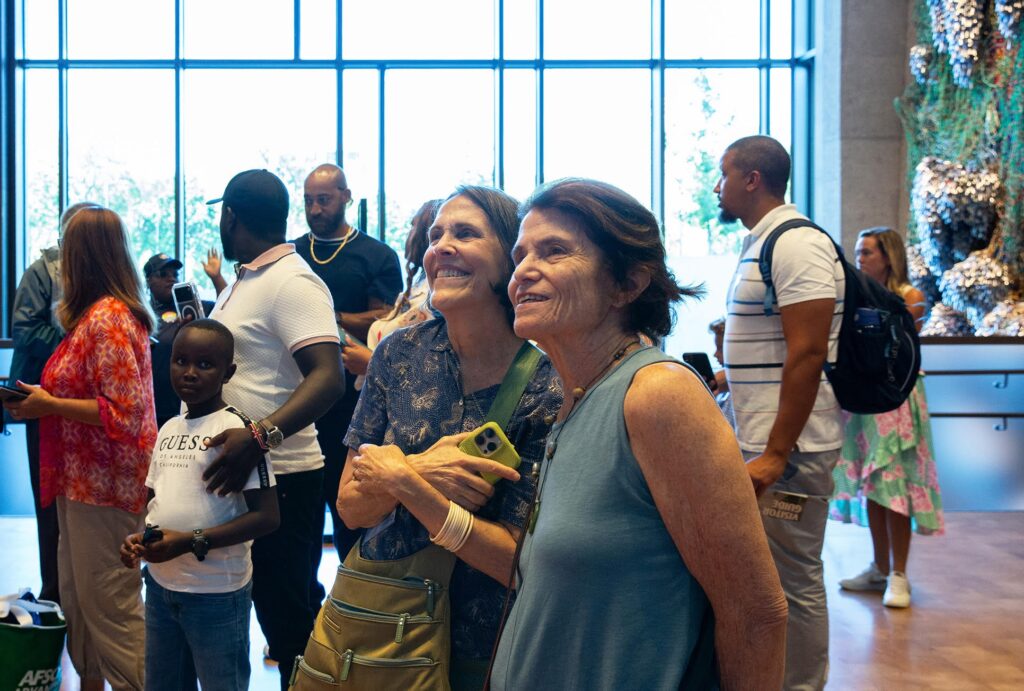
The weather is glorious, seventies with bright sun and a soft breeze. The longest line is in front of the statue of the Obamas—everybody wants a selfie. People high-five Michelle, lean against Barack. “They got into people’s souls,” a man murmurs.
The line moves easily, everyone offering to take the photo for whoever is in front of them. When an Asian family scurries away too quickly, the Black woman holding their camera calls, “Wait, let me get another one. Get closer together!”
Today is Juneteenth, the end of slavery in the United States, and like many others, that woman wears the pan-African black, gold, red, and green. Could this country ever change enough, I wonder, to make them—or me—comfortable in red, white, and blue? We were headed there, back in 2008. We have come here to remember that.
The longest line is in front of the statue of the Obamas—everybody wants a selfie. People high-five Michelle, lean against Barack. “They got into people’s souls,” a man murmurs.
Just as I am starting to feel glum, a sudden delight ripples through the crowd. Dancers in the Black Hawk Performance Company are streaming onto the plaza, coloring it bright. An older Black woman asks for a selfie with a woman her age in an exquisitely beaded and fringed dress, and afterward they give each other a big hug, crushing a few feathers. Younger dancers swish their hips to “All Night Long” as they wait for the performance to begin. Then the company invites OPC staffers into their circle, as a thank you. Some shuffle along with embarrassed good grace, but others put hands on hips and manage to catch the drummers’ beat. All music belongs to all of us, I think. We need more cultural appropriation, as long as it is appreciative and respectful. The push for identity should have stopped there. Instead, it grew so shrill it broke us apart.
After the performance, hip-hop and pop music fill the John Lewis Plaza. Now anybody can dance, and people do, so freely it is irresistible. OPC staffers join in for a minute as they scurry by. As I pass a woman, we bend our heads toward each other and sing it loud: “Easy as 1-2-3, a-b-c….”
But it is not easy at all. Not anymore.
Can this controversial, privately funded $850 million center—dismissed by many as a vanity project, architectural folly, and dangerous precedent—really shore up democracy?
“That’s the true genius of America. That America can change.”
—Barack Obama
Hope has been the through-line of Barack Obama’s life. A refuge, a strength, a promise—and sometimes, too, his blind spot.
When he was a kid with a single mother off doing research in another country, he needed hope. As he grew older, he chose it. Weary of his Midwestern grandparents’ can-do optimism and his mother’s exhortations to get up at dawn to study, he was tempted toward his father’s intellectual cynicism. Then he realized that would mean “withdrawal into a smaller and smaller coil of rage, until being black meant only the knowledge of your own powerlessness.”
Instead, he kept the hope. Used it to organize communities. Studied the trajectory of this nation through its filter. Without hope, Barack Obama would never have dished out pretzels in a Ramada Inn on the South Side of Chicago to announce a state senate campaign, let alone run for president twelve years later. He resorted to hope every time he was stonewalled, vilified, dismissed as un-American, caricatured as an ape. “We have chosen hope over fear, unity of purpose over conflict and discord,” he said in his first Inaugural address—words that sound quaint and faraway now.
When Barack left office eight years later, he took some time off—Michelle was owed—and floated above the political fray. “Just tone it down with the kitesurfing pictures,” John Oliver snapped. “I’m glad he’s having a nice time. America is on fire.” Exasperated by our demands to fix messes, Obama asked dryly if we had forgotten he was out of office.
He had a plan, though. Create a friendly green campus, a place of art, learning, and action that would restore the hope he had always urged.
Aquinas pronounced hope a virtue, a disciplined channeling of the will toward “a future good, difficult but possible to obtain.” Obama echoed that when he spoke of hope’s audacity, dogged in the face of any obstacle. But hope can also be a defense, summoned to preserve a favorite worldview or protect us from despair. It has held Obama’s life together and driven him forward. It has also led him astray more than once, proving him either naïve or too trapped by his fine intellect to understand acts driven by rapaciousness and stubborn hate.
Maybe the Obama Presidential Center is naïve, too. Maybe we have sprawled too big, too suspicious of difference, and the great American experiment is exploding.
Or maybe a place can make a difference.
“The best we can do is to try to align ourselves with what we feel is right and construct some meaning out of our confusion, and with grace and nerve play at each moment the hand that we’re dealt.”
—Barack Obama in A Promised Land
One visitor to the OPC, a Chicagoan all her seventy years, talks about all the hate you hear nowadays: “It makes my soul cringe.” Then she brightens. “This is our first African-American president. You tell your children, ‘You can do anything and be anybody’—and he’s a classic example.” Overhearing, a young father adds firmly, “Damage can be repaired.”
Michelle Obama is sure of it. In her opening-day speech, she insisted that the truth of this country lay “not in grabbing as much as we can get for ourselves, or knocking folks down to prop ourselves up, but in the overwhelming goodness, the relentless striving, the quiet dignity that is inside all of us.” Her hope is for the OPC to “reflect back just a fraction of that light.”
Michelle was the one who made sure there was a sledding hill, a fruit and veggie garden, a teaching kitchen, and picnic tables. She brings the joy, Barack the gravitas. They both knew they wanted a public library on site, a basketball court, an auditorium for talks and concerts, and recording studios where anybody with talent can test it.
How do you build a place where people can hope? You build a place where they can act.
Michelle brings the joy, Barack the gravitas. They both knew they wanted a public library on site, a basketball court, an auditorium for talks and concerts, and recording studios where anybody with talent can test it.
There are no commercial logos or big donor names at the OPC, just stories. Not only the Obamas’ story, though it tells that well, but stories of overcoming hardship and fighting for human dignity. You climb to the Nelson Mandela Sky Room, visit the Eleanor Roosevelt vegetable garden, stand in the auditorium named for Elie Wiesel or the atrium for fifteen-year-old Hadiya Pendleton, killed by a stray bullet just days after spinning a baton in Obama’s second inauguration parade.
Already on opening day, the 19.3 acres buzz with life: dragonflies flitting through the native grasses that border Michelle’s lush garden; baby rabbits scampering across the soft, springy surface of the playground. The energy is clean and 100 percent renewable, with solar panels and thermal wells. Wide, shallow basins absorb any deluge of rainwater, and a walking trail cuts through wetlands preserved as habitat. Which is what the entire center is: a sheltering, nurturing habitat.
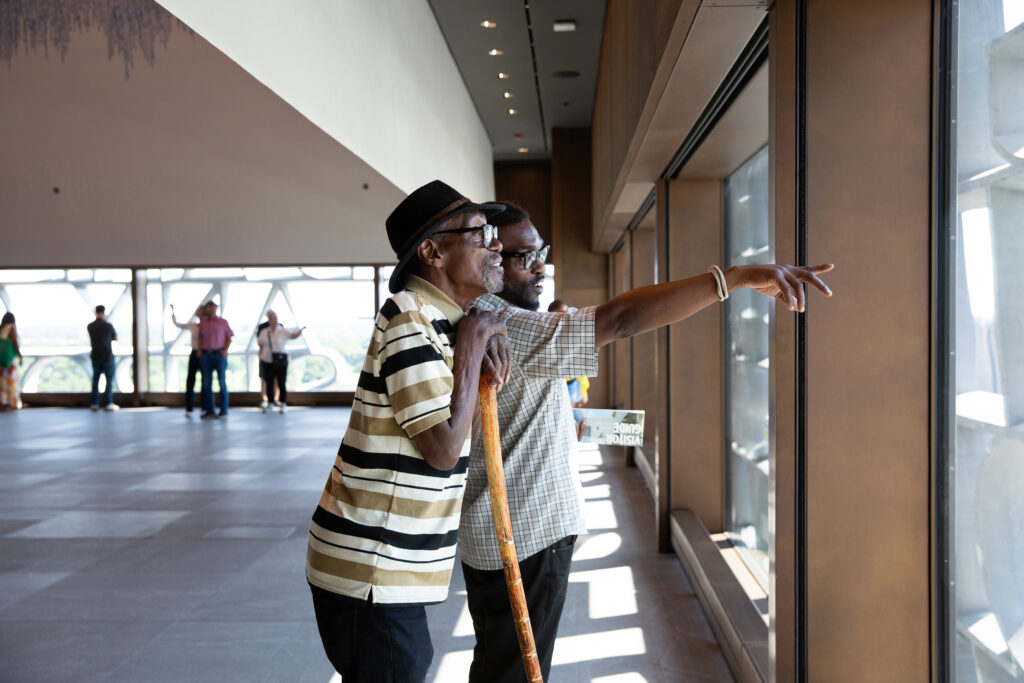
Every detail is executed with care, and together, they show us how we could live thoughtfully, creatively, cleanly, doing no harm to the earth or each other. There are wheelchairs, assistive-listening devices, on-screen American Sign Language interpretations, Braille signs, tactile replicas, recorded audio descriptions, and a tactile wayfinding map on each museum floor. The word “inclusive” has fallen out of favor, but this place deliberately makes room for difference. It aims to remind us of the power we each still possess, and the superpowers we have when we work together.
I need to believe that.
“It’s about creating buildings and spaces that inspire us…works of art that we can move through and live in. And in the end, that’s why architecture can be considered the most democratic of art forms.”
—Barack Obama in 2011
A wannabe architect, Obama drove the OPC’s designers, Tod Williams and Billie Tsien, a little crazy, pushing them to make the museum taller, more sculptural, more like art. I imagine him caught up in his old idealism, envisioning a beacon to light our way. A monument not to himself but to the progress we are fast erasing.
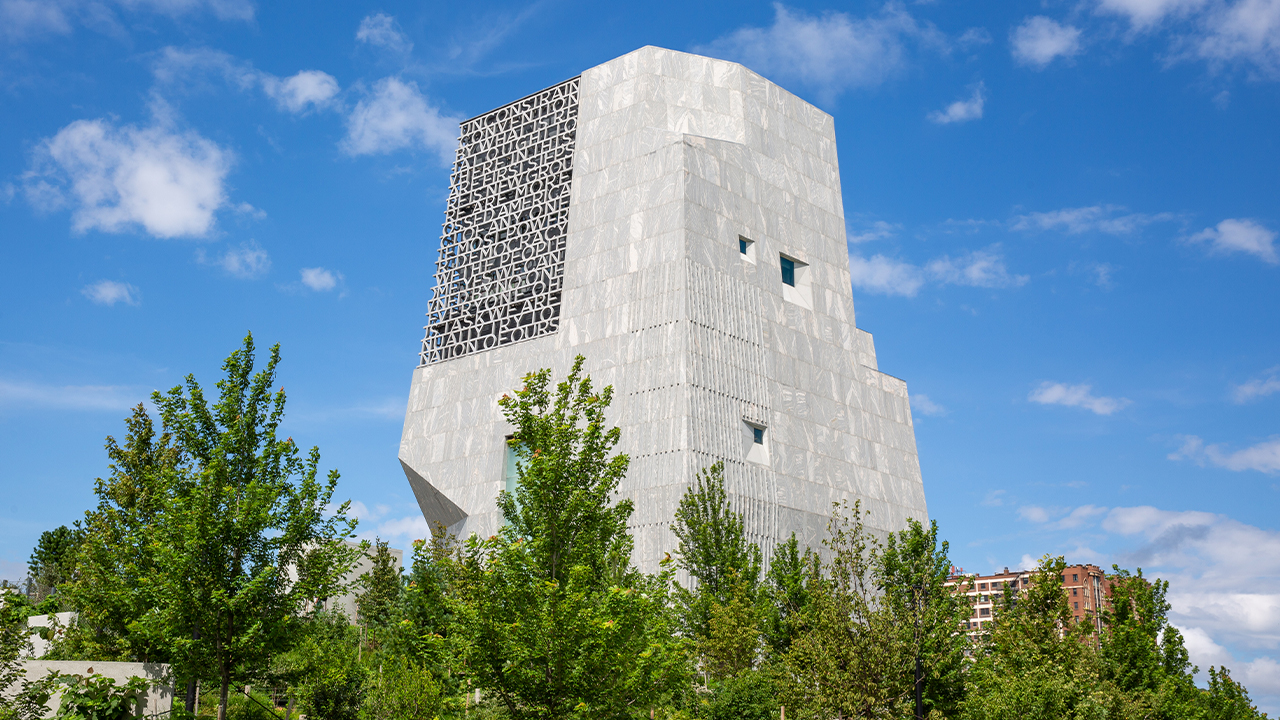
The critics did not buy it. The architecture is brutalist and ugly, many said, “cold and forbidding.” In The New York Times, architecture critic Michael Kimmelman wrote that the building was supposed to suggest four hands joining to hold a lantern, but all he saw was “a boulder in a park.”
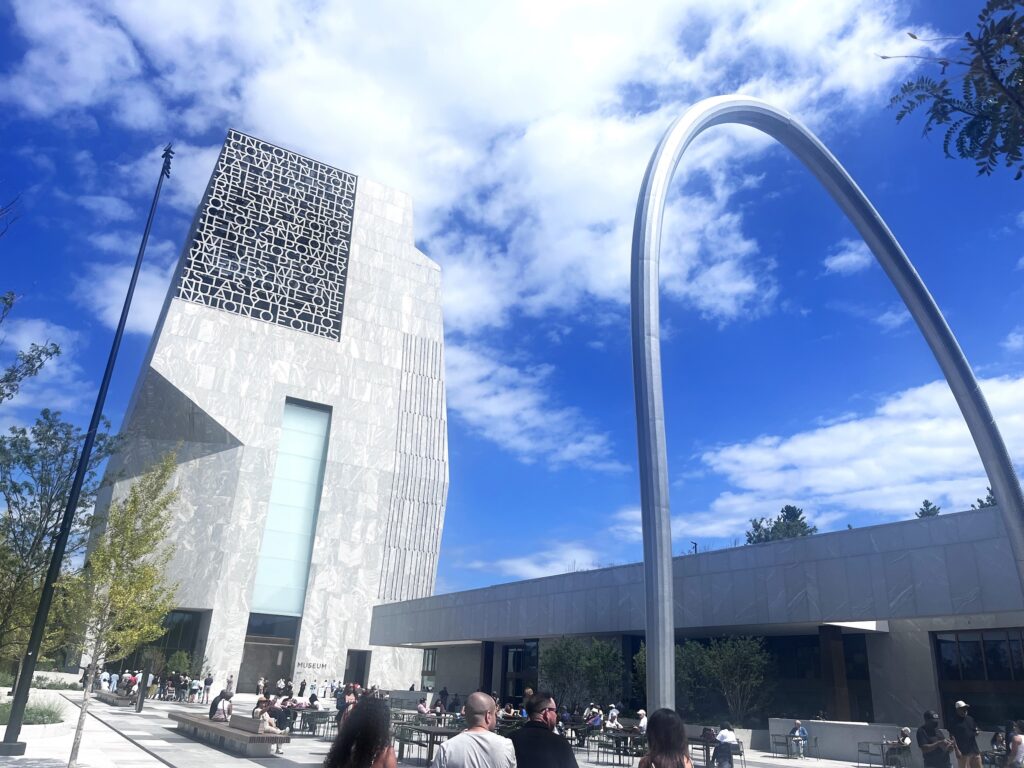
Now that I am here, I decide he is wrong. In person, you can see the soft veins in the blond New Hampshire granite, the textured details, the sculptural facets that photographs flatten. Those angles would let four hands join. The vertical band of colored glass glows, and air and sunlight flow through the five-foot letters cut out at the top. You have to move a few steps to the right, then a few to the left, but if you squint and concentrate, you can read the entire wraparound quote. Taken from Obama’s speech at the fiftieth anniversary of the Selma-Montgomery civil rights march, it assures us: “You are America. Unconstrained by habit and convention. Unencumbered by what is, and ready to seize what ought to be.”
“The first thing we saw when we got to the campus was those words,” a visitor named Sonya Hankerson says softly. I tell her that Kimmelman pronounced them “illegible, the lettering bunched together like Cheerios in a box.”
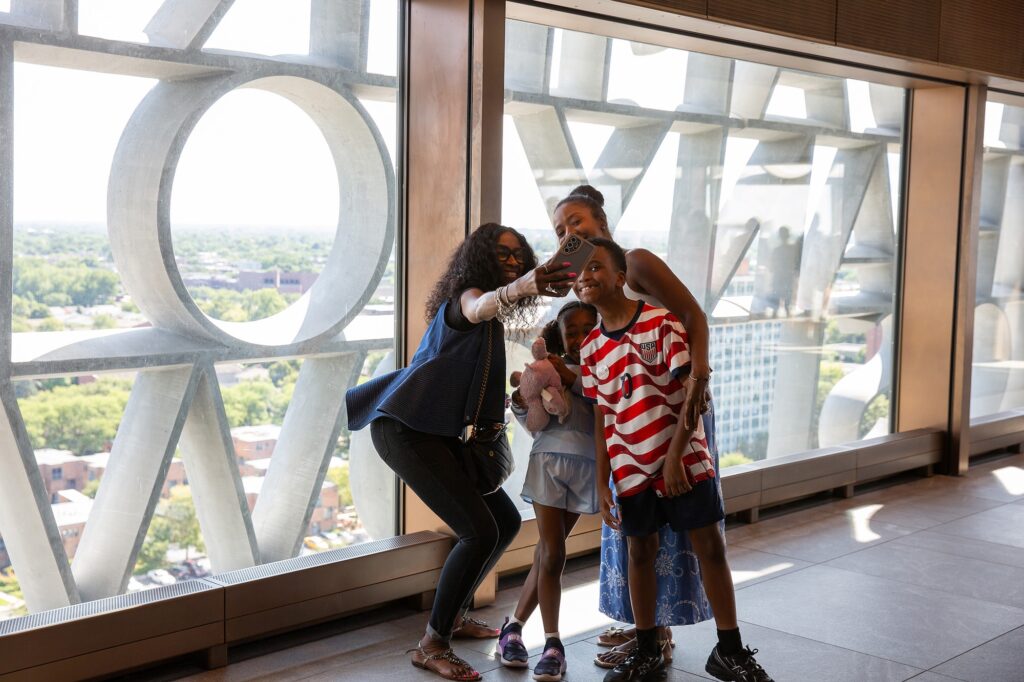
She grins. “You know how many people eat Cheerios? You know how many people look forward to seeing Cheerios?” Then she turns serious. “What we have seen in this climate is, throw enough lies out and somebody will believe you.”
Kimmelman also pronounced the OPC “the tallest monument yet to presidential self-glorification.” Is it? Campaigning, Obama regularly insisted that winning was not about him. But he knows the OPC needs to be. His presidency broke ground; it let a lot of people dream. Name a tower for one of the teachers and nurses he knows glue our society together? No one would show up. We need the drama of celebrity, the story of a triumph, to capture our attention.
Kimmelman is a respected critic, but the animus in that critique burns in a familiar way. Eight years as president, and Obama did not have one clear win. He was too conservative for the left and too leftist for the right; too Black for some Whites and not Black enough for others. Now that he is out of office, people are angry with him for failing to save us, and now that he has built us a center with private funds, we say he did it wrong.
The architecture is brutalist and ugly, many said, “cold and forbidding.” In The New York Times, architecture critic Michael Kimmelman wrote that the building was supposed to suggest four hands joining to hold a lantern, but all he saw was “a boulder in a park.”
Now that I am here, I decide he is wrong.
The OPC architects responded publicly to Kimmelman, explaining that the museum could not have windows piercing every floor: it is a museum, and the exhibits needed to be protected. Meanwhile, other critics were comparing the museum to the Death Star, a prison, or a trash can. In New York Magazine, Justin Davidson complained that the exhibits present recent U.S. history “as if the whole trajectory of the civil rights movement pointed to [Obama’s] election.” Apparently, he added, “megalomania flourishes just as well in blue America as in red.”
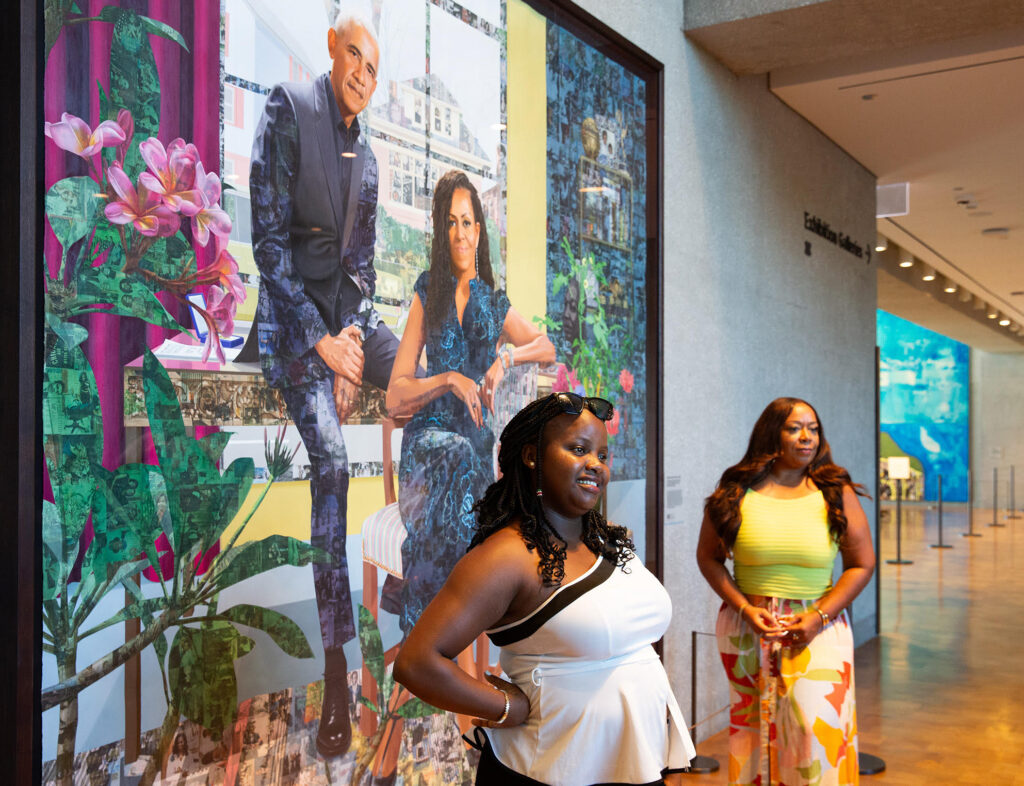
Seriously? Sure, there is a statue and a portrait of the Obamas, and Michelle’s dresses are here, and Barack’s favorite stuff. It would be disingenuous to say that the OPC was not a celebration of Obama’s presidency, or a celebration of the national trajectory that allowed us to elect him. But he is too fundamentally serious to let the celebration end with him. He wants a working center for citizenship, a place to workshop democracy. He wants to keep hoping.
“For all our differences, we are one people, stronger together than we could ever be alone.”
—Barack Obama
The euphoria I felt at the opening lasts a few days, until the news splashes enough acid to erode it. I return in August—the earliest possible museum ticket. I want to see the campus without all the hoopla and measure its power.
The crowd has thinned; there is no music, no dancing. The day is gray, and I gaze up at the museum and second-guess my appraisal. It does look a little bleak.
“What do you think of it?” I ask Hettie Collins as we gaze up from the Women’s Garden.
“When you go inside, you get it,” she assures me.
I step in—and look up. Two stories, three stories, four, through a column of air, words and images scroll on a digital canvas, and you crane your neck and watch history unfold. Women in white demand the right to vote. Viet Nam vets protest from wheelchairs. Black men hold signs that had to read “I am a man,” because somehow White people keep forgetting. Amazingly, the people in these images are not angry or sad. They are laughing, singing, flashing the peace sign. Moving forward, not back.
“When they go low”—the video scrolls up—“we go high.” That has been my anchor: the possibility of moral courage and sustained compassion. But I can feel my own weakening. I am done making excuses for people who applaud cruelty. The harshness of my disgust frightens me.
Floor by floor, I look for hope. If you are Black, the very fact of the Obama presidency is a sign of hope. I see grandparents murmuring the story to four-year-olds; women standing rapt in front of Michelle’s gowns. I envy them, because what I cannot stop seeing are the contrasts. None of those gowns had “I really don’t care” emblazoned on the back. The displays documenting Obama’s historic campaign show United Farm Workers holding signs: “Si, se puede!” Yes, we can! He spoke of “the irreducible worth of every person,” and how “every life is precious.” Compare that to the ICE killings, the roundups to horrific overseas mega-prisons, the barrage of insults streaming from the Oval Office.
Obama worried hard about health care. Now we eat diarrhea lettuce and die of measles, and public health has stopped even tracking many parasites and diseases. Obama yanked us back from economic catastrophe. Now half the country is having trouble affording groceries, gas, and housing. He addressed global warming head-on. We have decided to ignore it and go gung-ho for fossil fuels again. He said, “We will always be a nation of immigrants from all over the world.” The current Administration caters only to White Christians.
Heterosexual White Christians. I look at photos of the first legal gay wedding and think of all the couples now leaving the country because they do not feel safe here. So much that felt like real progress, at least to some of us, has been trampled, erased, or smashed to bits. Obama listened to critics and made changes; the current president just takes revenge on the critics. Photos of life in the Obama White House are full of joy and warmth, because however worried Obama was about the nation, he adored his wife, their daughters, their dogs. How full of life the People’s House was then. How trashed and gilded it is now.
Still, in the people showing up at the OPC—teachers, social workers, activists, teenagers, visitors from all over the world—there is hope incarnate. In the learning taking place all over campus—the library storytelling sessions, the healthy cooking classes, the young artists recording music or podcasts, the young people coming for leadership programs, the public discussions of democracy—there is hope.
“No matter who you are, where you live, or how much money you’ve got, you should be able to access the world’s knowledge and information just like anyone else.”
—Obama in 2015
Critics have bemoaned Obama’s choice to digitize his presidential records, making them available online rather than in a building under federal control. But when you look at what has come from federal control lately, scrubbing well-documented facts from the nation’s museums and displays, you understand the desire to veer away.
You also remember that we live in a digital age. Back in 2010, Obama—whose campaign was the first to use social media to galvanize young supporters, and who has been dubbed our first digital president—was already speculating about putting his records online. Many are already in digital form, and The Obama Foundation is paying to digitize about 30 million pieces of paper so their content can be read by all.
Sure, it would have been cool to have a research library at the OPC. It is a shame for scholars to lose the chance to confer with curators and other scholars. But realistically, how many people are going to cross an ocean—or even take a bus from Des Moines—to put on white gloves and use a stubby little pencil, when they can research comfortably from home?
It would be disingenuous to say that the OPC was not a celebration of Obama’s presidency, or a celebration of the national trajectory that allowed us to elect him. But he is too fundamentally serious to let the celebration end with him. He wants a working center for citizenship, a place to workshop democracy. He wants to keep hoping.
The world has changed. The National Archives is already struggling to digitize 12.5 billion documents from previous presidents. By policy, it does not give researchers access to paper originals when electronic versions are available. This switch starts to feel inevitable. Critics still worry that it sets a lousy precedent, though: a president’s various bits of paper could end up scattered, and the electronic records could be a massive data dump.
Or, they could be trashed, and the National Archives would have no say in that anyway. Donald Trump’s Department of Justice has announced that he “need not further comply” with the law requiring a president to hand over his presidential records. His library plans include a luxury hotel and his famous golden escalator.

“I’m from Chicago. I don’t break.”
—Barack Obama
“Here on the South Side of Chicago,” Obama announced in March, “hope is getting a permanent home.” Visitors would see all of Chicago in Mark Bradford’s 38-foot-tall City of the Big Shoulders, which maps the city thick and bright on a giant canvas of billboard and poster fragments, rope, caulk, twisted and torn salon hair wrappers, the old redlining maps, a yellow stitch of railroads, the lake’s deep blue. “Maps. Land. Power,” says Bradford. “It’s all here.”
The Obamas’ history, though, is on the South Side. Michelle grew up here; the Baskin-Robbins where she and Barack first kissed is near the OPC; their wedding reception was within walking distance; they bought their first house just blocks away; his office was down the street; their daughters were born while they lived here. Locating the center here was an obvious choice and a public thank you.
Not everyone said “You’re welcome.” A few community groups went so far as to sue, upset about parkland being taken and gentrification jacking up the surrounding rents. Obama conceded that risk, but controls have been put in place, and meanwhile the OPC has removed an ugly six-way road, planted 950 trees, boosted revenue for surrounding businesses, and created jobs and programs for kids in sore need of them. As an outsider, I brushed aside the local grumbling. But I did find the OPC’s drumbeat of emphasis on the South Side a little parochial for a place of national import.
Then I remembered how much place matters in this vast country. How a place can shape a life—then two lives—then four. How its influence can wind up shaping an entire nation.
“Barack was the first person I’d met at Sidley who had spent time in the barbershops, barbecue joints, and Bible-thumping Black parishes of the Far South Side,” Michelle wrote. Those experiences changed him. He talks about seeing people’s struggles, their courage, their hope. But I suspect community organizing also brought him into community, made him feel a part of something in a way his unusual early life had not. And that connectedness made it easier to fight for change.
Which is exactly what he wants to happen at the OPC.
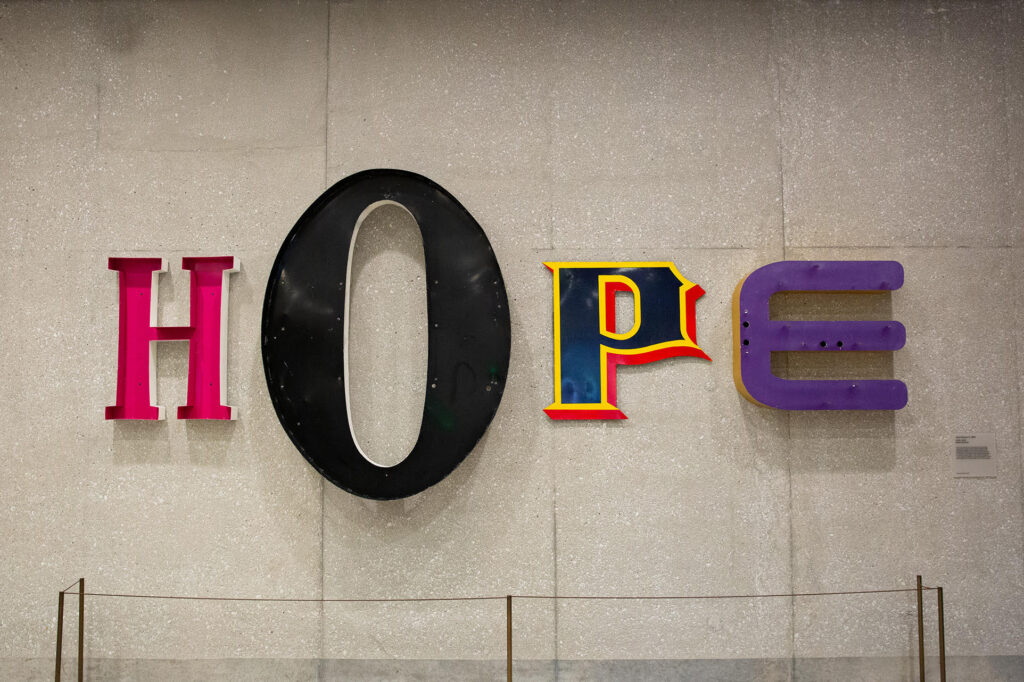
“The absence of hope can rot a society from within.”
—Obama, accepting the Nobel Peace Prize
Having breakfast at Daley’s on the South Side, I meet a tall, pleasant Black man who introduces himself as Q. Davis. I say why I am here. He is curious why I miss the Obama Administration. “Barack Obama is refreshing as a person,” he concedes. “I miss having people in government who reflect those qualities. But government is a system that no human being can really revise. When you get on a train, the track is going that way, regardless where you want to go. When a person gets in office, it’s a system that’s already built, and it’s built on human greed. His hands were tied, and I knew they would be. For me, government can only accomplish the minimum. I’m an advocate for God’s kingdom. So I don’t vote for anybody.”
As I walk to the OPC, I wonder just how many people have distanced themselves from voting—and the pain and disappointment that often follow—and fallen back on God. Who I thought was supposed to help us when we helped ourselves.
At the campus’s edge is a Register to Vote booth. I mention Q. Davis’s stance to the volunteers. “Yeah,” one says, “we gotta keep pushing.” Dave Chappelle, interviewed after the grand opening ceremony, used the same verb: “You just gotta push through it.” Chatting with visitors, I mention Q. Davis. “You gotta participate,” a woman named Kelley Townsend shoots back. “You gotta show up and keep pushin’.”
“We know the system is broken,” adds someone else, “but as long as good men stay silent, it’s going to stay broken.”
For all their talk about pushing, Black visitors seem far more serene than I am. In a fit of frustration, I rattle off reasons for despair to a woman who points out calmly, “Yeah, but now people are quacking back.”
Not everyone said “You’re welcome.” A few community groups went so far as to sue, upset about parkland being taken and gentrification jacking up the surrounding rents.
Which is true, and her phrase delights me, lightening the morass of politics into a barnyard squabble. Black Americans have grown up with injustice as a constant, taunting companion. They have formed defenses—laughter, love, and often religion, feeding their faith with need and gratitude. My own experience of religion soothed and exhorted, but it did not fortify me against hatred. There was no need; a large-scale, irrational hatred had never menaced me. White middle-class Christianity is more likely to make you feel smug than strong.
Later, on Threads, I will read: “Hopeless white people don’t move me…. You better feel hopeless and still find something to do! You can’t imagine a future? Don’t have hope for society? Well our folks have never been able to envision a future that didn’t include fear. And yet they imagined, and did, and tried, and loved, and fought.” Another post boils it down: “Hope is ancestral.”
I have no idea what it means to endure for generations, to hold a grim reality in your mind without giving up or lying to yourself. “And it’s no easy way out,” the plaque on the Fannie Lou Hamer Walkway reads. “We just got to wake up and face it.”
I pull out my phone and look her up. American voting and women’s rights activist, community organizer, and leader in the civil rights movement. I never even knew her name.
“People wore down their shoes so we could be here today,” another visitor, Brenda Graham, says softly.
“The arts have always been central to the American experience. They provoke thought, challenge our assumptions, and shape how we define our narrative as a country.”
—Barack Obama in 2018
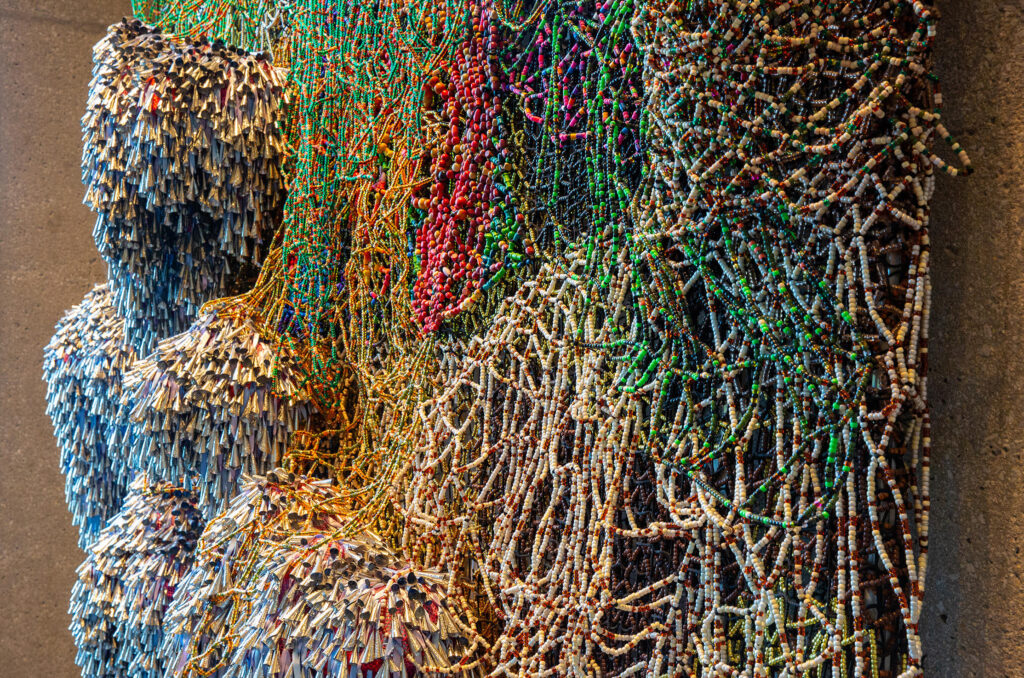
On Juneteenth, the plaza pulsed with African dance and native American dance—including the jingle dance, created to heal a young woman who was too sick to stand or speak. Inside the museum float clouds of these tin-cone jingles, thousands of them, created by Marie Watt and set against the rainbow of Nick Cave’s beaded nets. This Land, Shared Sky is a seamless collaboration several stories high, capturing the vastness of this land and the indigenous and African patterns and rhythms woven into it.
Cave’s work is often about adornment: “We do it to empower, to celebrate, to connect with our spirit,” he tells me. “And we do it for protection.” The OPC will be, he thinks, “an important place for moments of distress. It is flexible and will be able to adapt to any given moment when we all need to come together.
“What the Obamas represent to me is possibility,” he adds. “That we all are here, and we all belong here. We have a purpose.”
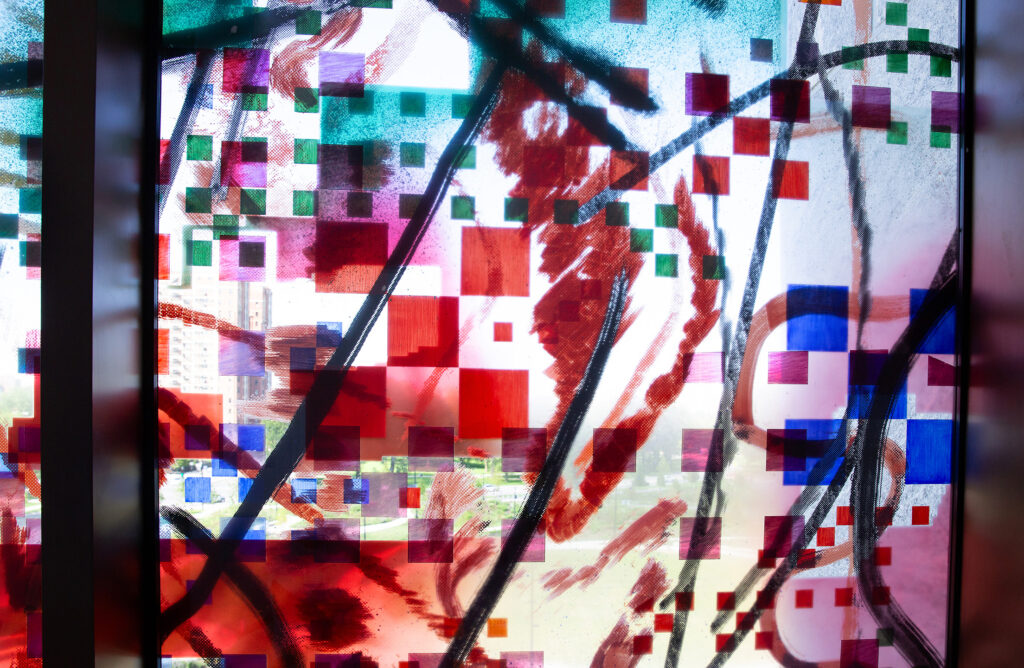
Why was art so important in communicating that? Julie Mehretu gives us a clue. Her 83-foot-high, glorious hand-painted “rose window,” a glass installation titled Uprising of the Sun, stole its colors from politically resonant American and Ethiopian paintings and made them holy. “Beauty and poetics carry weight,” she said in this year’s commencement speech at the Rhode Island School of Design. “They are how human beings have always processed what is unbearable, imagined what is not yet possible, and kept alive the sense that something else could exist.”
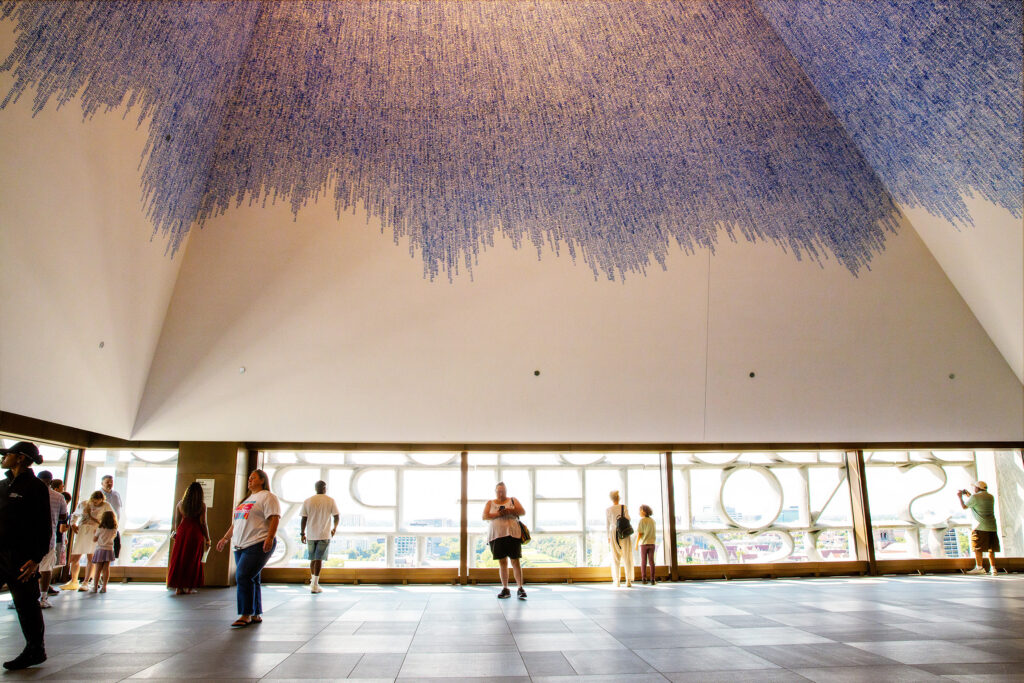
Mehretu’s family fled here from Ethiopia as refugees when she was seven. Her work for the OPC was inspired by Obama’s Montgomery civil rights speech—as was the quote at the top of the museum—as was Idris Khan’s Sky of Hope. All of Obama’s fine turns of phrase over the years, yet three works based on a single speech? A message, maybe, to a nation that never healed. Khan took thousands of words from the speech and let them tumble from the museum’s pyramidal ceiling, stamped in blue and overlapping. A beautiful effect that, like the quote on the building, requires a little effort to be legible. Is that the second part of the message, that ideals require struggle?
There is solace in Jenny Holzer’s Freedom Riders, a text-based painting, shimmering with platinum leaf, that uses declassified FBI files to remind us that activism expanded Blacks’ ability to travel through the country freely and legitimized the use of nonviolent direct action. Before you leave, you can rest in the Democracy in Action lounge, contemplating Tyanna Buie’s Be the Change! As a teenager, she did step routines in Chicago’s Bud Billiken Parade with Obama’s Senate campaign group. “Long parade, and it’s exhausting,” she recalls, laughing. “‘Who is this,’ we said, ‘and what kind of name is ‘Obama’? Toward the end, he came up to us while we were goofing around, and we had to look up at him. Immediately we were quiet. We hadn’t thought about the person.”
She has thought a lot about the person since then, especially after she received this commission and began screen-printing and inking images of people voting, speaking up, fired up for change. “They had me get rid of some of the images of Barack,” she adds. “They said, ‘It’s not about him.’” Instead, her work is huge, “wall to wall, so it’s embedded in the architecture. It’s not the biggest piece I have made, but it felt…epic.”
Out on the plaza, you see the arc that sculptor Martin Puryear carved from wood, not wanting the lie of engineered perfection. Cast in gleaming stainless steel, it frames views of the museum from John Lewis Plaza, named for the U.S. Congressman and civil rights activist. He quoted Martin Luther King Jr., who was quoting abolitionist preacher Theodore Parker’s promise back in 1853 that “the arc of the moral universe is long, but it bends toward justice.” Not automatically, Puryear believes. Only when it is moved by men and women of good will.
Maybe I am just used to the Gateway Arch, but the arc bending toward justice looks a little skinny and uncertain. As I think this, a little boy runs up and wraps his arms around the base. Over time, enough arms will steady its trajectory.
“We f—ed it up. Barack never took Putin seriously.”
—Joe Biden
My own criticism of the OPC is that Obama does not let the frustration and pain show. The exhibits document others’ struggles, his amazing campaign and victory, his earnest efforts as president, and his hope for that work to continue. But there is nothing to hint at the bitter opposition, the way he was thwarted and stymied and caricatured, the double standard by which he was judged. A tan suit was a catastrophe in international diplomacy, while a White president can alienate longstanding allies and wage capricious wars and punish vindictively and slide on by.
Exhibits acknowledge “the work that remained”: family leave, fuller healthcare access, banning nuclear weapons, resolving the fate of the “Dreamers” brought here by illegal immigrants. Obama has been frank about his own failure to plan for the aftermath of the 2011 intervention in Libya, which spiraled into chaos. He wishes he had been able to persuade Congress to enact stricter gun-safety laws. He wishes he had closed Guantanamo Bay on his first day in office. And as he admitted in his final State of the Union address, he found no way to heal the political divide that has since fomented hate and rage and tugged this country away from its own laws. Accepting the Nobel Peace Prize in 2009, a little abashed at not having earned it, he noted that globalization had caused people everywhere to “fear the loss of what they cherish in their particular identities—their race, their tribe, and perhaps most powerfully their religion.” Still, he did not foresee that fear tearing this nation apart.
“Democracy breaks down when the average person feels their voice doesn’t matter; that the system is rigged in favor of the rich or the powerful or some narrow interest,” he says now. “Too many Americans feel that way right now. It’s one of the few regrets of my presidency — that the rancor and suspicion between the parties has gotten worse instead of better. There’s no doubt a president with the gifts of Lincoln or Roosevelt might have better bridged the divide.”
The exhibits document others’ struggles, his amazing campaign and victory, his earnest efforts as president, and his hope for that work to continue. But there is nothing to hint at the bitter opposition, the way he was thwarted and stymied and caricatured, the double standard by which he was judged.
Could they, though? In a time when, paralyzed by the blur of change, many U.S. Americans think the answer lies in a segregated, patriarchal past?
Political scientists have written of failures Obama does not mention—chiefly his underestimation of Vladimir Putin. “This breezy attitude prevailed even as Russia occupied Crimea, invaded eastern Ukraine, intervened in Syria, and hacked the Clinton campaign and the DNC,” note scholars at the Brookings Institute. “Obama had a ‘long view’ of historical trends which in his view inexorably ‘bent’ toward liberalism…. [And] this timid realpolitik was mixed up with a healthy dose of disdain. Obama dismissed Russia as a ‘regional power’ that was acting out of weakness in Ukraine.”
The same thing happened with Trump. Obama now admits “he no longer harbors illusions about the nature of the Trump Presidency. His early prediction that Trump was capable of rolling back only a modest percentage of Obama’s achievements, and that political norms would prevail, has not remotely proved to be the case.”
Confident, idealistic, temperamentally unsuited to anger or cynicism, Obama consistently chooses a cautious optimism. This can blind him to the capacity of those who do not. He reads the U.S. as a nation that fought again and again for freedom and civil rights. “There is a genius in this narrative,” writes Oboo Patel, his advisor on faith. “It recognizes the ugly parts of American history without getting mired in them.” Those on the left who emphasized the structural evil of racism did get mired, Patel believes, and the blowback from the right was severe.
However you evaluate his politics, Obama brought the nation a thoughtful intelligence, a moral compass, warmth, steadiness, resolve, easy humor, and grace. He saved us from an ominous depression and gave us the Affordable Care Act. He was loved wholeheartedly and hated with the same passion, because everything he did became a flashpoint for arguments about what the United States should be. The OPC is just the latest flashpoint.
“Our collective future depends on your willingness to uphold your obligations as a citizen. To vote. To speak out. To stand up for others, especially the weak, especially the vulnerable, knowing that each of us is only here because somebody, somewhere, stood up for us.”
—Obama in his final State of the Union address
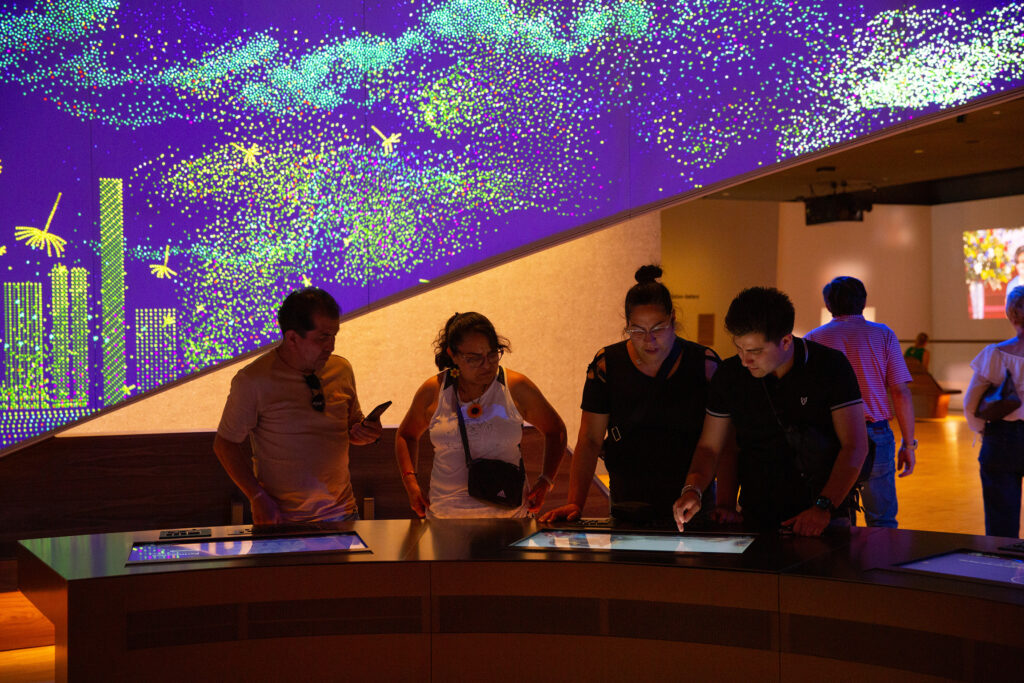
People’s faces are warm and engaged as they key in their first name, then watch it float for a minute in the sky of Jules Julien’s million-point digital mural. They are spending much of their precious museum time taking selfies. This is now normal: history is separated from us by the devices we think are connecting us. Here, though, it troubles me especially, because here, the point is to be moved to resist, to fight for justice. It is not enough for visitors to say, “Look how cool, and I was there!” Nor is it enough to set up a little station that asks what they will now do to make change happen. Or a light-up poll that asks their opinion of the health of American democracy (a loaded but fair question).
The OPC has been constructed, but it still needs to be built. Its programs need to take hold, and the young people it trains need to become leaders. I wanted too much, too fast. I wanted Obama, or if not him singlehandedly, this place, to give us a way to fix the whole damned country. Erase the hate that stonewalled him so often. Bring us together for real this time.
We have to do that ourselves.
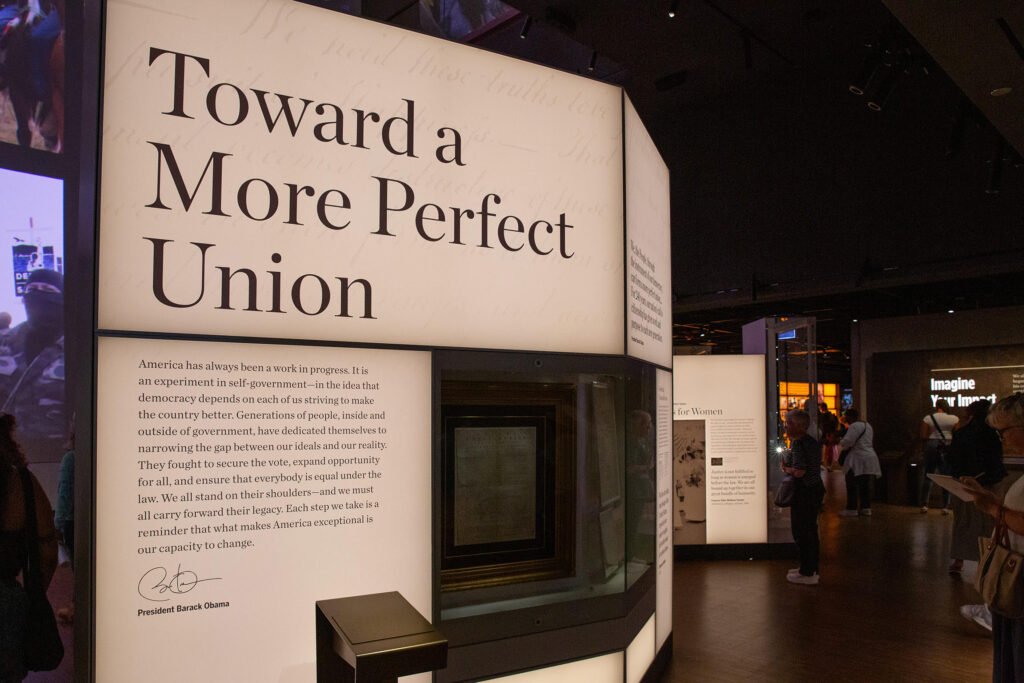
In 2008, people yelled back to Barack, loud and happy, “Yes we can!” Now we would all have to pack our pajamas and come to live in this idyllic place, built high above the hatred, before we could even begin to muster that response. The safeguards that for Obama define this nation—“a belief in checks and balances in our government and an accountability that comes with an independent judiciary and a robust, free press”—can no longer be taken for granted. The current challenges are huge and complex, well beyond the scope of community activism. How can any group of citizens break the stranglehold of concentrated power and broker solutions in a nation this divided?
I can feel myself sliding into the cynicism Obama refused to embrace, that devil’s kiss that makes us impotent. What harm do selfies do? Is it so bad to want to be part of this place, to let its values define you? The hope expressed at the OPC is not saccharine or placating. It agrees with Rebecca Solnit: “Hope is not a lottery ticket you can sit on the sofa and clutch, feeling lucky. It is an axe you break down doors with in an emergency.”
This would qualify as an emergency.
I can feel myself sliding into the cynicism Obama refused to embrace, that devil’s kiss that makes us impotent. What harm do selfies do? Is it so bad to want to be part of this place, to let its values define you? The hope expressed at the OPC is not saccharine or placating.
If we give up on democracy and civility, Obama warned at the OPC opening, “we open the door to the most ruthless, or the most careless, or the most fearful among us, who see some groups and some people as more equal than others, and see government as nothing more than a way to divvy up the spoils and punish enemies and keep those who are different in their place.” He paused. “I do not believe that is the story of America that prevails in the end.”
He remains hopeful. But the naivete has burned away.