Remembering Richard Wright, Outsider
The famed, pathbreaking Black author, less in vogue today, remains more relevant than many think.
September 15, 2026
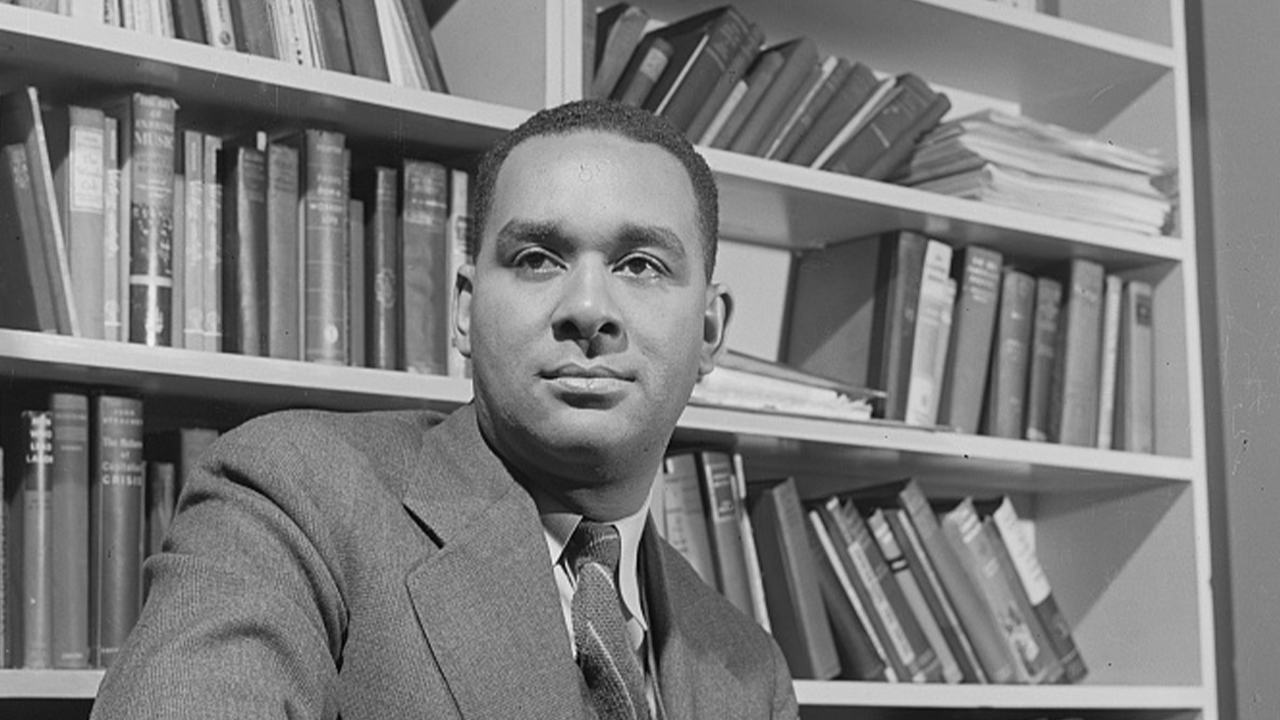
Richard Wright (1908–60) left behind seventeen book-length works of fiction and nonfiction, two of which, the novel Native Son (1940) and the memoir Black Boy (1945), stand as essential works of American literature, and all of which have a great deal to tell us about American society and the world as they function today.
Black Boy is the story of Wright’s growing up poor and constantly hungry in the South—Mississippi, Tennessee, and Arkansas—in a family whose religious strictures paralleled the absurd, inescapable racial strictures of that time and region, leaving the young man doubly isolated from mainstream society. Isolated and yet, even as he was often dazed from lack of food, oddly free: his outsider status allowed him to see the world around him more objectively than most, and combined with his intelligence, rebelliousness, and inner strength, it made him fiercely independent. Sent by his grandmother to spend time alone in prayer, he wrote his very first short story instead; advised by his peers to be obsequious in every encounter with Whites so as to avoid arousing their anger, he was unable, he wrote, to “make subservience an automatic part of my behavior”; selected as his class valedictorian in ninth grade—his last year of formal schooling—he insisted on giving the speech he had written rather than the one that had been written for him. Finally, determined to escape his suffocating environment, as a young adult Wright made his way eventually to Chicago, where—despite initially failing to make the weight requirement due to malnutrition—he found work in the post office and spent his free time writing.
Chicago is the setting of Native Son, the story of Wright’s most famous fictional creation, Bigger Thomas, and the first best-selling novel by a Black American. That book was Wright’s second book-length work of fiction. His first, the story collection Uncle Tom’s Children (1938), focused on the kinds of hardships among Blacks that Wright had witnessed and experienced his whole life; Wright recalled in his essay “How ‘Bigger’ Was Born” that upon reading reviews of Uncle Tom’s Children, “I realized that I had made an awfully naïve mistake. I found that I had written a book which even bankers’ daughters could read and weep over and feel good about. I swore to myself that if I ever wrote another book, no one would weep over it; that it would be so hard and deep that they would have to face it without the consolation of tears.”
From a young age, Wright read widely and voraciously, even in the days when he had to persuade White co-workers to obtain books for him from southern libraries that would not lend them to Blacks. He was a true intellectual, one concerned particularly with the issue of color not only in the United States but around the world, the subject of his full-length works of nonfiction.
Wright made good on that promise. Bigger, twenty years old and Black, lives with his mother and two younger siblings in a vermin-infested one-room apartment where, in the novel’s first scene, he must kill a rat, a trapped, doomed creature that fills others with fear and disgust—and thus a stand-in for Bigger himself. Bigger is in effect two people, both driven by the same emotion: he bullies his Black peers as a way of masking his own fear, the same fear that makes him subservient and monosyllabic around Whites. Pressured by his mother to get a job to help support the family, he becomes the chauffeur to a family of wealthy White philanthropists, the very people who own the slum in which he lives. One night, having helped the family’s drunk daughter—a young woman of about his age—to her room, Bigger fears his presence there will be misinterpreted and tries to quiet her, killing her instead. Though her death was accidental, and though Bigger tries to escape blame, inwardly he embraces the killing, which, in his world of severely limited opportunity, is the first thing in his life he can call his own. Having killed once, he finds it in him to do so again, purposefully. Native Son powerfully captures the tension and pressures that were the lived experience among Blacks of that time and place, and its title is an indictment of American racism: the murderous, unrepentant Bigger grew from our very soil. As he tells another character at the end of the novel, “What I killed for, I am!”
The esteem in which Native Son was held—and, to an extent, Wright’s own reputation—took a hit when James Baldwin published, in the Partisan Review, the essays “Everybody’s Protest Novel” (June 1949) and “Many Thousands Gone” (November–December 1951), both collected in Baldwin’s celebrated 1955 book Notes of a Native Son. The two essays were highly critical of Native Son. (This, apparently, was Baldwin’s way of repaying Wright’s having taken him under his wing and supporting his career.) Baldwin asserted that Wright had given us, in Bigger Thomas, a portrait of a Black man who was not fully human; Bigger’s “tragedy,” Baldwin wrote in “Everybody’s Protest Novel,” is “that he has accepted a theology that denies him life, that he admits the possibility of his being sub-human and feels constrained, therefore, to battle for his humanity according to those brutal criteria bequeathed him at his birth.” Baldwin’s assessment, however, seems to dismiss the passages in Native Son, written in close third person, in which Bigger’s humanity—his desire to connect with other people—is revealed, as in:
. . .if he reached out with his hands and touched other people, reached out through these stone walls and felt other hands connected with other hearts—if he did that, would there be a reply, a shock? Not that he wanted those hearts to turn their warmth to him; he was not wanting that much. But just to know that they were there and warm! Just that, and no more; and it would have been enough, more than enough. And in that touch, response of recognition, there would be union, identity; there would be a supporting oneness, a wholeness which had been denied him all his life.
While none of Wright’s books published after the 1940s reached the level of acclaim accorded Native Son and Black Boy, he wrote works of fiction and nonfiction for the rest of his life. The tone of his fiction owed much to the circumstances of his childhood, of course, but they also, perhaps, owed something to his early reading material. His first exposure to fiction, thanks to a teacher who boarded with Wright’s grandmother, was the grim story of Bluebeard; his grandmother strongly objected to such tales—which she called “Devil stuff”—but the seed, the fascination with stories of worlds beyond his own, had been planted in Wright. Later in his boyhood he read detective stories and what he called “cheap pulps.” Meanwhile, his mother endured a long-term illness, one that made for “meaningless pain” and “endless suffering,” as he wrote in Black Boy, adding, “A somberness of spirit that I was never to lose settled over me during the slow years of my mother’s unrelieved suffering.” That somberness, the grimness of his surroundings, and the violent nature of much of his early reading material perhaps help to account for the darkness of his themes as a novelist.
Wright recalled in his essay “How ‘Bigger’ Was Born” that upon reading reviews of Uncle Tom’s Children, “I realized that I had made an awfully naïve mistake. I found that I had written a book which even bankers’ daughters could read and weep over and feel good about. I swore to myself that if I ever wrote another book, no one would weep over it; that it would be so hard and deep that they would have to face it without the consolation of tears.”
Wright has in common with Thomas Hardy that the plots in his fiction are sometimes intricate to the point of distraction, and the events he depicts are often sensational, sometimes to a fault. Nonetheless, his novels published after Native Son have much to recommend them. The Outsider (1953)—whose title could well have applied to either Native Son or Black Boy—has as its existentialist protagonist Cross Damon, who could be described as an intellectual version of Bigger Thomas; Savage Holiday (1954) is a strange, compelling tale of killings—accidental and purposeful—and accountability; and the father of the main character in The Long Dream (1958), a Black man who carves out his own sphere of power in the segregated South, is nearly Shakespearean in his complexity. Several of the writer’s novels were published posthumously. Wright could sometimes seem disparaging of Black culture, yet Lawd Today! (1963), the story of a postal worker, contains hilarious scenes of “playing the dozens” that amount to a celebration of Black humor and wit. Rite of Passage (1994) is a heartbreaking story of boyhood, and in The Man Who Lived Underground (2021), Wright offers still another portrait of an outsider; a portion of that novel, published in 1944, revealed the influence of Dostoevsky while also prefiguring—with its story of a Black man who literally lives beneath the street—Ralph Ellison’s highly influential 1952 novel Invisible Man.
From a young age, Wright read widely and voraciously, even in the days when he had to persuade White co-workers to obtain books for him from southern libraries that would not lend them to Blacks. He was a true intellectual, one concerned particularly with the issue of color not only in the United States but around the world, the subject of his full-length works of nonfiction. 12 Million Black Voices (1941) is Wright’s portrait of Black life in America, complete with powerful images from photographers including Walker Evans. Black Power (1954) is the writer’s work of reportage from Africa’s Gold Coast, as it was emerging from colonialism to become the nation of Ghana. Wright also put on his reporter’s hat for The Color Curtain (1956), his chronicle of the historic meeting in Bandung, Indonesia, of representatives of formerly colonized nations including, in addition to Indonesia, India, Burma, Ethiopia, Liberia, Sudan, Yemen, and the Philippines—“the underdogs of the human race,” as Wright put it. Pagan Spain (1957) is the writer’s nonfiction account of life under a dictatorship in the country of the title. White Man, Listen! (1957) is his take on the history of racial oppression in the United States and elsewhere. One of its startling insights concerns the eighteenth-century, African-born Black American poet Phillis Wheatley. The poet, who was purchased by a White family but treated by them as an equal and thus “was at one with her culture,” produced writing that—unlike that of subsequent Black American writers, all of whom were subjected to oppression—“[struck] a universal note.” Wright notes, “Suppose the personalities of many Phyllis [sic] Wheatleys of America had been allowed to develop? What a different nation we might have been!”
Wright’s later nonfiction works also appear to hold up a mirror to our own time. The people of such nations as Ethiopia, Liberia, Sudan, and Yemen—four of the nations represented at the Bandung conference—are those described in The Color Curtain as “millions of folk-minded masses trapped in the nets of fear, hunger, and impossible dreams—masses at the mercy of irresponsible interpretations of their plight,” people whose fates depend on leadership, policies, and developments over which they have little or no control; and the people of these four nations are among those most severely affected by the elimination of U.S. foreign aid under President Trump and Elon Musk’s so-called Department of Government Efficiency. The cost has been untold numbers of lives of people whose only crime, as in Wright’s era, is the circumstances of their birth.
The Color Curtain also includes as keen an insight into the unthinking, and therefore hard-to-root-out, nature of racism as I have ever read, an insight brought home to Wright during a seemingly trivial interaction and one that would seem to explain a good deal of what happens today—in hiring practices and in criminal sentencing. The interaction, which took place abroad in the 1950s, has much to tell us about America in the twenty-first century, revealing an aspect of day-to-day encounters that no legislation—including the Civil Rights Act of 1964, passed after Wright’s death—can reach. At the Ministry of Information in Indonesia, Wright tells us, “I saw a white American newspaperman leaning forward intently and putting up an argument, and the dark Indonesian official to whom he was so urgently talking was obviously not listening and had already made up his mind as to the kind of negative answer that he was going to serve up to the white American. . . . But the moment that the Indonesian official’s dark face turned to me there was another and different attitude. His manner changed at once; I was one of his kind. . . . So, while the white American waited, I got my press card at once. I was a member of the master race! . . . It took no intelligence, no courage; in the situation that obtained, it was the easiest thing to do. It was racism. Well, there it was. . . . I’m not proud of it. . . . The racism I saw that morning had had its origin not in the desire (I think) of the colored man to put the white man in an embarrassing position, to sting and hurt him; it was simply a question of color, which was an easy way of telling friend from foe.”
Several of the writer’s novels were published posthumously. Wright could sometimes seem disparaging of Black culture, yet Lawd Today! (1963), the story of a postal worker, contains hilarious scenes of “playing the dozens” that amount to a celebration of Black humor and wit.
Still, Native Son and Black Boy stand as Wright’s most enduring achievements, because, I would argue, they capture the isolation from mainstream society that is the reality of many young Black people, in the time of Wright’s youth and in our time. The acts of pure, race-based cruelty that Wright personally experienced as a young worker are shocking—there is no other word—and yet no more shocking than the mass incarceration of our current era (see Michelle Alexander’s invaluable 2015 book The New Jim Crow), which sees Blacks comprise thirteen percent of the U.S. population and a third of prison inmates. This jaw-dropping discrepancy makes for generations of young Blacks who are as alienated from the rest of society as those in Wright’s day; and thanks to Wright we have an eloquent expression of the ramifications of that isolation. From Black Boy:
I began to marvel at how smoothly the black boys acted out the roles that the white race had mapped out for them. Most of them were not conscious of living a special, separate, stunted way of life. Yet I knew that in some period of their growing up—a period that they had no doubt forgotten—there had been developed in them a delicate, sensitive controlling mechanism that shut off their minds and emotions from all that the white race had said was taboo. Although they lived in an America where in theory there existed equality of opportunity, they knew unerringly what to aspire to and what not to aspire to.
In the decades since the publication of these books, other Black authors have written about Black alienation, in works including Nathan McCall’s memoir Makes Me Wanna Holler (1994) and the poems collected in Reginald Dwayne Betts’s Felon (2019). But for depictions of the challenges facing the generations of Blacks in the United States since the end of slavery, Wright’s work continues to stand tall—and to tell us about our own times.