The Revolution Will Be Televised as a Baseball Game in New York
A new book offers a people’s history of the New York Mets as the heroes of the proletariat.
September 15, 2026
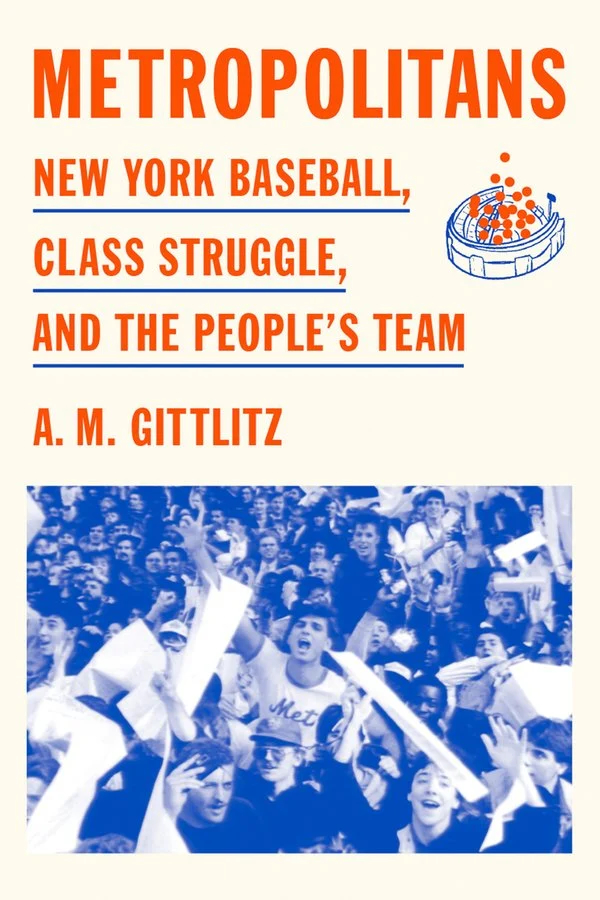
Metropolitans: New York Baseball, Class Struggle, and the People’s Team
Before he became the celebrated columnist who chronicled the tumult of the 1960s through the lens of a working-class New Yorker, Jimmy Breslin was a sportswriter. While reporting for the New York Journal-American and later freelancing for magazines, his milieu was stinky stables and sweaty locker rooms, populated by weather-beaten horse trainers and weaselly bookies.
In 1962 Breslin turned to the New York Mets. “Worst Baseball Team Ever,” proclaimed the title of his piece in Sports Illustrated. That inaugural season, the new expansion franchise went 40-120, a record-shattering mark of futility. Yet the Mets were stocked with delights: the bumbling first baseman “Marvelous” Marv Throneberry, the ancient and hilarious manager Casey Stengel, the fans who screamed “Let’s Go!” in the ninth inning of yet another blowout loss. When Breslin titled his short, jaunty book about these Mets, he borrowed an alleged quote from Stengel: Can’t Anybody Here Play This Game?
Breslin’s book opens with the scene of a construction worker helping to build Shea Stadium, balancing on a 500-foot-high beam. As it continues, it drips with bitterness at baseball’s oligarchs, who manufactured the exodus of the New York Giants and the Brooklyn Dodgers. And yet it smiles upon the lovable losers—not just the Mets, but also the fans.
“This is a team for the cab driver who gets held up and the guy who loses out on a promotion because he didn’t maneuver himself to lunch with the boss enough,” he writes. “It is the team for every guy who has to get out of bed in the morning and go to work for short money on a job he does not like. And it is the team for every woman who looks up ten years later and sees her husband eating dinner in a T-shirt and wonders how the hell she ever let this guy talk her into getting married.”
The New York Mets, insisted Jimmy Breslin, were the team of the people.
• • •
A.M. Gittlitz carries this idea into new waters. His book, Metropolitans, tells an alternative history of the New York Mets, through the lens of class struggle. Extensive and educational, entertaining and exasperating, it employs the team as a vehicle of left-wing politics, while prodding at the cultural conservatism associated with the national pastime.
Gittlitz realizes that he is challenging the traditional leftist critique of sports as a mass spectacle that dulls the revolutionary impulse. He admits, moreover, that “the people” are not the same as “the left”: A history of American populism has to account not only for William Jennings Bryan and Huey Long, but also George Wallace and Donald Trump.
A poll in 2020 found that the Mets had the highest percentage of fans who identified as Democrat (42 percent) and the second-lowest as Republican (28 percent).
Yet Gittlitz invests this endeavor with personal meaning. As a teenager in the New York suburbs during the heyday of Derek Jeter’s Yankees, his Mike Piazza jersey not only elicited jeers of “Mets suck!”, but also marked him among “the mall-goths, weebs, juggalos, and Magic: The Gathering players in black Hot Topic tees sporting nu-metal album covers or non-sequitur rebellious slogans like Normal people scare me.” His fandom withered as he became a Brooklyn-based anarchopunk organizer in the Occupy movement. Yet by the Mets’ thrilling pennant run in 2015, he found himself peering through bar windows, checking the score before hopping back on his bike to deliver fried chicken around Williamsburg.
In Metropolitans, Gittlitz casts the Mets as the counterpoint to the leviathan Yankees, as well as the jester in baseball’s staid court. In the 1960s, Shea Stadium lent a home to countercultural fandom, while hosting baseball’s versions of civil rights and anti-war protests. Even in the twenty-first century, when the franchise is owned by billionaires with dubious ethics, strands of that ethic survive. A poll in 2020 found that the Mets had the highest percentage of fans who identified as Democrat (42 percent) and the second-lowest as Republican (28 percent).
While Gittlitz gives the Mets his renewed devotion, he seeks to reframe the history of a sport steeped in tradition. “I am a writer and a Mets fan,” he states, “and this book’s task has been to rewire readers’ brains to enjoy baseball in a more radical way.”
• • •
Metropolitans is divided into three sections. The first predates the Mets, reaching back to the nineteenth century. It tells the history of New York baseball as an allegory of class conflict. The original “Mets,” in fact, were the Metropolitan Club, formed in 1880 by John Day, an agent of the Democratic political machine Tammany Hall, and John Mutrie, a populist “dude” who fancied a “people’s team” that catered to the working class with cheap tickets and Sunday games. Yet the short-lived squad’s best players moved to the Gothams, who played in the more stable, respectable National League.
Gittlitz’s evidence can appear selective, with his analysis serving his political ends. Babe Ruth had common-man appeal, for sure, but he was also a capitalist phenomenon, with a populist heroism fashioned by ghostwriters. His booming celebrity served to mass-market consumer goods from breakfast cereal to chewing gum.
In Gittlitz’s eyes, this class dynamic infused baseball from its origins. The early player-run teams contained a “hipster exuberance,” but succumbed to the money-driven professional game. The Brooklyn Dodgers of the early twentieth century illustrated “an American dream of classless community, where labor was play, and the highest value produced was collective pride.” Most notably, he casts Babe Ruth as a working-class hero, living the dreams of the common man while flouting bourgeois propriety. “While America would never have a political Lenin,” he writes, “Ruth served as his athletic equivalent.”
A touch overheated, no? Gittlitz’s evidence can appear selective, with his analysis serving his political ends. Babe Ruth had common-man appeal, for sure, but he was also a capitalist phenomenon, with a populist heroism fashioned by ghostwriters. His booming celebrity served to mass-market consumer goods from breakfast cereal to chewing gum. Gittlitz’s avowedly radical approach melts away some of that historical complexity. It runs the risk of substituting one myth for another.
Metropolitans nevertheless sharpens a focus on the class and cultural tensions that animated baseball’s rise as the nation’s pre-eminent spectator sport. Take the “Bums” who cheered for the Brooklyn Dodgers, with their underdog resentments of the dynastic Yankees, their embrace of pioneering Black superstars such as Jackie Robinson, and their anguish at the franchise’s 1957 departure for Los Angeles. In those dark days before the exodus, one activist group proposed a boycott until fans could purchase the team. Their pamphlet proclaimed: “Dodgers Fans of the World, Unite!”
The endeavor failed, of course. New York City needed a new team of the people. Five years later, it arrived.
• • •
Gittlitz calls the second section a “spiritual fan history.” It spans the Mets experience from the inception of the major league franchise through the sloppy aftermath of its World Series triumph in 1986. Borrowing from Carl Jung, he considers its players, writers, and fans as “tortured heroes eternally journeying in the Yankees’ kingly shadow,” playing “the iconoclastic trickster profaning baseball traditionalism.”
They called themselves “the New Breed,” a type of sports counterculture, with irreverent dismissals of baseball’s conventions. The uniforms and “Mr. Met” had pop art vibes. The cast-offs on the roster somehow became folk heroes. The wobbly ramblings of manager Casey Stengel weaved nonsense into poetry. The crowds—old Giants and Dodgers fans, new hipsters, happy kids, angry drunks—took an ironic delight in the team’s terribleness. Young sportswriters mined them all for stories.
Robert Moses’s massive, multi-purpose, brutalist Shea Stadium accommodated the political turmoil of the Sixties, starting with CORE protests during the 1964 World’s Fair. Baseball enthusiasts had long lauded the ballpark as an oasis from social troubles, but in the late 1960s, the Mets voted to postpone a game after Robert F. Kennedy’s assassination, and Tom Seaver offered an anti-war public statement in conjunction with the 1969 Moratorium Day demonstrations.
“Much of the New Breed had become the New Left,” writes Gittlitz. In his telling, the team and its followers had coalesced around a rebellious ethic, imagining a more peaceful and equal society. This vision achieved its highest expression with the Mets’ improbable triumph in the 1969 World Series. In radically spiritual circles, “the Tet Offensive, Woodstock, Stonewall, and the Miracle Mets provided equal confirmatory signs of this coming messianic Age of Aquarius, in which the last shall be first.”
Again, it can seem like a bit much. The average Mets fan was celebrating an incredible evolution from worst to first, not envisaging a society free from capitalist, imperialist, and racist oppression. Yet Gittlitz possesses an undeniable talent for weaving the Mets story into the fabric of an urban narrative. He centers the experience of fans who read larger meanings into a team that, at times, popped out from behind the Yankees’ shadow.
As Gittlitz paints it, the plight of a struggling, crime-stricken “Fear City,” marked by the flight of White residents and working-class jobs, was mirrored in the struggles of the Mets during the 1970s. In the Yuppified 1980s, as wealthy investors boosted the franchise, a democratic sensation again filled Shea Stadium, with fans inventing custom chants, unfurling banners, and fashioning K’s out of tape to record strikeouts.
The average Mets fan was celebrating an incredible evolution from worst to first, not envisaging a society free from capitalist, imperialist, and racist oppression. Yet Gittlitz possesses an undeniable talent for weaving the Mets story into the fabric of an urban narrative.
Metropolitans posits the mid-1980s Mets as the reincarnation of the people’s team, pulling together “two seemingly contradictory elements of the countercultural working class—the “real” New Yorkers who had survived the arsonous decay and depopulation of the seventies, and white flight’s returning children.” They rallied around an extraordinary, combustible team of fast-living, ill-fated stars including Darryl Strawberry and Dwight Gooden.
Gittlitz describes not only the Mets’ exciting World Series comeback victory in 1986, but also the messy aftermath. The Mets, in time, scrubbed the roster of players with chaotic and self-destructive behavior. By 1991, when the team fell to fifth place, the old populist spirit was dissolving away. The modern, corporate age of global capitalism chiseled at Gittlitz’s faith. It was getting harder to believe in a working-class revolution, and it was getting harder to be a Mets fan.
• • •
The final section of Metropolitans is the most personal. Gittlitz has attached himself to a team prone to late-season collapses and playoff disappointments. Meanwhile, a host of social justice movements have collapsed, while American politics got darker. He cannot help seeing the parallels: “We cling to a franchise that we know is likely doomed, racing toward defeat again and again in hopes for an October revolution that may never arrive.”
From Gittlitz’s perspective, the Mets represent the excesses of capitalism run amok. One owner, Fred Wilpon, was among the biggest investors in Bernie Madoff’s Ponzi scheme, which crumbled the team’s fortunes in the early 2010s. The latest owner, Steve Cohen, is dogged by accusations of massive financial improprieties.
And yet, Gittlitz nevertheless conjures portents of democratic hope. The Mets lost the 2000 “Subway Series” to the Yankees, but in comparison to his bat-tossing troglodyte nemesis Roger Clemens, Mike Piazza could only be the people’s hero. In ensuing years, Latino stars such as Pedro Martinez and Carlos Delgado drove the team’s revival. In 2012, the introspective knuckleballer R.A. Dickey overcame a past of abuse and poverty to win the Cy Young Award. Gittlitz attributes the team’s march to 101 wins in the 2022 season to a “militant confidence” powered by a “spirit of solidarity” in the wake of a successful push by the Players Association to unionize minor leaguers.
These efforts to interpret a baseball team through the lens of class struggle are strained. And yet, they are charming. The epilogue of Metropolitans is a diary of the 2024 season, centering upon a subversive, hipster fan culture, best evidenced by the appropriation of the McDonald’s mascot Grimace into a combination good-luck charm and folk idol. This diary lacks the specificity and sharpness of Gittlitz’s better writing, and it could have been cut. It nevertheless reinforces a key thread in the book. If the team’s twenty-first-century owners have shrouded the legacy of the New Breed, the spirit survives in these irreverent, democratic expressions. Like any good radical, Gittlitz sees power in the people.