How, After World War II, Vietnam Became the Graveyard of Empires
A new book provides a detailed view of the rise and fall of South Vietnam’s President Diem, which coincided with the rise and fall of President Kennedy.
By Gerald Early
June 4, 2026
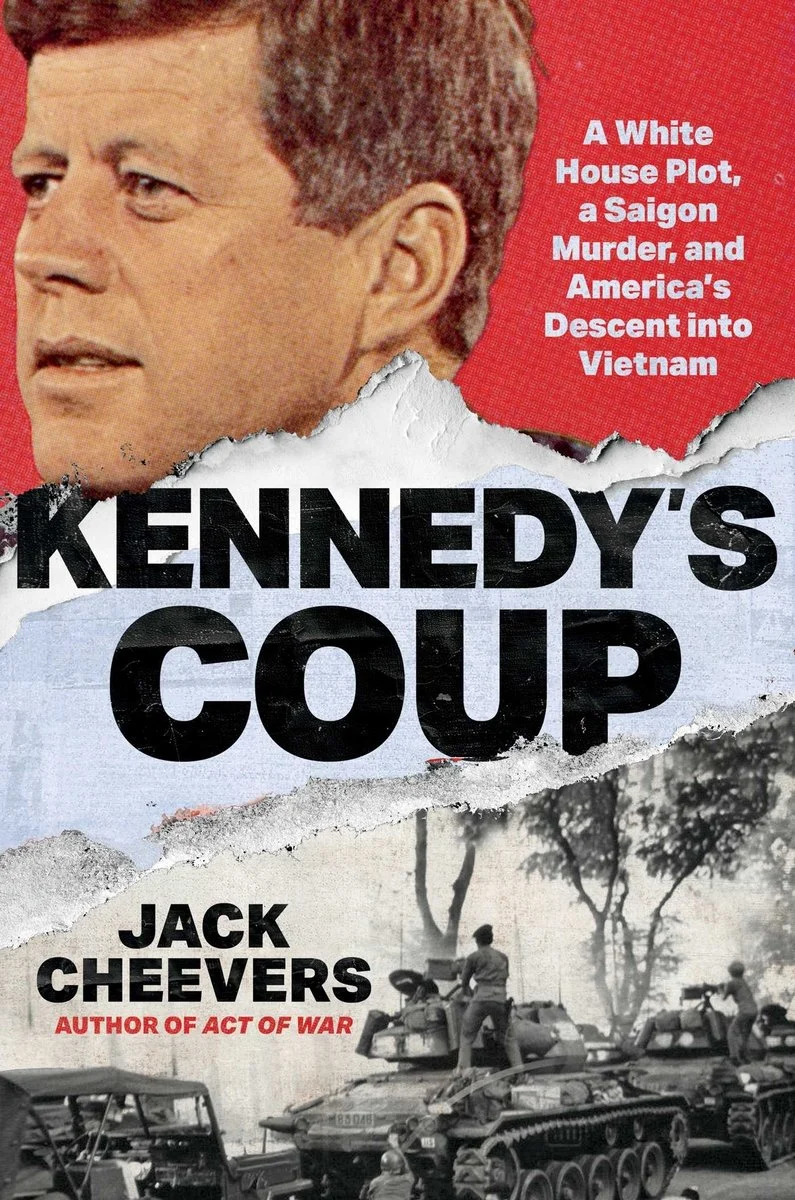
Kennedy’s Coup: A White House Plot, a Saigon Murder, and America’s Descent into Vietnam
That is invariably the case in the East; a story always sounds clear enough at a distance, but the nearer you get to the scene of events the vaguer it becomes.
—George Orwell, “Shooting an Elephant”
Riding the tiger
In his January 20, 1961, Inaugural Address, John F. Kennedy declaimed, “To those new states whom we welcome to the ranks of the free, we pledge our word that one form of colonial control shall not have passed away merely to be replaced by a far more iron tyranny. We shall not always expect to find them supporting our view. But we shall always hope to find them strongly supporting their own freedom–and to remember that, in the past, those who foolishly sought power by riding the back of the tiger ended up inside.”
Just a few weeks earlier, on January 6 (Jack Cheevers in Kennedy’s Coup mistakenly gives the date of January 9 on page 185), Soviet Premier Nikita Khrushchev gave his “wars of liberation” speech, which so affected Kennedy that he memorized portions of it and made sure his senior staff people read it as well. Clearly, Kennedy thought it was a defining statement of the times and that the United States needed to take countermeasures against the communists’ ambitions in colonized countries, posing themselves as their champions. As Cheevers writes, “Kennedy recognized wars of national liberation as a new form of aggression that had to be confronted with new tactics.” (185) For Khrushchev was confident that the communists would win because of the breakup of the colonial system and the falling prestige of the West, which was both the cause and result of the anti-imperialism of the world of color. What else was the 1955 Bandung Conference (the Afro-Asian Unity Conference), which birthed the Non-Aligned Movement, supposed to signify? He was, in effect, saying that communism, to borrow a phrase the American liberals and left like, was on the right side of history. Khrushchev described three types of modern warfare: world wars, which he felt must be avoided at all costs; local or limited wars, which he deplored; and wars of liberation or nations throwing off their imperialist overlords, which he favored. Khrushchev said:
“There will be liberation wars as long as imperialism exists, as long as colonialism exists. Wars of this kind are revolutionary wars. Such wars are not only justified, they are inevitable, for the colonialists do not freely bestow independence on the peoples. The peoples win freedom and independence only through struggle, including armed struggle.
“Why was it that the U.S. imperialists, who were eager to help the French colonialists, did not venture directly to intervene in the war in Viet Nam? They did not do so because they knew that if they gave the French armed assistance, Viet Nam would receive the same kind of assistance from China, the Soviet Union, and the other socialist countries, and that the fighting could develop into a world war. The outcome of the war is known—North Vietnam won.
“A similar war is being waged in Algeria today. Or take Cuba. A war was fought there too. It began as an uprising against a tyrannical regime, backed by U.S. imperialism. Led by Fidel Castro, the people of Cuba won.
“Is there a likelihood of such wars recurring? Yes, there is. Are uprisings of this kind likely to recur? Yes, they are. Is there the likelihood of conditions in other countries reaching the point where the cup of popular patience overflows and they take to arms? Yes, there is such a likelihood.
“What is the attitude of the Marxists to such uprisings? A most favorable attitude. The Communists support just wars of this kind wholeheartedly and without reservations, and they march in the van of the peoples fighting for liberation.”
Notice that Khrushchev mentions Vietnam’s 1954 victory at Dien Bien Phu over the French, who wanted to reassert their colonial control over Indochina after World War II ended. The Viet Minh sort of won its war of independence, and the French sort of pulled up stakes. The Viet Minh, who would be renamed the Viet Cong, would be a thorn in the side of the Americans throughout the 1960s and into the 1970s. Cuba and Fidel Castro, who will also long prove to be a thorn in the side of the Americans, were mentioned too. And it would only be in a few short months, April 1961, that Kennedy would launch the Bay of Pigs fiasco, which made him gun-shy about intervening in “wars of liberation” when the communists had the upper hand in propaganda and when he was unsure how much and what type of military force was required to win. But contrariwise, it also made him even more determined to be the tough Cold Warrior and contain communism’s advance on his watch. Could he afford to be the president who “lost” Vietnam? And Vietnam would dominate Kennedy’s foreign policy concerns, particularly in the last year of his life. With his administration’s severe division over how to proceed in Vietnam, it might easily be said that Kennedy wound up riding the tiger, wanting to stay on while trying desperately to figure out how to get off. The mistake everyone makes in riding the tiger is the illusion that the tiger can be controlled. That is why, sooner or later, the riders want off the tiger: because the tiger cannot control it. But one can control it better by being on it than getting off.
By March 1961, the Joint Chiefs of Staff, learning the lesson of the Korean War (1950-1953), was adamant that the United States should never fight a limited land war in Asia again. Either such a war should be unlimited in military options or should be avoided altogether. Kennedy was told that to prevent the communists from taking Laos, as “the fall of Laos would mean the collapse of all of Southeast Asia,” Cheever writers, it would mean a commitment of American armed forces, either limited, which would likely fail, or at best produce another stalemate like Korea, or unlimited, which was likely to produce World War III. “Neither of these potential scenarios appealed to President Kennedy, nor did the political cost of being the president to lose Southeast Asia,” writes Geoffrey Shaw in The Lost Mandate of Heaven: The American Betrayal of Ngo Dinh Diem, President of Vietnam. (Ignatius Press, 2015, 94) Kennedy, alas, was afraid that either way he would wind up inside the tiger, even if he could manage to stay on it. Riding the tiger was about the dilemma of losing disguised as winning because one is committed to a course of action. In short, it is winning while losing.
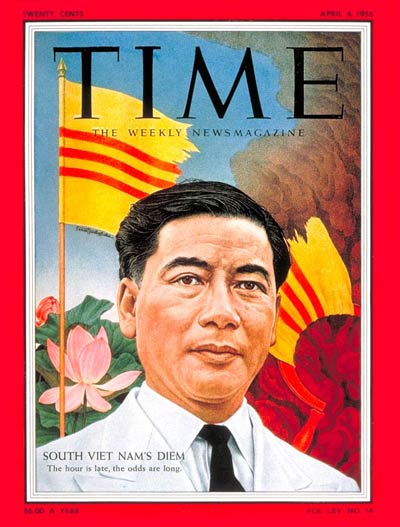
In 1961, Kennedy’s warning of “riding the tiger” might have been directed to Castro and Cuba, Nkrumah and Ghana, Laos, which outgoing President Eisenhower felt was the linchpin to keeping all of formerly French Indochina from falling to the communists (the Domino theory), or Indonesia. If the young president had said this in a speech in the summer of 1963, he probably would have been referring to South Vietnam’s prime minister and strongman Ngo Dinh Diem. In 1961, Kennedy asked Frederick Nolting, the U.S. ambassador to South Vietnam, to evaluate the viability of Diem as “someone Washington could work with,” writes Cheevers in Kennedy’s Coup (30), and Nolting responded that the United States should back Diem “to the hilt.” (30) Nolting would support Diem to the bitter end, when the president would fall out with the American government and ultimately be overthrown and assassinated in a coup in which the United States was complicit. Kennedy felt he could not win in Vietnam with Diem in power. Howard Jones noted in his Death of a Generation: How the Assassinations of Diem and JFK Prolonged the Vietnam War (2003, Oxford University Press) how the relationship between Kennedy and Diem resembled that of Henry II and Becket, with Kennedy finally crying out, “Will no one rid me of this turbulent priest?”(455) Four more coups would occur in South Vietnam after the death of Diem in 1963 and the ouster of General Khanh in 1965. The Americans discovered that without some semblance of stability they could not win without Diem, but alas, Diem was dead by then. The Americans realized that South Vietnam was not a place. It was never a place, but rather a political aspiration that was largely an expression of Diem’s will and imagination.
With his administration’s severe division over how to proceed in Vietnam, it might easily be said that Kennedy wound up riding the tiger, wanting to stay on while trying desperately to figure out how to get off. The mistake everyone makes in riding the tiger is the illusion that the tiger can be controlled.
Diem grew to hate the Americans as much as many of them grew to hate him. For him, riding the tiger was accepting the aid of the Americans while also being bullied by the advice and handcuffed by the strings that went with it. He could not beat Ho Chi Minh, the president of North Vietnam and the Viet Cong, without the help of the Americans, and, as he began to realize all the more, he could not, seen as a puppet of the Americans by his people, beat Ho with the help of the Americans. If, by 1963, Kennedy wanted a way for America to get out of Vietnam, Diem equally wanted them gone as well.
All coups look alike to me
Diem, short by American standards at 5 feet, 4 inches, was a chain-smoking workaholic, a deeply devout Catholic, who once thought of becoming a priest. One of his brothers, Ngo Dinh Thuc, was the Archbishop of Hue, the Vietnamese city where Diem grew up and which proved Diem’s undoing during the Buddhist uprising of 1963. The family paid a price for their Catholicism as it was associated with the oppressive French colonizers during the colonial period of 1887 to 1954 (with an interruption during the Japanese occupation of World War II). Catholicism also explains Diem’s intense anti-communism. Diem was well-educated, of both a scholarly and ascetic inclination, the latter being highly regarded by the Vietnamese during Diem’s halcyon days as president. Cheever tells the reader that “Hue’s people were the proud puritans of South Vietnam.” (7) Hue was the tradition-bound, self-righteous nun; Saigon was the worldly and morally bent courtesan.
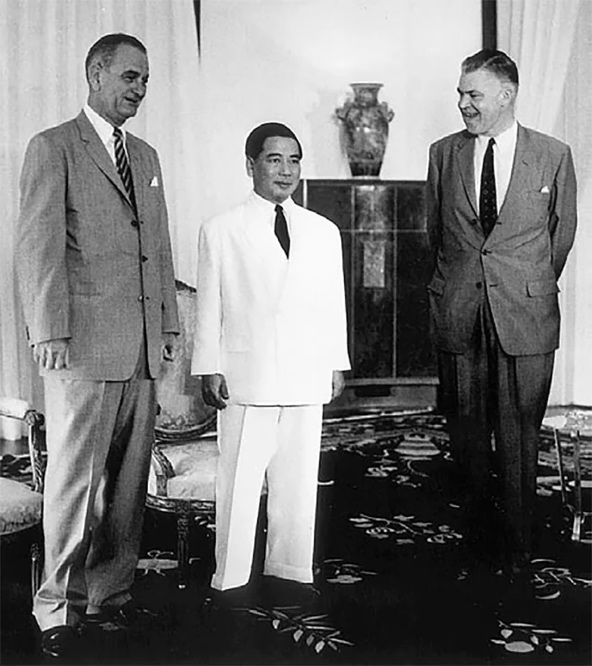
“Like many Vietnamese,” Cheevers writes, “[Diem] also embraced Confucianism, with its emphasis on obedience to family, the immutability of the social and political order, and the subordination of individual rights to collective welfare.” (47) When Diem became president, he made Confucius’s birthday a national holiday. He felt himself the embodiment of Vietnamese tradition and destiny and was convinced that the Americans never understood his country or him. He was not an Asian neoliberal and did not want the United States to make him such.
Oddly, Diem was disliked by South Vietnam’s professional and intellectual elite. As Cheevers writes, “In cable after cable, Washington instructed [ambassador] Nolting to prod Diem to broaden his government, to bring in other respected figures who could enhance his standing with his people. But the ambassador discovered that many South Vietnamese who could fill such a role—lawyers, doctors, academics, businessmen—held Diem in contempt. They attacked him in letters to Saigon newspapers and in café conversations with American journalists. To Nolting, they seemed like an unusually cliquish group; many had been trained in Paris and lorded their advanced degrees over those with less education.” (30) The important point here is that Diem never went abroad for his education. In this sense, he was never deracinated. As Marguerite Higgins wrote in Our Vietnam Nightmare (Harper and Row, 1965), “Part of the trouble with the Vietnamese intellectuals is that they have lost a sense of national identity. They seem uprooted, unsure, alienated, because of their French educations, which for so long were the only road to advancement, have also, in many cases frayed or severed altogether their deep taproots to their own profoundly Confucian culture. By the end of World War II, disobedience had become a virtue, anarchy a way of life.” (39) Despite his Catholicism, Diem was not an assimilated Asian at war with himself over his assimilation. He was and had always been a committed nationalist with a deep sense of his country’s culture and worth. “Much of his adult life had been devoted to getting the French out of Vietnam and guiding his country to independence,” writes Cheevers. (31) Ho Chi Minh’s agents captured Diem in 1946. Ho had Diem’s oldest brother, who had served as a provincial governor under the French, buried alive. Ho asked Diem to join his new government. Diem refused; after all, Ho had his brother murdered and Diem’s library of thousands of books burned to ground. Ho let Diem go, which he later regretted. Maybe Ho felt that Diem was not a French collaborator. In fact, the Vichy government considered Diem a subversive. As for the Japanese, “Diem and other Vietnamese nationalists had long regarded Japan as a model for Asian nations that sought to modernize without first undergoing a degrading interregnum of European colonization,” writes Cheevers. (52) Maybe Ho felt that killing Diem would have embittered Catholics and non-communist nationalists. In any case, Ho felt the Americans did him a big favor when they encouraged Diem’s overthrow in November 1963.
Diem grew to hate the Americans as much as many of them grew to hate him. For him, riding the tiger was accepting the aid of the Americans while also being bullied by the advice and handcuffed by the strings that went with it.
Diem was garrulous almost to the point of compulsion. He was known to talk for hours without let-up. When he first met Nolting, he, Cheevers noted, “launched into a monologue that lasted six hours.” (27) Some Americans thought these flights of rhetoric were long-winded sermons and Kennedy’s Assistant Secretary of State for Far Eastern Affairs famously (or infamously) turned off his hearing aid and feigned sleep while Diem talked, much to the latter’s displeasure.
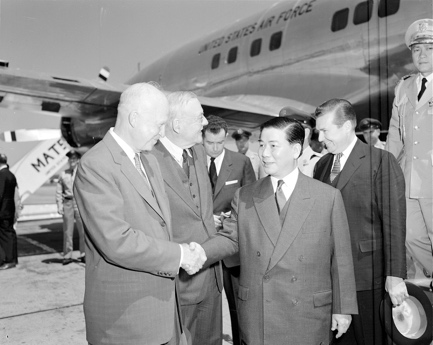
By 1956, Diem had succeeded in getting all French troops removed from South Vietnam, held a referendum that had him elected president and removed Bao Dia as the symbolic emperor, and began an anti-vice campaign to remove all vestiges of French colonialism from his country by stamping out prostitution, alcoholism, drug addiction, and organized crime. In 1957, when Diem visited the United States and President Eisenhower met him at the airport, a surprising thing for an American president to do, the Vietnamese president was “our miracle man in Asia.” If anyone was going to stem the tide of the Communists in Asia, it was this small, disciplined, habit-bound man who looked upon the crowd of Americans who lined the sidewalks as he drove in a motorcade to the White House with Eisenhower with stony indifference. He did not do crowds.
Cheevers’s monumental book, while it provides the background to events and characters that principally occupy its pages, is an incredibly detailed account of 1963, which ended with the assassinations of Diem and his brother, Ngo Dinh Nhu, State Counsellor who held no formal position but wielded enormous power under Diem, on November 2, 1963, in a military coup. For the Americans, Diem’s brother, who could be especially brutal, seemed even more of a problem than Diem himself. When Americans pressured Diem to get rid of Nhu (with an ambassadorship), which would also have gotten rid of his troublesome, outspoken wife, Madame Nhu, who, at one point, was more talked about in America than either her husband or her brother-in-law, Diem refused. Nineteen sixty-three also ended with the assassination of President Kennedy. Diem and Kennedy died within three weeks of each other. Were these murders connected? Was it karma? The former was a coup. Many have suspected the latter of being a coup too. The official, government-sponsored account of Kennedy’s assassination was that it was definitely not a coup, which has, in fact, convinced many people that it must have been. The murders wound up binding the United States and South Vietnam in a ten-year, misbegotten military and political adventure of bloodshed, catastrophic waste and ruin, and finally defeat that cost both countries dearly.
Cheevers begins with the story of the police murders of Buddhist monks in Hue that trigger the Buddhist uprising against the Diem government, which included the self-immolation of Buddhist monks in the summer of 1963, although Diem was not anti-Buddhist, as a later United Nations report would make clear. But the Buddhist crisis did not end with the death of Diem, an overthrow which apparently many Buddhists wanted. Diem wanted all the religions of Vietnam treated equally and none to see themselves as above Vietnamese nationalism or the face of Vietnamese nationalism. His government was not heavily tilted toward Catholics. Cheevers tells about the rising Vietcong insurgency in the countryside; the ineffectiveness, at times, the incompetence, of the South Vietnamese military; the recalcitrance of American reporters—especially David Halberstam—and how the closer they saw things, the more distorted it became; Diem and Nhu’s heavy-handed and self-defeating response to the reporters they did not like; the growing disintegration of Diem’s government, especially under U. S. government pressure for Diem to moderate his authoritarian ways. Diem was convinced that the only way he could hold South Vietnam together was through authoritarian means that liberal Americans did not seem to understand. He felt that Americans were too concerned that it made them look bad to support his government in the way he wanted to run it. Or perhaps the Americans would have been less critical had Diem been more successful in stopping the communists. But Diem was trying to make a viable country or political entity from an arbitrary, temporary division that divided Vietnam, ending the colonial war between the French and the Viet Minh, both sides having exhausted themselves in the conflict. The Geneva Accords, which Diem did not sign, had mandated an election to unify the country in 1956, which Diem did not honor, claiming that Ho would never permit a fair election in North Vietnam. He was going to reunite Vietnam on his terms because he had inherited the mandate of heaven, “an ancient Confucian concept that held that a sovereign was the mediator between heaven and earth, entitled to rule as long as he was personally virtuous and his reign benefited the people,” Cheevers writes. (76)
Diem and Kennedy died within three weeks of each other. Were these murders connected? Was it karma? The former was a coup. Many have suspected the latter of being a coup too. The official, government-sponsored account of Kennedy’s assassination was that it was definitely not a coup, which has, in fact, convinced many people that it must have been. The murders wound up binding the United States and South Vietnam in a ten-year, misbegotten military and political adventure of bloodshed, catastrophic waste and ruin, and finally defeat that cost both countries dearly.
Concerning the communists, the only concern of the Americans, Diem and his brother thought they were successful in containing the communists, and in some ways they were right. “Had Diem and Nhu remained in power, it’s likely they would have strongly resisted the introduction of large numbers of U. S. troops in 1965,” Cheevers concludes. (608) Ironically, the United States was complicit in killing the very leaders who would have kept them out of the war.
Cheevers gives a blow-by-blow account of Kennedy’s meetings with his wise men about Vietnam. The president grew increasingly frustrated with the infighting among his advisors, who could not come together on a coherent approach to the Vietnam problem. The leaks, the battles, and the undermining, fatigued and angered Kennedy. But he was also part of the problem as he did not adopt a course and tell his advisors to get behind it. As Cheevers writes, “JFK’s lackadaisical encouragement of the fatal overthrow of a close ally during wartime was the product of shortsightedness, indecision, and paralyzing bureaucratic quarrels. It’s one of the ironies of his presidency that while he hoped to get the United States out of Vietnam, he failed to perceive that the coup could produce the opposite result: deeper American entanglement in the war.” (608)
Cheevers does not cover anything new. Other books examine the same subject, though none are quite the same sort of synthesis this book is, a massive history that reads a bit like a massive novel. Indeed, as the accumulation of detailed narrative mounts, the reader finds it more unreal and unfocused, as if, as George Orwell said, in Asia, the closer and more finely tuned the view, the vaguer it gets.
Shooting the elephant
On October 27, 1961, in the concluding speech of the “Programme (sic) of the Communist Party of the Soviet Union,” Nikita Khrushchev offered this analogy about the relationship between the western (imperialist in Communist speak) countries and the countries the imperialists prey upon. It seems almost a reply to Kennedy’s analogy of riding the tiger:
“The predatory aspirations of the imperialists, who are intent on redividing the world and enslaving other peoples, are checked by the invincible forces of the world socialist system, above all, of the Soviet Union. These forces subdue the wolfish appetites of the imperialists. Hundreds of millions of people in the peace-loving countries, and in fact all the peoples, are championing peace. This is the important thing, and it has to be understood. Here is an example to make clear the idea I have just expressed. The tiger is a beast of prey and will be one as long as it lives. But a tiger will never attack an elephant. Why? After all, the flesh of an elephant is hardly less tasty than that of any other animal, and a tiger would probably not mind feasting on it. But it is afraid to attack the elephant because the elephant is stronger than the tiger. If a tiger were mad enough to attack an elephant, it would be sure to lose its life—the elephant would trample it to death. In films on Africa or Asia, you must have seen kings, princes, rajas, and other notables go tiger-shooting on elephants. They do so because they know that it is safe to hunt tigers in that way. To continue the simile, it must be said that the Soviet Union and the socialist world are today a tougher proposition for the imperialists than the elephant is for the tiger. Imperialism is much in the same position as the tiger.”
In Kennedy’s Coup, Cheevers tells the story of the Citadel, “a walled mini-city surrounded by moats” in the ancient imperial city of Hue where a succession of emperors lived with wives, concubines, armies, and “war elephants” and “caged tigers”:
“The emperors’ armies were backed on the battlefield by elephants, which could impale enemy soldiers with their tusks and scatter cavalry with their terrifying trumpets. The animals became royal favorites and emblems of imperial power. In a specially built arena, elephants and tigers battled to the death for the amusement of emperors and their guests. (The elephants routinely won, since royal keepers blunted the tigers’ teeth and claws.)” (7-8)
The elephants always won but they were fixed fights because of the elephants’ value as war weapons. What if the tigers had not had their teeth and claws blunted?
Besides, Khrushchev neglected this fact: as George Orwell knew so well, imperialists know how to shoot elephants. It is, as Orwell related in his famous essay, one of the ways they show their power to the colonized. And one of the shows the colonized expect.