Seeds Hear the Rain Sing
May 20, 2026
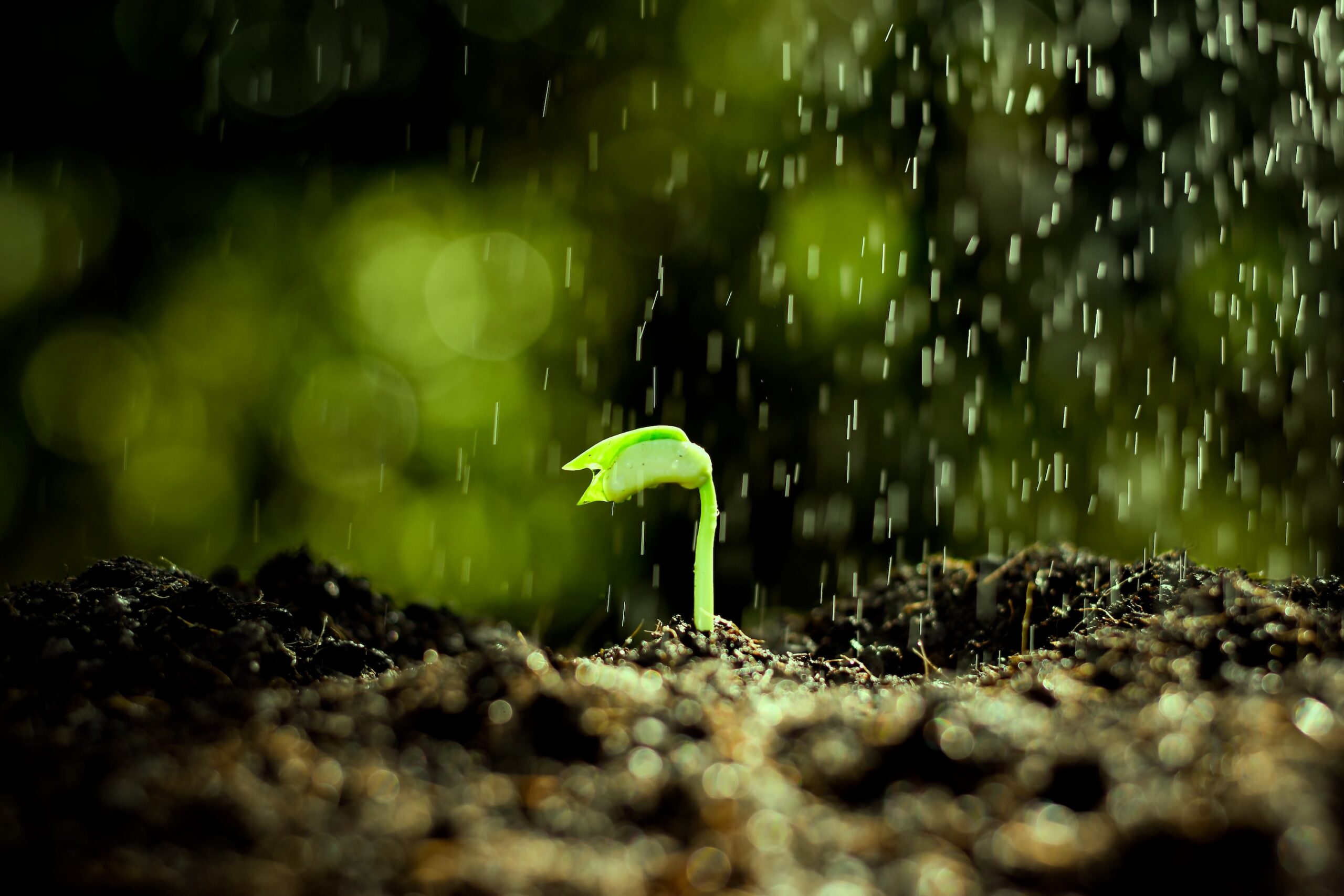
I could never live in the desert. Rain cleans my mind. That soft rinse sluicing down, soothing all that is dry or cracked or withering. Add thunder, and you have catharsis: any violent emotion can be released into that heavenly rage. And there is no comfort quite like cuddling close to your favorite person or critter on a stormy night, lamps aglow against the dark, all of you safe and sheltered. Such evenings are made for books, not the jangle and flash of screens that compete with the lightning.
Even seeds relish the sound of rainfall. Buried inches below the surface, they sense the drops. Researchers at MIT just completed a series of experiments showing that rice seeds sprouted faster to the sound of rainfall. Not the moisture—they are not yet thirsty—but the sound. It woke them from dormancy and made them eager to germinate. The researchers suspect that many similar seeds respond to the sound of rain in this way.
If you are picturing little jug ears on either side of the seed, it makes a good cartoon, but what actually happens is that the sound wave causes the seed’s surroundings to vibrate. The seeds feel the earth shake, or they feel the shallow water in which they are submerged begin to ripple. These auspicious vibrations can be strong enough to jostle the statoliths, which are dense, colorless, starch-filled structures that do all sorts of wonderful things, like transform kinetic energy and sense gravity. It is the statoliths that direct roots downward and stems upward. And when they get shaken up, that signals the seeds to sprout. A simpler version of falling in love?
Interesting, that my initial Romantic assumption—the sound of rain as a form of hope, promising refreshment for their seedlings and welcoming them to life—should be so wrong. It is not hope they sense, but a roughhouse taunt, shaking them out of slumber. Sometimes we need that, too. Years ago, watching my mom water delicate new plants, a little neighborhood boy announced, “If it’s shaking, it’s growing.”
Also, if a seed is close enough to the surface to respond to the rain’s soundtrack, it is at exactly the right depth to soak up moisture, which means it will be safe, well nourished, as it begins to grow. A clear biological advantage, then, this sensitivity to the environment. The study author, Nicholas Makris, ended an interview poetically, saying that this discovery “gives new meaning to the fourth Japanese micro-season, entitled ‘Falling rain awakens the soil.’”
Falling rain puts me to sleep. At bedtime, we nearly always choose the sound machine’s thunderstorm. I thought it was just the comfort of feeling cozy, safe, and dry that relaxed me. But a steady rain can reduce cortisol levels, slowing heart rate and lowering blood pressure. A recent study fond gentle rain to be the most effective, its forty to fifty decibels lowering stress levels up to 65 percent. I prefer our thunderstorm, though. It draws me in, surrounding me, drowning out lesser distractions.
The smell of rain is also delightful. Can the seeds sense that? Petrichor, such a cool word, naming the fresh, earthy reassurance of wet soil. Indian perfumers call it mitti attar and distill baked clay or soil into sandalwood oil to capture its scent. The original ingredients? Plant oils and the alcohols of tiny bacteria, their growth encouraged by the pre-rain humidity. When the drops fall and splatter, they release those fragrant aerosols into the wind. The scent is hopeful, unmissable when the rain follows drought. Our hungry ancestors would have been calmed by that rain’s promise.
Humans are more sensitive to the smell of rain than sharks are to blood.
Outside the window, I hear another sudden downpour and think of all the seeds that hear it, too. Just as I draw close to the fireplace in a cold rain, they respond to the sun that breaks through the clouds when the rain stops. Plants seem simple to us, but earlier cultures’ animism came closer to reality. In Beyond Nature and Culture, anthropologist Philippe Descola writes that in Amerindian culture, “Plants and animals possess…physicalities different from those of humans [but] most of them have so far preserved the faculties that they enjoyed before the split into different species. These faculties were subjectivity, reflective consciousness, intentionality, and ability to communicate in a universal language…. They are thus persons, clothed in the body of an animal or plant.”
I would not go that far, but they are certainly far more sensitive than I ever realized. Rather than wait passively, seeds are constantly sampling their surroundings, detecting specific wavelengths of red or far-red light that tell them whether they are buried far below the surface or near the surface, and whether they are in shade or sunshine. Subtle oscillations in temperature also help them figure out their own location. And their measurement of moisture is sophisticated enough to stop them from germinating too soon, fooled by a brief unreliable rainstorm or two. If they detect chemicals released by smoke, they germinate faster—do they want to make sure they are born before they burn up? As they grow, their roots choose the paths of least resistance, veering around obstacles. A plant’s electrical signaling system can be compared—loosely—to neural processes.
When I ask experts how a seed “chooses” when to sprout, I am rightly rebuked; they are not choosing, in our sense of the word. But they record layers of signaled information over time, until it reaches a certain threshold, and the result can look a lot like decision-making. I am pretty sure I used a similar process years ago, when I finally decided to quit a miserable job. I should have taken more cues from the seeds: they are careful not to germinate in a dry environment, and they listen for the rain.