AI and the Inhabited Body
April 25, 2026
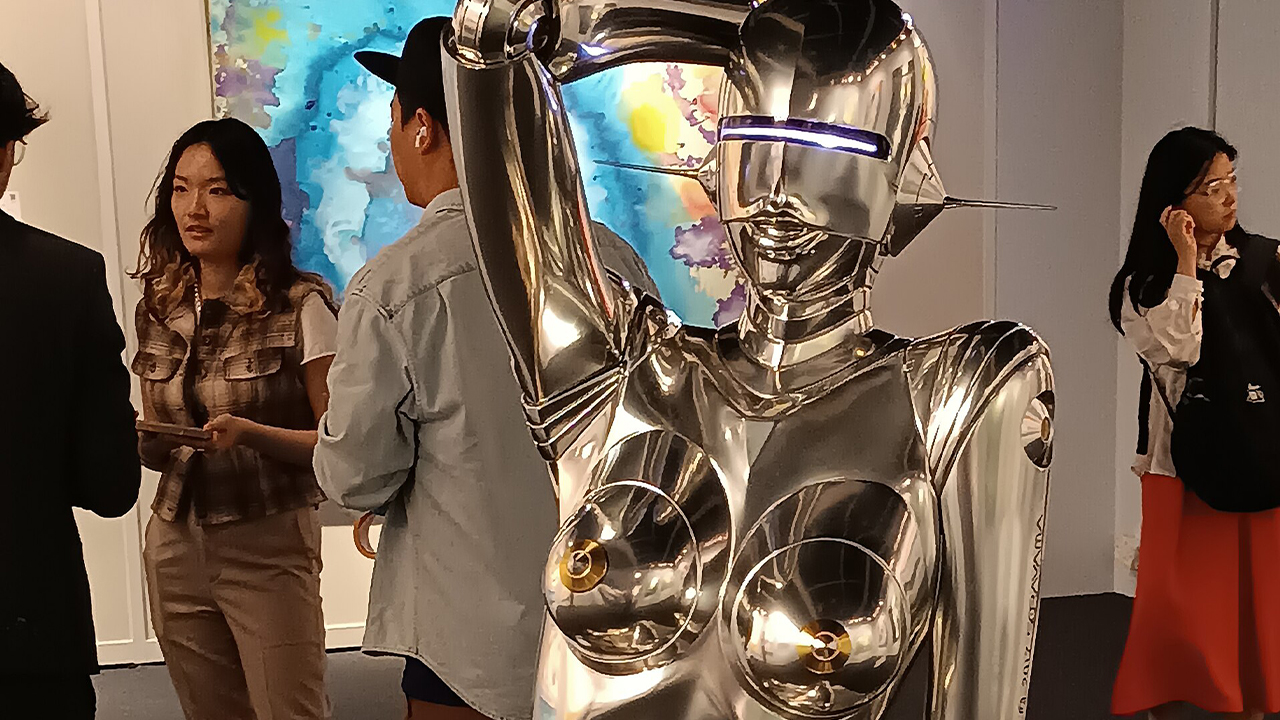
Marty, who tells me he works “in the tradition of pinup art,” but whom I would call a very soft pornographer, hopes to get to 10,000 followers on Instagram. That, he says, is where the real money starts, the kind of income “that lets you live middle-class anywhere in the world.”
“Anywhere?”I say. “Tokyo?”
He gets defensive and tells me I know nothing about social media.
Marty’s art is mostly AI slop of nonexistent women wearing bikinis and high heels in places that the generative AI thinks humans find romantic and/or classy, such as the middle of the Sahara or a busy French bistro. His women no longer have fourteen fingers, as they did just a couple of years ago, but he rues that the free version he uses of an AI model balks at anything too suggestive. It also will not make recurring characters, much to the disappointment of his followers—mostly bots and the grammatically challenged, who hope to develop meaningful, long-lasting relationships with particular nonexistent women by praising their beauty in the comments.
Marty has begun trying to trick the AI into doing what he wants by feeding it instructions disguised as what is being called “adversarial poetry”—his own doggerel, with enough figurative language and screwy syntax to make the AI think something else is going on. A study at the start of this year showed that “poetic framing” of requests tricked AI safety and propriety protocols, on average, 62 percent of the time. Marty thinks poetry works because AI has been trained on prose, even narrative, which may be part of the answer.
Poetry is a different embodiment in words of the experience of being human. AI does not (yet) understand the mysteries, perspectives, uncertainties, and feelings—the experience itself—of inhabiting a body in the physical world. The problem began being worked on in 1991; by 2021 embodiment was thought to be “key to the evolution of intelligence” by the Stanford Institute for Human-Centered AI (HAI).
The lack of understanding of embodied language also seems to be a possible reason for the terrible quality of AI-read texts, even at periodicals such as The New York Times. The music of the prose is badly off, to the point of distraction and changed meaning; there are mispronounced words; sometimes the AI seems too happy about disaster or snidely angry at nothing. These are not the honest and simple mistakes of second-language learners, e. g., who often get the important things exactly right, but in a conversation about, say, acidic soil, might lack the vocabulary and so substitute “sour earth” to make their point. That is human. That is ingenious. That is poetic. It is, as far as I know, beyond what an AI can do.
A Facebook friend recently posted a photo of a heroic mother cat and her nursing kittens rescued after Chernobyl. The accompanying, heartwarming story claimed a Russian soldier left his stew ration for the hungry cat, and that she chewed it to a paste and spit-fed it to each of her kittens to help them survive. Cats are not birds or apes. Picture and text were both AI slop that did not understand. Animals eat differently, so metaphors of selflessness will look different.
Poetry—the rhythms, sounds, structures, and metaphors of a body—is, in part, the point of education, not the hack.