How Shopping Became Miserable
June 24, 2026
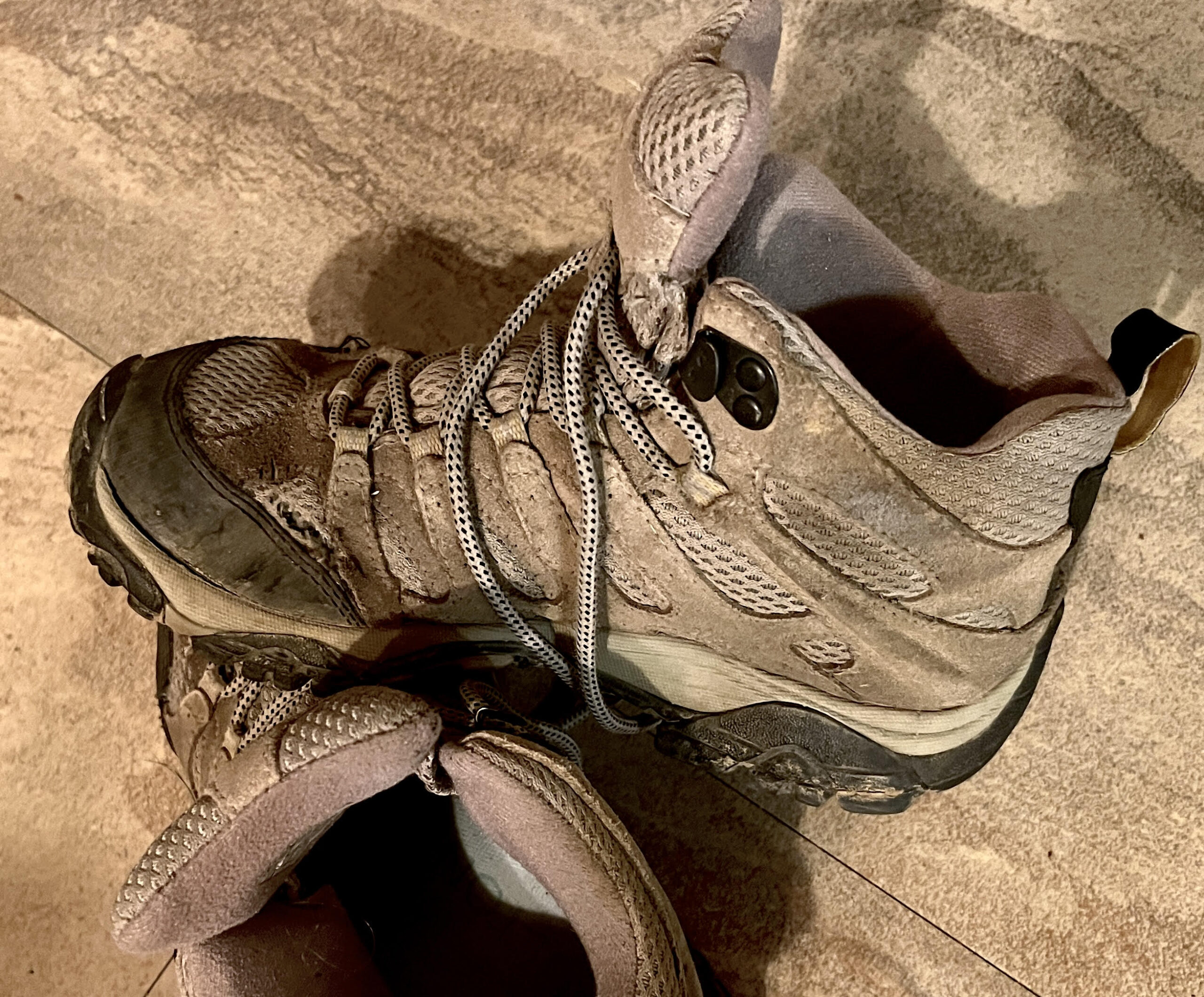
One foot on a tangle of tree root, I looked down at my beloved Merrell hiking boots and noticed big, frayed holes on both sides. Time to spring for a new pair. To be loyal, I went—in the flesh—to REI, but they had only waterproof hiking boots. “Tariffs,” muttered the salesperson.
This might be harder than I thought. I tried Lorrie’s, where I was informed that they never carried anything but waterproof, and it really was best, otherwise my boots would smell.
I came home and took a big sniff. Just a little cedary and muddy. And I like getting my boots wet in a cold creek, and my feet breathe in giant gulps. Still, I finally caved and ordered a Merrell waterproof pair, on sale, online.
They were hot and stiff. I wore them just often enough to be sure they would not give—which was just often enough to make a return impossible. At night, a sharp pain in my right foot woke me. I had sized up, per the online comments, but now my shorter foot was being pushed up to the narrow top. Also (I read), Merrell had changed its “last,” so the shaping did not fit my foot as well as it used to.
Just in case, I had my feet measured. Sure enough, on top of the changed fit and misleading comments, my feet had spread like a duck’s, and I probably needed a wide. Which was even harder to find in my size, let alone a breathable fabric. I scrolled past so many “waterproofs,” I was hallucinating “whiffenpoof.”
The point is not to inflict my mundane desperation. The point is that this is the consumer world today. We are no longer spoiled for choice. We can no longer walk in anyplace and expect inventory. The stuff we really want is often no longer being made. And every purchase requires research.
Frustrated by my first-world problem, I asked Chatgpt why I could not find breathable boots.
“Many experienced hikers are frustrated by exactly the same thing,” it replied.
Then why, in a capitalist economy, would shoe companies not respond?
“A few reasons: Waterproof boots are easier to market. ‘Waterproof’ is a simple, appealing feature. Someone trying on boots in a store immediately understands the benefit: my feet won’t get wet. Breathability is harder to explain.”
Good God. Are we that stupid?
“The average buyer isn’t doing long-distance backpacking or hiking several times a week. They’re taking day hikes, walking the dog, or traveling. For that customer, stepping through a puddle with dry feet feels like a win. The drawbacks—hotter feet, slower drying, more sweat buildup—may not become obvious.”
Yes, we are that stupid. Also, as always, there is a profit motive: “Membranes became inexpensive and standardized. Technologies like Gore-Tex became widely accepted, and many boot companies simply began offering waterproof versions as their default models. Once the manufacturing process was established, it became easier to make most of the line waterproof. Retailers stock what sells.”
Ah, but they also sell what they stock. And “stores often carry the waterproof version and skip the non-waterproof version because inventory space is limited.”
All waterproof, all the time. Yet “modern hiking philosophy has actually shifted away from waterproofing in many situations,” the bot concluded. The workaround is to switch from boots to shoes. “Breathable shoes dry quickly. Waterproof shoes often become sweat-soaked from the inside. Once waterproof footwear fills with water, it dries very slowly. The waterproof membrane can make a shoe stiffer, hotter, less forgiving around the forefoot, and slower to break in.”
Which is why we all love waterproof?
This country, giant of consumer capitalism, thinks its people free to choose. Companies are meant to be responsive. Tech now allows room for individual preferences. But that is not what we are seeing. Clothes and shoes are homogeneous, trending fast but seldom interesting—unless they come from individual makers on etsy.com—where they are harder and harder to find because etsy opened the floodgates to crap. Also, the market mirrors the wealth gap: either the quality is shoddy or the price hovers out of middle-class reach. The shift to buying online has brick-and-mortar stores stocking less and less, which is supposed to be an efficient change, but most of us wind up having to return fairly often, because we cannot touch or try on, which doubles the fuel costs and environmental damage and wastes everybody’s time.
Chatbots pretend they are mommy’s little helper, but invariably suggest the same well-known well-advertised brands. Or confidently insist on a product that ignores your criteria. Search engines and algorithms seem designed to keep anything unique and interesting out of sight. Sizing is a nightmare, first because industry standards have melted away and second because the drop-ship outfits that claim to be French or American but sell clothes made in China are using slender Chinese sizes. Even in the west, styles cater to a twenty-year-old body even though the disposable income is thirty years older. Fabric is hard to fathom—lyocell is Tencel and ramie is rayon and “cotton” often is not. If you are not sure, it will be polyester. Even online sources close fast: find a great site, like the old LastCall.com or Polyvore.com, and it will die on you. Meanwhile, there are a million choices out there electronically—which actually makes it harder to choose, paralyzing us into a stupor. Store buyers used to curate for us, narrowing to the best designs and quality in their price range. Now (and this seems a trend across many areas of life), we must do all the work ourselves.
People who study such things write about “dark patterns”: shopping sites using pop-ups, countdowns, recommendations, and scarcity messages to rush or confuse us. What they also do is annoy us and destroy all trust. As do the emails that have begun to arrive unsolicited if I have so much as landed on a site.
There is a larger shift behind all this cavilling: we have lost any sort of stability, trust, or predictability. Local stores where we might have come to know a helpful salesperson—plus become familiar with the stock, sizing, and sale patterns—are gone or headed that way. Instead of keeping a few beloved classics on hand, brands change all offerings every season. Sizes, cuts, and fabrics are unpredictable. The push is toward novelty and speed, which means endless search and comparison on our part. We read reviews and must decide if the person is persnickety or honest or paid by the company. We must study shipping policies and return policies, then hunt for a coupon code, which used to be helpful but now trap us on another site that demands membership in exchange for the damned code.
Do I sound grumpy? I am. This is not the pleasant exhaustion that used to sink me into a chair for quiche and an eclair between shopping sessions. This is a mental fatigue that stacks, on top of the anxiety of spending money that feels disproportionate to the object and one’s income, the need to do skeptical research on every purchase and the frustration of not even finding the right product after that. I cannot bring myself to do what friends do and order three sizes at once, just to try them on at home and send back two. I still roll the dice. But the game has stopped being fun.