How Gangsta Rap Made Headspace For the Conscious Criminal
Or, why seemingly competing schools of hip-hop flow toward the same sea.
November 16, 2026
Maturer listening
One obvious sign of maturity is acquiring the new power to admit that you were wrong, and to do so freely, without much ado. I will focus it. It is the power to own up to the fact that you had not even been listening—that you were wrong about what you had no ideas concerning. One more deepening of the matter: maturity is the ability to listen again. It is a going back to what you may have dismissed out of turn or judged too quickly. I have no idea if I am, or will ever be, “mature.” Probably like most, it is an evolving accomplishment, and so the gerund—“maturing”—is preferable to the adjective—“mature.” But I do feel strongly that maturity involves the category of admission I have just laid out.
When it comes to the arts, we may speak of maturity as if it were an act of graduation, of going through one aesthetic portal in order to appreciate a yet deeper one. If we want to wrestle with the bad boy protagonist who has developed a charismatic distaste for the world, we tend to read The Catcher in the Rye first, then Notes From Underground, and finally Hamlet. We eventually learn to appreciate the harder, more advanced material, so even if we do not aim to jettison our teenage-year touchstones, Shakespeare, Bach, and the whole cerebral lot have been added to a mix that at one time consisted of “easier” pleasures.
I have also come to recognize that aesthetic maturity is the retiring of precisely this snobbery. At the very least, this is my story in the world of hip-hop, a world that from the ages of 12 to 20 was my world, with little outside to it. I admit to a snobbery that infected my ability to take in all stripes and sounds of the genre, and that I had been myopic in my partitioning of “real” hip-hop from “fake.” As it pertains to the specifics, I took seriously the distinction between so-called “gangsta” rap and “conscious” rap. Gangsta rap concerns itself only with materialism and capitalistic expansion, I thought, whereas conscious rap prioritizes self-knowledge, political awareness, and positive messaging. I no longer hold this dichotomy sacred. I “matured” out of it, having learned to engage with gangsta rap on its own terms and to detect where its conscious properties reside. They happen to reside in crime. The following is a dishing up of what I mean.
Crime: It’s a mental thing
“I think of crime/When I’m in a New York state of mind.” So raps Nas in his ’94 classic “New York State of Mind,” probably the most celebrated track from the now immortal Illmatic, widely heralded as one of the greatest hip-hop albums of all time.
“Crime” is a suspended reality in Nas’s representation, something he thinks about in the abstract, and to which he attaches no moral judgment. I also wonder what it really means to “think of crime.” Is Nas some sort of crime-philosopher? Or rather, is he thinking of committing a crime? Perhaps crime is simply a fact of his New York-based existence that is stuck in his head.
Gangsta rap concerns itself only with materialism and capitalistic expansion, I thought, whereas conscious rap prioritizes self-knowledge, political awareness, and positive messaging. I no longer hold this dichotomy sacred.
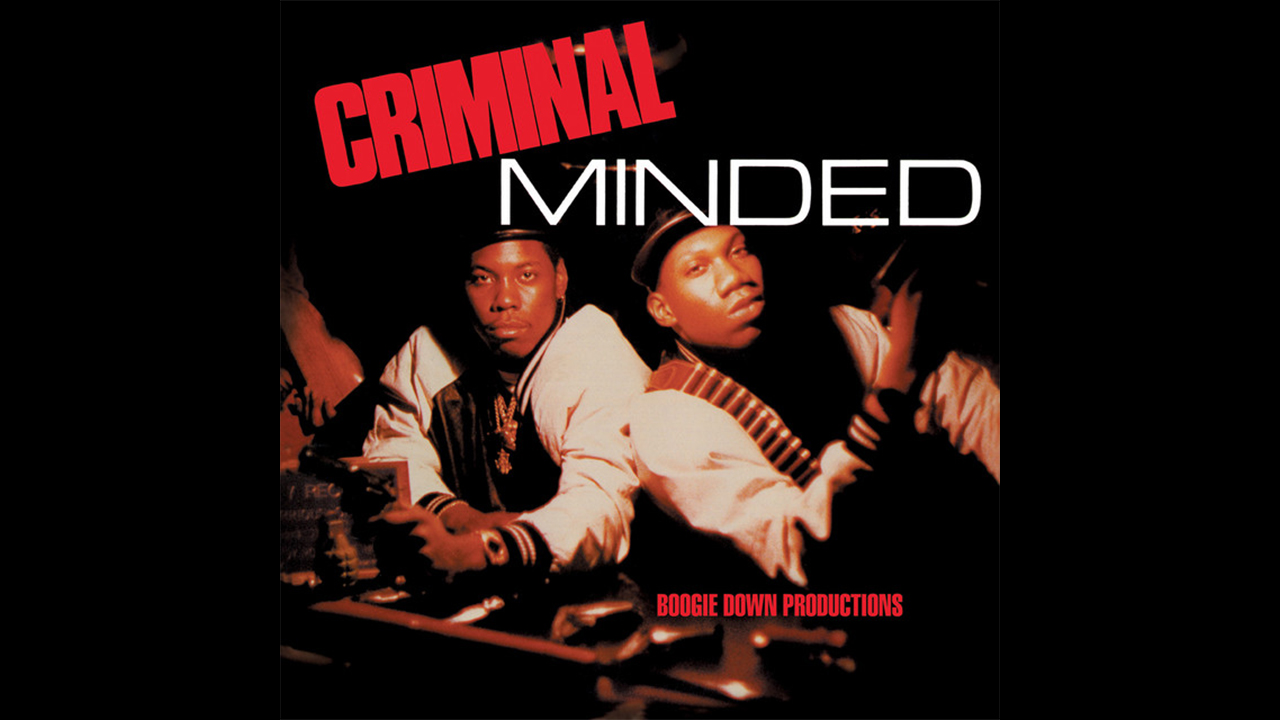
Nas was not the first to press the fact that criminality is equal parts mental and an aspect of our action-world—a state of mind as well as a behavioral descriptor. One of the first gangsta rap albums is Boogie Down Productions’s 1987 Criminal Minded. On the title track, KRS-One, the crucial Bronx emcee, offers his chilling account of what it is to think criminally:
Rapping on the mic like this to me is fine
‘Cause if I really want to battle, I will pull out a nine
You can see that Scott La Rock and I are mentally binded
In other words, we’re both Criminal minded,
i.e., battle rapping is all fun and games, but if it gets to that point, he has no problem breaking out the guns. KRS-One is letting us know that part of what it means to be a rapper is to announce on full blast the criminal mindset, even or especially if that comes at the expense of rapping itself—that the art of emceeing is defined by the dialectical acknowledgement that at any given moment, the craft will cease and the reality of street life will take over. That is what being a criminal mind entails. It is a formidable practicality that suggests the interplay of violence and art.
The gangsta v. conscious ordeal
We should never exaggerate the extent to which hip-hop is a music defined by crime stories and gangster lore. For every N.W.A or UGK—couriers of the gangsta strain—there is A Tribe Called Quest and Dream Warriors—ambassadors of the conscious brand. But as I outlined before, isolating the “gangsta” from the “conscious” does not make sense. I imagine that pretty much across the board, rap artists, no matter their label, listen to the full spectrum of the genre. Even if, as consumers, we do not always notice the cross-pollinating influences, there are certainly notes of gangsterism in the conscious flows as well as alternative flavors in the gangsta flows. Integration of perspective is essential to hip-hop sophistication.
Such an antimony between dream and reality is hardly new to the American arts. F. Scott Fitzgerald explores precisely this in The Great Gatsby (1925).
I met with J. P. Cupps, a PhD candidate in music theory here at WashU, who had this to say about the matter: “gangsta and conscious are treated as distinct marketing categories, but respond to the same social problem.” Siloing one from the other thus does not hold much water. Cupps likewise magnified the degree to which there is a “respectability politics” associated with the whole “conscious” thing—that, as they would effectively put it, “it’s not as if Yasiin Bey [formerly known as Mos Def, one half of the legendary Brooklyn duo Black Star] necessarily engages in fewer illegal activities.”
Yet there is also the reality that the best gangsta rap is actually full of “conscious” rapping. As I see it, the gangsta rapper has two tales to tell. One is of the dreams of hedonistic leisure. The other is of the reality of his criminal lifestyle. Consider once again the Nas of “New York State of Mind”:
Be havin’ dreams that I’m a gangsta, drinkin’ Moëts, holdin’ TECS
Makin’ sure the cash come correct, then I stepped
Investments in stock, sewin’ up the blocks to sell rocks,
Winnin’ gunfights with mega-cops
These “dreams” mark the onset of the second verse. As Nas is rapping these lines, the beat has been downsized to nothing more than the break loop, providing clarity to Nas’s gangsta-hopeful words. Yet as the instantly recognizable piano loop begins to creep back into the fold of the tune, Nas immediately switches from fantasy to actuality, rapping, “But just a n***, with his finger on the trigger.” In other words, Nas ebbs from a gangsta-dream to something basic, relatable, criminal, and not fully gangsta. His raps are still gun-related, but he is no longer a gangster. He is “just” an anonymous gun owner ready to shoot.
Such an antimony between dream and reality is hardly new to the American arts. F. Scott Fitzgerald explores precisely this in The Great Gatsby (1925). Theodore Dreiser does the same in An American Tragedy (1925). The lyrical expression of Bruce Springsteen brims with the clash of dream and nightmare. It is essentially superfluous to mention the plethora of mob/gangster films that take as their running theme the devolution of glitz and glamour into their infernal opposites.
But I wonder if in the hip-hop context we can christen criminality as the chief container of the real. This is to say that crime, rather than merely setting the scene of gangster activity, is in fact the conscious underbelly of the gangsta rap genre. In this way, there is not so much a distinction between gangsta and conscious across sub-genres but rather an internal dialectic of the gangster and the criminal within gangsta rap itself. And if criminality is by and large a headspace—a way of thinking as well as a manner of relating to other minds—then that is where the consciousness of gangsterism resides. Crime undresses the folly of excessive gangster-dreaming and offers an improbable way out.
In The Mark of Criminality: Rhetoric, Race, and Gangsta Rap in the War-on-Crime Era, scholar Bryan J. McCann puts it this way: “Criminality is not a static site of meaning, but highly contingent. While discourses of crime and criminality serve the interests of those occupying the upper echelons of power, they also provide resources for those very subjects deemed criminal in a particular context.” (3) In other words, just as Hawthorne’s Hester Prynne challenges a society that deems her adulterous by not only accepting that marker but enjoying the hell out of it (this is a reduction, I know), many gangsta rappers are of the mind that the subversion of an unjust label may involve the ironic and joyful adoption of it.
Cupps spoke to me about how the gangsta in hip-hop can be described as an “affected archetype”—a “[literary] persona” (think of the “pimp” in the Southern rap tradition)—that is knowingly excessive. In Prophets of the Hood, Imani Perry accords, offering her own account. “Hip-hop embraces the outlaw,” she informs us. “Outlaw status is conferred only metaphorically through lawbreaking, but on a deeper, more symbolic level, it is achieved through a position of resistance to the confines of status quo existence.” (102) And of course it is not just hip-hop that embraces the outlaw, but the whole American fraternity, at least since Ralph Waldo Emerson celebrated the “coarse energy” of the “bruisers” in his essay “Power” from The Conduct of Life.
But I think that there is more to it than just rubbing hyperbolic forms of gangsterism in the face of the enemy. In a conversation with Marc Blanc, a scholar of Black radicalism at Saint Xavier University in Chicago, Richard Wright’s Native Son came up. “At the end of the novel,” Blanc would explicate for me, “Bigger [Wright’s protagonist] concludes that his life of crime and his ultimate persecution have this social function. He realizes that White-supremacist capitalism has put him in a situation to become this isolated outlaw. His class consciousness comes in prison—he develops a sense of solidarity with the prisoners in the cells around him.”
If criminality is by and large a headspace—a way of thinking as well as a manner of relating to other minds—then that is where the consciousness of gangsterism resides. Crime undresses the folly of excessive gangster-dreaming and offers an improbable way out.
Gangsterism so often fails because it is the final step in a life of blind loyalty, destructive rituals, and unchecked masculinity. Nobody knows this truth more viscerally than those who have lived that life, including true-to-life gangsta rappers. Alternatively, criminality is the unlikely first step in the promotion of solidarity and consciousness. I return to KRS-One’s definition: “You can see that Scott La Rock and I are mentally binded/In other words, we’re Criminal minded.” The mental bind that crime encourages may be the very thing that sets in motion the transcendence of a criminal life.
On the second verse of “Eye for an Eye (Your Beef is Mines),” the fourth track off Mobb Deep’s ’95 classic The Infamous, Havoc, like Nas, underscores the swift transformation of gangster sanguinity into criminal darkness:
‘Cause I wanna chill, laid up in a Jacuzzi,
Sippin’ bubbly, with my fingers on the Uzi,
Try to infiltrate my fort, get caught
Dead up in New York, my brain is packed with criminal thoughts
When we listen to gangsta rap, we should always keep in mind where its gangsterisms end and its criminalities begin. We ought to regard crime as the eyes and ears of the music. This specifies an effective means to capture the dialogue inherent to the best the genre has to offer.