Bitter the Chastening Rod
Colin Kaepernick’s memoir tells the story of a rebel with a cause and a lonely crusade.
November 16, 2026
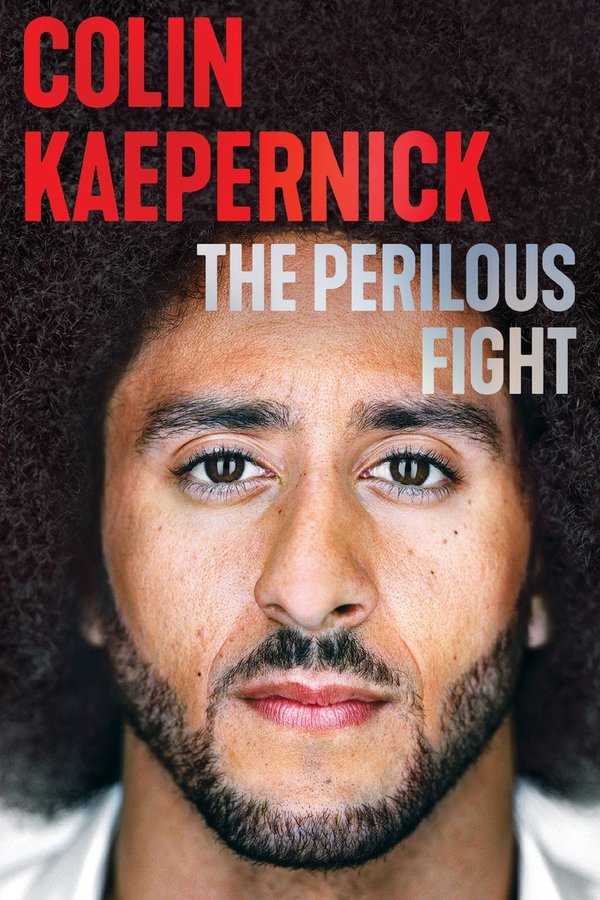
The Perilous Fight
“You’re in the middle of all this love,” a woman smiled at me. I had passed her a copy of Colin Kaepernick’s new memoir, The Perilous Fight, from her friend down the row, as we waited for Kaepernick’s talk at the National Civil Rights Museum in Memphis, Tennessee. The well-dressed audience was full of people hugging, laughing, chatting about jobs and kids. It felt like an event for Black professionals, with a celebratory air.
If most people were there to affirm a Black hero, I arrived with curiosity. Ten years earlier, Kaepernick had started kneeling during the national anthem prior to NFL games, in protest of police brutality against Black citizens. He ignited a national controversy. While progressives admired the San Francisco 49ers quarterback for using his platform to advocate for social justice, conservatives lambasted him as a sinister Black militant. It was red meat for President Donald Trump, who at a 2017 rally in Huntsville, Alabama, exclaimed, “Wouldn’t you love to see one of these NFL owners, when somebody disrespects our flag, to say, ‘Get that son of a bitch off the field right now, out. He’s fired. He’s fired!’”
Yet since that moment, the public has caught only glimpses of Kaepernick. Despite an NFL lawsuit, a Nike marketing campaign, and a Netflix series, he has avoided any sustained presence in the spotlight. To half of America, he is a noble crusader, and to the other half, he is a churlish menace. Who is the actual man? At this book event in Memphis, I was hoping to find out.
When Kaepernick appeared on stage, the crowd rose to their feet, cheering and clapping, and he bathed in the moment with a wide, appreciative smile that bordered on goofy. Although 6’5″ with a capacious Afro, his affect is less Black Panther and more assistant professor at a prestigious liberal arts college. As he answered questions, it was clear that he was smart and sharp, with a radical critique of the nation’s racial history, its crisis of police brutality, and its assault on democracy. Mostly, however, he seemed like a man who was grateful to have undergone a journey that delivered him meaning, identity, and love.
In the wider world, he was a political lightning rod. In person, Colin Kaepernick seemed like a sweet guy.
• • •
How did Kaepernick become the face of Black protest in sports? In The Perilous Fight, he locates its roots in a long search for self, tracing back to his childhood in Turlock, a predominantly White and conservative city in California’s Central Valley. He was a mixed-race child adopted by two White parents, with two White siblings. The memoir recounts tales of racist treatment: getting called racial slurs, facing different expectations for behavior than White kids, absorbing the surprise of coaches when they learned about his 4.5 GPA.
In trips to a Black hairdresser or Black church, or in his emulation of Randy Moss or Allen Iverson, young Colin sought to claim his Black identity. But in this White world, he sought to contain it, too. His book reveals a complicated relationship with his parents—they clearly loved and supported him, but they failed to understand his perspective. Kaepernick aches with resentment as he describes how his parents favored White girlfriends over Black ones, or when his mother said that his cornrows make him look like a “thug.”
Despite an NFL lawsuit, a Nike marketing campaign, and a Netflix series, he has avoided any sustained presence in the spotlight. To half of America, he is a noble crusader, and to the other half, he is a churlish menace. Who is the actual man?
Kaepernick explored these same themes in Colin in Black & White, a six-episode Netflix series from 2021, in partnership with the filmmaker Ava DuVernay. Pitched to young audiences, it dramatizes his life as a young athlete and racial outsider.
In The Perilous Fight, Kaepernick explicitly attributes his adult activism to his childhood ambivalences: “When you grow up Black in white spaces, in a white family, in order to maintain your Blackness you have to march to the beat of your own drum all the damn time. You are going to have to fight for your Blackness, work for it, and not flinch when it is constantly questioned. Because you are going to be under a microscope every minute of every day, with your movements and decisions always critiqued, denigrated, discounted. That’s something I simply got used to.” (200)
In December 2015, San Francisco police opened fire on a twenty-six-year-old Black man named Mario Woods. Kaepernick showed his mother the gruesome video circulating across social media. His rage was textured by his own encounters with suspicious police officers. But she expressed doubt, wondering if Woods provoked the officers into this execution-style killing.
Their conversation sharpened not only his political conscience, but also his personal frustrations. In his first preseason game of 2016, during the opening notes of the Star-Spangled Banner, he found a seat on a big orange cooler full of Gatorade.
• • •
The National Civil Rights Museum is built into the old Lorraine Motel, the site where Martin Luther King was assassinated in 1968. Kaepernick’s event was maybe fifty yards from the balcony where King lay in a pool of blood. The museum’s exhibits portray Black life under slavery and Jim Crow and continue with displays of civil rights flashpoints from the 1950s and 1960s. The tour concludes in the new Legacy Building, which considers the triumphs and travails of the Black freedom struggle in the past half-century. Those exhibits include photos, quotations, and video clips of Kaepernick.
Before his audience, Kaepernick recalled when his wife, the media personality Nessa Diab, gave him a copy of The Autobiography of Malcolm X. “It changed my life,” he said. Just as Malcolm evolved in response to the demands of Black politics and Black people, Kaepernick was evolving as an athlete who felt a responsibility to address racial injustice. It launched his reading of revolutionary Black thinkers, from Frantz Fanon to Steve Biko to Stokely Carmichael to Angela Davis.
He understood the costs of activism. Malcolm X and Martin Luther King sacrificed their lives in service of their cause. He lost only his career. By protesting during the national anthem, he writes, “I had unwittingly instigated a drama that in many ways would define the rest of my life.” (191)
• • •
The Perilous Fight explains the protest and its aftermath from Kaepernick’s personal perspective. Colored by his understanding of popular distortions of Black history, he seeks to correct the “false narratives” about his moment in the nation’s political crosshairs.
His initial demonstration was a spontaneous decision, rooted in disgust over the police killings of Woods in San Francisco, Alton Sterling in Louisiana, and Philando Castile in Minnesota. He asks: “If I feel the US has shown its support for the mass incarceration of and the state-sponsored violence against my people—Black people—wouldn’t it be hypocritical for me to exalt the country, to participate in the patriotism façade?” (179)
The backlash started after his third preseason game in 2016, when he told a reporter that he refused to exhibit pride for a nation that was complicit in Black oppression. The story catapulted beyond the sports page. Talking heads babbled about it on cable news. Social media bubbled with reactionary frenzy, urging him to go back to Africa.
On one hand, this ascension into a political personality deepened Kaepernick’s activism. He started “Know Your Rights” camps that taught thousands of young people about community organizing…. On the other hand, the NFL co-opted his message with performative gestures, such as locking arms during the national anthem or painting anti-racist slogans across end zones.
At that point, Kaepernick started kneeling for the anthem. It recalled the Black Power salutes of John Carlos and Tommie Smith at the 1968 Olympics, eliciting both pride and bile. In the memoir, he hearkens to his historic forebears in Black athletic protest, including Muhammad Ali, Curt Flood, and Mahmoud Abdul-Rauf.
According to most media stories, Nate Boyer, a former Green Beret and long snapper for the Seattle Seahawks, suggested kneeling as a way to register protest, yet convey respect. In actuality, San Francisco 49ers safety Eric Reid suggested that they kneel, so they could still join their teammates during the anthem. Kaepernick bristles at the popular narrative that privileged “a white savior military veteran” over his Black teammate, a compatriot in his struggle.
In the aftermath, Kaepernick received copious death threats. Steve King, a White nationalist congressman from Iowa, suggested the influence of radical Islam—because his wife was Egyptian-American. During most of the 2016 season, he lived at a friend’s house to dodge the constant harassment.
On one hand, this ascension into a political personality deepened Kaepernick’s activism. He started “Know Your Rights” camps that taught thousands of young people about community organizing. He invested in grassroots social justice organizations. His example inspired athletes in both professional and amateur sports to protest police killings of Black citizens by kneeling during the anthem. The popularity of his 2018 ad campaign with Nike, called “Dream Crazy,” illustrated his impact on the mainstream discourse about sports and racial justice.
On the other hand, the NFL co-opted his message with performative gestures, such as locking arms during the national anthem or painting anti-racist slogans across end zones. When scholar-activist Harry Edwards, the architect of the 1968 Olympic boycott movement, counsels him to stand for the anthem, Kaepernick questions his motives, since Edwards works for the 49ers. In his eyes, the NFL barged into the political conversation, muffling his voice.
“So while I was trying to fight against the police killing Black people, I was also trying to fight them making an example out of me,” writes Kaepernick. “But I was not comfortable making the second part of that statement into some type of movement.” (233)
Unlike Muhammad Ali, for instance, he had no natural affinity for the spotlight. He would neither court the press nor play the martyr. Since 2016, he has restricted his public appearances to those that align with his focus on police brutality and grassroots organizing, For the most part, his ideas and experiences have been obscured by the larger controversy. His humanity lay under the shadow of his grand symbolic gesture.
• • •
At the National Civil Rights Museum, Kaepernick likened the NFL’s campaign to “buck breaking”—the practice of abusing a resistant slave as a warning to the larger enslaved community. When he said that this kind of racial discipline extends beyond the NFL, the audience of Black professionals murmured in assent. In Kaepernick, they saw a man with the courage to stand up to authority, to call out racism, to put himself on the line.
Kaepernick sees himself as all of those things, too. Perhaps surprisingly, he still sees himself as a football player, as well. He is now thirty-eight years old. His last game was ten years ago. His final few seasons were plagued by injuries, losses, and mediocre play. Yet he still works out every day, and he believes he can stage a comeback.
The Perilous Fight is the story of not only an activist, but also an athlete. It contains the allures and drawbacks of many sports memoirs. At times, the sportswriting is a dull summation of game events, devoid of personality. At other moments, it sizzles with insights into on-field action and back-and-forth strategic adjustments. Throughout the book, it insists upon Kaepernick’s excellence as a quarterback: It spotlights his astonishing ascension into the young star of Super Bowl XLVII, while downplaying the struggles of subsequent years.
Perhaps surprisingly, he still sees himself as a football player, as well. He is now thirty-eight years old. His last game was ten years ago. His final few seasons were plagued by injuries, losses, and mediocre play. Yet he still works out every day, and he believes he can stage a comeback.
The book often echoes the sports protest literature of the early 1970s, such as David Meggyesy’s Out of Their League and Gary Shaw’s Meat on the Hoof, books about the dehumanization of big-time football. Kaepernick likens the inspection of semi-naked bodies during the Draft Combine to the auction block for slaves. When front office executives interviewed prospects, they asked invasive, disrespectful, and prejudiced questions: Is your mother a prostitute? Are you gay? (92) (After 2016, they asked players for their thoughts on Kaepernick’s protests.) With the 49ers, team doctors downplayed his injuries, while general manager Trent Baalke tried to police his style in hair and clothes, as if a team leader could not express his Blackness.
And yet, Kaepernick loves football. He embodies the cliché that athletes die twice. The end of his career came too soon and too unjustly. In early 2017, the 49ers urged him to opt out of his contract. Although franchises are in constant, desperate need of quality quarterbacks as both starters and backups, no team signed him. The NFL had blackballed him.
Kaepernick filed suit and received a financial settlement, but he refused the league’s offer to become the face of a social justice campaign. If anything, the experience deepened his distrust of the NFL’s powers-that-be.
In arguably the book’s most fascinating section, Kaepernick recalls his botched tryout in 2019. Without his input, the NFL staged a workout for him in Atlanta, while demanding that he waive all claims of discrimination or collusion. Kaepernick captures the moment’s frustrating chaos: the player’s camp set up an alternative workout, scouts and media scrambled all over the city, and team owners kept refusing to sign him, despite his obvious talent.
Justifying his yearning to play again, Kaepernick fights the perception that he lost his career for his principles. “That would be a painfully destructive lesson for my saga to convey to Black people,” he writes. (236) Instead, he wants to prove himself on the field, where the completions, touchdowns, and wins are objective facts. They cannot be twisted into the doubting or hateful narratives that he so deeply resents.
“All I can do is tell the truth about what has happened to me and others around me,” he states. (238) The autobiography is a clear statement of Kaepernick’s principles and experiences, and it provides multiple correctives to the mainstream media narrative of his protest and exile. When future historians seek to understand the drama of sports and race in the Trump era, it will serve as an essential document.
As a memoir, however, it packs less of a punch. Kaepernick may communicate his values, but not his personality. He never explores his missteps or regrets. He never looks inward. He never lets readers into his home, his family, his soul. If he is the kindhearted guy that I thought I saw in Memphis, then his book offers scant clues.
In the best memoirs, the reader lives the triumphs and setbacks alongside the narrator. But in the decade between taking a knee and writing a book, Kaepernick has erected walls around himself. The Perilous Fight presents him as a superlative athlete and political icon. It fails to crack those walls.