Caitlin Clark Has Just Entered the Building
Two new books on the biggest star in women’s sports and the controversy in her wake.
October 16, 2026
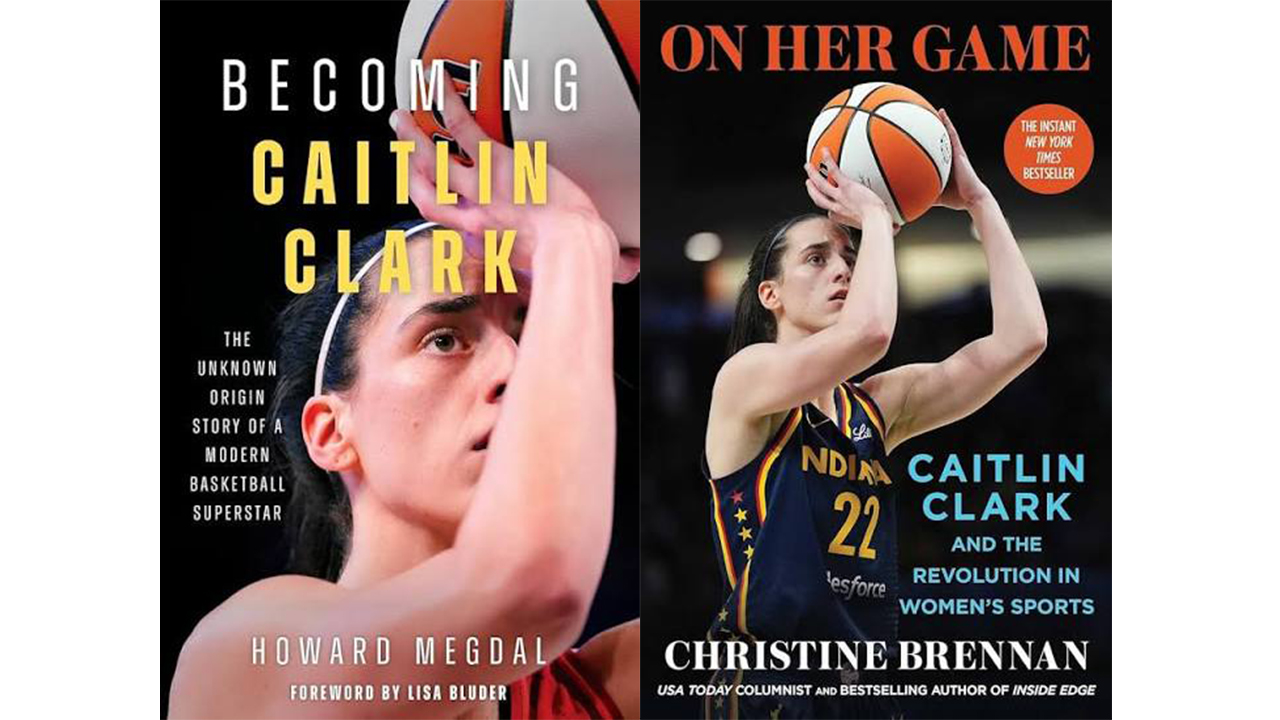
On Her Game: Caitlin Clark and the Revolution in Women’s Sports & Becoming Caitlin Clark: The Unknown Origin Story of a Modern Basketball Superstar
C’mon, y’all. This one should have been easy. When Caitlin Clark splashed into big-time celebrity in 2024, all we had to do was marvel at how she was bending the game of women’s basketball. She enlarged its possibilities. She swirled together an astonishing court vision, a simmering-to-boiling competitive desire, and an audacious confidence in rapid-fire, way-beyond-the-arc jumpers—the kind that, for one second, get your heart caught in your throat, and then, when they flush through the net, leave you flopped on the couch, grinning in wonderment.
We also could have acknowledged that Clark, fresh off a championship-game run with the University of Iowa, was going to suffer growing pains as a rookie with the Indiana Fever. We could have credited the WNBA for cultivating women’s pro basketball, and we could have celebrated the league’s players—most of whom are Black, and many of whom are queer—as pathbreakers, competitors, and stars in their own right. We could have recognized that some part of Clark’s mass appeal rested in her race and her sexuality. We could have done all that, and still, we could have appreciated that she was something special.
But this is the United States of America in the third decade of the twenty-first century, a land plagued by visceral, tribal politics that get supercharged by social media. In recent years, especially, the WNBA has become a battleground in our culture wars. As we argue about everything and anything, Caitlin Clark gets caught in the crossfire.
• • •
Two books published in the summer of 2025 address the Caitlin Clark phenomenon. Of the two authors, the higher profile belongs to Christine Brennan, a national sports columnist at USA Today and author of Inside Edge, an acclaimed chronicle of figure skating in the 1990s. Her book, On Her Game: Caitlin Clark and the Revolution in Women’s Sports, narrates Clark’s rookie season in the WNBA with vigor and detail, as one would expect from this accomplished journalist. It is sunk, however, by Brennan’s inability to navigate the choppy waters of the WNBA’s culture. She becomes part of the story, dragging the discourse into darker depths.
By contrast, Howard Megdal assesses Clark’s rise from manifold perspectives, explaining its controversies with sensitivity and insight. A longtime reporter on women’s basketball, he is the founder and editor of The IX Newsletter and The Next, publications devoted to women’s sports. His book, Becoming Caitlin Clark: The Unknown Origin Story of a Modern Basketball Superstar, is less comprehensive in its coverage of Clark’s college and pro careers. Instead, it textures Clark’s stardom within the long, fascinating history of women’s basketball in Iowa, employing the past to illuminate the present.
We could have recognized that some part of Clark’s mass appeal rested in her race and her sexuality. We could have done all that, and still, we could have appreciated that she was something special. But this is the United States of America in the third decade of the twenty-first century, a land plagued by visceral, tribal politics that get supercharged by social media.
Clark ushered in a watershed year in women’s basketball. Her senior season at Iowa started with an exhibition game at Kinnick Stadium—the football stadium!—attended by 55,646 customers. Every home contest at Carver-Hawkeye Stadium sold out, as did most of the road games. FOX and NBC placed Iowa games in prime slots, and ratings far surpassed those for men’s basketball.
For almost twelve straight months in 2023 and 2024, Clark shot hoops under a spotlight. Two weeks after Clark led Iowa to its second straight Final Four, she was the first pick in the WNBA draft, and one month after that, she was the starting point guard for the Fever.
Thanks to Clark, the Fever’s ticket sales increased 265 percent, and jersey sales jumped 1,193 percent. The WNBA leapfrogged its records for television viewers and social media engagement. Clark signed a lucrative deal with Nike, joked with the “Weekend Update” anchors on Saturday Night Live, appeared on a massive billboard in Times Square, and hung out with Taylor Swift. Young girls screamed like it was 1964 and she was all four Beatles. Middle-aged dudes—the type who had long scoffed at women’s basketball—thought she was just great.
Yet when Time named Clark “Athlete of the Year,” Washington Mystics owner Sheila Johnson appeared on CNN and asked, “Why couldn’t they have put the whole WNBA on that cover and said the WNBA is the league of the year because of all the talent that we have? Because when you just keep singling out one player, it creates hard feelings.”
The absurd comment, on its own, could be shrugged away. But it constituted one zone of the minefield through which Clark was tiptoeing.
• • •
Brennan makes a sustained critique that the WNBA fumbled a golden goose. Clark’s arrival exponentially magnified attention upon the league. Brennan is mystified, then, when a league official compares Clark’s impact to that of Maya Moore. She is frustrated when stars such as Diana Taurasi, Breanna Stewart, and Sheryl Swoopes critique Clark. She is annoyed by a social media post from Cheryl Reeve, coach of the Minnesota Lynx and the U.S. Olympic team, that suggests Clark drains attention from her WNBA colleagues.
Without question, the WNBA has a more insular, collective spirit than other professional leagues. In today’s terms, it has served as a “safe space” for progressive sports politics. A number of players, including Moore, have sat out seasons to focus on social justice issues. The Atlanta Dream campaigned against their own franchise’s co-owner, Republican Kelly Loeffler, and helped elect the Democrat Raphael Warnock, swinging the balance of the U.S. Senate during the 2020 elections. Many players mobilized to secure the 2022 release of Brittney Griner from a Russian prison.
Young girls screamed like it was 1964 and she was all four Beatles. Middle-aged dudes—the type who had long scoffed at women’s basketball—thought she was just great.
WNBA players also chafe at the dearth of mainstream media exposure, and they endure racist, sexist, and homophobic abuse on social media. So, it is understandable why many saw a racial double standard in the press swarm around Clark. “It doesn’t matter what we all do as Black women,” said league MVP A’ja Wilson, “we’re still going to be swept underneath the rug.”
Brennan documents those frustrations, but as a longtime advocate of women’s sports, she imagines Clark’s celebrity as a special opportunity to lift the entire league. She breaks the news, for instance, when the WNBA switched from commercial to charter flights – a development based on new revenue streams in the age of Caitlin Clark.
Along the way, Brennan bristles over any perceived slight to the league’s new superstar. She complains not only when Clark loses a spot on the U.S. Olympic team, but also when a journalist places Clark fourth on a rookie “power rankings” list, one month into the season. When Clark endures tough fouls and cheap shots, Brennan adopts a protective tone.
On Her Game suffers from this too-close identification of the author with the subject. Clark serves as the vessel for Brennan’s aspirations for women’s sports. When other women do not share her vision, Brennan notes that she reached out for comment, but the subject (Diana Taurasi, Sheryl Swoopes, Angel Reese, the members of USA Basketball’s Olympic selection committee, WNBA commissioner Cathy Englebert) did not respond. While normal in an article or column, this recurrent device reflects Brennan’s defensive stance around the sport’s leaders.
Brennan stumbled into her own controversy. In the aftermath of the Fever’s playoff elimination, the Women’s National Basketball Players Association issued a press statement blasting her for “a blatant attempt to bait a professional athlete into participating in a narrative that is false and designed to fuel racist, homophobic, and misogynistic vitriol on social media.”
On Her Game suffers from this too-close identification of the author with the subject. Clark serves as the vessel for Brennan’s aspirations for women’s sports.
The reason for this outcry? Brennan had asked DiJonai Carrington of the Connecticut Sun about an incident from a playoff game against the Fever. Carrington had jumped out on defense, and her finger poked Clark in the eye. Social media posts accused her of targeting Clark. Brennan asked Carrington if her action was intentional. In Brennan’s mind, her question was standard journalistic practice, giving Carrington the chance to get a denial on the public record.
Instead, it sparked a media firestorm for the modern age. Carrington and her teammates yelled at Brennan but refused to discuss the matter. The Players Association accused Brennan of insensitivity towards Black and queer women. Journalists defended Brennan for asking fair questions. The online outrage multiplied.
In her book, Brennan quotes an anonymous WNBA official, blaming the whole affair on the players’ inexperience with the spotlight of the press.
• • •
It is instructive to read Megdal’s analysis of the Brennan brouhaha. The question about Carrington’s eye-poke was legitimate, in a vacuum. Yet as he writes in Becoming Caitlin Clark, “By that time players, coaches, and even other media members around the league had heard Brennan say and do things that called her objectivity into question.”
In the same game, Carrington had hit a three-pointer and put three fingers to her head, a la Carmelo Anthony. In a follow-up question, Brennan asked: Was she celebrating the injury to Clark’s eye? Carrington never meant to poke Clark, and she certainly did not celebrate it. Brennan’s questions, however, triggered a slew of racist denigrations of Carrington on social media.
From Megdal’s perspective, Brennan owns the right to ask tough questions and allow players to clarify issues. “But that requires a fuller understanding of the context,” he writes. “It requires a building of trust between reporter and interviewee.”
As someone who had covered Carrington since her college days at Stanford, Megdal knew her character. She had struggled to find playing time in her first few seasons, only to develop into a relentless defender and respected teammate. As she found her foothold, the media bombarded her with questions about Clark, which she answered with both professionalism and frustration.
Like many others, Carrington appreciated Clark’s impact on their livelihood, even as she resented the comparative degrading of the WNBA’s other stars. “Perhaps the discourse did not hold room for this dichotomy,” writes Megdal. “But for dozens of WNBA players I spoke to about this, both dynamics were at play.”
To his credit, Megdal avoids any reflexive defense of the WNBA. Sheila Johnson’s comment that the entire league should win Time’s “Athlete of the Year” elicits some deserved mockery. And while he defends Carrington, he condemns Chennedy Carter of the Chicago Sky, both for her dirty play against Clark and her longer record of confrontational behavior. He is careful to consider individuals and personalities, to embrace the depth and complexity of Clark’s impact, to wade above the swamp of egos and outrage.
Becoming Caitlin Clark does more than parse out these contemporary controversies about race, gender, and the media. The book intersperses chapters about Iowa’s tradition of six-on-six women’s basketball. This version of the game, with three offensive and three defensive specialists confined to their halves of the court, was designed in the early twentieth century, ostensibly to protect delicate feminine constitutions. Yet Iowa women of the age, such as the great Dorcas Andersen of tiny Kimballton, found meaning and confidence in the sport.
“There is no Caitlin Clark without Iowa,” argues Megdal. The six-on-six game, which lasted in Iowa until 1993, left a legacy of girls and women who found fulfillment through basketball, who played a fast-paced perimeter-oriented game, and who produced big crowds and fan enthusiasm. They created a world where a hypercompetitive, deep-shooting female hoopster could live her dreams.
Megdal relates how the high school girls’ basketball tournament developed into a statewide phenomenon by mid-century, how the Van Horne Hornettes of the early 1960s introduced an exciting fast-break style, and how Molly Van Benthuysen (later Molly Bolin, now Molly Kazmer) used six-on-six as a springboard to stardom in the various women’s pro leagues of the 1970s and 1980s.
Throughout this history, gender roles constricted the possibilities for female athletes. (Molly Bolin, the all-time leading scorer in women’s basketball, while still at her career peak, moonlighted as a construction worker.) Yet threads connect these generations of Iowa women. The Hornettes tap away on a group text during University of Iowa games. Jan Jensen—a six-on-six star like her grandmother Dorcas Andersen—was Associate Head Coach during the tenure of Caitlin Clark, and she is now the head coach.
“There is no Caitlin Clark without Iowa,” argues Megdal. The six-on-six game, which lasted in Iowa until 1993, left a legacy of girls and women who found fulfillment through basketball, who played a fast-paced perimeter-oriented game, and who produced big crowds and fan enthusiasm. They created a world where a hypercompetitive, deep-shooting female hoopster could live her dreams.
• • •
What of Caitlin Clark herself? In a March 2024 profile on ESPN.com, Wright Thompson captured the Iowa senior at the cusp of superstardom, employing his in-depth access to paint a young woman entering adulthood, grounding herself in family while relishing fame, struggling to contain her fiery ambition and uplift her teammates. “You’re trying to know yourself,” she described to Thompson, “while you’re trying to become this great person.”
Neither Brennan nor Megdal gleaned such nuggets. Soon after Thompson’s profile, Clark surged into another realm, becoming a larger-than-life athletic icon, another Tiger Woods or Michael Jordan or Serena Williams. At that level of celebrity, you wall off parts of your life. You limit your introspection. You reveal less of your authentic self.
“It’s safe to say that no athlete in the nation was interviewed more in 2024 than Caitlin Clark,” writes Brennan. Despite sometimes having three press sessions a day, Clark bore the burden with aplomb. Brennan admires her natural charisma, her easy relatability. Megdal highlights how she builds community in women’s basketball.
At the same time, Clark had to steer through the resentments within the WNBA, as well as the fraught politics of a presidential election between a racist demagogue and a Black woman. Clark could credit the Black women who built the league, and she could talk about white privilege. But her Black teammates and opponents still saw memes that superimposed Clark’s face on Derek Chauvin and Carrington’s face on George Floyd.
At times, Clark stumbled. When a reporter asked her about becoming a weapon in the culture wars, she tried to focus on basketball. Carrington was among the critics, insisting that “Silence is a luxury.” Clark needed a follow-up interview to clarify her distaste for racism and misogyny.
Yet throughout the tumultuous year that included her final college season and initial pro campaign, Clark walked a tightrope with aplomb. With fire and flair, she pulled waves of new fans into women’s basketball. She also lifted her teammates, celebrated the WNBA’s pioneers and superstars, and urged respect and understanding.
“She is the calm in this sea of madness,” writes Megdal, “able to hold two disparate ideas in her head at the same time.” Too many people in the media, and in the nation at large, failed to do the same.