Roald Dahl, Hidden Auteur for ‘Chitty Chitty Bang Bang’
How sentient technology may come to the rescue before the final reel.
October 16, 2026
The movie Chitty Chitty Bang Bang, written and produced some 60 years ago, is about an eccentric, socially awkward, rocket-loving inventor whose father spent time in what is now South Africa. The inventor lives on the cusp of worldwide cataclysmic change and uses an “uncategorical” sentient machine he cannot fully control—along with funny dances and music clips—to help free the citizens of an incompetent autocracy, in a country he is not from. As the citizens join in terrible violence against an army of their countrymen, the inventor flies away in his “fantasmagorical” technology—“Everywhere we go, on [it] we depend”—with his children and a new partner, to discover that he has become much richer by another of his ventures.
Fans of the movie—and there are many, I among them—might rise up against this characterization rooted in our own time, but it is always interesting to consider how we think and believe through our stories. Chitty is by turns charming, troubling, funny, dark, romantic, nonsensical, and weird. More than many other movies, it continues to inspire questions about its layers of inventiveness, even though its premise—that specific inputs cannot explain magical output—is in the news every morning now.
The original children’s novel by Ian Fleming (inventor of James Bond) was published in 1964. A screenplay began to be adapted in 1965 by writer Earl Hamner (inventor of the Waltons of Walton’s Mountain), but in the end Roald Dahl (inventor of Willy Wonka), who began work on it in 1966, would be co-credited with Chitty director Ken Hughes (inventor of a violent disdain for Dahl, who enthusiastically reciprocated).
Ken Hughes, according to the authorized biography of Dahl by Donald Sturrock, “contrived to take the script away from [Dahl] after the first draft, claiming that [producer] Broccoli thought Roald’s work ‘a piece of shit.’ Hughes claimed later that he had written ‘every fucking word’ of the final script on his portable typewriter. He was almost certainly exaggerating.” (436)
Fans of the movie—and there are many, I among them—might rise up against this characterization rooted in our own time, but it is always interesting to consider how we think and believe through our stories.
On the Chitty movie set in London in 1967—the year Sgt. Pepper’s Lonely Hearts Club Band was released—Hughes is portrayed by the New York Times as a swinging cat in Chelsea boots and Carnaby Street fashion, who seems to imply he too is from Liverpool, “currently the place to come from,” the reporter says wryly. Whether the reporter misunderstood or Hughes was self-mythologizing, the fact is that Hughes’s family had moved to London soon after he was born in Liverpool, and Dahl biographer Jeremy Treglown says Hughes was a “voluble cockney,” which seems to be what is reproduced phonetically in the Times article.
“Roald Dahl is supposed t’be Chitty‘s screenwriter,” Ken Hughes tells the Times. “Well, you ‘aven’t seen him around ‘ere ‘ave you? No. I had to rewrite the whole bleedin’ scenario. Did y’know Lenny Bruce? Was a mate a’ mine, poor bloke.” Bruce, who was among the many famous figures on the cover of Sgt. Pepper’s, had died of a morphine overdose the previous year. “’E’s my idol,” Hughes says. “Changed my entire sense of humor. I’d like to write like ‘e did.”
Lenny Bruce is undetectable in Chitty Chitty Bang Bang (released in 1968), and fans have mostly forgotten Hughes’ role or, like me, can offer no specific examples of his writerly contributions. Fleming’s influence is obvious, and since he died two months before the novel was published, the story’s origins were never complicated by collaboration.
Fleming’s novel is in three parts, but only the first is used for the movie: Caractacus Pott (“Potts” in the movie) is a former Commander in the Royal Navy, like James Bond and Fleming himself. (Bond/Pott are virtually the same name but for their voiced vs. voiceless plosive consonants.) Pott is married, though wife Mimsie plays so insignificant a role that a scholar mistakenly wrote she is Caractacus’ mother. They have eight-year-old twins. He invents a candy that whistles and sells it to industrialist “Lord Skrumshus” for (in today’s money) $145,000 down and perhaps $60,000 per year.
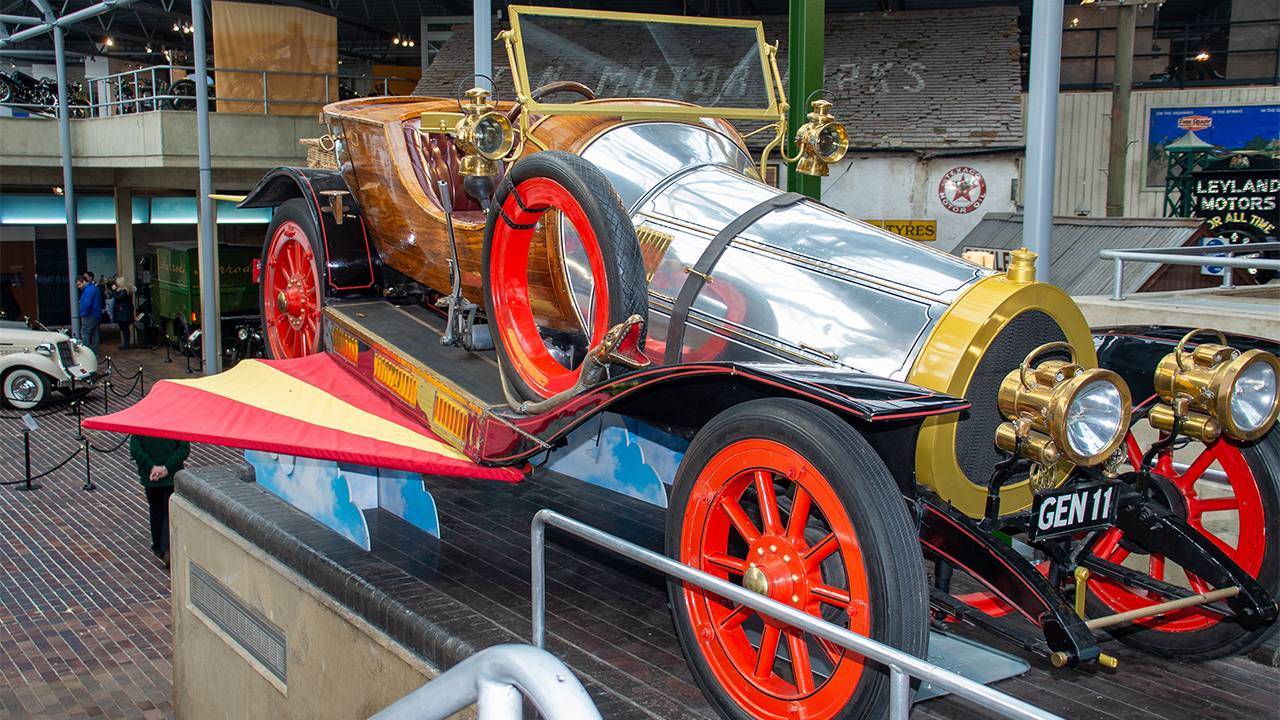
The Pott family, who feel empathy for well-designed machines with human qualities, buy the hulk of a former racing car totally unlike “one of those black beetles that the [n.b. German] factories turn out in hundreds and thousands and that all look alike,” Fleming’s narrator grouses. Its license plate reads “GEN II” (an attendant spirit, or “fuel-burning oracle,” as the title song in the movie claims). The seller, a former race-car driver himself, tells them, “You’ve saved her from the scrap heap, and I’ll eat my hat—if I had a hat to eat—if she doesn’t repay you for what you’ve done today.” (17)
Fleming, who often wrote passages of what a professor of mine used to call “Popular Mechanics fiction”—its interest in mechanical things and consumer goods over complex human drama—puts considerable effort into describing the car, a five-ton steel beast with an eight-foot-long hood and a 12-cylinder, eight-liter, supercharged engine based on a German, military-style, zeppelin engine. Given that the novel starts in England a little more than a decade after WWII, a reader might feel concern about the anthropomorphic car’s militaristic German heart. But Fleming makes sure to say she raced for Britain, wore British Racing Green, and sounds like a Hawker Hurricane, the type of British fighter that claimed 60 percent of the Nazi planes shot down in the Battle of Britain (and in which RAF flying ace Roald Dahl got his first kill elsewhere in the war.)
(For a similar technological anxiety of the time, see English poet Ted Hughes’ children’s book The Iron Man, published the year that the movie Chitty came out. It is about a mechanical intelligence that causes havoc before it saves humanity. The book became the basis for the 1999 animated film The Iron Giant, in which the “metal man” is now a hostile, alien, plasma-weapons system that has forgotten its programming. Given free will and taught ethics from a comic book, he chooses to sacrifice himself for the community—more Christ than Superman—against its own nuclear-tipped violence. “The idea I pitched to Warner Bros. after reading the book…was[,] ‘What if a gun had a soul?’” director Brad Bird said.)
Given that the novel starts in England a little more than a decade after WWII, a reader might feel concern about the anthropomorphic car’s militaristic German heart. But Fleming makes sure to say she raced for Britain, wore British Racing Green, and sounds like a Hawker Hurricane ….
In Part One of the novel Chitty-Chitty-Bang-Bang, Commander Pott sends the kids away to boarding school, ignores his wife, and locks himself in with Chitty—fingering parts and banging away at her day and night for months, a lesser essayist might point out tastelessly—“only emerg[ing] to eat and sleep…through periods of gloom and impatience and frenzy and triumph and dejection and delight and unhappiness and nightmares and loss of appetite,” but eventually becoming “calmer and happier [and] smiling and rubbing his hands.” (18-19)
“It’s funny,” Pott says, “but all bits of machinery that people love are made into females.” (24) Chitty, more mistress now than vehicle, comes to think of the Potts as “her family” and reveals she can fly, when made peevish waiting in line, (27) or become a hovercraft, when caught by a tide. (41) Pott invented neither of these capabilities. Chitty seems to be Fleming’s sublimated version of James Bond’s Aston Martin DB Mark III in the 1959 novel Goldfinger, which is equipped with “certain extras which might or might not come in handy.” (Penguin 69) The Bond movies expand this so extensively that the tech comes to seem like magic that saves Bond—and civilization—when all hope is lost.
Other than a couple more tricks by Chitty, the end of Part One is the end of the movie’s direct use of the novel, whose Parts Two and Three send the family to France to defeat a mobster called Joe the Monster. Fleming’s influence on the movie continued, however, by other James Bond means.
Roald Dahl, who was Ian Fleming’s friend and fellow British intelligence agent, had written the screenplay for the 1967 Bond movie You Only Live Twice just before he was hired for the Chitty project. Later, the Chitty screenplay would be revised yet again by Richard Maibaum, writer of 13 Bond films. Ken Hughes had also been one of several directors for the 1967, non-franchise, Bond movie Casino Royale (in its first incarnation, as a satire with Peter Sellers).

Producer Albert “Cubby” Broccoli, the patriarch of the decades-long “Eon” Bond era, brought cast and crew to Chitty from the Bond franchise, including special effects artist John Stears (creator of the hyper-gadgeted Bond Aston Martin DB5 we all know), set and car designer Ken Adam (a German national who flew for the RAF in the war), actor Desmond Llewelyn (“Q”) as the junk man, and German actor Gert Fröbe (Goldfinger in the 1964 movie, now the comic bad guy, Baron Bomburst of Vulgaria, in Chitty).
This Fleming-adjacent influence is evident in a scene where the Baron is delighted that the Baroness (played by Anna Quayle, also in Casino Royale) gets launched into the sky by Chitty’s ejector seat, à la Goldfinger. A variation on the slow, minor chords of the Bond theme plays, and the Baron suddenly has a shotgun in his hands, planning to shoot spousal skeet.
But whose casual misogyny is responsible for the extraneous recurring “joke” of the Baron trying to kill his wife, an attractive, hyper-attentive, even generously doting, younger woman who professes her love and dresses up for his birthday in vaguely-fetish wear? (Sure, she hates children so much the Baron bans them from the country, but nobody is perfect.) The joke sounds like Fleming’s but was not. (Dahl did publish a collection of adult stories called Switch Bitch and other such fictions, and Ken Hughes directed Alfie Darling, a sequel to womanizing Alfie, and Night School, a slasher movie with the usual victimization of women.)
In any case, what Broccoli actually had in mind for Chitty was something like Mary Poppins (1964), a hugely successful, bright fantasia. Like Chitty, Mary Poppins stars Dick Van Dyke as a singing, dancing, obviously American man living in Edwardian England, who is sweet on an attractive, sensible English woman serving as replacement maternal figure for a young boy and girl. The famous songwriting team The Sherman Brothers worked on both movies, as did musical arranger Irwin Kostal and choreographers Dee Dee Wood and Marc Breaux. (The tropish counterpoint duet in Chitty, often called the “music box” scene, is said to have been a point of pride for The Shermans, post-Mary Poppins; it slayed me as a kid.)
In this systemic/production sense, Chitty Chitty Bang Bang might be seen as a mashup of the Bond franchise and Mary Poppins: Bondian jingoism, technology-love, spy intrigue, and women with names such as Truly Scrumptious; also, Mary Poppins-style “1960s Edwardiana…the green croquet lawns of Heatherden Hall…all white summer frocks, parasols, garlanded hammocks, white swans, composition urns and ivied balustrades”…costuming and colors hinting at emotional repression/freedom or class-consciousness… the dignity of labor, the properness of treaty-treats, and value placed on imagination and the creative spirit.
Chitty fans are probably most curious, however, about Roald Dahl’s role in the layers of the movie. Biographies of him contain no more than a page or two about his work on the screenplay, and most of that is about, e.g., the feud with Ken Hughes, how Dahl “hated” the final product, and Dahl’s grousing that Cubby Broccoli did not get Dahl an invitation to meet the Queen at the charity premiere. (Sturrock 436)
The Roald Dahl Museum and Story Centre, in his former house in Great Missenden, northwest of London, has an archive with an online index that lists 21 items related to Chitty, including several screenplay drafts. Most of this material has not been digitized, but it seems as if some answers might lie there.
Will Phillips, Head of Collections, tells me by email that “the ‘committee’ element of the screenwriting process makes it very difficult to say with certainty which aspects were Dahl’s own invention.
Chitty fans are probably most curious, however, about Roald Dahl’s role in the layers of the movie. Biographies of him contain no more than a page or two about his work on the screenplay, and most of that is about, e.g., the feud with Ken Hughes, how Dahl “hated” the final product, and Dahl’s grousing that Cubby Broccoli did not get Dahl an invitation to meet the Queen at the charity premiere.
“The Child-Catcher, for example, is often—and, I think, justifiably—described as ‘Dahl-esque’ in style, but the character does not feature in Roald’s ‘very first draft’ (RD/8/7/1) or ‘first draft’ (RD/8/7/2) manuscripts. The Child-Catcher’s first appearance written in Dahl’s own hand—in pencil on his usual yellow lined legal paper—is in an undated manuscript (RD/8/7/10) found originally in a folder marked ‘2nd draft’. A bound typescript of the Chitty screenplay (RD/8/7/8), marked ‘Revised Treatment’ and dated 22nd March 1967, also features the Child-Catcher—but it has no author attributed to it. In other words, we don’t know which came first—RD/8/7/8 or RD/8/7/10.”
Phillips says there are “intriguing comparisons to be made with characters in Dahl’s other work,” such as a 1953 short story called “The Ratcatcher.” “That story’s eponymous character is described ‘sniffing the air with a nose that twitched perceptibly from side to side’, and whose ‘nose-end twitched, sniffing the air’. In the Chitty manuscript RD/8/7/10, the Child-Catcher is described, in Dahl’s own hand, entering the Toymaker’s workshop ‘…sniffing like a dog. We can see his long mobile nose-end twitching delicately from side to side’. The similarities are obvious. And in our archive, we have a deleted chapter from Dahl’s autobiography Boy in which he describes the handyman at Repton School (where he was a pupil in the 1930s) as a rat catcher, ‘sly and obscene’ and carrying a cage.”
This perfectly describes the Child Catcher (performed by Robert Helpmann, a Shakespearean actor, ballet dancer and choreographer), who seems now like a proto-Hans Landa from Inglourious Basterds, claiming to be good at his job because he can think like his prey.
“It is difficult not to see Dahl’s fingerprints on the Child-Catcher, but proving it is another matter,” Phillips says.
I wondered if Dahl could be proved to have invented Baron Bomburst, evidently a spoof of some combination of the Kaiser and Hermann Göring, who as a WWI German fighter ace and the Nazi Luftwaffe supreme commander was sure to have provoked Dahl’s ire. Göring too married a Baroness, and they lived in Bavaria not far from Neuschwanstein Castle, which is used in the movie for Bomburst’s castle, and where he moors his zeppelin, cousin to Chitty. (Göring had a long professional interest in zeppelins.) These details sound like pure Dahl, as does the name Vulgaria, and the existence of a grotto filled with scores of hunted children under the castle. But there is also an imprecision totally unlike Dahl, including a baron apparently serving as the country’s king, and the unexpressed implications for the future of a state that forbids children.
Phillips adds, “[I]n Roald’s first draft manuscript (RD/8/7/2) —handwritten by Dahl in pencil on yellow legal paper—Grandpa Potts is kidnapped on the orders of ‘His Excellency, The Prince of Vulgaria’. As for the many children held prisoner beneath the castle, that scene first appears in the anonymous ‘Revised Treatment’ typewritten draft RD/8/7/8, dated 22nd March 1967, but one might see an influence in Roald’s earlier typewritten screenplay from 22nd Nov 1966 (RD/8/7/4) in which Jeremy, Jemima and Grandpa Potts experience a dream sequence inside a fairy-tale ‘Hushabye Mountain’, which is described as a beautiful cave paradise of the Mountain King, swarming with mountain children, with stalactites and stalagmites everywhere and little waterfalls.”
Ultimately, what we might be looking for in the details of this slightly ill-invented collage is responsibility, because it would help determine what it is all supposed to mean.
Aspects of Grandpa Potts (played by the wonderful Lionel Jeffries) also sound like Dahl inventions: Grandpa never takes off his British army medal for the Anglo-Zulu War of 1879 (fought in today’s South Africa) and calls the enemy “Fuzzy Wuzzies,” a racial epithet I heard from a Royal Navy veteran in an American bar as recently as 2002.
As Donald Yacovone writes in ReVista: Harvard Review of Latin America: “The depiction of the Oompa-Loompas in Charlie and Chocolate Factory is so brazen that Dahl might have had a copy of Thomas Clarkson’s 1829 description of slavery in the British West Indies by his side when he crafted the book. […] Willy Wonka tamped down speculation that he made [the Oompa-Loompas] of chocolate. ‘They are real people! They are some of my workers! […] I discovered them myself…in the very deepest and darkest part of the African jungle where no white man had ever been before.’”
Grandpa’s medal is precise, so why is Grandpa’s biological son, Caractacus, with whom he lives in Buckinghamshire, an American? (Actually, this was a get-on-with-it decision by Broccoli, who convinced Dick Van Dyke to do Chitty only by agreeing he would not have to do another humiliatingly-bad English accent, as he did in Mary Poppins.)
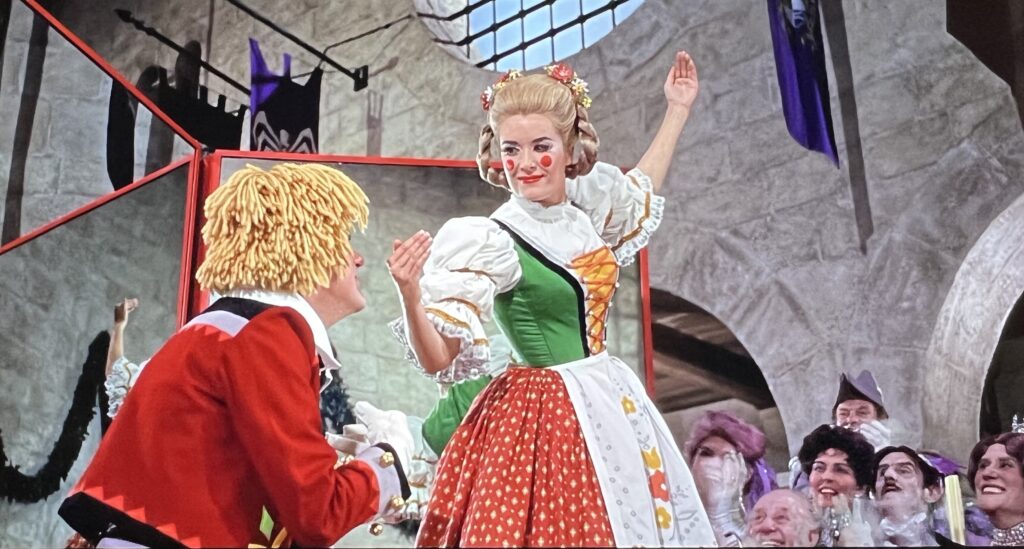
Who decided that Truly Scrumptious (the elegant Sally Ann Howes), daughter of Lord Scrumptious (the venerable Peter Ustinov), would fall in love with Caractacus Potts after one day, especially since he began it by complaining like an incel that women should learn to use technology and stay out of his life?
Why did no one stabilize the narrative frame of the movie, so we can tell when we are in or out of Caractacus’ storytelling binge? Why does Chitty, at the end, fly without wings, when her big surprise all along was hidden wings?
Ultimately, what we might be looking for in the details of this slightly ill-invented collage is responsibility, because it would help determine what it is all supposed to mean.
Chitty Chitty Bang Bang could be seen as comic British revenge for all they had been through: a Yank abroad having to help the English take on Vulgarians (i.e., Bavarians in Prussian helmets, meaning the Germans, twice) with his magnificent flying machine (another Gert Fröbe reference), rescuing the children of Mitteleuropa and England from an auto-genocidal leader, and winning an English bride (though the bounder will never become an English lord by marriage, even once Lord Scrumptious dies).
Yes, it is true: Chitty the novel and Chitty the movie show our era that love for children, romantic partners, and country will take us far.
Or it could be seen as a Cold War artifact. The two Vulgarian spies sent by the Baron to capture Chitty are very much in the slapstick, cartoon tradition of Mad magazine’s Spy vs. Spy, created in 1961 by a Cuban political dissident. One of Grandpa’s big musical numbers, “The Roses of Success,” shows prisoners of the Baron, tasked with making an ordinary car seaworthy like Chitty—reminiscent of a technology/weapons race—impotently hanging life preservers from the windshield and radiator cap as they sing, “From the ashes of disaster / Grow the roses of success!” The segment looks now like a comment on post-war Europe (and, grotesquely, Japan), or a deeply pessimistic but comic condemnation of hope for personal agency in cataclysm. As Roald Dahl once told a marketing director for Penguin books, “[T]he thing you’ve got to remember, is that humour (sic) is delayed fear, laughter is delayed fear.”
Yes, it is true: Chitty the novel and Chitty the movie show our era that love for children, romantic partners, and country will take us far. Violent revolution does things too; the freed children make Bomburst’s castle look like the Battle of Borodino for a bit. But in the end, if we are to survive, we better hope that our inventions, especially the ones that can think and act on their own, are as empathetic to us as we have been to them.
“Don’t you know where we’re going?” Truly Scrumptious asks Caractacus anxiously, after waking up in Chitty. It is night. They are flying thousands of feet over the North Sea in an open-top car with no seatbelts or doors, and the children are asleep in the backseat. They are headed for Vulgaria, an unknown except for its malice.
“No, I don’t,” Caractacus says, eerily calmly. He has always been a little strange and unreliable, as his own father has said repeatedly. “But Chitty does. I think we’re in pretty good hands.”