Visiting the Farm of the Rainmaker on a Hot Day
How to understand what is normal about abundance and scarcity in St. Louis.
By Tolu Daniel
October 16, 2026
It was a hot September morning as I drove to the county side of St. Louis to meet Tyrean Lewis, a local St. Louis farmer, to spend the day with him. When I made his acquaintance via a mutual friend in late August, my message to him was that I just wanted to see him doing his thing. The truth was that I was clueless about what to ask him. More, I was clueless about what it means to see farmers do their thing in a country like this one. As an immigrant and a student at that, my impression of America was very simple. It involved ideas of progress in manufacturing and its many descendants: machines and factories, computers and technology, the various instruments through which I had been taught to recognize American advancements.
Yet when I first arrived in the country, I had lived in Kansas, in the midst of people who lived by the land, people who lived in big farmyards, with acres and hectares of wheat and corn, and cows and horses grazing peacefully. The town I lived in back then had a perpetual smell of manure and cow dung. I remember thinking of it as one of those small contradictions of America, the kind that never quite fit my imagination of it before arriving. And so when I moved a little east from Manhattan, Kansas, to St. Louis, I arrived carrying the other America with me. In my new career as a city dweller, I promptly forgot what it was about the disarming charm of small-town America that held me. I had other things to occupy me now: nightlife, jazz clubs, comedy clubs, concerts, musicals, and all the typical allures of a city that kept me looking forward.
Yet St. Louis, for all its appeal, was also where I first encountered American poverty in a way that jarred me to tears. On my second day in the city, having secured a modest apartment in the basement of a fellow African that I met on the internet, I set out on an accidental excursion to buy groceries. I boarded a bus to my destination, following the directions of Google Maps, an application whose usage in my hands was hardly stable. Somewhere along the way, I took the wrong bus. I did not know this immediately. I simply sat there as the bus carried me farther and farther away from the side of the city I was familiar with, and before I understood what was happening, I was crossing the part of town I would later come to know as the infamous Delmar Divide.
Until this moment, most of my education about St. Louis had been anecdotal. Friends from Manhattan, Kansas, when informed of my desire to go to grad school in that part of the country, told me of the decay of the city, the gang violence, the riotous activists, and the extreme poverty. At the time, I thought they were being sensationalist. Yet on the drive that brought me into the city, I saw none of that; in fact, what I saw was a beautiful, carefully managed city: manicured lawns, pretty houses, and all things that felt desirable. I had no reason to doubt that this was the city I had come to live in. Then on the accidental bus ride, I encountered another St. Louis. There were police patrols and sirens, dilapidated buildings, and young people being led away in handcuffs. Even the bus seemed to change as we moved farther into the city. The people getting on and off were different from the ones who got on the bus from my side of town. Some carried the visible exhaustions of poverty, some smelled of weed or alcohol or both, and many appeared to be carrying a weariness of those accustomed to suffering. Somewhere during the ride I began to sob. I remember trying to contain myself, embarrassed to be crying on a public bus, but unable to stop. When I eventually made my way home, having abandoned the bus and renegotiated my route with an Uber, I remember thinking that perhaps I had made a mistake in coming to St. Louis.
I had arrived in America imagining abundance, lived among acres of wheat and corn in Kansas, seen cows and horses grazing on land that seemed to stretch on without end, and then moved to a city where some people could not easily access such food. I wanted to understand that contradiction.
Yet, this is what cities are like. Perhaps being Nigerian had already prepared me for that knowledge. To travel from Alagbado to Lekki in Lagos is to be presented with hard evidence of the farce of equality. Cities contain their contradictions so completely that sometimes we can live beside them without ever seeing them. What unsettled me that afternoon was not that poverty existed in America, I would be lying if I claimed to not have had any prior awareness of it. What unsettled me was that I had spent so much of my life imagining America as the place where the poverty, particularly the type I knew so well in Nigeria, had been solved or at least pushed somewhere beyond ordinary sight.
In Manhattan, Kansas, such spaces seemed impossibly far away. They existed mostly as an idea, somewhere beyond the limits of my imagination as a student. When I spoke to my White farmer friends, Black people seemed to exist for them mostly as an abstraction, people they encountered rarely enough that their encounters could become stories. And when I occasionally met Black people who told me about the hood, I received their stories with a kind of nonchalance. Outside of what I knew from television, I had little understanding of what those spaces actually were. I knew that they existed. I knew that poor Black neighborhoods existed somewhere beyond the edges of the life I was living. But there is a difference between knowing that a place exists and suddenly finding yourself carried into it by a bus that Google Maps told you to take.
What was strange, too, was that I was living in St. Louis as a university student, albeit a graduate student. I spent much of my time at the university, in classrooms, libraries, offices, and the particular world that a university creates around itself, and yet the city outside of it could sometimes feel remarkably distant. The university was in St. Louis, certainly, but it did not always seem to be of the St. Louis I was beginning to encounter. I could spend an entire day moving through the intellectual and institutional life of the university without having to confront the conditions under which many of the people who lived in the city actually lived. There was a peculiar kind of proximity in that. I was close to the city without necessarily being connected to it. I share all of this because it helps explain why I reached out to Mr. Lewis, the farmer with whom I planned to spend the day. Over my time in the city, I had heard about food deserts, about the ways some predominantly Black neighborhoods had disproportionately little access to things that seemed ordinary to me as a student: from fresh food, grocery stores, the basic infrastructure through which one imagines a city feeds its people. Then the question began to bother me: I had arrived in America imagining abundance, lived among acres of wheat and corn in Kansas, seen cows and horses grazing on land that seemed to stretch on without end, and then moved to a city where some people could not easily access such food. I wanted to understand that contradiction.
I arrived at Confluence Farms around 9 am, with the sun already out and scorching. The drive to that part of town had been mostly unremarkable save the phone calls that constantly interrupted the ride. I was nervous, of course, to be meeting with a strange person in a part of town that I hardly knew, but my brief conversation with Tyrean the previous week to set this date up should have set me at ease; I am never one for easy things. When I got there, Tyrean was sitting in his truck, awaiting someone who was also supposed to meet him at the farm. When I got out of my car and approached him, he mistook me for that person, but I immediately corrected him and introduced myself. There was something almost reassuring about the mistake. After introductions, we got to work, or rather Tyrean got to work, and I followed.
The sun was already high, and the heat was beginning to settle over the farm. Tyrean told us (myself and the other farm workers who were there, one of whom was also his cousin) that we would work until noon because after that it would become too hot. There was something else to do: waterlines that needed to be worked on, trellises that had to come down, crops that needed to be pulled to make room for others. The summer crops that needed to give way for fall ones, which meant that the farm existed for several seasons at once. Something was always ending while something else was beginning. There was watermelon, cantaloupe, sweet potatoes, tomatoes, okra, peppers, collards, cabbage, and bok choy among the crops they cultivated. I had come expecting the farm to offer some version of the pastoral image I had carried with me from Manhattan, Kansas, the vast fields and quiet animals and a farmer moving slowly through his land. But there was very little quiet about this place. There were weeds to contend with, insects to keep away, plants to protect, soil to feed. Farming seemed less like waiting for something to grow than attending to all the things that might prevent it from growing. Tyrean moved through the rows with the ease of someone who knew what each plant needed, or at least what it was asking for. He talked about companion planting, about rosemary and sage and marigolds, about using one plant to protect another. He talked about the soil and cover crops and the peculiar demands of the season. Some of the beds were being cleared, while others were being prepared for what would come next. There were many more relationships involved in the process. The farmer had to negotiate with the weather, the insects, the pests, the soil, the seasons, and the plants themselves. And somewhere beyond all of this was another question: who gets to eat what is produced here?
It was this question that brought me back to the reason I had wanted to meet Tyrean in the first place. I had come to understand St. Louis through its divisions, through the Delmar Divide and the strange geography of abundance and deprivation that I had stumbled into on that bus ride years earlier. But food made the division feel different. There was something particularly strange about living in a country where I had seen acres upon acres of farmland, where food seemed to exist everywhere, and then discovering that there were neighborhoods where fresh food was difficult to find. Tyrean had his own story about discovering this contradiction. He told me about the first time he went to a grocery store in West County. Until then, he had mostly known the grocery stores around his neighborhood, the ones where the options were limited enough that he did not think of the limitation as anything unusual—he had thought them normal. Then he walked into this other store and was confronted with an abundance that seemed almost theatrical. There were samples. There were rows of fresh produce. There were things he had never eaten before, things he had never even imagined he could simply pick up from a grocery store. He described the experience with the particular astonishment of someone discovering that a thing he had accepted as ordinary was, in fact, a choice.
I found myself laughing as he said this, though I knew laughing was an inappropriate reaction to the comment. Tyrean had begun growing food in his backyard in 2017, then taken over a vacant lot across the street, a piece of land covered with bottles and the ordinary debris of a neighborhood that had stopped expecting much from itself. He cleaned it out and planted. The garden became a community garden. What began as a response to something missing in his own life had slowly become a way of making that absence less permanent for other people. As I listened, I thought about how many things can become ordinary simply because we have lived with them long enough. How the lack of fresh food, the christening of a neighborhood as bad, bad governance, lack of electricity, or pipe-borne water. His idea of normal was familiar, because of how the moment he said it, I felt like I was back in Nigeria yet again. It made me remember something my late father used to say, ‘sometimes normal is simply another name for something we have stopped questioning.’ Normal was also something one discovers when you are Black and live in St. Louis.
I told Tyrean about my father. He had several acres of farmland in Nigeria, land that I had spent much of my childhood trying to avoid. I hated being sent there to work. At the time, the farm seemed to me like another obligation, another place where adults could find work for a child who would rather be anywhere else. I had spent years moving away from it, first in my imagination and then literally, across an ocean. And yet here I was, years later, standing in another field.
Tyrean spoke about young people, about taking farming into schools, about showing children where food comes from. He seemed particularly interested in the possibility that farming could become something special. There was education in what he was doing, but there was also a kind of reclamation. To grow food in a place where people had become accustomed to not having it was already to ask a question of the place. At some point, we began talking about rain. The conversation moved in a direction I could not have anticipated when I left my apartment that morning. Tyrean told me about a drought he had experienced and about doing a rain meditation, something connected to his spiritual practice. He told me he was a Reiki Master and spoke about a teacher who had taught him things about rain. I listened, increasingly amused by the familiarity of what should have been unfamiliar. I told him about growing up in Nigeria, about the rainmakers I had heard about as a child, the people who seemed to possess some particular relationship with the elements. I told him about Christianity too, about being raised Pentecostal, and how curiosity led to my discovery of Ifá. We talked about how Christianity and capitalism had managed to rearrange so much of what people once knew about themselves.
It was an odd conversation to be having in a St. Louis field on a hot summer day. But perhaps this was exactly where such conversations belonged. Later, I told Tyrean about my father. He had several acres of farmland in Nigeria, land that I had spent much of my childhood trying to avoid. I hated being sent there to work. At the time, the farm seemed to me like another obligation, another place where adults could find work for a child who would rather be anywhere else. I had spent years moving away from it, first in my imagination and then literally, across an ocean. And yet here I was, years later, standing in another field.
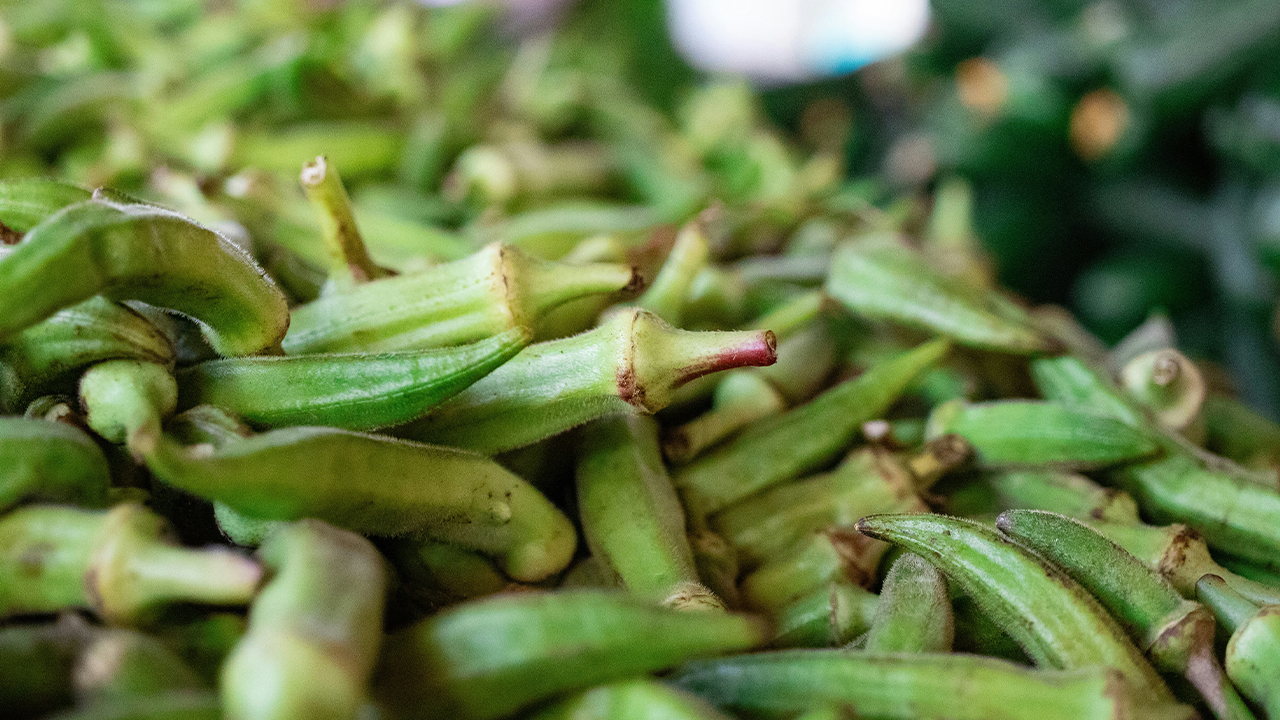
Tyrean was growing Nigerian okra. I remember the peculiar pleasure of hearing those two words together in St. Louis. He had gotten the seeds a couple of years earlier and had been growing different varieties, allowing them to cross and change. The plant had traveled. So had I. Before I left, one of the boys working with Tyrean showed us a watermelon that had grown to forty-seven pounds. He had grafted the watermelon onto pumpkin rootstock and removed the smaller fruits so that the plant could direct its energy toward one. Afterwards, Tyrean told us that he had once grown a forty-four-pound watermelon in his backyard, hand-watering it with a gallon jug. He laughed as he spoke. His eyes held such joy.
I had come to Confluence Farms because I wanted to see Tyrean doing his thing. I thought I was going to learn something about farming in St. Louis, about food deserts and the strange geography of abundance in a city divided by a street. I did learn those things. But by the time I left, the farm had become something else to me. It had folded St. Louis into Nigeria, food into memory, my father’s farm into this one, and the child who once resented the land into the adult who had crossed the city to find it. Perhaps this is what farming does. It keeps putting things in the ground and waiting to see what remembers how to grow.