Untitled Pictures in an Exhibition
Fourth of July, and the dialectics of memory.
September 15, 2026
A visit to a museum on the Fourth of July is not surprising, certainly to be expected, and perhaps an obvious choice or even the right thing to do and place to be to commemorate a historical day of independence. And so, when my good friend and brother, Nana Prempeh, asked me to join him on his tour of the famous Saint Louis Art Museum, it seemed not just convenient but also exciting. So, with a resounding nod and gusto, I joined my brother as we took a Lyft to SLAM to spend the day in the comfort of its holdings of historical paintings, art, carvings, and various artistic movements.
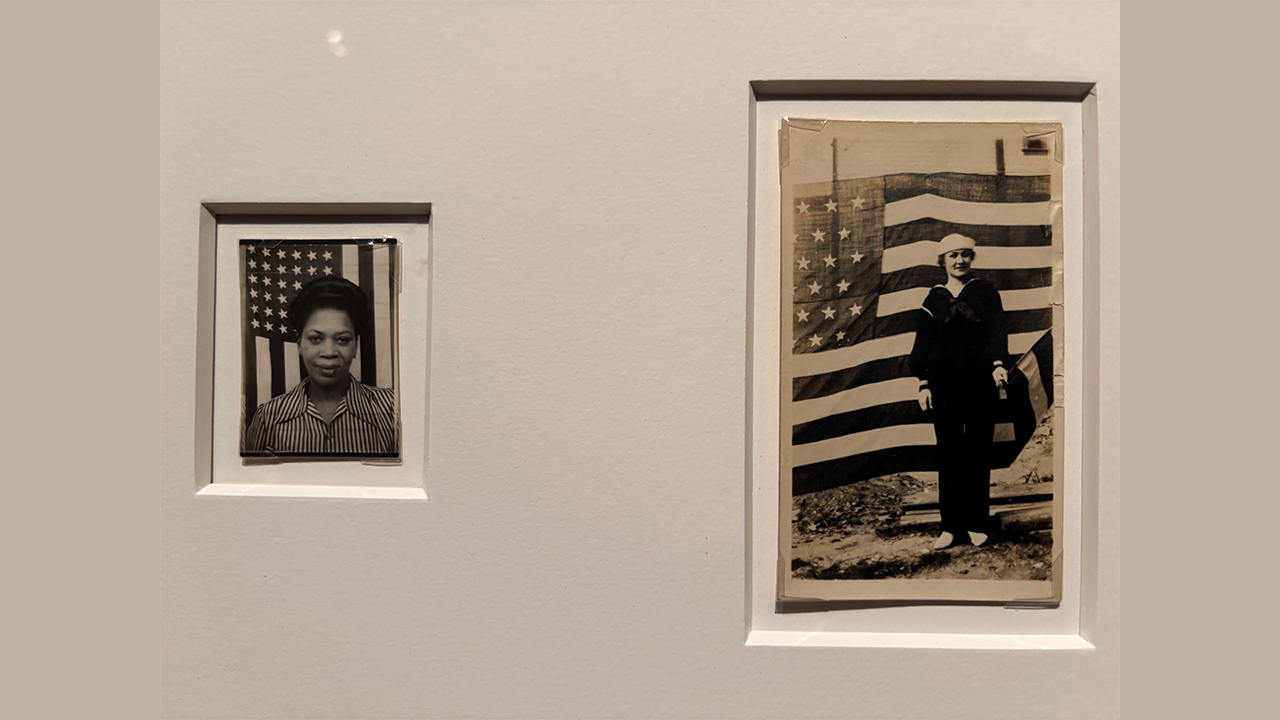
It was not until what I would consider the second phase of our tour that I chanced upon what would be the subject of my present musing: two images of women who had posed in front of the American flag for a portrait. The description of the images for both women read as “Untitled (Woman and Flag), c. 1940s gelatin and silver print” and “Untitled (Woman in Sailor Uniform in Front of American Flag), 1940s gelatin silver print,” respectively. These two images, perhaps in my view, might have constituted the two most minute images amongst the myriad displayed archives that I saw; they were those that left the most remarkable and profound impression. Their posture with the flag at once is a reminder of patriotism and their service to their nation, in whatever form and manner, which, while captured in the 1940s, has been preserved by the indelible bridge of time.
But what is more intriguing, largely in part for me as a budding postcolonial studies scholar who works with archives and texts of culture and memory, is the naming of these images as “untitled.” The naming as “untitled” at once signals and registers an unknown, a blind spot about these images and the figures captured in them. The audience can just behold them from a distance, but that is all there is to them. This is not to say they are not unknown, for unknown would suggest that these are obscured individuals, forever curated and made. Rather, they are “untitled” images, images that, while named, refuse and suspend the totality and finality of such a naming. Whether the images had titles but the donor forgot to give them to the museum, or the photographer or donors just refused to name the images, remains a mystery, but it is that mystery which gives these images their effervescence. And it is this idea of “untitled” not as lost, not as the absence of proper naming, but as a suspension and an opening of possibilities for the existence of a title that was lost or not, which I find quite intriguing about these two figures who sat with me in the museum.
Whether the images had titles but the donor forgot to give them to the museum, or the photographer or donors just refused to name the images, remains a mystery, but it is that mystery which gives these images their effervescence.
These two definitions do not supersede the other. Both make meaning and are suggestive of the name “untitled,” both as a refusal and as a loss. These two possible definitions, therefore, are what make up the image, the dialectic of the photographic memory which these two images exude, and can only be understood when we appreciate them from such a perspective as an audience.
The subject of the image which remains “untitled” reminds me of a similar conversation the Italian philosopher Giorgio Agamben had about photographs. In his collection of short essays, which he titled Profanations, Agamben wrote that “the photograph is always more than an image: it is a site of a gap, a sublime breach between the sensible and the intelligible, between copy and reality, between a memory and hope.” While I understand the philosopher’s sentiments about photographs, as my personal musings above have shown, the power of photography might not lie only in what it cannot show but in what it invites us to see, acknowledge, and appreciate in what it equally shows and does not show.
Thus, the photograph does not simply produce distance; rather, it furnishes the very conditions by which that distance becomes a form of intimacy, and it is precisely because the image withholds itself that we continue to approach it. In other words, it not only creates a gap, but it also gives us the opportunity, the ladder, to come into it by virtue of such a distance being simultaneously that which bridges us to it. And so, the untitled photograph is not merely a breach between memory and hope, but rather an invitation to inhabit that breach from a distance. And perhaps only by sitting with such a contradiction can images like these make sense, knowing that their memory and the secrets they hold are made accessible from a respectful distance that will forever hold us in their awe and continuous reverence.
Perhaps this notion of “respectful distance” that the photograph exudes can be a generative ethical mode of reading archives and, for me, a way of thinking about America itself. As a young scholar of colonial histories, I enter into America—the United States of America, with its histories and enmeshed stories of individuals, monuments, effigies, and memories of past events, traumatic or otherwise, which, while I can admire, should be careful not to presume full knowledge of, despite their full reach from the past into the present, one that undoubtedly structures its own people, mine, and the world at large. And yet, it is this partial inaccessibility, the knowledge and awareness that such a country holds the weight and bears the brunt of millions of stories that demand our respectful distance is one which also invites us to collaborate and share in these memories, knowing that such an invitation is one to sit with the multi-faced nature of these many stories: the traumatic ones of struggle and pain, and slavery and runaway, and also the ones of laughter, of joy, of hope, of romance and song. In all this, I partake, knowing that I must do so from the vantage point that it allows.
The naming as “untitled” at once signals and registers an unknown, a blind spot about these images and the figures captured in them. The audience can just behold them from a distance, but that is all there is to them.
And with this newfound insight I leave my readers, as I left the museum, knowing that this place and space, with individuals and stories that fill its belly, will forever continue to demand my and our respectful distance. This America, their America, holds its subjects in time in ways that not only preserve them but also continue to keep them in the nation’s temporal imagination. Likewise, they demand of us, children of the present who visit their walls to linger between the threshold of knowledge and humility, where (their) history remains open without becoming ours to possess, and it is in this respectful distance that memory finds both its dignity and endurance.