The Woodson Boys
Playing chess with the barbarians at the gate.
July 4, 2026
The boys from Woodson were coming. I should have known I could not escape them forever.
The irony, in retrospect, is that by the time I tried to escape them, they had already done their worst. Before they attended Woodson High School, in Washington, DC, these boys had been at Kelly Miller Junior High, which I attended from 1975 to 1978. At Kelly Miller I was known for being skinny, studious, skinny, shy, fight-averse, and skinny. (Did I mention skinny? My large Afro—already passé by then, adding to the whole package—completed the licorice-lollipop look.) For the more violence-prone of my male schoolmates, this was all tantamount to an invitation, and a number of them RSVP’d “Yes,” with acts that ranged from casual abuse—spontaneously pounding the back of my head with a thick notebook, say, for the best reason there was, i.e., no reason—to outright and nearly successful attempts to kill me: in seventh grade I was knocked unconscious and was saved from worse only by the fortunate, if tardy, intercession of my social studies teacher.
All of this led to one particular morning when I was in ninth grade. As I recall, there was nothing about that morning to separate it from any other of that era, just as nothing distinguishes the last straw from the one before it. I do not remember the words I said that morning to my mother, who had just come home from the night shift of sorting mail at the post office. But whatever I said made things clear to her. She let me stay home from school that day, and shortly afterward we began looking into private schools in DC, which mostly meant Catholic schools. The following fall I enrolled in St. Anthony’s High School, which, like Kelly Miller, was almost entirely Black and, unlike Kelly Miller, was a bus and subway ride away. Most importantly to me, I would not be walking down the street from our little house to Woodson High, the destination of nearly all of my classmates at Kelly Miller. No more public schools for me.
At St. Anthony’s I did not suddenly transform into some dream version of myself, some mix of Romeo and Bruce Lee. I was still skinny, still shy, still fight-averse, still a nerd. But here, it did not cost me. I could be, if not among the “in” crowd, then at least myself, as nerdy as that might be, and find acceptance. In my junior year, for example, I started a chess club, which it would not have occurred to me to do among the barbarians at Kelly Miller.
Chess is not life. Chess is a meritocracy; life is emphatically not. Unfairness and luck, good and bad, are constant factors in life, and to live to a certain point is to have sometimes seen qualities that would make one terrible at chess—unawareness and the assumption that somebody else will come to the rescue—richly rewarded.
Looking back, though, I wonder if their barbarism had less to do with the students themselves, or where we lived, than with this particular time of life, when our bodies were changing in ways that our minds could not keep up with. Is it possible that my daily life at Woodson, had I gone there, would not have been substantially different from my daily life at St. Anthony’s, that we were entering a new stage and leaving all of that barbarism behind? (If so, there were some exceptions. The kid who nearly killed me in seventh grade later succeeded in killing someone else.) I do not know the answer to this. One thing I do know: Woodson had a chess team. In my senior year, they came to St. Anthony’s to play us.
Chess, in the popular imagination, is a game for nerds. Those who view it that way do so dismissively, but that view is dismissive only if we define “nerd” incorrectly or too narrowly. A nerd, to my mind, is different from a dork, for example. There is nothing good about being a dork, the word suggesting an obliviousness to the ways of social discourse. That is certainly a quality that can characterize a nerd, but “dork” has none of the positive connotations of “nerd,” among which are brain power and the tendency to think long and deeply about a particular subject. “Nerd” is also sometimes associated with “wimp”: picture a nerd and you are likely to think of a skinny guy in glasses who cannot defend himself, who is not strong—and again, that description certainly fits some nerds. But a nerd has a particular kind of strength. And for chess nerds, that strength is multiplied, a good chess player being a kind of Trojan horse, containing many things within.
One of those things is self-reliance. Like a boxer, a chess player is on his/her/their own. There are no teammates to take up the slack, and luck is not a factor. The outcome in a chess game is a measure of each player’s foresight and awareness of many scenarios taking place at once, and the only thing resembling luck in the game is an opponent’s lack of these two qualities. Another quality in a good chess player is imagination. The player must be able to envision what has not yet happened and try to make it happen, imagining the opponent’s possible responses to a particular move and being ready to execute a strategy based on any of those responses. A good chess player is also a master of the unspoken threat. In the St. Anthony’s lunchroom, I once played against a classmate who, as he was losing, said in exasperation to an onlooker, “Clifford’s not that good—but he says, ‘You can take that piece over here if you want to, but if you do, I’ll kill you over there.’” The onlooker, who was also my best friend and who had lost many games to me, said, “I know!” I said nothing, but I thought: Thank you both. You have just told me I am good.
Another way of saying all of this is that I had developed skills on the chessboard that eluded me in the rest of my life. There was nothing remotely threatening about me. In a number of situations—for example, courting girls—I had no idea how others would respond to my moves, unless it was to laugh loudly in my worried face, and so I usually made no move at all. I had plenty of imagination; I made up and drew comics, and in my head I had constructed the life I would one day lead, but in the case of the latter, I had not thought through the steps to make that life my own. It would be easy to look back at my young self and think that I should have applied my chess savvy to other parts of my life, but to think that is to make the classic older person’s mistake of forgetting what it is to be young.
It is also to perceive chess inaccurately. Chess is not life. Chess is a meritocracy; life is emphatically not. Unfairness and luck, good and bad, are constant factors in life, and to live to a certain point is to have sometimes seen qualities that would make one terrible at chess—unawareness and the assumption that somebody else will come to the rescue—richly rewarded. But if chess is not perfect preparation for life, it is nonetheless beautiful, and the attitude one must bring to this beautiful game is one without which we would be immeasurably poorer. To become good at chess is to master skills that would allow one to succeed in a perfect world. And to lose sight of that world, to forget to dream of how things could be, is to lose a great deal, even if it is in this world that we will always be mired.
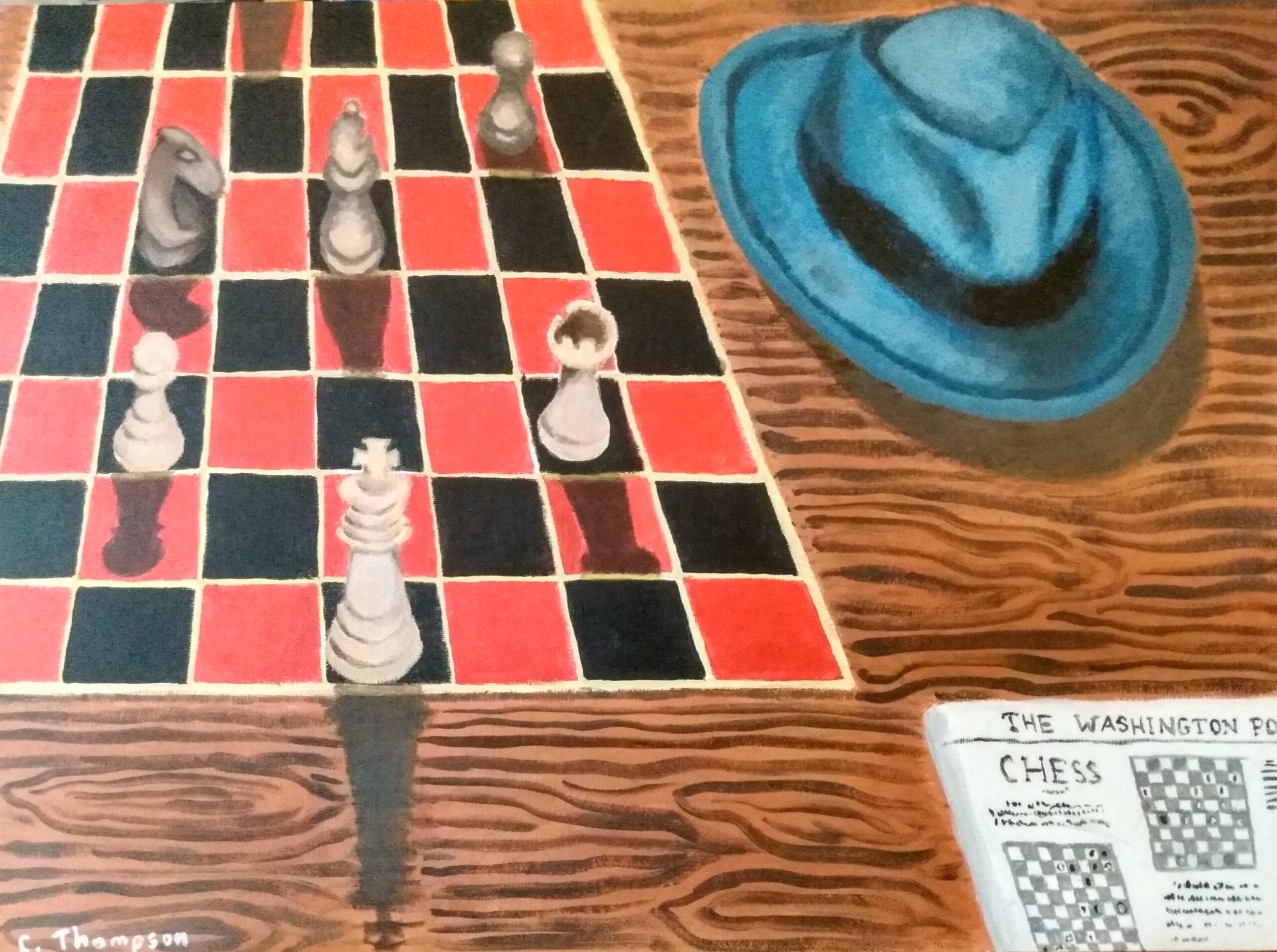
Sometimes during my high school years, on a lazy Sunday, say, I would sprawl on the green carpeting of our family’s little living room with The Washington Post and read the recaps of chess games played by masters. They were complete with illustrations of the board, showing who had moved which piece where. I found those recaps fascinating and mystifying. Many of the moves were, to me, counterintuitive, seemingly aimed not at defending one’s king but at courting danger. But I understood, or felt, that these masters were thinking and playing on a higher plane, that they were seeing chess in a dimension I could not fathom. Perfect worlds, perhaps, are not only unavailable to us, except on a theoretical plane, except through games; they are also, for many of us, stuck as we are in the sweat and noise and nonsense of our physical plane, difficult even to imagine. But it is comforting to think that they are there just the same.
St. Anthony’s High School, which closed years ago, was housed in a fairly small space, which was all we needed; I graduated in a class of sixty. Woodson High was much bigger, and the seven or so Woodson boys let us know it, loudly and good-naturedly, as they came striding into our library, where our chess match would be held. “Where’s the elevator?” asked one of the boys. (We had no elevator. That was his point.) He was dark-skinned and not very tall, and he turned out to be the captain of the team—my counterpart. This was the boy I would play.
This was St. Anthony’s first and only chess match, the single day on which the club became a team, and it showed, even before we sat down to play. The members of the Woodson team were already ranked according to their abilities. I had not thought about rankings; I had to figure it out on the spot, and I did a fairly bad job of it. With our number-one spot taken by me, my aforementioned best friend, who was not an especially good player, cheerfully announced that he wanted the second spot, not seeming to grasp that this meant he would be playing Woodson’s second-ranked guy. I did not have the heart to dissuade him. I did make sure, however, to pick as our third-ranked player a thin, bespectacled freshman named Darren, who had actually, to my consternation, once beaten me. The rankings below that have turned to fog and dust in my memory.
Darren did very well against his opponent. (I made sure to have the principal mention that over the intercom in the school’s morning announcements the next day.) Our players ranked below him were uniformly creamed. My best friend’s opponent, I recall, had an unlit pipe in his mouth (I do not know if he ever actually smoked it, though of course he would not have been allowed to in our library); this affectation may have been meant to convey his sophistication, a way to psyche out his opponents before they could make a single move on the chessboard. If so, it worked that day.
Perfect worlds, perhaps, are not only unavailable to us, except on a theoretical plane, except through games; they are also, for many of us, stuck as we are in the sweat and noise and nonsense of our physical plane, difficult even to imagine. But it is comforting to think that they are there just the same.
Then there was me. It is only in chronicling the events I am about to describe that I realize I am no longer sure of their order. I do remember two things clearly: the Woodson captain and I played two games and started a third, and the games were not blowouts—on the whole we seemed evenly matched. What I am not sure of is whether the game in which we played to a draw came before or after the one in which he beat me. I am also unable to recall why we could not finish the third game. Maybe the Woodson team had to leave for some reason; more likely, it was time for our library to close.
Whatever happened, the Woodson captain was ahead when we parted. But because our set of matches was unfinished, and will remain unfinished for all time, I choose to believe that I did not lose that day; I hang on to the possibility, however slight, that I could have won the third game, and the three matches together would have constituted a tie. I like the sound of that, for my own sake and for the sake of the Woodson boys. If I had lost outright, then the Woodson boys—the former Kelly Miller boys, the tormentors of my teen years, of whom the Woodson chess captain was representative—would have beaten me yet again, this time at my own game. If I had won—an impossibility after the second match, of course—I would have denied the Woodson boys the redemption of demonstrating brain power over barbarism. A tie would have been best. In a perfect world, that is how it would have gone.