Father and Child Reunion
A writer connects with his daughter through her love of F1.
By Stephen Dark
July 4, 2026
What I remember most about my first Formula 1 (F1) race was being unable to get my ass onto a chair. The plastic seats laid out in ascending rows in front of a tricky corner of the Belgium Spa Grand Prix track were perfect size for kindergarten. At best, given the proximity of my seat’s neighbors, I could squeeze in one and a quarter buttocks. And when it came to my pain-plagued knees, the upper rim of the chair in front kept them trapped in an agonizing right angle.
Having shelled out $500 for a three-day weekend of watching ground-hugging, brightly colored hornets zip past at over 120 mph, to find myself having to put my arm around the shoulders of the guy on my left to squeeze into the seat was a sobering introduction to the globe-trotting, multi-billion-dollar sport of motor racing.
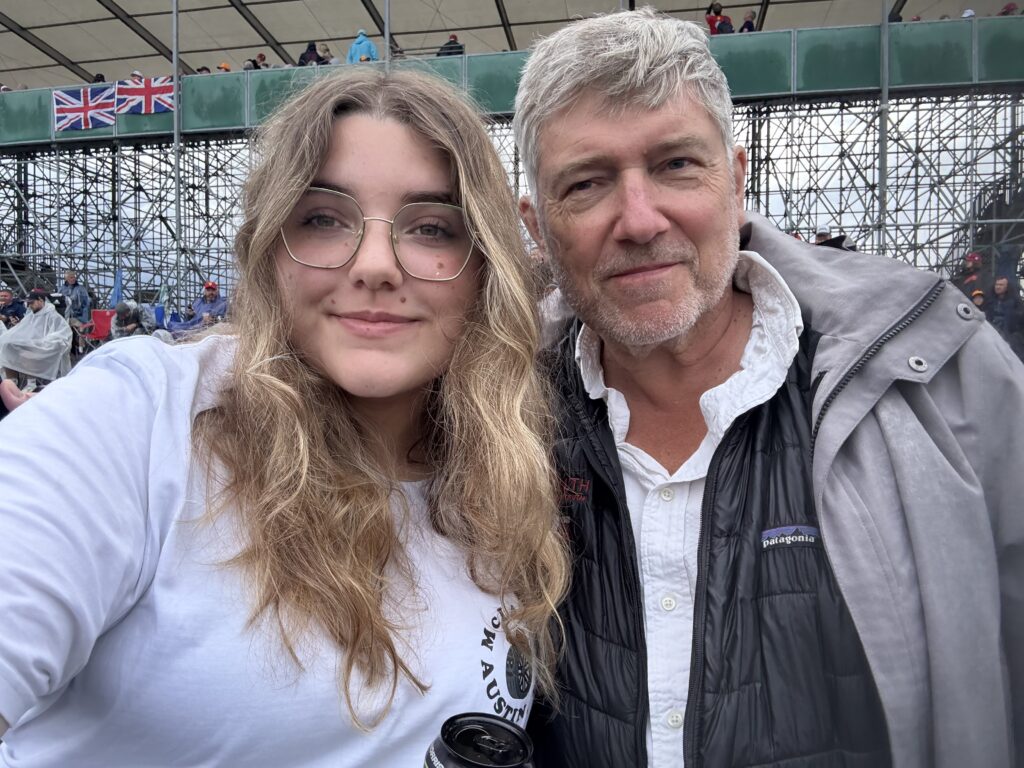
What brought me to the race was the neighbor to my right: my then 20-year-old daughter Kathryn (“Katy” to all and sundry) Dark. If not the most auspicious start to my swan dive into F1 culture, it was successful in one regard: the cool excitement in Katy’s eyes as she authoritatively scanned the cars sweeping by on their Friday practice.
Officially, I was there to provide company as she took her passion to its logical next step of seeing races in person rather than on TV. We had decided we could afford to visit one racetrack from a different European country per year. Unofficially, learning about her in-depth knowledge, insight, and passion for something I had long looked down upon as not only an environmental disaster but also an overpriced junkyard peopled by automoton-esque adrenaline junkies putting their lives on the line for corporate overlords and the rich and easily bored, had provoked an existential crisis. Not so much, “Where had my daddy-adoring three-year-old daughter gone?” as, “How could she have possibly landed so far from the paternal tree?” As a lifelong writer, journalist and art lover, I shared a love of art and cinema with my eldest daughter, Elizabeth (Elli), that took us to cinemas and exhibitions. But F1? Where does one even begin?
My youngest daughter’s fascination with sports reminded me of my brothers growing up, who had been closer to my athletic father because they both pursued sports while I buried myself in books and movies. Obscure film noirs or heartbreaking Japanese 1950s family dramas, I am your man. Favorite soccer team? Pass.
Looking to understand Drive to Survive better, I turned to F1 pundit Jennie Gow’s book How to Read F1: Everything You Need to Know about Racing in the Fast Lane (2024), which Katy had purchased from the author for me. Gow had autographed her alphabetical collection of disciplined, authoritative and affectionate driver profiles, assessments of teams and racetracks, urging me, in an inscription, to “Become an F1 convert!”
But if I wanted to be in either of my daughters’ lives, I had long ago recognized I needed to become interested in their passions. In Katy’s case, that had included attending midnight screenings of Marvel premieres, costume sightseeing at ComicCon, swinging 7-irons on a golf course (a sport I had sworn I would never take up), and now it seemed being carried round race tracks in human rivers like so much flotsam.
In the process of traveling with my youngest daughter to five races, I learned that my crude assumptions about the nature of F1 drivers were wrong and that my daughter was an F1 authority to be reckoned with and very much part of a female generation rewriting the rules, membership and nature of sports fandom. Most of all, I learned that no matter how much I love my daughters, I still needed to remember and accept that their lives were their own.
The pot-bellied vampire
Two of my favorite pictures of Katy are from her birth country, Argentina. One is from behind with her on my shoulders as I do an asado— Argentine Spanish for wood-fire barbecue—in the evening light on the Argentine coast. The other is her walking beside me on a Buenos Aires back street, holding my hand in her deliciously loving bear-paw mitt, looking up at me with a cheeky grin.
She was three in these pictures, shortly before we moved to the United States, and looking at those images even now I feel the ache of distance imposed not only by geography and time but also by our inevitably divergent natures.
That devastating moment when your daughter stops holding your hand is one no one prepares you for, but in retrospect my journey to stay in her life began right there. That said, my best efforts did not always curry her favor. For years, we went to Salt Lake City ComicCon together. One Con I dressed up as the punk-loving, English-accented vampire, Spike, from Buffy the Vampire Slayer. In her edgy Red Riding Hood outfit set off by Doc Martens, she was unimpressed. “You’re an over-the-hill Spike with grey hair and a beer pot-belly,” she said. “Daddy” begat “Dad” which begat “father,” or the dreaded “Stephen,” but I never lost hope that we would rediscover something of those halcyon days when I could do no wrong.
“Inexpressible love”
Katy’s relationship with F1 began with the Netflix series, Drive to Survive. She and I had just left Salt Lake City in 2021 to start new lives in Europe, her pursuing a degree at an Irish university, my wife and I in search of somewhere to live and work close to the children and my mother struggling with early dementia. Katy and I were under UK quarantine laws for two weeks. She could not adjust to the seven-hour time difference and started binge-watching the first two seasons of Drive to Survive. This series emerged as a rite of passage for many teenage girls and young women who, like my daughter, would become deeply committed to F1. A sportsbusiness.com article noted female fans of F1 were around 8 percent in 2017, compared to a whopping 42 percent by 2025 according to F1. Driven by this sea change in its fan base, F1 is trying to address a 76-year history dominated almost entirely by male drivers, launching in 2023 an all-female racing series called the F1 Academy.
Looking to understand Drive to Survive better, I turned to F1 pundit Jennie Gow’s book How to Read F1: Everything You Need to Know about Racing in the Fast Lane (2024), which Katy had purchased from the author for me. Gow had autographed her alphabetical collection of disciplined, authoritative and affectionate driver profiles, assessments of teams and racetracks, urging me, in an inscription, to “Become an F1 convert!”
Gow described Drive to Survive as a watershed moment for F1. By the late 2010s, many pundits had been asking if the sport was doomed. “The audience was getting older, and the fan base was not expanding,” she wrote. Drive to Survive’s first season, which debuted in 2019, changed all that. For the first time, film crews were allowed into some of the teams’ paddocks—home both to hospitality stands and engineering trucks—where all the off-track drama took place. “The show lifted the lid on the sport and brought drama and personality to the table,” Gow wrote. “Suddenly, viewers could relate to F1 drivers, and you didn’t have to care about the sport to find the series entertaining.”
It was not just Drive to Survive that built powerfully loyal female audiences. Women may come to the sport via a variety of routes, including digital content creators fascinated by motor racing and its personalities, but what keeps them engaged? That can be anything, wrote Elizabeth Blackstock in her Substack, Deadly Passions, Terrible Joys, from the rabbit holes of F1 history and how straightforward the sport is (who crosses the finishing line first) to the non-threatening, even sensitive nature of F1’s male athletes.
“I truly do not understand why so many men fail to understand this when, logistically, being a Formula 1 fan fucking sucks,” Blackstock wrote. “It costs an arm and a leg to go to a race or to buy a hat to represent your favorite team, but women do it anyway. It is annoying to wake up at ass o’clock on a Sunday morning to watch cars go in circles, but women do it anyway. It is exhausting trying to defend your inexpressible love of this sport when surrounded by hundreds of men who want to quiz you on your fandom, but women do it anyway.”
Katy agreed with Blackstock’s sentiment. “Men can’t be gatekeepers the way they used to be,” she told me. Now, young women with disposable income jostle with men for the “merch” in crowded team stands and put down serious money on tickets and travel. “Men think women go to F1 because the drivers are fit,” she said. “But the races are two hours long, and the drivers wear helmets all the time. It’s all about the motor racing.”
The sublimeness of Max
For our F1 baptism, we chose Spa, the Brussels Grand Prix, because it had the cheapest tickets we could find. We took the Channel Tunnel to Brussels on Thursday, July 27, 2023, and that afternoon, while the drivers refamiliarized themselves with the track, we wandered Brussels’ elegant streets. We enjoyed a dozen-strong brass band panhandling on one corner and the over-the-top toppings on the national dessert of waffles. I stopped to admire Belgian surrealist René Magritte’s 1955 masterpiece, The Schoolmaster, covering the side of one building. Underneath a crescent moon, a man in bowler hat and suit pondered the mysteries of the universe. The silent awe it evoked seemed almost antithetical to the world of noise and speed jostling past me.
Towards the end of the day we stumbled across a store celebrating one of our earliest father-daughter pleasures, the cartoon arch-sleuth and gun-wielding journalist Tintin. A staff member tartly corrected my pronunciation to “Tantan.” All those years later, Katy was still an admirer. “He’s 5′ 5″, the bad guys never take him seriously, yet he always wins,” she said as we perused the shelves.
Saturday was sprint and qualification day, when drivers’ best lap times determined their start position for the Sunday race. We took a chartered bus out to the country to Spa. Neither of us was prepared for the 250,000 crowd, small by F1 standards, circulating the track.
That day we sat opposite the exit from the pit lane where the cars “pitted” to change their tires in just over two seconds if all went well. Katy explained the different tires–wet (heavy rain), inter (light rain), soft (fastest), medium, and hard (long lasting). Over the course of the day, she guided me through the then ten teams with their pairs of drivers and their often ruthless, Machiavellian hierarchies and the worlds of gossip and conspiracy theories that zapped back and forth between the fan bases. Her knowledge of F1, its lore and arcana, was astonishing (as is her similar dedication to global soccer), all the more so because it was delivered with an infectious smile. In the face of this firehose education, I felt like a deer in the headlights.
On the other side of the track was a huge TV screen providing the blow-by-blow of the drivers’ laps. Katy listened to race commentators on her earpods. I split my attention between the cars flying by, scanning the sky for rain, the screen, and my fellow spectators, trying to figure out what the hell was going on.
Her knowledge of F1, its lore and arcana, was astonishing (as is her similar dedication to global soccer), all the more so because it was delivered with an infectious smile. In the face of this firehose education, I felt like a deer in the headlights.
Come Sunday and race day, we made our way to turn 15. The crowds were even larger than Saturday, with one grandstand flooded with the orange T-shirts of fans of Red Bull driver Max Verstappen, then the seemingly undefeatable Dutch champion heading for his third consecutive world championship. Gow termed him “one of the greatest drivers of our era, and maybe of all time.” He was just 18 when he won his first F1 race in Spain, the youngest driver to do so. “Verstappen has a natural talent for racing: his feeling in the car, his mental capacity, his total dedication and commitment are all outstanding,” she wrote. His aggressiveness on the track also made him controversial. But it was his “sublime” driving skills, as Gow put it, that were on display at Spa, where he fought his way from a sixth-place grid penalty to victory.
Katy was raptly following the progress of her favorite driver, Brit Lando Norris. His team McLaren had wrong-footed his tire strategy from the start, opting for softs and then gambling on hards, decisions that cost him tire grip both times and eventually dropped him to 16th.
Norris was just three years older than Katy. Gow characterized him as having “an aggressive driving style and great ultimate pace. Off track he has a “cheeky chappie” personality and is universally liked by fans and the F1 world.” It was that niceness that made me wonder if he had what I assumed was essential for a world champion, the killer instinct to win at all costs, but I underestimated his determination. On lap 17 of the 44-lap race, as rain forced drivers to slow down, McClaren saw an opportunity to switch Norris to softs, and this time it paid off. He surged through the pack with consummate driving skills to seventh place, a result that had Katy jump up with glee.
Father and son
We left it too late the following year to find cheap F1 tickets or flights for a European venue, which meant opting for the UK-based Silverstone, a four-hour drive from our home. A one-time WW II airfield, in 1950 it was the birthplace of the phenomenon that is Grand Prix racing. The only tickets we could get were for a grandstand called “Racing Green,” which included, adjacent to the stand, three beer bars sheltering under awnings and food trucks whose fare was included in the price.
Silverstone is quintessentially English, no more so than in the names of its corners and flat-out sections called straights: Maggots (local marshes), Becketts and Chapel (a local chapel in memory of Archbishop of Canterbury Thomas à Becket, murdered by knights acting on Henry II’s wrathful outburst), Hanger Straight (a tip of the hat to the Royal Air Force base that once stood there) and Copse and Vale, elegant nods to England’s woodlands and valleys. And let us not forget Silverstone’s diabolically unpredictable rain.
Sixteen years living in Utah’s desert climate had softened my memories of English rain to nostalgic pitter-patter. Silverstone’s torrential tendencies provided a brisk corrective. Sitting on plastic seats as water seeped into my jeans from every direction (at least the seats were big enough to get my butt on), my choice of shelter was either sharing Katy’s F1-branded umbrella or a plastic poncho that marked my first purchase at a “merch” stand.
Some drivers Gow noted in her book, such as Norris, British legend Sir Lewis Hamilton and Verstappen, are highly adept at wet-weather racing, earning them the sobriquet “rain-master.” Rain makes harsh demands on both tires and drivers, especially if the team gets the strategy wrong in trying to judge when it will rain, when the sun will come out, and when the track will dry. Make a misstep, and you can skid off the track at 160 mph or spin around 720 degrees.
In between different track events, we went to the closest bar for a drink and sampled the food trucks. Next to the bar was a large Scalextric track of Silverstone where two boys were slot-racing cars as men looked on. I was flung back to my childhood, standing in front of a toyshop, yearning for the Scalextric set in the window. My parents were poor; my mother’s favorite saying was: “Look after the pennies, my son, and the pounds will look after themselves.” So instead I got a cheap Meccano set of nuts, bolts, and girders you bolted together into a crane. My father worked in civil engineering, so no doubt this was his kindly way of encouraging me to get my nose out of books and start tinkering with the real world.
Rain makes harsh demands on both tires and drivers, especially if the team gets the strategy wrong in trying to judge when it will rain, when the sun will come out, and when the track will dry. Make a misstep, and you can skid off the track at 160 mph or spin around 720 degrees.
Come Sunday, the sprints had left British driver George Russell in pole position, his Mercedes team partner Hamilton second and McLaren’s Norris third. The standout performer in Saturday’s qualifying was German driver Nico Hulkenberg, who, racing for Haas, was sixth on the starting grid, his best-ever qualifying position at Silverstone. While Hulkenberg had a reputation for being a skilled, determined driver, excellent at endurance racing (he won the 24 hours at LeMans in 2015 driving for Porsche), he had never had the machinery to match his skill level, some of his fellow drivers argued in interviews, leaving him with 239 career starts and, as yet, not a single top-three podium. This gave him the dubious distinction of the most starts without a podium in F1 history.
Russell maintained the lead for 18 laps until, in the midst of a downpour, Hamilton overtook his more rain-cautious partner. As the rain’s drumbeat intensified, Norris also overtook Russell to chase Hamilton. Katy, sporting face paint colors for McLaren, was on the edge of her seat as Mercedes and McLaren fought through the wet conditions for the lead.
Both Hulkenberg and Norris lost valuable seconds to their teams’ slow pit stops changing tires, Norris also plagued by his team’s poor tire strategy. Fight as he could to make up the seconds lost to Hamilton ahead of him, Norris could not stop Verstappen bearing down on him from behind. On lap 49, the Dutchman accelerated past him on the back of what Gow called the “magic overtake button” of DRS. In a certain set of conditions, drivers are allowed to reduce the drag on their rear wing, gaining a brief burst of additional speed. “Critics say [DRS] makes overtaking in F1 too easy and takes away the skill needed to make a pass without DRS,” she wrote.
It had been three years since Hamilton had won a race, but by the last 10 laps it was clear victory was in sight. The crowd and the hyped-up commentators were ecstatic as he crossed the finish line. Katy was also cheering, but for Norris as he came in third behind Verstappen, with Hulkenberg a respectable sixth.
I had always considered F1 a sport so tightly wrapped around the mechanics of machinery and the skillsets of great drivers that emotions were of little consequence. It was the killer instinct to win at all costs that mattered, which Lewis Hamilton had in spades.
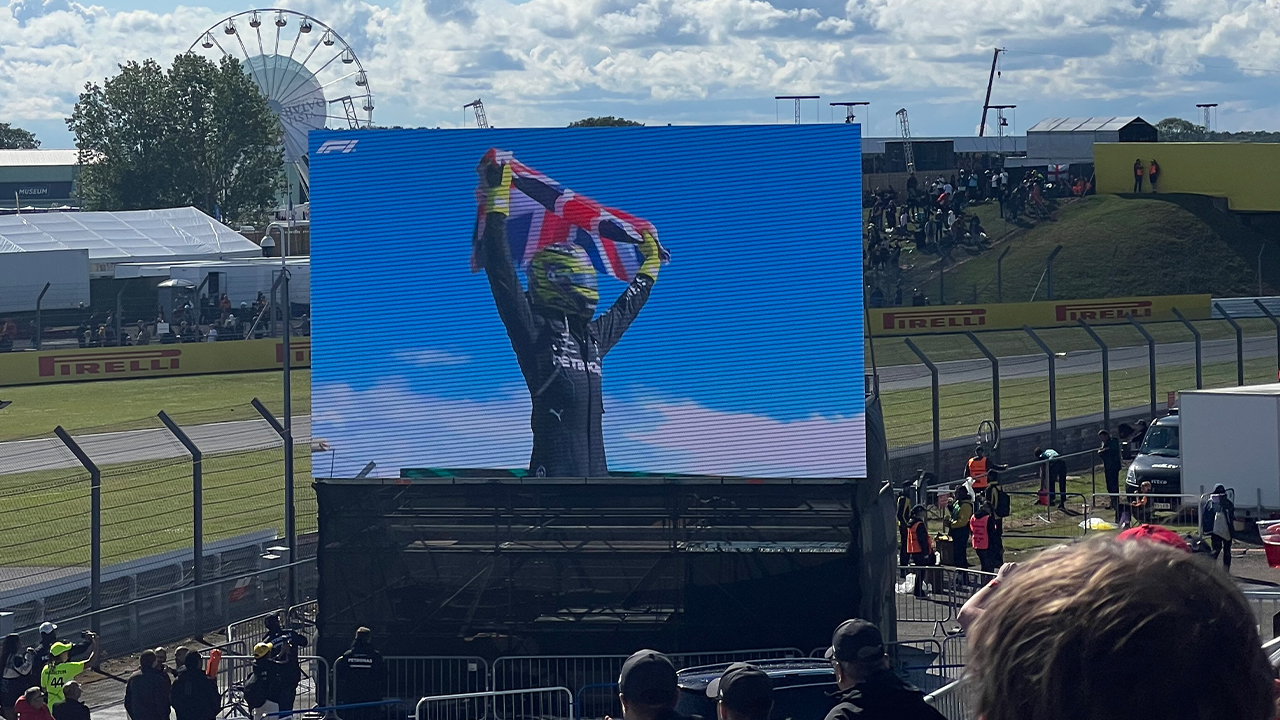
“Get in there Lewis, you’re the man, you’re the man,” Hamilton’s race engineer shouted on the radio (selections of radio conversation are often featured live on TV coverage, providing entertaining peaks into the dynamic between driver and race engineer, the latter overseeing the car and track performance). Choked up, Hamilton managed, “Love you guys.” He pulled over, took a Union Jack from an associate and finished the lap, his fist in the air, the flag streaming behind him. He pulled up before Parc Fermé where the three podium finishers park, pushed his visor up and brought his gloved hands to his eyes.
I had always considered F1 a sport so tightly wrapped around the mechanics of machinery and the skillsets of great drivers that emotions were of little consequence. It was the killer instinct to win at all costs that mattered, which Hamilton had in spades. But that day he surprised me. One of the first people he embraced when he got out of his car, his helmet still on, was his father. It feels in these moments that the driver, despite wearing his helmet, is at his most naked. “Me and my dad,” he told Gow of his early days competing in go-karting, “spent a lot of time in the back of our van, eating Pot Noodles and working on the go-kart my dad bought me.” They used secondhand tires thrown out by competitors. Hamilton sobbed in his father’s tight embrace, his body shuddering with the sheer weight of his emotions. You could feel the two of them transported back to all those years ago, when, the only Black competitor on the karting circuit, Hamilton first showed the world what he could do.
“Enjoy, enjoy”
Our chosen European city for 2025 was Budapest in August. Providence, however, saw us head off again in early July 2025 to Silverstone, courtesy of free general admission tickets Katy had won at a Silverstone Christmas giveaway. General admission meant taking camping chairs, bulky rain jackets and sandwiches while we peered through a safety fence at the track in front of us.
We got there at 8 am and went straight to a stretch of safety-fenced gravel in front of Becketts. I wore my late dad’s grey anorak, more out of loyalty than as an effective rain measure, since it soon started leaking. Over the Saturday and Sunday, I lost count of how many times I took off and put back on increasingly sodden gear. There was nowhere to hide from the leaden heavens, a misery gleeful commentators seemed to revel in as they announced the latest storm sweeping in.
In the first two places on the starting grid were Verstappen and Norris’ Australian McLaren teammate Oscar Piastri, with Norris at fourth. Right at the back at 19th was Hulkenberg.

The race started with a rolling safety car formation lap due to a downpour and standing water. It allowed drivers to test tire grip and build tire temperature before the actual start. It would be the first of several safety car interventions.
Piastri seemed to thrive on the very mixed weather conditions, while Verstappen struggled. But it was Hulkenberg who increasingly caught my attention. He moved up to tenth with steady, workmanlike dedication. Then he pitted to switch to intermediates to be ahead of yet another downpour. When the sky opened, Verstappen’s tires lost their grip on the track. Intense streams of spray from cars blinded drivers behind them. But Hulkenberg continued climbing to fourth position, the closest he had been to a podium since 2014. As one pundit noted, “No one has ever waited longer.”
When I asked Katy about the German, she shrugged. “He’s always just been there.” What kind of fortitude did it take to line up 238 times without success?
When Hulkenberg got DRS and overtook Aston Martin’s Lance Stroll for third place, the commentators were stunned. As he fought off Hamilton just one second behind him, one said, “Nico is having the performance of his life.”
Hamilton pitted, switching to soft tires, then, a lap later, Hulkenberg went for medium tires. Hamilton’s strategy was punished by Silverstone’s notoriously tire-unfriendly track. While Hulkenberg’s pit stop was slow, he still ended up eight seconds ahead of the English driver.
Piastri served a ten-second penalty in the pit for erratic driving behind a safety car, leaving him little, if any, chance to catch Norris, who cruised to his first victory at Silverstone. Taking first on your home soil is the ambition of every driver, and Norris was as determined as anyone. “I would trade all of my wins for this one,” he said. As he went through the checkered flag, he was in tears thinking of what this would mean to his mother.
Katy jumped up and down, brushing away her own tears.
“Thanks for the memory,” Norris said to his team over the radio. “I’ll remember this more than anything.”
He jumped out of his car, bent over and pumped his fist. Norris’s mother lifted up her son’s visor and told him, “Enjoy, enjoy.”
When Lando Norris stood on the podium, he did what his mother told him, closing his eyes and savoring the moment, almost vibrating with the intensity of it.
Hulkenberg clinched third, his maiden F1 podium finally under his belt. “This is the most overdue podium in Formula 1 history and you nailed it,” his race engineer told him over the radio. The jubilant driver ran into the riotous embrace of teammates chanting his name as they all jumped up and down.
When Norris stood on the podium, he did what his mother told him, closing his eyes and savoring the moment, almost vibrating with the intensity of it. Hulkenberg hoisted up the third-place cup and sprayed the ritual champagne two of the other teams had donated after learning Haas’ fridge had only two lonely bottles with which to celebrate. The German driver’s achievement moved me to tears. It wasn’t just British passion for the underdog. It was that such an old-fashioned value as perseverance could still be rewarded. As Katy and I stood there, like two drowned cats, cheering on our respective heroes, something touched me deep inside: we had found a place to connect, to celebrate, to rejoice.
A crack pipe between three
We flew out to Budapest in August, staying in a ground-floor flat on the edge of the Jewish Quarter. The tenement building’s dilapidated condition was a fitting introduction to the city’s gothic, gritty pleasures.
Katy and I took the train out to the suburbs. As we walked past tree-shrouded houses where people sat in front of their doorways watching the streams of mostly English speakers amble past, we ruminated on our F1 experiences.
One of the things that struck Katy the most from watching the races in person was that the cult of personalities that had grown up around F1 was very much separate from the racing itself. Sometimes the personalities did not feel real, she said, as if they were performing. She lamented that so many spectators came for the cars, the photos and the merchandise. “It’s called Formula 1 for a reason. You need a good car and a good driver. But a good driver with a shit car will take you only so far. F1 should be motor racing. That’s the important part.”
What struck me most this trip was less the race than Budapest’s underbelly. A female cop talking amiably to a man without legs in a wheelchair going through a rubbish bin. Three middle-aged women sitting on the floor in an underground ticket lobby, their backs to the cream-tiled wall, sharing a crack pipe. Most of all, though, it was a father and teenage daughter with long blonde hair gathering plastic bottles from bins.
That cloudy but rain-free Sunday afternoon, Norris fought off a determined Piastri and Ferrari’s Charles Leclerc, who both opted for two trips to the pits for tire changes. Norris gambled on staying out after one stop and kept ahead of the pack. In the dying stages of the race, Piastri fought again and again to pass Norris, almost hitting him on one attempt, but to no avail as his teammate crossed the finish line first, well on his way to winning his first world championship at the end of the season.
What struck me most this trip was less the race than Budapest’s underbelly. A female cop talking amiably to a man without legs in a wheelchair going through a rubbish bin. Three middle-aged women sitting on the floor in an underground ticket lobby, their backs to the cream-tiled wall, sharing a crack pipe. Most of all, though, it was a father and teenage daughter with long blonde hair gathering plastic bottles from bins. An hour later, as I was leaving a Lidl supermarket near where we were staying, I found them pushing the scavenged bottles into a machine that paid a nominal fee for each return. As they left, the father first, then the girl, she lowered her head, her hair covering her features, as she stared at the floor.
I thought of so many unhoused teenagers and young adults I had met through reporting, all veterans of downtown Salt Lake City’s harsh street life, none of whom had had a father to protect them. I looked at my daughter, so much her own woman now, and I wanted to hold her so badly, to protect her from the world around us and all she did not know or did not want to know. But that time was behind us now. I just had to accept it.
Falling star
When it came time to choose our 2026 race, ever-steeper race package prices ruled F1 out. That left us with Formula E (for electric) where drivers competed on tight street circuits. FE grandstand tickets could be had for under $120.
We plunked for Madrid, a city we both knew and loved. Early March, the Jarama circuit, on the city’s outskirts, would be holding its first FE race. Once you got used to how lithium batteries dictated so much of race strategy, and got a feel for a slew of new names and personalities, Formula E proved more digestible than F1, its races running a comparatively brief 33 and 46 laps.
After the race, we decided to attend the podium. We marched up a small hill and looked down at the proceedings as a larger crowd gathered in front of the stand.
Jaguar’s Antonio Felix da Costa and Mitch Evans took first and second, with Porsche’s Pascal Wehrlein third. Wehrlein ran off stage and brought on his little girl in a mauve jacket. She stood in front of him, looking across the upturned faces.
Katy was standing in front of me, just below my eye level. A woman glared at me for not ceding space to her, but I would not have moved for the world. I looked at the little girl on the podium and then at my daughter. Katy was simply doing what we all do as young adults, I thought. It was not that she was leaving me or becoming someone I did not recognise. It was that she was presenting herself to the universe, claiming her place in life, an ever-brighter star rising to heights I could not imagine. My own, all-too-mortal star could only whisper, “Don’t forget me,” as I faded slowly and contentedly into Madrid’s evening light.